Do you know what is Hubble’s Law and Age of Universe? In the past, people thought that our galaxy stood still in the void and that all the stars lived together in a single galaxy. When Edwin Hubble said that the universe was getting bigger, everything changed. He later showed proof of what is now called Hubble’s law.
The idea that the universe is expanding made people wonder about other things. For example, if the universe is expanding, it must have started somewhere. This is how the Big Bang theory was born, which is now the most widely accepted theory in science.
The History behind Hubble’s law and Age of Universe
Einstein’s equations were used by mathematicians and physicists to explain the relationship between space and time before Hubble’s law theory was proposed. When these theories were used in a way that combined the general rules with the way the universe works, contradictions arose.
The fact that there were contradictions showed that the universe, which was once thought to be static, was actually dynamic, either shrinking or growing. Scientists were confused by this, and even Einstein himself didn’t believe what his own equations said about him.
Hubble would show that his claims about the expansion of the universe were true after more than 15 years of theories, studies, and observations of galaxies. Hubble went back to school at the observatory on top of Mount Wilson after serving in World War I.
Hubble was able to make amazing measurements with the help of the world’s largest telescope at the time, which had a 100-inch (2.5-meter) mirror. Using the red shift, he was able to find the proof he needed to prove his theory, which became known as Hubble’s law.
His relationship with the Big Bang
With the help of Hubble’s calculations, astronomy made a big step forward. People used to think that the galaxy was always in the same place in the universe. Some even thought that there was only one galaxy in the whole universe.
Hubble’s law and the Big Bang theory that came after it changed astronomy as it was known at the time. Most of the main theories about the Big Bang are based on the redshift of other galaxies and the Hubble diagram.
Edwin Hubble made two important observations about the galaxies he was studying that led him to the idea of a big bang in the beginning. First, a clear link between how far away galaxies are and how red their light is. showing that redshift can be seen in one direction and in the other direction as well.
Which would explain why galaxies moving in different directions seem to be moving away from each other faster the farther away they are. Second, he said there is more than one galaxy and that they are all over the universe. Which means that galaxies are everywhere in the universe.
Einstein visits Hubble
Einstein said that he made his biggest mistake when he didn’t find out that the universe was expanding. Hubble’s calculations forced Einstein to change his “cosmological constant.”
He then went on a famous trip to Mount Wilson, where he congratulated Edwin Hubble on his discovery and thanked him for laying the groundwork for modern cosmology.
What is Hubble’s law?
Hubble’s law is a rule of physics that is based on the Hubble diagram and the redshift measurements that Edwin Hubble made of other galaxies. The information gathered from these tests showed that the other galaxies’ redshifts were proportional to how far away they were.
In this way, it shows that the galaxies are not only moving away from ours, but also from other galaxies in all directions. He also noticed that the speed of the galaxies was faster the farther away they were.
The red shift
It is called the redshift or redshifts and it is a way to measure how fast things in the sky move compared to the earth. A good example is the difference between how cars sound when they are still and when they are coming closer.
This is because when a car moves away from a sound receptor, the sound waves get bigger, but when the car moves closer, the sound waves get smaller. The so-called “Doppler effect,” named after the Austrian physicist who found it in 1842, is the reason for this change.
The same thing happens to light waves as they travel from stars to Earth through space. So, if the light waves of an object get smaller, the meter moves toward blue to show that it is getting closer.
On the other hand, a red shift in the electromagnetic spectrum would show that the object is moving away if the light waves spread out. Which is why it was called “The redshift” or just “redshift.”
What is the Hubble constant?
Hubble’s law has a mathematical form in which the well-known Hubble constant shows up as a constant of proportionality. Many astronomers call it “The Hubble Parameter” because they don’t think of it as a constant but rather as a variable.
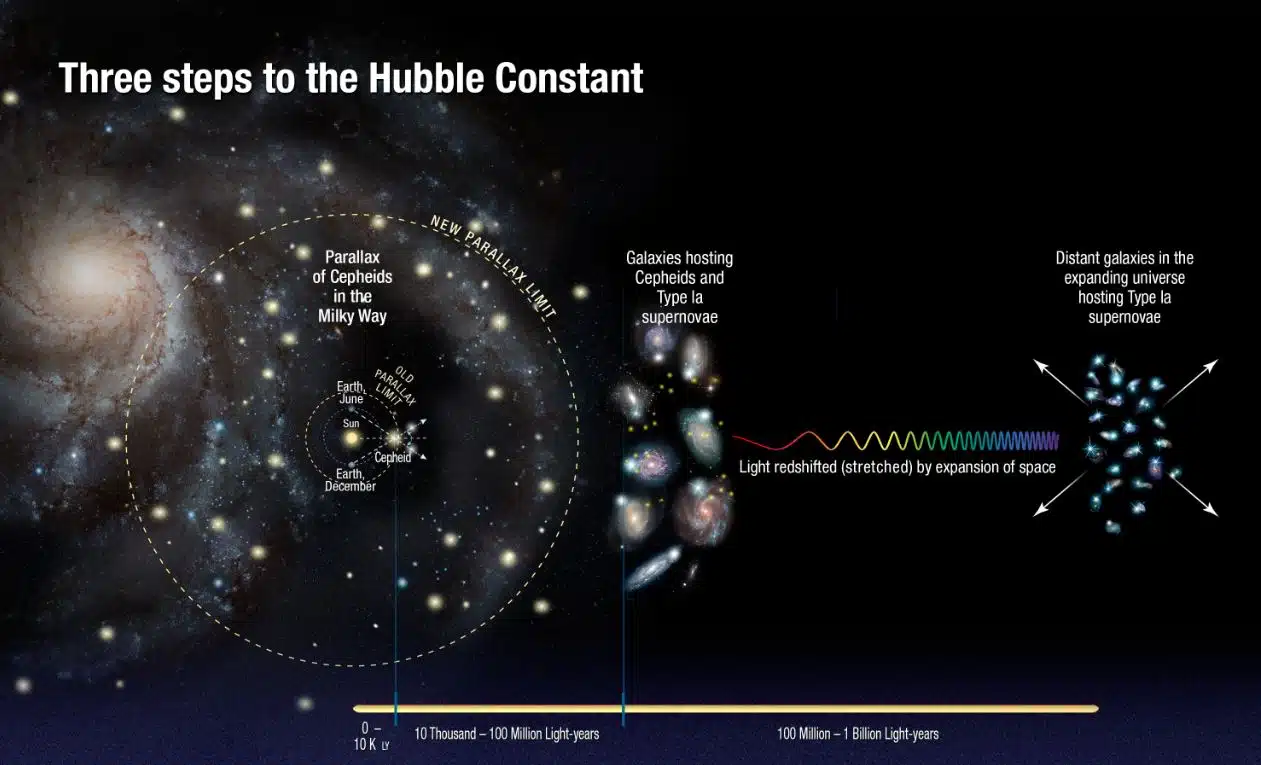
3 Steps to Measuring the Hubble Constant
This diagram illustrates the three stages astronomers took to determine the universe’s expansion rate with an unheard-of level of precision, cutting the overall uncertainty to 2.4%.
The cosmic distance ladder, which is used to estimate precise distances to galaxies near and far from Earth, was streamlined and strengthened to help astronomers make the measurements.
Starting at left, astronomers use Hubble to calculate the distances to a group of pulsating stars known as Cepheid Variables. They do this by using a fundamental geometry concept known as parallax. Surveyors use a similar method to estimate distances on Earth. Astronomers can use the Cepheids as cosmic yardsticks to measure distances to galaxies considerably farther away than they can with the parallax method once they have calibrated the Cepheids’ true brightness. Cepheids pulse at different rates, with slower pulses for brighter Cepheids providing an extra fine-tuning to the true brightness. To calculate precise distances, astronomers contrast the calibrated true brightness values with the apparent brightness of the stars as seen from Earth.
Astronomers begin looking beyond our Milky Way to neighbouring galaxies [seen at center] when the Cepheids have been calibrated. They search for galaxies containing Cepheid stars and another trustworthy metric, Type Ia supernovae, which are exploding stars with the same brightness. The Cepheids are used by astronomers to gauge the actual brightness of each host galaxy’s supernovae. The astronomers calculate the distances between the galaxies using these observations.
The next step is to search for supernovae in galaxies that are even more distant from Earth. Type Ia supernovae, in contrast to Cepheids, are luminous enough to be observed from comparatively greater distances. Astronomers measure out to the distance where the universe’s expansion may be seen by comparing the true and apparent brightness of distant supernovae [seen at right]. They contrast those distance readings with the way that the expansion of space stretches the light from supernovae to longer wavelengths. They compute the Hubble constant—the rate at which the universe enlarges with passing time—using these two numbers.
How old is the universe according to Hubble’s law?
Many tests have been done to try to figure out how old the universe is. Hubble was the first person to use data from 46 galaxies to figure out how old the universe is. The answer from these calculations was 500 km/s/Mpc, which meant that the universe had been around for about 2 billion years.
Isotope tests had already been done on the earth, and its age was known to be 4,500,000,000 years. So, these data were thrown out right away.
Other claims for the age of the universe
Due to a lack of tools, other astronomers and cosmologists came up with different estimates for how old the universe is. These estimates were always between 50 km/s/Mpc and 100 km/s/Mpc.
In 2014, scientists found out that the universe is actually about 13.7 billion years old, which is much older than they had thought at the time. The Planck space mission looked at microwave background radiation to figure out how to do the math.
The theory that put humanity’s sight outside the galaxy
Edwin Hubble’s idea, which he first put forward in 1927, changed astronomy in a big way. Using the equations of well-known physicists like Einstein, scientists got a better idea of what they thought was the beginning of the universe.
So, people were able to look at the nebulae and figure out that they were not part of our galaxy but instead were from other galaxies. He also pointed astronomers and physicists in the right direction so they could figure out where everything in the universe came from.
If you are interested, you can also read Entertainment, Numerology, Tech, and Health-related articles here: Amazon Prime Release Date September 2022, Steps for Casual Look, Daredevil Season 4, Tinyzone, Elon Musk Mother sleeps in Garage, Lady Gaga All movies, Virgo, Does TikTok Spy on You, Thank You in Spanish, Openload, Invention of Antibiotics, Subnautica, Knives Out 2, Best Basketball Anime, 13 Regions for Astronauts to Land on the Moon, Red Bottom Shoes, StoriesDown, Meaningful Learning, E-learning 2022, She-Hulk release date, Overlord Season 5, Samsung Galaxy Z Fold 4 Review, Feogi, Laal Singh Chaddha Review, Baki Season 5, Bflix, Leonardo DiCaprio Sneakers,
Hurawatch, Salman Rushdie, Accessibility Apps for Android, Best Jobs in the Metaverse, QueenslandMax, Shower Standing Handle, August 11 Zodiac, How to pass a drug test, How to Roll a Joint, iFun, Emerald Chat, How to Play Mancala, August 8 Zodiac, OnePlus 10T Review, Jilo Virals, August 4 Zodiac, Findsnap, Tomb Raider Anime, Netflix August 2022 Schedule, Animixplay, Upcoming Marvel Movies 2022, July 31 Zodiac, Best Lily Collins Movies, Notepadqq, Flaxseeds with Milk Benefits, Imginn, Snaptik, Picuki, Alexis Clark Net Worth, Black Panther 2, Marvel Echo Release Date, Frozen Fruit Recipes, Black Tourmaline, Webtoon XYZ,
Fastest VPN for Android, IFVOD, XXXX Dry Review, Highest Grossing Indian Movies of all Time, Highest Grossing Movies of All Time, Rush Limbaugh net worth. Gotham Season 7, Parag Agrawal Net Worth, Tara Reid Net Worth, Blonde Trailer, Fastest VPN for PC, Highest Paid CEO in India 2022, Highest paid athletes 2022, My5 TV Activate, Kissmanga, Highest Paid CEO 2022, Grey’s Anatomy Season 19, Alexa.com Alternatives, The Resident Season 6, Kraven The Hunter, One Punch Man season 3, The Resident Season 5, Yellowstone season 5, Ozark season 4 part 2, How to Remove Bookmarks on Mac, Outer Banks Season 4, How to watch NFL games for free, DesireMovies
Apart from the above articles, you can read more
6streams, 4Anime, Moviesflix, 123MKV, MasterAnime, Buffstreams, GoMovies, VIPLeague, How to Play Music in Discord, Vampires Diaries Season 9, Homeland Season 9, Brent Rivera Net Worth, PDFDrive, SmallPDF, Knightfall Season 3, Crackstream, Kung Fu Panda 4, 1616 Angel Number, 333 Angel Number, 666 Angel Number, 777 Angel Number, 444 angel number,
Bruno Mars net worth, KissAnime, Jim Carrey net worth, Bollyshare, Afdah, Prabhas Wife Name, Project Free TV, Kissasian, Kickassanime, Moviezwap, Jio Rockers, Dramacool, M4uHD, Hip Dips, M4ufree, Fiverr English Test Answers, Fiverr SEO Skill Test, NBAstreamsXYZ, Highest Paid CEO, The 100 season 8, and F95Zone.
Thanks for reading. Stay tuned!