
As of March 9, 2026, the immigration landscape in Aotearoa has undergone its most significant fiscal adjustment in years. The Accredited Employer Work Visa (AEWV) has officially moved to a new wage floor, reflecting the latest economic data and a push toward higher-value migration. For both international talent and local businesses, the Accredited Employer Work Visa median wage 2026 is no longer just a number—it is the master key that unlocks residency pathways, family reunification, and long-term stability in New Zealand.
Our Selection Methodology
To compile this guide, we analyzed the March 2026 policy directives from Immigration New Zealand (INZ) and the updated National Occupation List (NOL). We focused on the intersection of the new $35.00 hourly median wage and its ripple effects across different visa categories. Our criteria for these ten facts prioritized “threshold-dependent” rules—those where a few cents’ difference in hourly pay determines whether a migrant can support a partner’s work rights or qualify for the Skilled Migrant Category (SMC) residence.
10 Key Facts About New Zealand’s Accredited Employer Work Visa
The 2026 updates have clarified the distinction between temporary work and long-term settlement, with the median wage acting as the primary filter.
1. The March 2026 Median Wage Jump to $35.00
The most critical update is the official increase of the immigration median wage to NZD $35.00 per hour, effective from March 9, 2026.
-
Best for: Skilled professionals in Level 1–3 roles and those aiming for the “Straight to Residence” Green List pathway.
-
Things to consider: While the general $35 floor for all AEWV roles was technically removed in 2025, it remains the non-negotiable benchmark for residency points and partner support.
This indexed increase ensures that immigration settings remain aligned with the actual New Zealand labor market earnings as reported by Stats NZ.
2. The $28.00 Floor for Level 1–3 Partner Support
For those in Skill Level 1–3 roles, the income threshold to support a partner’s open work visa has risen to $28.00 per hour.
-
Best for: Families relocating together where the primary applicant is in a professional, technical, or trade-based role.
-
Things to consider: If your hourly rate falls even a cent below this mark, your partner may only be eligible for a visitor visa or a restricted, employer-specific work visa.
Maintaining this wage level is essential for ensuring a dual-income household can survive and thrive in New Zealand‘s current economy.
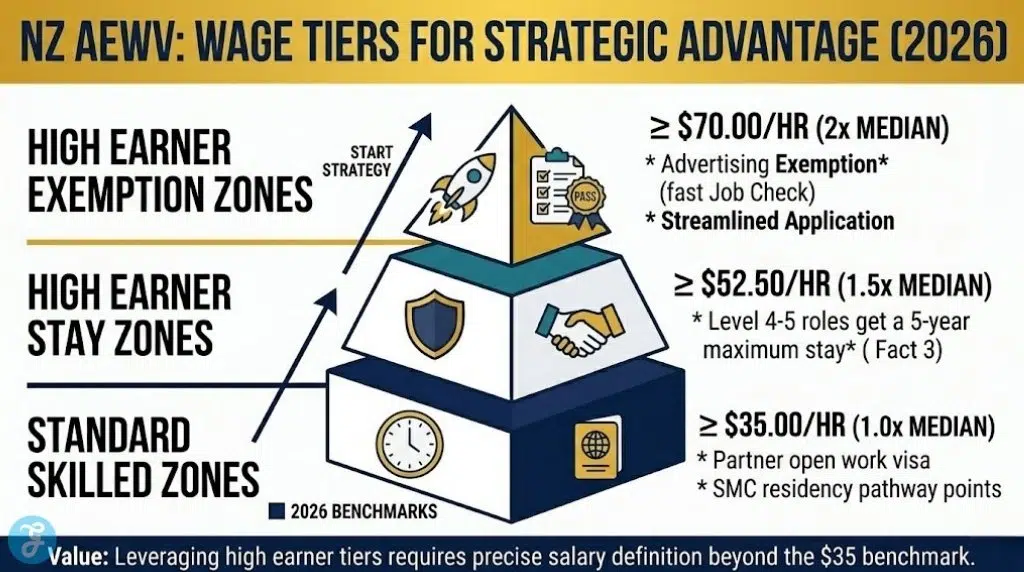
3. The “High Earner” 5-Year Stay Threshold
Migrants in lower-skilled roles (Level 4–5) can now only secure a 5-year maximum continuous stay if they earn at least 1.5x the median wage, which is $52.50 per hour.
-
Best for: Highly experienced workers in essential sectors who may not have formal degree qualifications but command high market salaries.
-
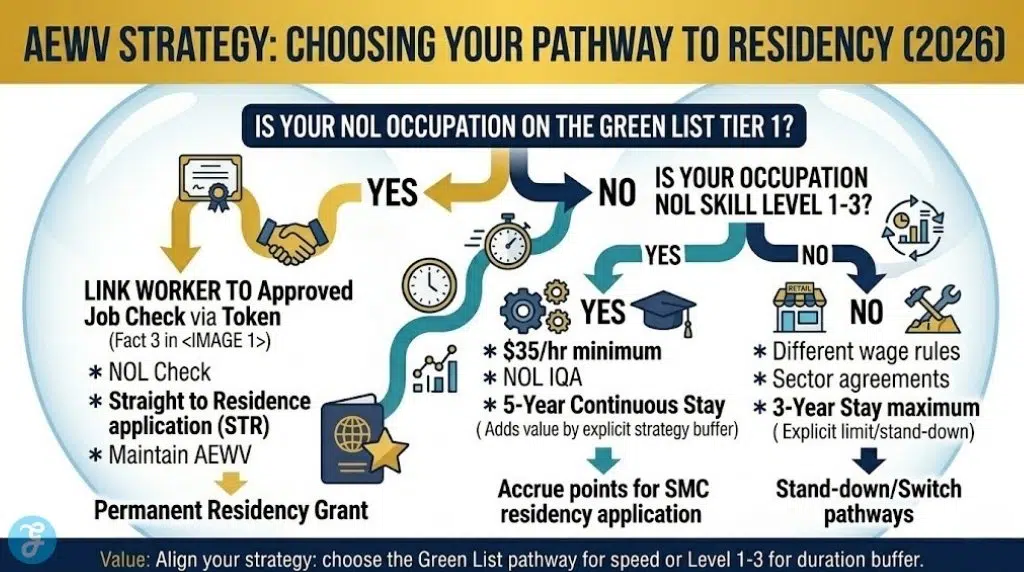
Things to consider: Most other Level 4 and 5 roles are now strictly capped at a 3-year stay before a mandatory 12-month stand-down period outside the country.
This rule serves to encourage the retention of high-productivity workers while managing the volume of lower-skilled temporary migration.
4. Reclassification of Pet Groomers, Nannies, and Kennel Hands
As of March 2026, three common roles—Pet Groomer, Nanny, and Kennel Hand—have been officially reclassified from Skill Level 3 to Level 4.
-
Best for: Employers in the domestic and animal care sectors who need to adjust their recruitment and Job Check strategies.
-
Things to consider: New applicants in these roles now face a 3-year stay limit and must meet mandatory English language requirements.
This shift highlights the government’s focus on re-evaluating skill classifications to protect local labor and ensure migrant workers are fairly compensated for higher-level roles.
5. The 47-Role Expansion of the National Occupation List (NOL)
The National Occupation List has officially added 47 new recognized roles at Level 1–3, providing a clearer path for specialists who previously didn’t fit the old ANZSCO codes.
-
Best for: Augmented Reality (AR) specialists, Sustainable Energy technicians, and niche culinary professionals.
-
Things to consider: These NOL occupations are currently only recognized for AEWV purposes; skilled residence pathways still rely on a mix of NOL and ANZSCO data.
The expansion allows the visa system to keep pace with New Zealand’s rapidly evolving technology and environmental sectors.
6. Twice the Median Wage: The Advertising Exemption
Employers looking to hire for roles paying at least twice the median wage ($70.00 per hour) are now exempt from standard labor market testing.
-
Best for: Executive-level hires and senior medical or engineering consultants where a global search is required.
-
Things to consider: While advertising isn’t required, the employer must still hold valid accreditation and complete the Job Check stage.
This “fast-track” for high-income earners reduces administrative friction for New Zealand’s most critical skill gaps.
7. Mandatory English Standard for Lower-Skilled Roles
The English language requirement (IELTS 4.0 or equivalent) remains a strict prerequisite for all new AEWV applicants in Skill Level 4 and 5 roles.
-
Best for: Improving migrant safety and integration by ensuring workers can understand their contracts and workplace hazards.
-
Things to consider: There are generally no English requirements for Level 1–3 roles, though most professional registrations in those levels have their own higher standards.
This policy is a direct response to historical issues with migrant exploitation in industries with lower-skilled workforces.
8. The 16% Post-Accreditation Audit Commitment
Immigration New Zealand has intensified its oversight, committing to auditing 1 in every 6 accredited employers annually to ensure compliance with the 2026 standards.
-
Best for: Maintaining the integrity of the AEWV system and weeding out “shell” companies or non-compliant employers.
-
Things to consider: Audits focus heavily on whether the employer is paying the promised wage and providing the mandatory settlement information to migrants.
Being hired by an accredited employer now carries a higher level of government-vetted security than in previous years.
9. Teachers and the “Step 5” Residency Shift
Under the 2026 Skilled Residence pathways, teachers must now reach Step 5 of the unified pay scale to remain eligible for certain residence-from-work options.
-
Best for: International educators planning their long-term career trajectory in the New Zealand school system.
-
Things to consider: Previously, reaching Step 4 was sufficient; this change aligns teaching residency with the higher $35 median wage benchmark.
Education professionals should review their collective agreements to ensure their progression timeline matches their residency goals.
10. The 14-Day Advertising Rigor for Job Checks
Despite the shift to a digital Job Token system, the 14-day mandatory advertising period on a national platform remains the bedrock of the labor market test.
-
Best for: Ensuring New Zealand citizens and residents are prioritized for available roles before international recruitment begins.
-
Things to consider: The advertising must explicitly state the salary range, and it must align with the current market rate and median wage thresholds.
This transparency ensures that the Job Check stage is a genuine reflection of New Zealand’s domestic labor supply.
Strategic Analysis
The 2026 AEWV landscape is a matrix of skill levels and salary thresholds. The table below summarizes how the Accredited Employer Work Visa median wage 2026 directly dictates your rights and stay duration in-country.
| Visa Feature | Skill Level 1–3 (NOL) | Skill Level 4–5 (NOL) |
| Max Continuous Stay | 5 Years | 3 Years (unless paid >$52.50) |
| English Requirement | Generally None | Mandatory (IELTS 4.0+) |
| Partner Work Rights | Open (if earning $28.00+) | Restricted / None |
| Residency Pathway | Direct / Work-to-Residence | Limited / Highly Paid only |
Our Top 3 Picks And Why?
-
The Green List “Straight to Residence”: This is our top pick for 2026 because it bypasses the “temporary” nature of the AEWV entirely, offering a direct path to security for those in Tier 1 roles like senior doctors and engineers.
-
The 5-Year Level 1–3 Stay: We chose this as a top-tier option because the five-year window provides the necessary “breathing room” to accumulate the 6 points required for the Skilled Migrant Category residency.
-
The $28.00 Partner Support Threshold: This is a critical strategic pick because it represents the “Goldilocks” wage—high enough to support a spouse’s career in NZ, yet low enough to be achievable for most mid-level trade and tech roles.
Preparation Checklist
-
[ ] Confirm your role’s skill level under the 2026 National Occupation List (NOL).
-
[ ] Ensure your employment agreement reflects an hourly rate of at least $35.00 if aiming for residency.
-
[ ] Verify that your employer’s accreditation is active and has not been flagged in a 2026 audit.
-
[ ] Obtain your IELTS or PTE results if your role is classified as Skill Level 4 or 5.
-
[ ] Use the INZ “Job Token” to link your worker application to your employer’s approved Job Check.
-
[ ] Check your “Maximum Continuous Stay” clock if you have previously held an AEWV to avoid the 12-month stand-down.
A Precise Path to New Zealand Residency in 2026
The 2026 Accredited Employer Work Visa system is a precision instrument designed to attract and retain the talent Aotearoa needs for its future. By anchoring the most vital visa rights to the $35.00 median wage, the government has created a transparent, if demanding, roadmap for migrants. Success in this new era requires more than just a job offer; it requires a strategic understanding of how your wage, skill level, and occupation classification interact. For those who meet the new benchmarks, the AEWV offers not just a job, but a stable and clear pathway to calling New Zealand home.
FAQs
Does the $35.00 median wage apply if I already have a visa?
No, the new wage only applies to new AEWV or Job Check applications submitted on or after March 9, 2026. Your current conditions remain valid until your visa expires.
Can I apply for residency if I earn less than $35.00?
Generally, no for the Skilled Migrant Category, unless you are in a specific “sector agreement” role (like care or construction) that has its own lower wage threshold.
What happens if my job is on the Green List but pays below $35.00?
To qualify for the Green List residency pathways, you must usually meet the median wage requirement (or a specific higher threshold defined for that role).