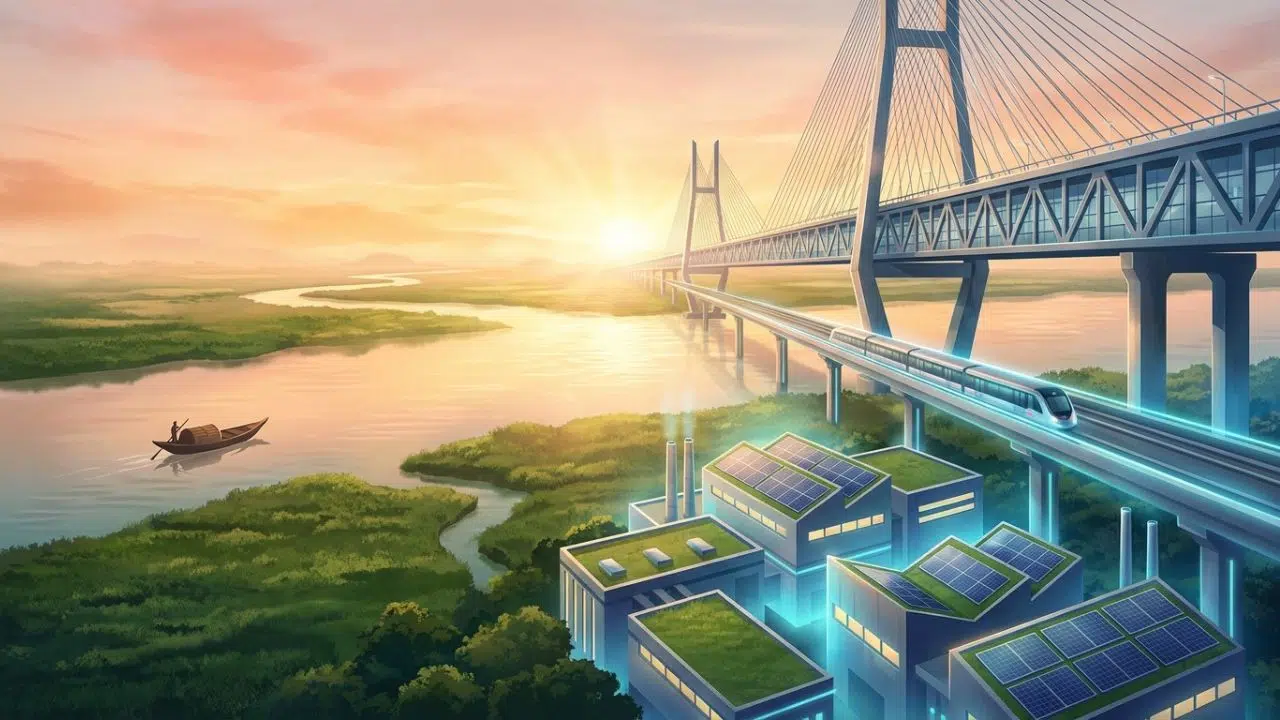
March 26, 2026, marks a historic crossroads for South Asia. As the nation pauses to reflect on the question on Independence Day 2026—how far has Bangladesh come in fifty-five years of independence? , the answers we find are deeply layered.
To view Bangladesh from a “third-eye” perspective—looking past the standard political talking points and purely statistical triumphs—is to witness a masterclass in human resilience juxtaposed with severe structural bottlenecks. Rising from the brutal devastation of the 1971 Liberation War, the country defied every pessimistic prediction of the 20th century. It shed the controversial “basket case” label to become a $450 billion economic engine.
Yet, as we observe the landscape in 2026, the narrative is no longer just about survival; it is about the quality of existence. Following the historic political uprising of 2024, the nation is undergoing a painful but necessary democratic reset. Grappling with global inflation, a highly debated delay in its Least Developed Country (LDC) graduation, and the stark realities of climate change, the story of Bangladesh’s fifty-five years of independence demands a critical, impartial examination. Let us look at the verified data and unpack the triumphs, the paradoxes, and the ultimate trajectory of this delta nation.
The Paradox of Growth: Rebuilding Post-2024
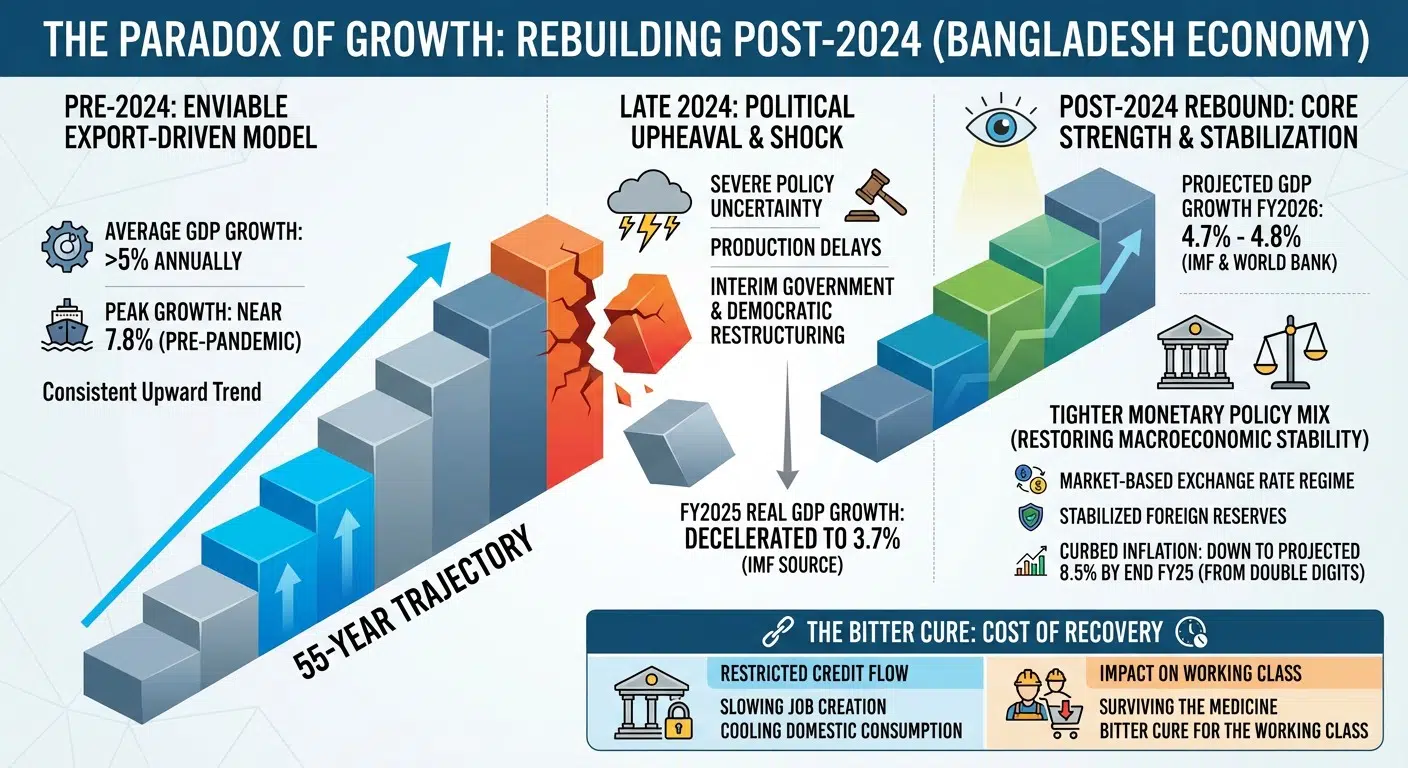
Viewed from an analytical lens, the economic trajectory of Bangladesh over the last fifty-five years resembles a steep, upward staircase that has suddenly encountered a broken step. For over a decade, the country boasted an enviable, export-driven economic model, averaging above 5% annual GDP growth and peaking near 7.8% prior to the global pandemic.
However, the political upheaval of late 2024 profoundly shocked the system. While the uprising paved the way for an interim government and subsequent democratic restructuring, it introduced severe policy uncertainty and production delays. According to the International Monetary Fund’s (IMF) early 2026 Article IV consultation reports, Bangladesh’s real GDP growth decelerated to 3.7% in FY2025.
But here is where the third-eye view reveals the nation’s core strength: its innate ability to rebound. The IMF and the World Bank both project GDP growth to accelerate to around 4.7% to 4.8% for the FY2026 cycle. The interim and newly formed governments implemented a tighter monetary policy mix aimed strictly at restoring macroeconomic stability. By enforcing a market-based exchange rate regime, the central bank managed to stabilize hemorrhaging foreign reserves and curb runaway headline inflation, pulling it down from double digits to a projected 8.5% by the end of FY25.
This recovery, however, comes at a cost. Tight monetary policies restrict credit flow to the private sector, slowing down job creation and cooling domestic consumption. The nation is currently surviving the medicine, but the cure is undoubtedly bitter for the working class.
Macroeconomic Health at a Glance (2025-2026)
To understand the current breathing rate of the economy, we must look at the hard metrics. The table below highlights the critical financial shifts, showcasing a highly managed stabilization phase:
|
Core Economic Indicator |
FY 2024 / 2025 (Actual) | FY 2026 (Projected) | The Third-Eye Context |
|---|---|---|---|
| Real GDP Growth | 3.7% | 4.7% | A steady rebound, but well below the 7%+ historic highs required for rapid poverty eradication. |
| Headline Inflation | 8.5% | 8.7% to 6.0% | Declining due to strict monetary control, yet food inflation remains a daily burden for the poor. |
| Foreign Exchange Reserves | $26.8 Billion | $30.9 Billion | Stabilizing, largely thanks to the painful transition to a floating, market-based currency rate. |
| Current Account Balance | 0.0% of GDP | -0.3% of GDP | Import rationalization successfully narrowed the deficit, but at the cost of capital machinery imports. |
The RMG Engine: Running Out of Cheap Steam?
No analysis of how far Bangladesh has come is complete without scrutinizing the Ready-Made Garment (RMG) sector. Over the decades, it has been the undisputed champion of the economy, contributing roughly 84% of total export earnings and transforming the societal fabric by empowering millions of rural women.
| Timeframe | The Metric | The Ground Reality |
| First Half FY26 | -2.63% (Totaling $19.37 Billion) | A clear signal that structural contraction is setting in as buyers hesitate. |
| December 2025 | -14.23% (Year-over-Year drop) | Massive shockwaves rippling directly through Dhaka’s industrial belts. |
| January 2026 | +11.77% (Month-over-Month rebound) | A testament to the raw resilience of our factory floors and workers. |
Yet, a critical view in 2026 shows an industry that is dangerously close to running out of its traditional fuel: cheap labor. In late 2025, the Export Promotion Bureau (EPB) reported that RMG exports fell by 2.63% to $19.37 billion during the first six months of the fiscal year. A sharp 14.23% year-over-year drop in December 2025 sent shockwaves through Dhaka’s industrial belts.
This contraction was not random. High domestic inflation drove up production costs, the removal of specific export cash incentives hurt global pricing, and political instability forced buyers to temporarily look toward Vietnam and Cambodia. However, proving its resilience once more, the sector saw a remarkable 11.77% month-on-month rebound in January 2026.
From an OP-ED perspective, the RMG sector is standing at a technological precipice. The future is no longer in basic cotton t-shirts; it is in man-made fibers (MMF), automated 4IR (Fourth Industrial Revolution) technologies, and green, LEED-certified factories. To survive the next fifty-five years, Bangladesh must aggressively pivot from a low-skill, high-volume model to a medium-skill, high-value ecosystem.
The LDC Graduation Dilemma: A Badge of Honor or a Financial Trap?
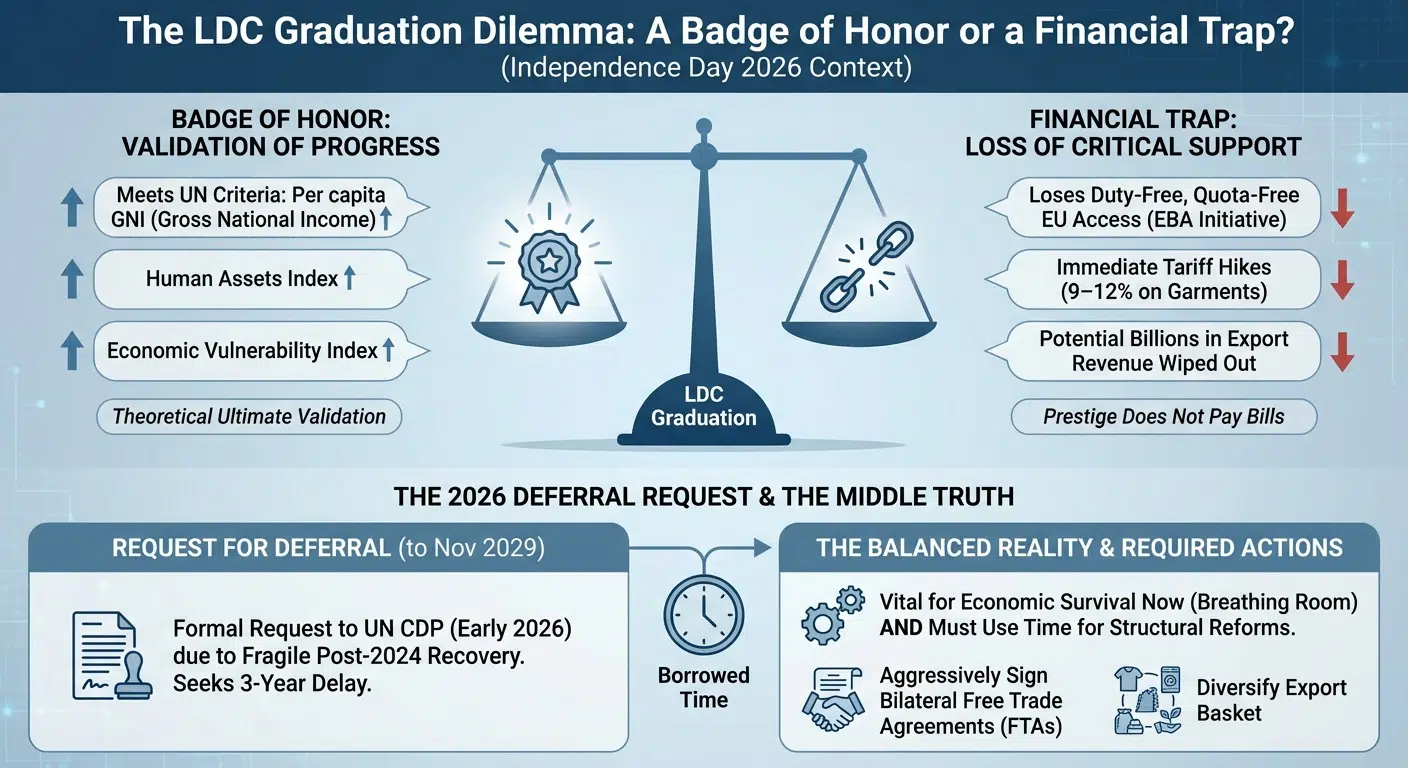
Perhaps the most fascinating paradox we face on Independence Day 2026 is the debate surrounding the United Nations Least Developed Country (LDC) graduation. Originally slated for November 24, 2026, graduating from LDC status is theoretically the ultimate validation of a developing nation’s progress. Bangladesh meets all UN criteria: per capita Gross National Income (GNI), the Human Assets Index, and the Economic Vulnerability Index.
However, prestige does not pay the bills. Graduating means losing critical international support mechanisms, most notably the duty-free, quota-free market access to the European Union (Everything But Arms initiative). Losing this access could result in immediate tariff hikes of 9–12% on Bangladeshi garments, potentially wiping out billions in export revenue overnight.
| The Scenario | The Timeline | The Economic Consequence |
| The Original Cliff | November 24, 2026 | Immediate 9–12% tariff hikes imposed on Bangladeshi garments. |
| The Requested Delay | November 2029 | Buys the fragile post-2024 economy three years of vital breathing room. |
| The Required Action | Right Now | Time must be used to aggressively secure bilateral Free Trade Agreements (FTAs) and diversify. |
Recognizing the fragility of the post-2024 economic recovery, Dhaka submitted a formal request to the UN Committee for Development Policy (CDP) in early 2026, seeking a three-year deferral to November 2029. An impartial observer must ask: Is this a necessary breathing room, or is it delaying the inevitable structural reforms required to compete on a level global playing field? The truth lies in the middle. The delay is vital for economic survival right now, but the government must use this borrowed time to aggressively sign bilateral Free Trade Agreements (FTAs) and diversify its export basket.
Demographics and the Ticking Clock of Youth Employment
While infrastructure like the Padma Bridge and the Dhaka Metro Rail visually signify how far Bangladesh has come, the true wealth of the nation lies in its demographics. However, this “demographic dividend” is a ticking clock.
| The Metric | The Hard Number | The “Smart Bangladesh” Deficit |
| National Poverty Rate | 21.2% (FY25) | Millions are hovering just above destitution, vulnerable to a single medical or climate crisis. |
| Labor Force Participation | 58.9% | Shrinking participation, with women disproportionately exiting the workforce during economic slowdowns. |
| The NEET Crisis | >8.5 Million | Youth Not in Education, Employment, or Training fuels brain drain and reliance on low-skilled remittances. |
A critical third-eye view reveals a deeply concerning disconnect between economic growth and human capital utilization. Despite rising literacy rates, millions of young graduates find themselves structurally unemployable, as the education system fails to align with modern industrial demands. The World Bank’s recent reports highlight that labor force participation has actually shrunk to 58.9%, with a disproportionate number of women exiting the workforce during recent economic slowdowns.
Furthermore, over 8.5 million young Bangladeshis are classified as NEET (Not in Education, Employment, or Training). The resultant brain drain of top-tier talent and the heavy reliance on low-skilled expatriate remittances expose a vulnerability. Moving forward, the “Smart Bangladesh” vision cannot just be a digital slogan; it must manifest in massive investments in vocational training, IT skill development, and entrepreneurial funding.
The Erosion of Social Gains and the Banking Sector Crisis
Historically, Bangladesh has been a trailblazer in grassroots social development, pioneering microcredit and achieving massive strides in life expectancy. But economic shocks have a cruel way of reversing social progress. The World Bank’s late 2025 Development Update delivered a sobering reality check: the national poverty rate climbed to 21.2% in FY25.
Millions of citizens live in a precarious state of vulnerability, hovering just above the poverty line, where a single medical crisis or extreme weather event can plunge them back into destitution. This highlights the urgent need to transition from traditional microloans to robust, state-sponsored social safety nets.
Simultaneously, the elephant in the room remains the banking sector. The third-eye perspective cannot ignore the systemic risk posed by Non-Performing Loans (NPLs). Years of lax regulatory oversight allowed massive capital flight and loan defaults by powerful conglomerates. For the economy to truly mature past 2026, the central bank must act with absolute autonomy, enforcing ruthless governance and anti-corruption measures to clean up corporate balance sheets.
Climate Change: The Existential Tax on Progress
Finally, one cannot write an OP-ED on Bangladesh without addressing the sky above and the waters below. Bangladesh contributes a fraction of a percent to global greenhouse gas emissions, yet it pays one of the highest existential taxes for climate change.
Rising sea levels, encroaching salinity in the southern agricultural belts, and the increasing ferocity of cyclones constantly threaten to wash away the infrastructural and economic gains of the last half-century. While the government’s “Delta Plan 2100” is a visionary roadmap for water management and climate adaptation, its execution requires hundreds of billions of dollars in international climate financing—funds that the global north has been painfully slow to disburse.
The Verdict on the Next Era
As we return to the central question on Independence Day 2026—how far has Bangladesh come in fifty-five years of independence? -the verdict is one of immense pride tempered by urgent realism. To look at Bangladesh today is to see a nation that has achieved the impossible. It has fed a massive population, built awe-inspiring megastructures with its own funds, and woven its way into the global supply chain.
Yet, the third-eye view warns us that the strategies that brought the country out of the ashes of 1971 will not be sufficient to carry it into 2050. The transition from an emerging market to an equitable, high-income nation requires painful institutional reforms. It requires cleaning up the financial sector, diversifying beyond garments, investing heavily in modern education, and fortifying democratic governance.
The story of fifty-five years of independence is undeniably a story of triumph over tragedy. The foundation is poured, and the walls are up; now, the nation must decide how resilient the roof will be.
We owe our deepest respect to the fearless martyrs and fighters who risked everything—and shed their blood—in the long struggle for Bangalee freedom and rights.