
As of early 2026, South Africa has officially transitioned from a “wait-and-see” crypto environment to one of the most strictly regulated digital asset markets in the Southern Hemisphere. While many investors are aware that the Financial Sector Conduct Authority (FSCA) now requires licenses, the fine print of these regulations contains specific, often overlooked mandates that can make or break a Crypto Asset Service Provider (CASP). Navigating this landscape requires more than just a basic understanding of blockchain; it demands a deep dive into the intersection of traditional financial law and emerging digital standards.
Our Selection Methodology
To curate this list, we analyzed the latest 2026 FSCA regulatory updates, the 2026 South African Budget Speech, and recent enforcement reports from the Financial Intelligence Centre (FIC). We prioritized “lesser-known” facts—regulatory nuances that aren’t typically found in headline news but are critical for operational compliance. Our selection criteria focused on new enforcement deadlines, specific technical exemptions, and imminently changing tax thresholds that impact both small startups and established exchanges.
10 Things Most People Don’t Know About South Africa’s FSCA Crypto Licensing Rules
The regulatory framework for crypto in South Africa is no longer a set of suggestions; it is a legally binding regime with high stakes for non-compliance. Below are the key insights into the current FSCA licensing requirements.
1. The “Zero-Threshold” Travel Rule for All Transactions
Unlike many global jurisdictions that apply a de minimis threshold for identity sharing, South Africa’s FIC Directive 9 mandates that the “Travel Rule” applies to every single crypto transaction, regardless of its value.
-
Best for: CASPs and wallet providers managing high-frequency, small-value transfers between users.
-
Things to consider: While the threshold is R0 for data collection, significantly stricter identity verification is required once a transaction exceeds R5,000.
Effective transaction monitoring is now a cornerstone of maintaining an FSCA license in the current 2026 landscape.
2. The Hard Deadline for Regulatory Examinations (RE)
For a long time, CASPs operated under an 18-month exemption regarding the mandatory Regulatory Examinations (RE) for Key Individuals (KIs). As of mid-2025, that window has permanently closed, making it a current 2026 requirement.
-
Best for: Founders and compliance officers acting as Key Individuals within a crypto-based Financial Services Provider (FSP).
-
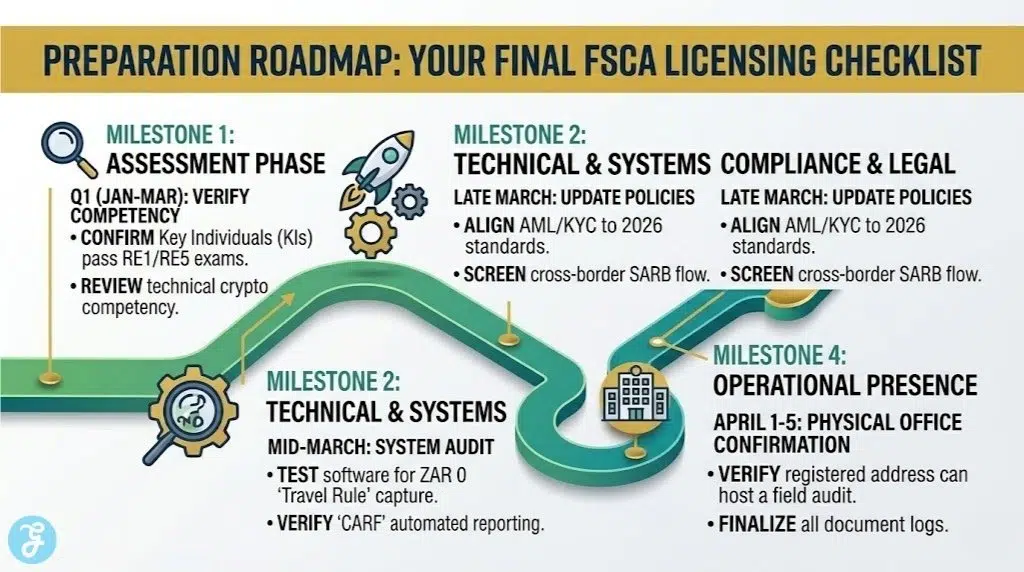
Things to consider: No further extensions have been granted; any KI who has not passed the RE1 or RE5 exams by early 2026 is legally barred from overseeing regulated activities.
This shift ensures that crypto leadership holds the same foundational financial knowledge as traditional banking executives.
3. Implementation of the Crypto Asset Reporting Framework (CARF)
From March 1, 2026, the South African Revenue Service (SARS) has begun receiving automated, granular transaction data directly from platforms under the new CARF regime.
-
Best for: High-net-worth investors and exchanges looking to stay ahead of the next tax filing season.
-
Things to consider: This automated reporting leaves virtually no room for manual non-disclosure of crypto-to-crypto or crypto-to-fiat trades.
Seamless reporting infrastructure is now a prerequisite for any platform seeking to renew its FSCA credentials.
4. Specific Exemptions for Miners and Node Operators
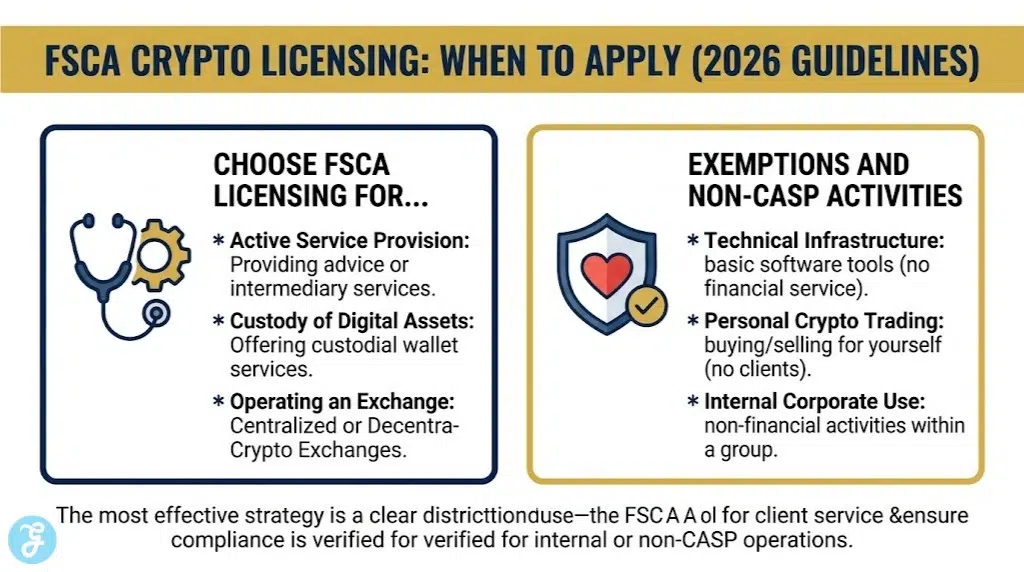
One of the most common misconceptions is that everyone in the “crypto” space needs a license. The FSCA has clarified that infrastructure providers like miners and node operators are currently exempt.
-
Best for: Technical service providers and blockchain infrastructure companies that do not provide financial advice.
-
Things to consider: If these entities begin offering custody or advisory services, they immediately fall back into the FSCA’s licensing perimeter.
Understanding where the line is drawn between “service provider” and “infrastructure” is vital for cost-effective corporate structuring.
5. Imminent Integration into Exchange Control Regulations
Following the 2026 Budget Speech, the South African Reserve Bank (SARB) is moving to officially include crypto assets in the capital flow management regime.
-
Best for: Arbitrage traders and businesses moving significant crypto capital between South African and offshore accounts.
-
Things to consider: Draft regulations suggest that “offshoring” crypto will soon require the same prior approval as traditional currency transfers.
This move effectively ends the era of unregulated cross-border crypto rails in South Africa.
6. The Requirement for a Physical Local Office
A virtual mailbox or a shared coworking address is no longer sufficient for the FSCA. The current licensing rules require a physical presence where records can be audited.
-
Best for: International crypto firms looking to “passport” their services into the South African market.
-
Things to consider: The office must be a location where physical inspections of IT infrastructure and compliance documentation can occur.
Establishing a genuine local footprint is a non-negotiable part of the “Fit and Proper” test.
7. Licensing of Intermediaries vs. Legal Tender Recognition
While the FSCA licenses CASPs as Financial Services Providers, this does not mean South Africa recognizes Bitcoin or Ethereum as legal tender.
-
Best for: Merchants considering accepting crypto payments for goods and services.
-
Things to consider: The regulator supervises the service provided around the asset, while the asset itself remains a “financial product” rather than a currency.
Businesses must be careful not to misrepresent their FSCA license as an endorsement of the underlying asset’s stability.
8. The “Fit and Proper” Crypto Competency Test
Applying for a license requires proving “competency,” which now specifically includes practical experience and knowledge pertaining to crypto assets, not just general finance.
-
Best for: Compliance officers transitioning from the traditional banking sector into the fintech space.
-
Things to consider: The FSCA has increasingly declined applications where the leadership cannot demonstrate a technical understanding of private key management or DLT.
Education and specialized certification have become the primary gatekeepers for new market entrants.
9. The VAT Threshold Leap in April 2026
Effective April 1, 2026, the compulsory VAT registration threshold for small crypto businesses has increased to R2.3 million per annum.
-
Best for: Emerging startups and solo-run crypto advisory firms managing smaller turnovers.
-
Things to consider: This change provides significant administrative relief for micro-enterprises that previously had to register at the R1 million mark.
The increased threshold allows smaller players to focus on growth rather than heavy tax administrative burdens.
10. The Reality of FSCA “Enforcement Actions”
As of early 2026, the FSCA has already initiated over 80 formal investigations into unlicensed CASP activities, signaling the end of the “grace period.”
-
Best for: Any entity currently operating under a “pending” application or transitional exemption.
-
Things to consider: Penalties for providing services without a license can include fines up to R10 million or 10 years in prison.
The Authority is now actively “clamping down” on those who missed the 2023–2024 application windows.
Strategic Analysis
The following table compares the three most critical compliance pillars that every CASP in South Africa must address in 2026 to avoid regulatory friction.
| Compliance Pillar | Primary Authority | 2026 Requirement Status | Impact on Operations |
| Licensing Status | FSCA | Mandatory Category I/II FSP | Cannot operate without active license or pending status. |
| Transaction Privacy | FIC (Directive 9) | Enforceable (ZAR 0 Threshold) | High administrative load for all transfers. |
| Tax Reporting | SARS (CARF) | Active (from March 2026) | Automated disclosure of user gains/losses. |
Our Top 3 Picks And Why?
-
The Travel Rule (FIC Directive 9): This is our top pick for the most impactful rule because it forces crypto to behave like traditional banking, removing the “anonymity” factor that many users value.
-
Exchange Control Integration: This pick is critical because it represents the most significant structural shift for 2026, effectively leashing crypto to the South African Rand’s global flow.
-
The RE Exam Deadline: We chose this because it is the ultimate filter for professionalizing the industry, ensuring that only qualified individuals lead the sector.
Preparation Checklist
-
[ ] Confirm that all Key Individuals (KIs) have passed the RE1/RE5 exams.
-
[ ] Audit your internal software to ensure compliance with the ZAR 0 Travel Rule.
-
[ ] Verify that your registered address is a physical office capable of hosting an audit.
-
[ ] Update your AML/KYC policies to align with the 2026 CARF reporting standards.
-
[ ] Screen all cross-border transactions against the imminently updated SARB capital flow rules.
The 2026 FSCA crypto licensing requirements mark a point of no return for the industry. While the compliance burden is undoubtedly higher, these rules offer a level of legitimacy that was previously missing, paving the way for institutional investment and broader consumer trust. For businesses, the “hidden” rules regarding office physicals, specific crypto competency, and zero-threshold reporting are no longer optional—they are the new standard for doing business in South Africa’s digital economy.
FAQs
-
Do I need an FSCA license if I only trade for myself? No, the licensing requirements apply only to those providing “financial services” to others, such as advice, intermediary services, or asset management.
-
Are NFTs regulated by the FSCA in 2026? Not currently. Service providers solely dealing in NFTs are exempt unless the NFTs are used as a wrapper for traditional financial products.
-
What happens if my FSCA application is declined? You must immediately stop all CASP-related activities. You may re-apply, but only once you can prove you have addressed the specific reasons for the rejection.