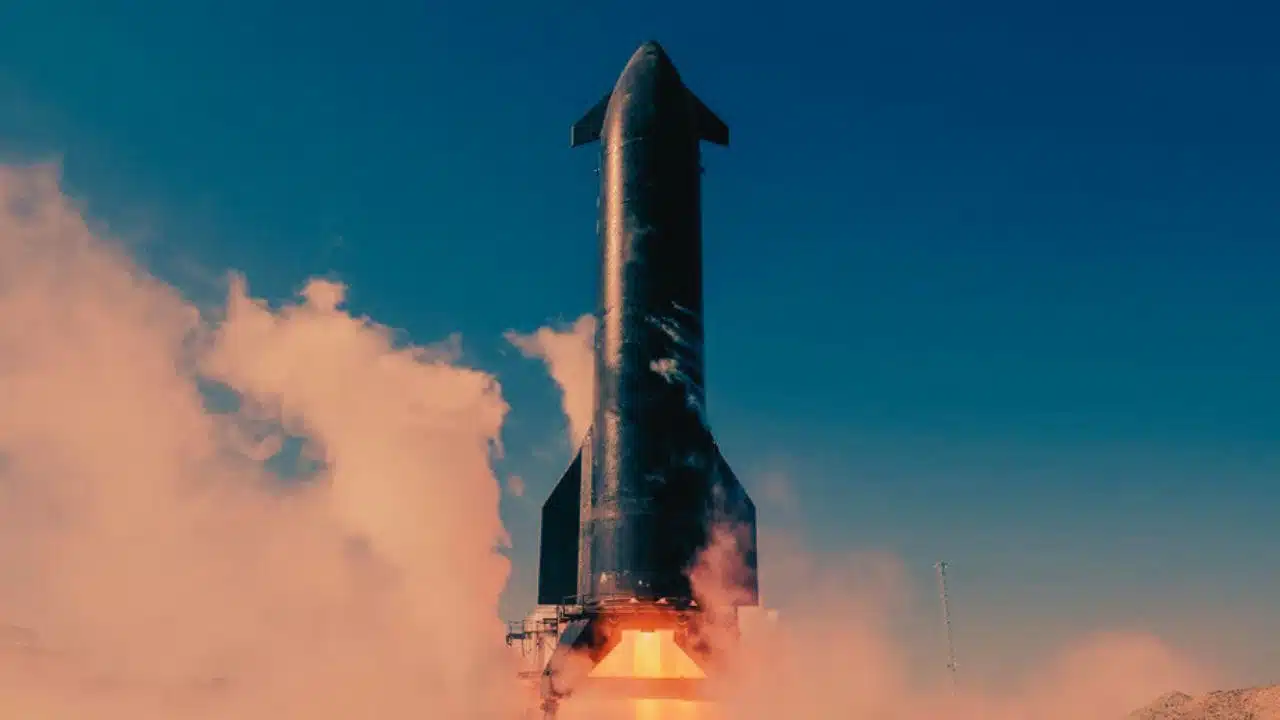
Late on the night of June 18, 2025, one of SpaceX’s Starship prototypes, known as Ship 36, was destroyed in a massive explosion during a ground-based static-fire test in South Texas. The incident took place at SpaceX’s private Starbase launch and development facility, located near Boca Chica Beach, close to the U.S.–Mexico border. The explosion was captured on surveillance cameras and seen by local residents, lighting up the sky with a fiery blaze.
This test was a critical pre-launch procedure meant to verify engine and propellant systems while the rocket remained secured to the ground. Instead, the vehicle suffered what SpaceX later described as a catastrophic anomaly, resulting in a complete loss of the prototype and significant damage to the test infrastructure.
What is a Static-Fire Test and Why It Matters
Static-fire tests are a routine yet essential part of a rocket’s launch preparation. During such a test, propellant is loaded into the rocket, and the engines are briefly fired while the vehicle is held securely in place. This allows engineers to evaluate everything from ignition sequences to fuel system integrity and engine response under pressure.
In this case, SpaceX was preparing to fire the six Raptor engines of Starship 36 when the incident occurred. Just minutes into the fueling process, a violent explosion ripped through the test stand, sending flames and debris into the sky. The rocket was not intended to launch that night; it was undergoing one of its final tests before a planned flight later in June.
No Injuries Reported, Area Secured
Despite the magnitude of the explosion, there were no reported injuries. SpaceX had established a secure perimeter around the test site, and safety protocols were in place to ensure all personnel were clear of danger. The company confirmed that all team members were accounted for and that nearby communities were not at risk.
Emergency crews and site managers were quickly deployed to assess the damage and secure the area. Local law enforcement coordinated with SpaceX to maintain a restricted zone while safety operations continued.
Likely Cause: Pressure Vessel Malfunction
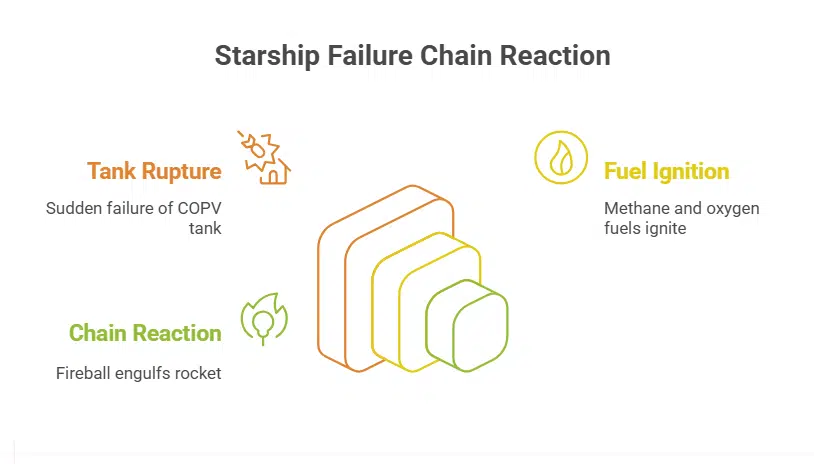
Preliminary investigations suggest that the failure may have originated from a high-pressure nitrogen tank, known as a Composite Overwrapped Pressure Vessel (COPV), located inside the payload section of the Starship. These vessels are used to store pressurized gases and are a standard component in many aerospace systems.
Early data indicates that one of these tanks failed while under relatively low pressure, well below its expected tolerance level. This sudden rupture may have triggered a chain reaction involving the highly combustible methane and oxygen fuels already loaded into the vehicle. The result was a devastating fireball that engulfed the entire rocket.
If confirmed, this would be the first recorded failure of this kind in the current Starship design iteration. SpaceX engineers have begun a thorough analysis of the debris and test data to identify the root cause and make necessary adjustments in future builds.
Test Infrastructure Severely Damaged
The Massey test stand, a key structure used for static-fire operations, was heavily damaged in the explosion. Photos and aerial images show that support scaffolding, control wiring, access platforms, and propellant lines were either destroyed or severely burned.
In addition to the structural loss, several nearby support buildings and temporary test equipment were also impacted. Clean-up and recovery efforts began the following morning, but rebuilding the test stand is expected to take weeks, if not longer.
Until repairs are complete, SpaceX cannot perform further static-fire tests at Massey, potentially slowing the timeline for upcoming Starship flights.
Flight Timeline Disrupted
Starship 36 was scheduled to be part of SpaceX’s tenth major test flight under the current development program. That launch was tentatively set for late June, possibly June 29. With the prototype destroyed and the test stand out of service, the schedule has now shifted.
The next available prototype, Starship 37, is currently undergoing final assembly and outfitting. Depending on the outcome of ongoing safety reviews and infrastructure repairs, it may become the new candidate for the next flight test.
While this will likely push back SpaceX’s internal timelines, the company remains committed to its long-term goals and has reiterated its focus on iterative testing and rapid problem-solving.
Starship’s Role in the Bigger Picture
Standing 403 feet tall, Starship is the largest and most powerful launch vehicle ever built. It is designed to be fully reusable and capable of delivering up to 150 metric tons of cargo to low Earth orbit. More importantly, Starship is central to SpaceX’s vision for future space exploration, including human missions to the Moon and Mars.
NASA has selected a modified version of Starship for its Artemis program, which aims to return astronauts to the lunar surface. The rocket is also expected to play a key role in deploying SpaceX’s next generation of Starlink satellites and in enabling large-scale space cargo missions.
Despite recent setbacks, including three other Starship-related failures earlier in 2025, SpaceX remains confident that its development model—based on frequent testing and fast iteration—will yield a reliable and cost-effective space transportation system in the long term.
Setbacks and Progress: A Recurring Cycle
The destruction of Ship 36 is just the latest in a series of high-profile Starship failures this year:
-
In January, another prototype disintegrated during a mid-flight engine test, scattering debris into the ocean.
-
A March flight test ended with the upper stage losing control and breaking apart over the Caribbean.
-
In May, the Super Heavy booster failed to splash down safely, detonating above the Gulf of Mexico after a partially successful ascent.
These failures, while dramatic, are part of SpaceX’s intentional strategy. The company prefers real-world testing over simulations and accepts destruction as a necessary step toward refinement.
In fact, the company has already achieved several engineering milestones this year, including successful tower catches of the Super Heavy booster and expanded flight testing approvals from the Federal Aviation Administration (FAA).
Environmental and Regulatory Implications
Earlier in May, the FAA approved an increase in the number of Starship launches allowed annually—from five to twenty-five. This approval came after a detailed environmental review and despite objections from conservation groups concerned about the local impact on wildlife, including endangered sea turtles and migratory shorebirds.
The recent explosion will likely renew scrutiny over the environmental and safety implications of Starbase operations. SpaceX must continue to submit post-incident reports and satisfy all FAA requirements before resuming any further launches.
Musk and SpaceX’s Response
Shortly after the incident, Elon Musk acknowledged the failure on social media. He commented on the suspected COPV malfunction and emphasized that investigations are underway. Engineers are combing through telemetry and sensor data to determine the exact sequence of events leading up to the explosion.
SpaceX’s official statement emphasized that safety procedures had worked as intended, personnel were unharmed, and the company remains committed to its ambitious roadmap.
Summary Table
| Event | Starship 36 explosion during static-fire test |
|---|---|
| Date | June 18, 2025 |
| Location | Massey Test Stand, Starbase, Texas |
| Cause (preliminary) | Pressurized nitrogen tank failure |
| Result | Total destruction of rocket and test infrastructure |
| Injuries | None reported |
| Upcoming impact | Delay in Flight 10 test, pending recovery |
| Next prototype | Starship 37 in final prep stage |
| FAA stance | Approved up to 25 Starship launches annually |
| SpaceX goal | Mars colonization, NASA Artemis support, satellite delivery |
The destruction of Starship 36 is undoubtedly a major setback, both in terms of schedule and public perception. However, it also reinforces SpaceX’s strategy of learning through action. The company’s ability to adapt quickly, investigate failures transparently, and refine its technology has been key to its dominance in the commercial space industry.
With ongoing support from NASA and FAA regulators, and with new vehicles in the pipeline, SpaceX is already preparing for the next phase. Starship 37 may now take the lead, and a new static-fire stand could soon be constructed to maintain testing cadence.
Failures like this serve as reminders of how complex spaceflight really is. But for a company like SpaceX, every explosion is another step closer to making interplanetary travel a reality.