

Cloud gaming is changing the mobile experience by removing the hardware barriers that once limited handheld play. By shifting heavy processing to remote servers, players can now stream high-fidelity, console-quality titles on standard smartphones without worrying about overheating or storage limits. Industry leaders like NVIDIA GeForce NOW and Xbox Cloud Gaming are effectively turning every mobile device into a high-end gaming rig, democratizing access to premium content.
This evolution is forcing developers to rethink engagement and multiplatform accessibility. Through edge computing and cloud-based emulators, the friction of massive downloads is disappearing, replaced by “click-and-play” immediacy. For developers, this means reaching a global audience that isn’t tethered to expensive consoles, ensuring that the future of mobile gaming is defined by connectivity rather than hardware specs.
What Is Cloud Gaming?
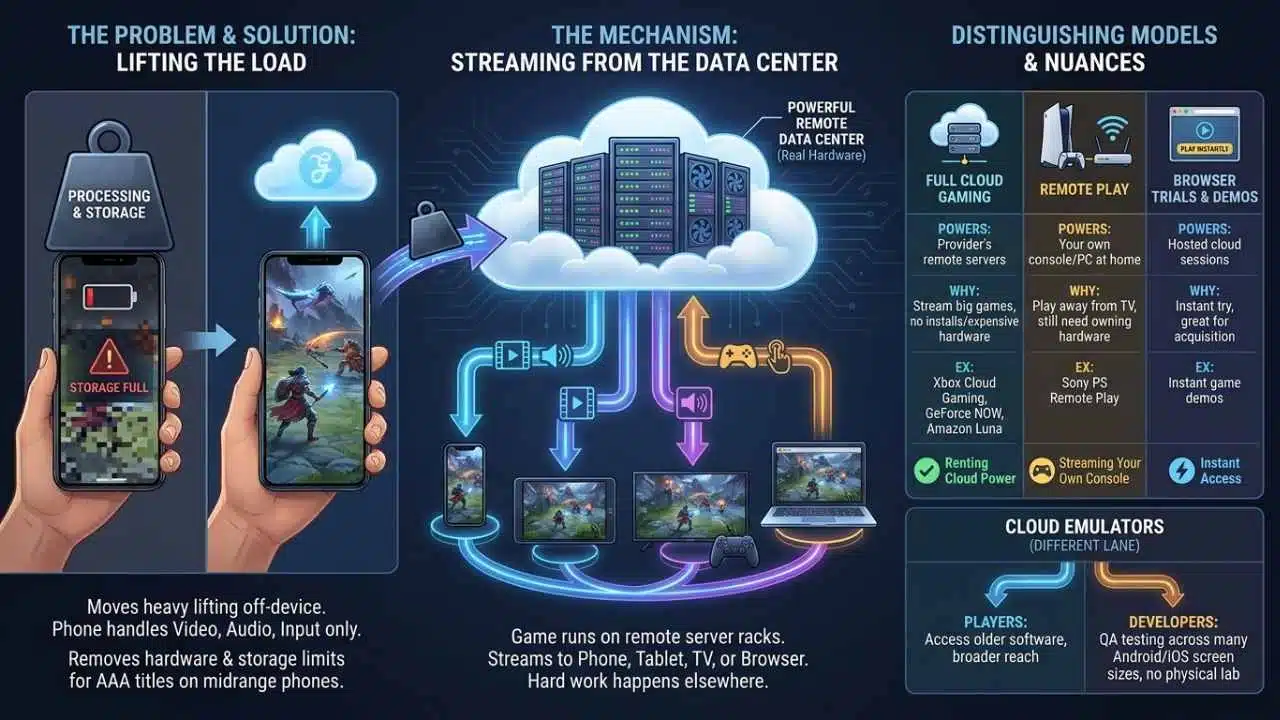
Cloud gaming moves the heavy lifting off the device in your hand, so your phone mostly handles video, audio, and input.
Cloud gaming streams a game from a powerful data center to your phone, tablet, TV, or browser. The game still runs on real hardware, but that hardware sits in a remote server rack instead of in your pocket.
That matters because it removes two of the biggest pain points in mobile gaming: hardware limitations and storage limits. A midrange phone can suddenly access aaa titles, richer graphics, and faster updates because the hard work happens elsewhere.
It also helps to separate three ideas that often get mixed together.
| Model | What actually powers the game | Why it matters on mobile |
|---|---|---|
| Full cloud gaming | A provider’s remote servers | You can stream big games without local installs or expensive hardware. |
| Remote play | Your own console or PC at home | You keep playing away from the TV, but you still need the hardware you already own. |
| Browser-based trials and cloud demos | Hosted game sessions in the cloud | Players can try a game instantly, which is great for acquisition and player engagement. |
That distinction is useful because Xbox Cloud Gaming, GeForce NOW, and Amazon Luna are not the same thing as Sony’s PS Remote Play. Remote Play is incredibly convenient, but it is closer to streaming your own console than renting cloud power from a gaming platform.
Cloud-based mobile emulators sit in a slightly different lane too. For players, they can help with access to older software and broader device reach. For game developers, they are often more valuable as testing tools that speed up QA across many Android and iOS screen sizes without building a huge physical device lab.
The Rise of Cloud Gaming in Mobile Experiences
Cloud gaming did not take off on mobile because one feature suddenly appeared. It grew because networks, cloud computing, codecs, and mobile expectations all improved at the same time.
Impact of 5G Networks
5G helps because it cuts the delay between your tap and the game’s response. That does not make every match perfect, but it gives game streaming a much better shot at feeling smooth on phones and tablets.
In Opensignal’s June 2025 U.S. mobile network report, all major carriers landed in its Fair band for game experience. That is a good reminder that 5G is helpful, but it does not erase jitter, congestion, or weak indoor coverage.
- Use 5 GHz Wi-Fi first if you care about ranked play, shooters, or racing games.
- Save cellular for casual sessions like turn-based games, deck builders, or story titles.
- Test at the times you actually play, because evening congestion can change the gaming experience more than peak speed tests do.
- Keep your device close to the router if you want steadier latency and fewer image drops.
That last step sounds basic, but it fixes a surprising amount of frustration. For player engagement, stable sessions matter more than flashy peak numbers.
Advances in Cloud Infrastructure
The big leap came from better cloud infrastructure, not just faster phones. Providers now use edge computing, smarter video encoding, and distributed remote servers to keep streams closer to the player.
AWS says Amazon GameLift Streams can deliver games at up to 1080p and 60 frames per second in a browser, with little to no game-code modification. For game developers, that is important because it lowers the cost of building instant demos, playtests, and browser-based launches.
Better infrastructure does more than improve graphics. It shortens the distance between a player tap and the on-screen result, which is what makes mobile cloud gaming feel playable.
This is also why edge computing shows up so often in cloud gaming conversations. Moving workloads closer to the user trims round-trip time, and that can be the difference between a game that feels snappy and one that feels mushy.
Increased Demand for High-Quality Mobile Gaming
Players now expect more from mobile gaming than a quick match while waiting in line. They want deeper progression, stronger visuals, synced saves, and the freedom to start on a phone and continue on a bigger screen.
The business signal is hard to miss. ESA reported that U.S. consumer spending on video games reached $58.7 billion in 2024, and its 2026 economic impact study counted 82,930 U.S. video game industry employees in 2025. When the market is that large, gaming platforms keep chasing better mobile reach.
- Players want instant access, which makes no-download game streaming more attractive.
- Studios want wider reach, which makes cloud-first distribution easier to justify.
- Publishers want lower friction, because every removed install step can improve conversion.
That is why the demand is no longer just about flashy tech. It is about convenience, reach, and better user experience from the first tap.
Features Transforming Mobile Cloud Gaming
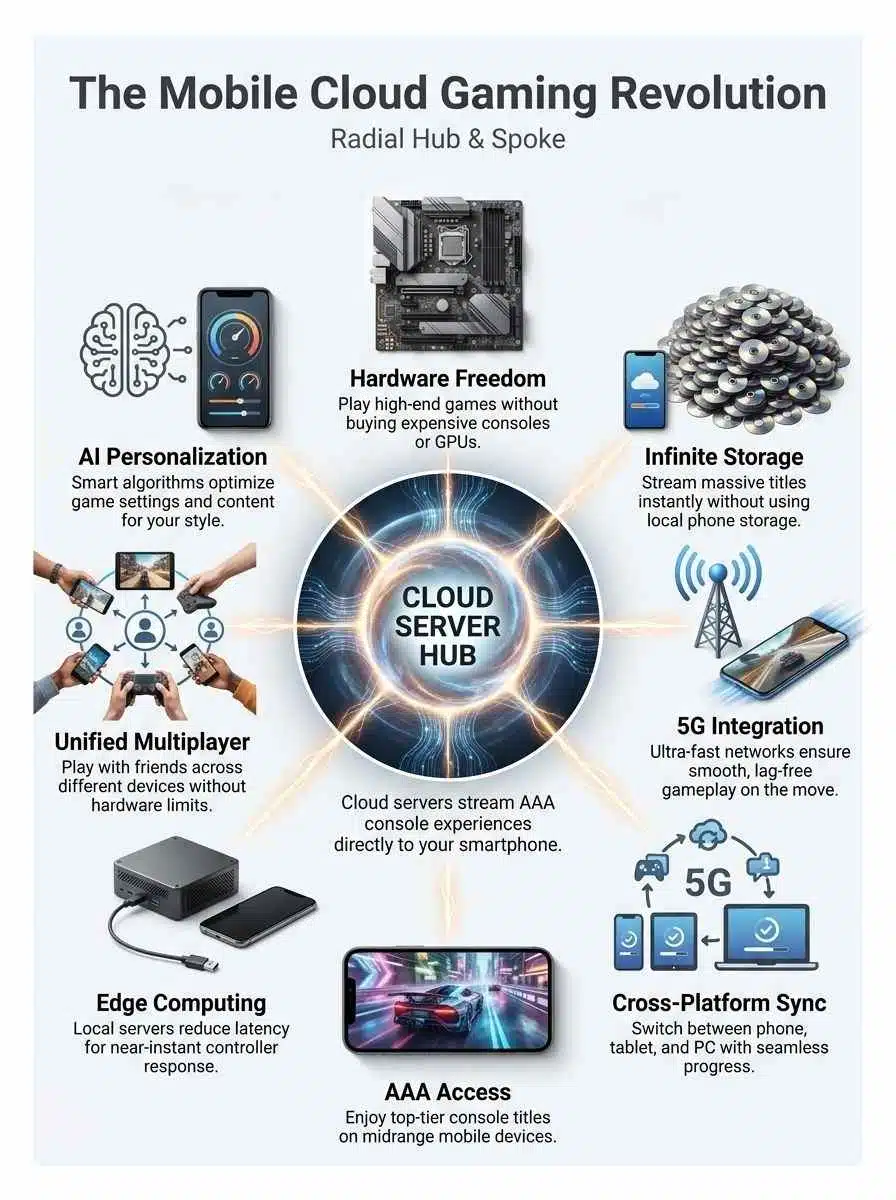
The best cloud gaming features do not feel flashy at first. They simply remove the things that used to make mobile play feel cramped, compromised, or cut off from the rest of the gaming industry.
Freedom from Hardware Limitations
This is the feature most players feel first. Game streaming lets a modest phone access visuals and game design that would usually need a console, gaming PC, or top-tier chipset.
NVIDIA lists support for Android phones and tablets running Android 7.0 or later with 1GB of available memory. It also lists 35 Mbps for 1440p at 120 FPS on supported Android devices, with network latency below 80 ms. That tells you something useful right away: the bottleneck is often your connection, not your handset.
- Good phone, weak connection: cloud gaming still struggles.
- Average phone, strong connection: cloud gaming can feel shockingly good.
- Controller attached: the gaming experience usually improves more than it does from a small bump in raw bandwidth.
For readers deciding whether to try it, that is a helpful mindset shift. Stop asking, “Is my phone powerful enough?” and start asking, “Is my network steady enough?”
Elimination of Storage Constraints
Mobile storage fills up fast, especially once a few large games, videos, and everyday apps pile on. Cloud gaming sidesteps that problem because the install footprint on your device stays small or disappears entirely.
That changes how players sample games. Instead of committing 30 GB or more to a title they may not love, they can launch it almost instantly, test the feel, and move on if it does not click.
It changes business strategy too. Xsolla’s cloud gaming documentation describes a pay-as-you-go model based on actual minutes played, and its 2025 mobile virtual gamepad overlay gives streamed PC games touch-based control on Android and iOS. That opens the door to quicker trials, easier onboarding, and lower friction for mobile audiences.
Cross-Platform Accessibility
Cross-platform compatibility is one of the clearest wins in cloud gaming. A player can start on a tablet, pick up later on a laptop, and still keep the same library, saves, and multiplayer identity.
Xbox says select cloud-playable games you own can now be streamed across supported devices, including phones, tablets, browsers, TVs, and VR headsets. That is a meaningful shift because it moves cloud access beyond the old idea of a fixed subscription library.
For developers, this reduces fragmentation. One account system, one progression flow, and fewer device-specific dead ends usually means a cleaner user experience.
Access to AAA Games on Mobile Devices
If your goal is to play aaa titles on a phone or tablet, the smartest first question is not “Which brand is best?” It is, “Which service fits the hardware I already own?”
| Service | What you need on mobile | Best fit |
|---|---|---|
| NVIDIA GeForce NOW | Strong connection, supported browser or app, and usually a controller for the best experience | Players who already own PC games and want high-end streaming options |
| Xbox Cloud Gaming | Xbox Game Pass Ultimate or supported owned titles, 10 Mbps on mobile as listed by Xbox, controller or touch controls for select games | Players who want easy access to a broad library and synced progress across screens |
| Sony’s PS Remote Play | PS5 or PS4, mobile app, and a solid home connection | Players who already own a PlayStation console and want to keep playing away from the TV |
| Amazon Luna | Supported browser or Fire device, plus a controller for most serious play | Casual players and Prime households that want easy access on existing devices |
Sony recommends at least 5 Mbps for PS Remote Play and says 15 Mbps feels better. Xbox lists 10 Mbps for mobile cloud streaming, while NVIDIA starts at 15 Mbps for 720p60 and 25 Mbps for 1080p60. Those numbers are more useful than marketing slogans because they tell you what kind of gaming experience you can realistically expect.
How Cloud Gaming Is Redefining Mobile Gaming
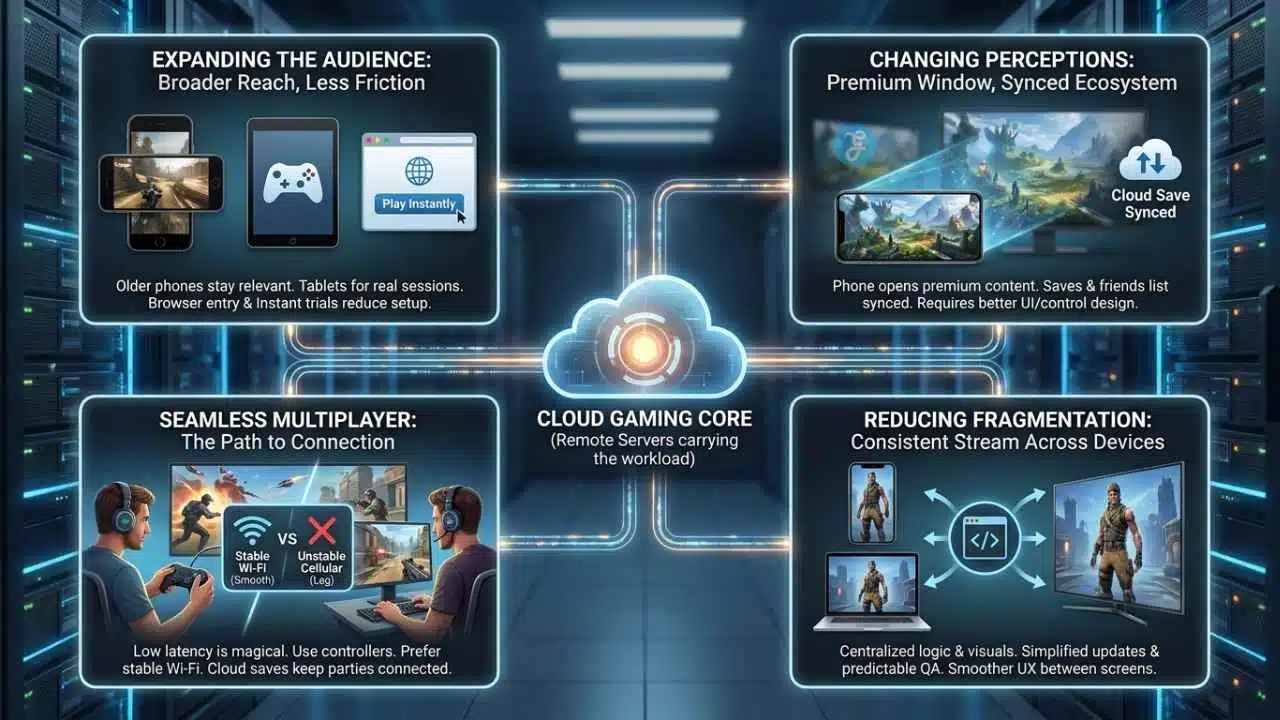
Cloud gaming is not just adding another way to launch a game. It is changing what players expect from mobile gaming in the first place.
Expanding the Gaming Audience
The old mobile divide was simple: high-end phones got the best-looking games, and everybody else made trade-offs. Cloud gaming softens that divide by letting remote servers carry the hardest work.
- Older phones stay relevant longer.
- Tablets become more useful for real gaming sessions.
- Browsers become valid entry points for players who do not want a long setup.
- Instant trials reduce friction for new users who would never commit to a full download.
That broader reach helps player engagement because more people can get to the good part faster. They are spending less time managing installs and more time actually playing.
Changing Perceptions of Mobile Gaming Quality
For years, many players treated mobile gaming as the lighter, smaller cousin of PC and console gaming. Cloud gaming is changing that because the phone becomes a window into the same class of content people expect on larger screens.
When a phone can open a premium game in seconds, keep your save synced, and connect you to the same friends list and multiplayer session, it stops feeling like a side device.
That matters for game developers. Once players see mobile as a real front door to the same ecosystem, design choices around UI scale, controls, progression, and monetization have to get better too.
Enabling Seamless Multiplayer Experiences
Multiplayer is where cloud gaming can feel either magical or miserable. When the pipeline is tight, cross-play feels easy. When latency spikes, every movement feels late.
- Use a controller for fast games. Touch controls can work, but they add friction in shooters, sports titles, and action games.
- Keep background downloads off. A game stream hates competition for bandwidth.
- Prefer stable Wi-Fi over a stronger-looking but unstable cellular signal.
- Treat cloud saves and party tools as part of the core experience. They keep players connected across devices.
This is why multiplayer success in the cloud is not just about server power. It is about the whole path between the player and the session.
Reducing Game Fragmentation Across Devices
Cloud delivery gives studios a cleaner way to serve the same game across phones, tablets, laptops, and TVs. Instead of maintaining wildly different builds, they can centralize more of the game logic and visual output.
That can simplify updates, limit version drift, and cut down on the headache of supporting too many hardware profiles. For mobile game development teams, it also makes QA more predictable because the stream is consistent even if the receiving device is not.
In practice, that means fewer platform-specific excuses and a smoother user experience for players who bounce between screens during the week.
Challenges in Implementing Cloud Gaming for Mobile
Cloud gaming can feel amazing, but it is still less forgiving than regular app-based mobile gaming. If one part of the chain fails, the whole experience feels off right away.
Latency and Connectivity Issues
Latency is still the main enemy. Your input has to travel out, get processed, and come back as video fast enough to feel natural.
That is why connection quality matters more than raw download bragging rights. Xbox notes that streamed games can have limits tied to video resolution, audio outputs, cloud-save-only storage, in-game purchases, and accessory support, which shows how many moving parts still affect the final experience.
- Weak Wi-Fi causes stutter and blurry image recovery.
- Busy home networks create random spikes even when average speed looks fine.
- Mobile data caps can turn long sessions into expensive sessions.
- Bluetooth controller issues can add a second layer of delay that feels like network lag.
A small but useful pro tip is to test a cloud game with the phone in airplane mode plus Wi-Fi enabled. If the session feels cleaner, your device may have been bouncing between wireless radios or background mobile tasks.
Technical Barriers for Developers
For game developers, cloud gaming is not just a switch you flip. It changes how you think about input handling, UI readability, streaming bitrate, session scaling, and customer support.
| Challenge | Why it is hard | What smart teams do |
|---|---|---|
| Touch controls | PC and console games were rarely built for thumbs on glass | Create touch-friendly overlays, larger hit areas, and controller-first fallbacks |
| Session scaling | Traffic spikes can get expensive fast | Use regional capacity planning and short trial sessions before full rollout |
| Visual clarity on phones | Small text and dense HUDs look worse in a stream | Redesign HUD elements for small screens and high-compression conditions |
| Testing | Networks vary by location, time, and device | Run real-world tests across U.S. carriers, Wi-Fi conditions, and controller setups |
AWS and Xsolla are pushing this forward by making browser-based delivery easier, but teams still need solid game design choices on top of the infrastructure. The stream can be excellent, yet the game can still feel clumsy on mobile if the controls and UI were never adapted.
The Future of Cloud Gaming in Mobile Experiences
Cloud gaming on mobile is already useful. The next phase is about making it feel less like a workaround and more like the default way some players access games.
Integration with AR/VR Technology
AR and VR raise the stakes because they are even more sensitive to delay than standard mobile gaming. That means cloud support will likely grow first in lighter use cases such as shared spaces, social lobbies, companion screens, and streamed experiences that do not demand instant head-tracking precision.
Ericsson has said that time-critical cloud gaming experiences can need 20 to 30 milliseconds of end-to-end latency with around 99.9 percent reliability. That is a high bar, and it explains why immersive gaming will improve in steps instead of all at once.
Still, edge computing gives this idea real momentum. As servers move closer to players, more augmented reality and mixed-screen experiences become practical on phones and tablets without asking users to buy premium local hardware.
Enhanced Personalization Through AI
Artificial intelligence will shape cloud gaming in ways players may not even notice at first. It can help platforms adapt bitrate faster, sharpen streams, spot churn risk, recommend better control schemes, and tune sessions around the device and network a player actually has.
- Adaptive stream quality can protect smooth play when bandwidth dips.
- Smarter recommendations can surface games that work well with touch or short sessions.
- AI-assisted support can flag common problems like weak Wi-Fi, unsupported accessories, or overloaded local networks.
- Personalized onboarding can move a new player to controller, browser, or app setup faster.
That is the exciting part for the user experience. AI does not need to be flashy to be valuable. If it helps a session start faster, look cleaner, and fail less often, players will feel the benefit right away.
Final Thoughts
Cloud gaming is changing mobile gaming because it removes the old trade-off between convenience and quality. You can reach aaa titles, better cross-platform compatibility, and a stronger gaming experience without relying on top-tier local hardware.
The real test is still simple: your connection has to be steady, your controls have to fit the game, and the service has to match the devices you already own.
If you are curious, try one service with a controller and a strong 5 GHz Wi-Fi connection first. That is still the easiest way to see how far cloud gaming has pushed mobile experiences, and how much farther it can go.
Frequently Asked Questions (FAQs) About Mobile Cloud Gaming
1. What is cloud gaming on mobile?
Cloud gaming runs games on remote servers, and streams them to phones and tablets, so you play without high-end hardware.
2. How does cloud gaming change performance and graphics on phones?
It moves the heavy work to fast servers, so midrange devices get better graphics. But it needs a strong internet link, like 5G or fiber, and latency can hurt play.
3. Does cloud gaming affect controls and touch play?
Yes, it can add input lag, which makes tight controls feel slippery. Many services map touch to gamepad inputs, or let you pair external controllers. That can fix the feel, but it can add gear, so try options that suit you.
4. Will cloud gaming change game libraries and cross-platform play?
Cloud services bring big game libraries to phones, you get more titles without long installs. Cross-platform play grows, so you can jump from a phone to a big screen, like carrying an arcade in your pocket.





















