
Every May, corporate brands and tech conglomerates flood social media with performative praise for mothers. Yet, when the Monday after Mother’s Day arrives, the actual financial systems remain unchanged. Consider a mother in Dhaka who has managed a household for 40 years without ever billing a single hour. Our economic metrics classify her as “inactive.”
She is the ultimate paradox of the modern market: universally praised, yet financially invisible. It is a stark reminder that the caregiver economy generates more latent value than the entire Big Tech sector, yet continues to face a systemic drought of venture capital attention.
Moving from cultural observation to economic reality requires translating sentiment directly into actionable financial data.
The Trillion-Dollar Blind Spot in Venture Capital
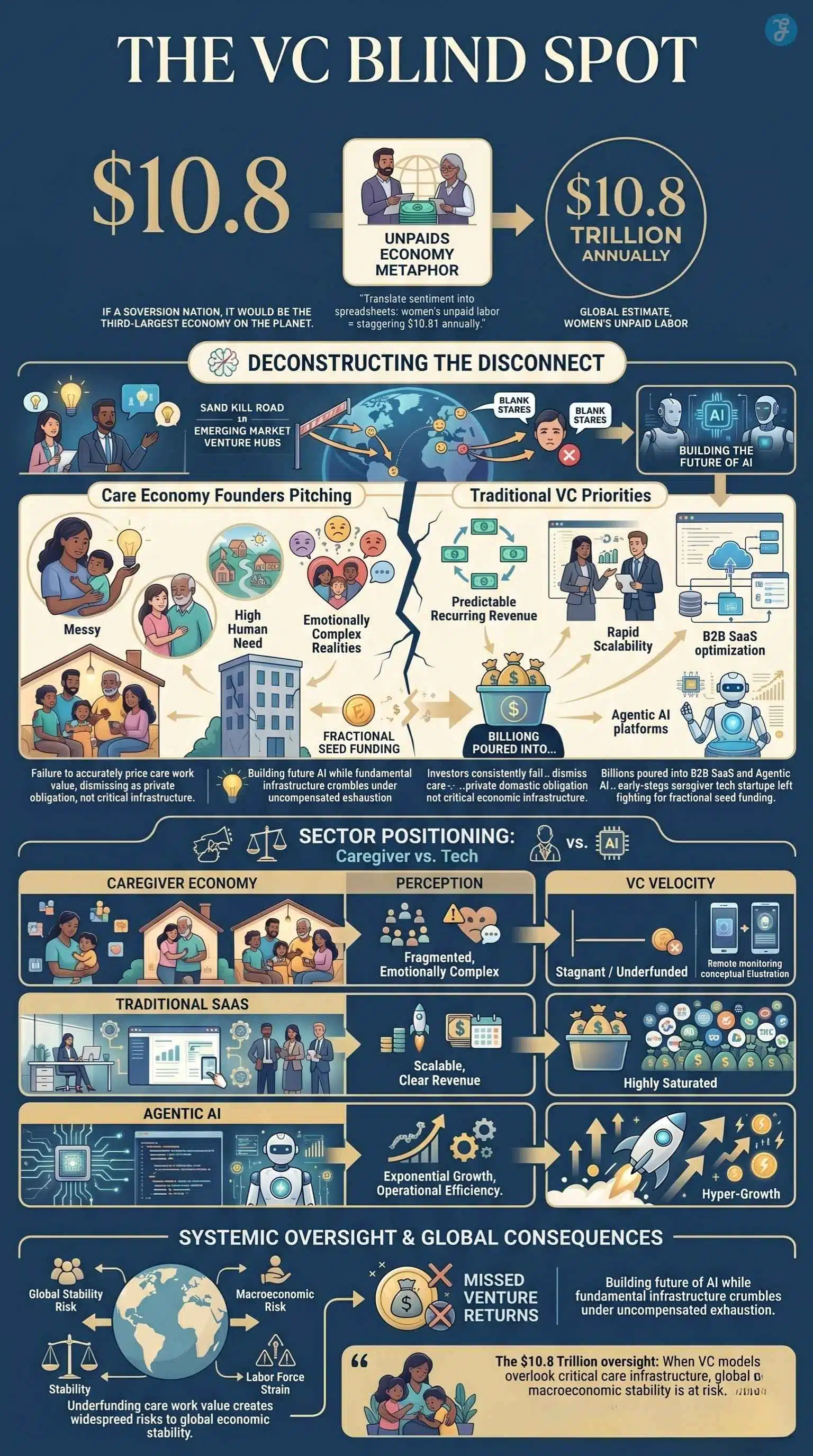
To understand the scale of this oversight, we have to translate sentiment into spreadsheets. The global estimate of women’s unpaid labor currently stands at a staggering $10.8 trillion annually. If this sector were a sovereign nation, it would be the third-largest economy on the planet. Yet, when founders pitch solutions for this space, they are met with blank stares from Sand Hill Road to emerging market venture hubs.
Deconstructing the Valuation Disconnect
Traditional venture capital relies on models built for predictable recurring revenue and rapid scalability, not the messy, hyper-localized, and emotionally complex realities of human dependency. Investors consistently fail to accurately price care work value, dismissing it as a private, domestic obligation rather than critical economic infrastructure.
As a result, while billions are poured into B2B SaaS optimization and agentic AI platforms, early-stage caregiver tech startups are left fighting for fractional seed funding. We are building the future of artificial intelligence while letting the fundamental infrastructure of human life crumble under uncompensated exhaustion.
To illustrate this systemic oversight, we must contrast the care sector directly against the industries currently monopolizing global venture capital.
Here is a breakdown of how the caregiver economy is positioned against traditional venture-backed tech industries.
| Sector Focus | Market Perception | VC Funding Velocity |
| Caregiver Economy | Fragmented, high-liability, emotionally complex | Stagnant / Underfunded |
| Enterprise SaaS | Scalable, predictable recurring revenue | Highly Saturated |
| Agentic AI | Exponential growth, operational efficiency | Hyper-Growth |
While the financial disparity is glaring, the consequences of this underfunding extend far beyond missed venture returns into global macroeconomic stability.
The Geopolitical Time Bomb: 2026 Labor Realities
While the emotional toll of uncompensated care is profound, the macro-level threat to global markets is what truly commands venture capital attention. A localized failure in caregiver support creates a compounding deficit in the formal labor force.
The Shrinking Workforce vs. The Silver Tsunami
The global formal health caregiving market is rapidly expanding, yet it only addresses a fraction of the demographic need. In regions across the Global North and Asia-Pacific, the ratio of working-age individuals to elderly dependents is plummeting.
When formal care infrastructure is underfunded, the burden defaults to the informal sector. This dynamic forces millions of capable workers to scale back their employment or exit the workforce entirely, severely constricting the global labor supply.
The demographic crisis acts as the undeniable catalyst, but resolving it requires founders to overcome the sector’s most notorious friction point: finding a sustainable payer.
Cracking the Revenue Code: Monetizing the Invisible
The immediate pushback from any seasoned investor analyzing the caregiver economy is the customer acquisition cost. If the primary caregiver is unpaid and the recipient is often on a fixed income, direct-to-consumer models inevitably face devastating churn rates.
The Employer-Sponsored and B2B2C Pivot
The most viable revenue model in 2026 shifts the financial burden away from the exhausted family and onto the corporate balance sheet. Unpaid care responsibilities drive massive productivity losses and workforce attrition across global enterprises.
Startups that position themselves as B2B2C platforms, selling care coordination, emergency backup care, and caregiver fintech solutions directly to corporate HR departments as essential employee benefits, tap into predictable, recurring SaaS revenue. By directly reducing corporate churn and operational friction, these platforms easily justify their venture valuations.
Understanding the hierarchy of these revenue models is essential for evaluating the long-term viability of care-focused startups.
Below is an analysis of the primary monetization strategies available to care tech founders.
| Monetization Strategy | Target Payer | Scalability Potential | Market Friction |
| Employer Benefits (B2B2C) | Corporate HR / Enterprise | High (Recurring SaaS) | Low (Driven by retention metrics) |
| Government Integration | State Funds / Insurance | High (Massive TAM) | High (Slow regulatory hurdles) |
| Direct-to-Consumer | Families / Caregivers | Low (High churn rate) | High (Pricing out the unbanked) |
With the revenue mechanics established, the mandate for the tech industry is to build the actual tools required to support this new B2B2C infrastructure.

The Technical Frontier: From Passive UI to Agentic Care
The primary reason traditional technology has failed the care sector is a fundamental misunderstanding of the user interface. Most legacy care applications are passive; they require an already exhausted caregiver to manually input data, manage schedules, and trigger alerts. In 2026, the real opportunity for founders isn’t a better dashboard; it is Agentic AI.
Because care is a high-entropy environment requiring real-time, autonomous decision-making, the technical “moat” for new startups lies in cognitive offloading. We are seeing a transition from “Software as a Service” to “Agent as a Service,” where autonomous systems proactively handle insurance disputes, medical coordination, and supply chain management without human prompting.
Founders must move beyond simple coordination tools and focus on building autonomous agents that act as a “Chief Operating Officer” for the home. By leveraging Large Action Models (LAMs) that can navigate complex government portals and healthcare APIs, startups can provide the first true relief for the Dhaka mother and her global counterparts. This shift from manual tracking to agentic execution is what will finally turn care from a domestic burden into a scalable technology vertical.
Building the Care Work Infrastructure
If venture capital is designed to solve complex, high-friction problems at scale, the caregiver economy presents the ultimate untamed frontier. The founders who will capture this space are engineering the hard infrastructure of human life. The opportunity lies in translating the invisible labor of care into measurable, monetizable data.
Fintech, Agentic AI, and Decentralized Networks
The market is starved for specialized fintech platforms that bridge the gap for unbanked caregivers, offering digital wallets that treat care coordination as a verifiable asset class. Simultaneously, traditional B2B SaaS models must be replaced by agentic AI capable of managing the volatile cognitive load of medical scheduling, insurance negotiation, and inventory management.
Finally, tech founders have a unique opportunity to build decentralized, community-driven care networks that operate as localized utility grids, facilitating care-swapping and fractional respite care to shift the burden away from the isolated individual.
The failure to fund these solutions is not just an oversight; it is a fundamental misunderstanding of what sustains global markets.
The Exit Horizon: Who Acquires the Care Economy?
For the social-impact VC, the question of the caregiver economy isn’t just about market size; it is about the exit. As Big Tech and global retail giants pivot toward “Life Services,” the acquisition landscape for care-focused startups is becoming increasingly concentrated.
The convergence of Big Insurance, Big Retail, and Big Tech is creating a massive appetite for platforms that can control the “Home-as-a-Health-Hub.” Companies like Amazon, Apple, and UnitedHealth are no longer just looking for health data; they are looking for the connective tissue that manages the household’s daily wellness and dependency needs.
This creates a clear path to liquidity. When a startup successfully manages the care infrastructure of a million households, it becomes a primary strategic asset for any entity looking to reduce long-term healthcare costs or dominate the household supply chain.
The exit strategy for the caregiver economy is no longer a distant IPO; it is becoming the essential operational layer for the 2026 wellness economy. For VCs, this represents a unique opportunity where high social impact aligns perfectly with a robust Internal Rate of Return (IRR).
The Final Valuation of Human Infrastructure
Every metric of modern economic health relies on a foundational layer of labor that remains entirely off the books. The mother in Dhaka, methodically managing a household for four decades without a single line of equity, is not an anomaly; she is the unacknowledged underwriter of the global GDP.
Continuing to ignore the massive scale of the caregiver economy is no longer just a social failing; it is a catastrophic misallocation of capital. The venture capitalists and founders who recognize this first will not only capture a multi-trillion-dollar market but will also fundamentally redefine the true value of the labor that sustains human existence. The future of innovation does not lie solely in artificial intelligence; it lies in finally funding the infrastructure of life.
Beyond Outdated Metrics: The Defining Challenge of the Decade
Observing the trajectory of global policy and digital infrastructure, it becomes clear that relying on outdated GDP metrics to gauge economic health is a critical vulnerability. The reluctance of institutional capital to engage with care labor reveals a systemic bias where tangible software products are inherently trusted over human-centric ecosystems.
Moving forward, the true test for international markets will not be the processing power of their artificial intelligence, but their ability to integrate the invisible economy into the formal financial sector. Until care work is formally underwritten, global supply chains and labor markets will remain precariously balanced on the uncompensated exhaustion of millions.
This transition from performative gratitude to structural equity is the defining economic challenge of the decade.