
Do you constantly cancel your own plans just to help someone else? I completely understand how exhausting it is to try to fix everyone’s problems, especially when those problems are not yours to solve. If you always put others first at the expense of your own well-being, you might be stuck in a cycle of emotional dependence. Understanding the codependency recovery stages is the very first step toward finding a way out and changing everything for the better.
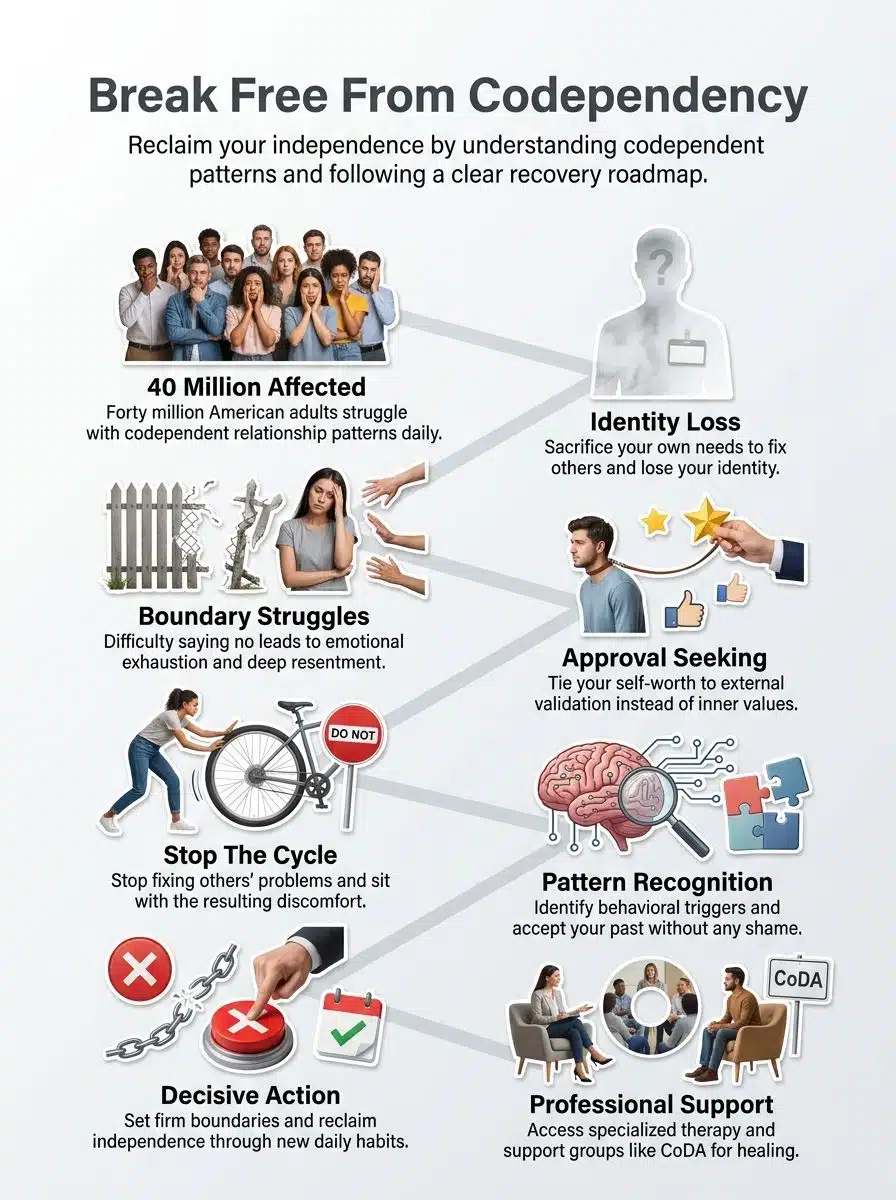
A 2026 report from Mental Health America found that nearly 40 million adults in the United States struggle with codependency. Instead of feeling overwhelmed by that number, look at it as proof that you are far from alone.
Many of us grew up in environments where we learned to ignore our own needs just to keep the peace. You may have carried that survival pattern into adulthood, but you have the power to change it today. Let’s walk through what codependency really means, how to spot the signs, and the exact stages you can take to break free.
Understanding the Roots: What is Codependency?
Codependency shows up when you entirely lose yourself in another person’s problems. You sacrifice your own happiness, health, and goals to fix them, creating an unhealthy dynamic.
Definition and Key Characteristics
Author Melody Beattie beautifully defined this dynamic in her famous book, Codependent No More. She described a codependent person as someone who lets another person’s behavior affect them completely. As a result, you become obsessed with controlling that other person’s behavior just to feel safe and secure.
It feels like a one-way street where you give everything but get little back. You struggle to say no, and your self-esteem depends entirely on outside approval. This creates a relationship addiction that drains your energy and prevents real personal growth.
Common Causes and Contributing Factors
Trauma and childhood experiences deeply shape how we form attachments. If you grew up around addiction, emotional neglect, or family dysfunction, you might have learned that love equals sacrifice. Data from The Recovery Village in 2026 shows that about one in four US adults grew up in a household with substance abuse.
This chaotic environment forces a child to manage everyone’s moods just to maintain peace. That childhood survival strategy becomes a prison in adulthood, fueling low self-esteem and deep insecurity. Remember: codependency is not true love; it is a fear-based attachment to another person’s emotional state.
Spotting the Red Flags: Signs of Codependency
It can be incredibly difficult to recognize your own toxic patterns when you are living in them. If your happiness often depends on getting approval from those around you, you might be exhibiting core codependent traits.
Difficulty Setting Boundaries
People with codependent behavior fear that setting limits will push loved ones away, so you keep giving until your tank is entirely empty. Therapist Nedra Glover Tawwab explains in her bestseller, Set Boundaries, Find Peace, that boundaries act like healthy fences around your personal space. Without those fences, other people’s problems become your direct responsibility. You might start covering up their mistakes or taking the blame for conflicts.
Here are a few clear signs that your boundaries need an urgent tune-up:
- You apologize constantly for things that are not your fault.
- You feel deep, lingering resentment after helping a friend.
- You change your core values or hobbies to match your partner.
- You answer work emails during your personal family time.
Excessive Need for Approval
Your desperate hunger for approval connects directly to weak boundaries. You constantly seek validation and wonder if you said the “right” thing. The American Psychological Association notes that highly lonely people often seek this validation out of a deep fear of abandonment.
You learned early on that your worth depended on making others happy, leading you to say yes to things you hate just to avoid disappointing someone. Breaking this cycle requires knowing that your genuine value comes from within.
Prioritizing Others Over Oneself
You put your partner’s feelings and goals miles ahead of your own personal growth. You fear abandonment so much that you reshape your entire life to keep others happy, often ignoring your own pain to soothe someone else’s discomfort. Over time, you lose touch with your own identity and literally forget what makes you happy. You cannot pour from an empty cup; you must prioritize your own emotional health before you can truly help anyone else.
The Toll on Life: Impact of Codependency on Relationships
Codependency creates a highly unhealthy imbalance where one person sacrifices everything. This pattern not only drains your emotional energy but leaves you feeling completely trapped in your own life.
Emotional Dependence and Imbalance
Emotional dependence creates a distinctly lopsided dynamic. You need constant reassurance, and your partner feels suffocated by the heavy pressure to “fix” your anxiety. This destroys your ability to feel okay without outside validation.
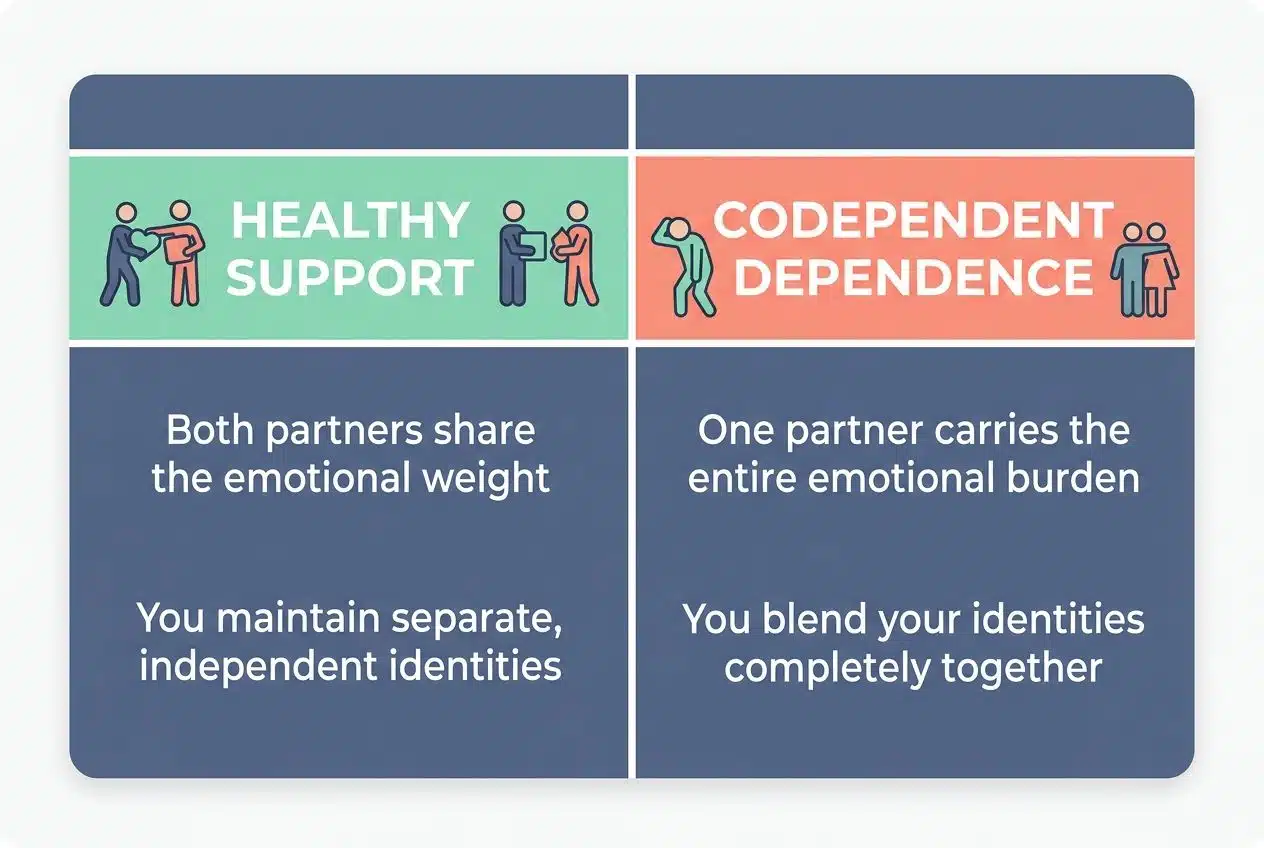
To clearly understand the difference, look at how an imbalanced dynamic compares to a healthy connection:
| Healthy Support | Codependent Dependence |
| Both partners share the emotional weight. | One partner carries the entire emotional burden. |
| You maintain separate, independent identities. | You blend your identities completely together. |
| You give help freely without any resentment. | You give help specifically to gain control or approval. |
Strain on Personal Well-Being
Sacrificing your needs constantly leaves you completely exhausted. The 2026 Stress in America report from the APA calls this exact dynamic a “Crisis of Connection,” finding that 94% of highly lonely adults experience physical stress symptoms. This includes daily headaches, stomach problems, and serious muscle tension. Your personal growth stops dead in its tracks because you abandon your goals to focus entirely on another person.
The Core Journey: The Four Codependency Recovery Stages
Recovery follows four distinct phases. Navigating these codependency recovery stages moves you from painful, old patterns into a stronger, independent life.
Stage 1: Abstinence
Stage 1 asks you to stop feeding the toxic cycle immediately. You pull back from constantly seeking approval or sacrificing your basic needs. Many support communities recommend a “Low Contact” rule for this phase, where you intentionally limit conversations that trigger your urge to fix things. This stage feels incredibly hard because your brain fights back, but you must sit with the discomfort. Practice this by waiting at least 24 hours before agreeing to a new favor.
Stage 2: Awareness
In this stage, you start seeing the patterns very clearly. You catch yourself people-pleasing and bending your boundaries like rubber. This stage brings cognitive dissonance, where your new knowledge clashes with your old habits. Many people use a Cognitive Behavioral Therapy (CBT) thought record during this stage to track what specifically triggers their need for immediate approval. Facing these hard truths temporarily hurts, but it is completely necessary for real growth.
Stage 3: Acceptance
Acceptance means you stop fighting what you see in your relationships and face the honest truth without any shame. You accept that your past sacrifices came from childhood survival instincts, not character flaws. This major shift in perspective opens the door to genuine healing. You stop expecting yourself to change overnight and start treating yourself with the exact same compassion you freely give to others.
Stage 4: Action
Stage 4 is where you stop talking and start doing. You build new habits, actively protect your emotional health, and practice true independence by making decisions based on what you actually want. Therapists highly recommend setting SMART goals (Specific, Measurable, Achievable, Realistic, Time-bound) for your boundaries here to ensure lasting success. Breaking free requires massive courage, and this action stage proves you have exactly what it takes.
Taking Control: Steps to Break Free from Codependency
You can break free by taking concrete actions today. Alongside the recovery stages, applying daily habits will keep you grounded.
Awareness and Acknowledgment
Awareness starts with honest self-reflection. Therapist Susan Forward coined the excellent acronym “FOG” to describe how codependents feel: Fear, Obligation, and Guilt. You might be in the FOG if you fear a bad reaction when saying no, feel obligated to solve other people’s crises, or experience intense guilt for taking time off. Acknowledgment means accepting the truth right now and facing the problem head-on.
Building Self-Worth and Self-Love
You cannot break free from unhealthy attachments if you strongly dislike yourself. Dr. Kristin Neff, a pioneer in self-compassion research, suggests talking to yourself like you would a good friend. Notice when you criticize yourself and swap those harsh thoughts out for kindness. Start small by doing things that make you feel genuinely good, because your independence depends entirely on a solid foundation of self-respect.
Learning to Set Healthy Boundaries
Boundaries stop you from giving too much of your energy away. Dialectical Behavior Therapy (DBT) uses a great tool called “DEAR MAN” for boundary setting, which teaches you to Describe the facts, Express your feelings, and Assert your needs clearly. Write down the specific things that drain your energy today and share those clear limits with the people in your life. It might upset someone at first, but stay firm.
Finding Guidance: Seeking Professional Help for Codependency
A great therapist helps you untangle the old patterns keeping you stuck, while support groups connect you with people who truly understand the difficult journey.
Therapy Options Tailored to Codependency
Therapy gives you real tools to break free from toxic cycles. Finding the right style of treatment makes a massive difference in your recovery. In 2026, online platforms will offer affordable options around $60 to $100 per session.
Here is a quick look at two highly effective therapies for treating codependency:
| Therapy Type | Best Used For |
| Cognitive Behavioral Therapy (CBT) | Spots negative thought patterns and swaps them for healthier beliefs. Great for stopping enabling habits. |
| Dialectical Behavior Therapy (DBT) | Teaches emotional regulation and uses mindfulness tools. Perfect for managing intense boundary guilt. |
Support Groups and Community Resources
You do not have to walk this difficult path entirely alone. Support groups bring people together who share the exact same daily struggles. Groups like Codependents Anonymous (CoDA) and Al-Anon meet regularly across the US, offering a safe, completely judgment-free space to talk about your experiences. Reaching out to these local resources shows immense strength.
Real Inspiration: Personal Stories of Recovery We Collected
Real people break free from codependency every single day. Their stories prove that meaningful, lasting change is entirely possible.

Sarah’s Story: Finding Her Independence
Sarah, a high school teacher from Ohio, spent years putting everyone else’s needs before her own. She felt trapped and disconnected from her authentic identity until her therapist introduced her to the “grey rock” method. She learned to become emotionally unresponsive to manipulative requests. She gave short, neutral answers to unreasonable family demands and reclaimed her weekend mornings for her own quiet hobbies. Today, Sarah maintains meaningful relationships entirely on her own terms.
James’ Story: Rebuilding Healthy Relationships
James, a software developer from Texas, constantly sacrificed his own needs to keep his partner happy, completely losing his independence in the process. He made the tough choice to seek therapy and joined a local CoDA group. James used somatic experiencing therapy to calm his nervous system when he felt the strong urge to fix things. His journey from dependence to independence deeply inspires others facing similar struggles.
The Final Step: Reclaiming Your Independence
Breaking free from codependency takes immense courage and a real commitment to your own healing process. Your beautiful journey toward independence starts with choosing yourself. You hold the power to reshape your relationship dynamics, assert your boundaries, and prioritize your emotional health. Support systems and therapy can absolutely light your path forward on the darkest days.
Life after these unhealthy patterns looks delightfully different, and by mastering the codependency recovery stages, you can build something real that truly honors both yourself and the people you love.
Frequently Asked Questions (FAQs) on Codependency Recovery Stages
1. What does codependency really mean?
Codependency means you rely too much on someone else for your happiness and sense of self, often putting their needs before yours, even when it actively hurts you. You might feel like a shadow, always following their lead instead of living your own independent life.
2. How can I tell if I’m in a codependent relationship?
If you feel completely lost without your partner, ignore your own feelings to keep the peace, or constantly worry about upsetting them, those are clear signs. You might also notice friends pointing out that you give way more than you receive in your relationships.
3. Why do people become codependent?
Codependency often develops in childhood when you learn to manage a parent’s emotions or cope with unstable family situations. Research shows that growing up with addiction, mental illness, or emotional neglect in the home significantly increases the likelihood of developing these protective survival habits.
4. How long do the codependency recovery stages take?
There is no set timeline for recovery. Moving through the stages of abstinence, awareness, acceptance, and action can take months or years, depending on the depth of your childhood trauma and your commitment to therapy and boundary-setting.
5. Can a codependent relationship be saved?
Yes, a codependent relationship can be saved, but it requires both partners to acknowledge the toxic dynamic. The codependent partner must learn to set strict boundaries, and the other partner must be willing to accept those boundaries without manipulation or guilt-tripping.
6. How can I start breaking free from codependency today?
Start by noticing when your body feels tense or resentful before agreeing to a favor. Pause and wait 24 hours before saying yes. Additionally, reach out to Codependents Anonymous (CoDA), a free support group with meetings across the US, to surround yourself with people who understand your journey.