


If you want to grow your wealth outside the usual US and UK markets, looking north is a smart move. The Nordic region includes Sweden, Denmark, Norway, and Finland. These countries host some of the most stable, innovative, and shareholder-friendly companies on the planet. From weight-loss drug makers in Denmark to green energy giants in Norway, the opportunities are massive.
But you cannot just blindly buy international shares. Investing in Nordic stock exchanges requires a specific game plan. You have to deal with different currencies, unique tax rules, and highly concentrated industries. This guide walks you through exactly how to approach these markets practically, keeping your fees low and your returns optimized. We will dive deep into the mechanics of these markets so you can build a resilient portfolio that withstands global economic shocks.
1. Understand the Platforms When Investing in Nordic Stock Exchanges
Investing in Nordic stock exchanges means you first need to wrap your head around the actual trading floors where these transactions happen. Unlike the United States where you just punch in a ticker and the broker handles the rest across a unified national market system, the Nordic region relies on a slightly fragmented but highly efficient network of exchanges. Nasdaq Nordic is the undisputed heavy hitter here, acting as a massive umbrella organization that seamlessly connects the trading floors of Stockholm, Copenhagen, and Helsinki. This consolidation is a massive win for retail investors because a single brokerage connection to Nasdaq Nordic usually grants you instant access to three different countries under the same basic trading rules and operating hours. You get a streamlined experience when tracking your orders and managing your portfolio across these three borders.
However, you cannot assume that Nasdaq covers everything in the region, because Norway plays by its own rules entirely. The Oslo Børs is owned by Euronext, completely separate from the Nasdaq system, which means it runs on different backend technology and clearing protocols. If you want to buy into the massive Norwegian energy or seafood markets, you have to explicitly verify that your broker routes orders directly to Euronext Oslo. Without this direct connection, you might find yourself locked out of the Norwegian market entirely, or worse, forced to buy expensive over-the-counter proxy shares that suffer from terrible liquidity. Knowing exactly which exchange lists your desired company is the absolute foundation of your international investing strategy.
| Exchange Name | Countries Covered | Parent Company | Key Characteristic | Trading Currency |
| Nasdaq Stockholm | Sweden | Nasdaq Inc. | Tech and industrial heavy | SEK |
| Nasdaq Copenhagen | Denmark | Nasdaq Inc. | Pharma and shipping focus | DKK |
| Nasdaq Helsinki | Finland | Nasdaq Inc. | Forestry and machinery focus | EUR |
| Oslo Børs | Norway | Euronext | Dominated by energy and seafood | NOK |
2. Analyze Sector Strengths Across Countries
Exploiting National Industry Specializations
Treating the Nordic region as a single economic blob is a huge mistake that will ruin your diversification strategy. Each country has a completely different economic engine that drives its local stock index. Denmark punches way above its weight in global healthcare, meaning the Copenhagen stock exchange is heavily skewed toward life sciences and pharmaceuticals. A massive portion of the local market index is tied to the performance of companies producing diabetes care, weight-loss drugs, and medical equipment. When you buy Danish stocks, you are largely betting on global healthcare trends and drug approvals, making it a brilliant defensive play during global recessions since people always need medicine regardless of the economic climate.
Norway presents a total contrast, as its economy is built almost entirely on commodities. The Oslo Børs moves up and down based on the global price of crude oil and natural gas, with state-backed energy giants and offshore drilling contractors dominating the listings. Norway is also the undisputed global king of farmed salmon, meaning investing here gives you heavy exposure to global energy demands and food supply chains. Sweden and Finland offer the most balanced traditional markets, with a deep history of engineering and manufacturing. Sweden is packed with companies making mining equipment and trucks, while Finland shares this heavy industrial base with a strong focus on forestry, paper, and elevators. You have to pick and choose the best industries from each country to build a proper portfolio.
| Country | Primary Economic Driver | Defensive or Cyclical | Major Global Exports | Market Volatility |
| Denmark | Pharmaceuticals and Healthcare | Highly Defensive | Insulin, weight-loss drugs, shipping | Low to Medium |
| Norway | Energy and Aquaculture | Highly Cyclical | Crude oil, natural gas, farmed salmon | High |
| Sweden | Heavy Industrials and Technology | Balanced Growth | Telecommunications, vehicles, software | Medium |
| Finland | Basic Materials and Machinery | Cyclical | Paper products, elevators, heavy machinery | Medium |
Managing Forex Risk Across Four Currencies
When you buy stocks overseas, the actual stock price is only half the equation, because the other half is the currency exchange rate. The Nordics use four different currencies, meaning if the local currency drops in value against your home currency, your investment loses value even if the stock price goes up on the local exchange. You have to monitor exchange rates just as closely as earnings reports. Norway and Sweden use floating currencies, and the Norwegian Krone is heavily tied to energy markets. When oil prices spike, the Krone usually gets stronger, whereas the Swedish Krona relies heavily on global trade and the policies of the Swedish central bank, making both currencies prone to wild swings during global crises.
Denmark operates under a totally different monetary system because the Danish Krone is officially pegged to the Euro. The Danish central bank actively intervenes in the currency markets to keep the value of the Krone within a very strict, narrow band relative to the Euro. If you live in the Eurozone, investing in Denmark carries basically zero currency risk, and Finland simply uses the Euro natively. To protect yourself from getting destroyed by currency swings in Sweden and Norway, you should consider using a multi-currency brokerage account so you can convert cash when rates are favorable instead of paying forced conversion fees on every single trade. Ignoring the mechanics of foreign exchange will quietly wipe out your dividend yields over time.
| Currency Name | Ticker Symbol | Monetary Policy Mechanism | Primary Value Driver | Risk Level for Foreigners |
| Swedish Krona | SEK | Free floating currency | Global trade and central bank rates | High volatility risk |
| Norwegian Krone | NOK | Free floating currency | Global crude oil and energy prices | High volatility risk |
| Danish Krone | DKK | Pegged to the Euro | European Central Bank policy alignment | Low risk for Euro users |
| Euro | EUR | Shared currency system | Broad European economic health | Zero risk for Euro users |
4. Master the Tax Implications for Foreign Investors
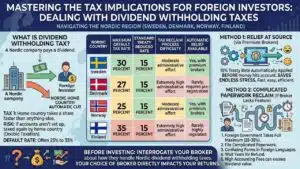
Dealing with Dividend Withholding Taxes
Taxes eat into your returns faster than anything else, and when a foreign company pays you a dividend, their home country automatically wants a cut of that cash. This is called a dividend withholding tax, and if you do not set up your accounts correctly, you could be taxed by the Nordic country and then taxed again by your home country. Most Nordic countries apply a steep default withholding tax on dividends, often hovering between twenty-five and thirty-five percent right out of the gate. However, most western nations have bilateral tax treaties with the Nordics that legally reduce this punitive rate down to a much more manageable fifteen percent.
The real headache is figuring out how that treaty reduction is actually applied to your brokerage account. Some high-quality international brokers use a system called Relief at Source, which automatically applies the fifteen percent treaty rate before the money even hits your account, saving you endless stress. If your broker is cheap or lacks this specific feature, the foreign government will take the full maximum percent, forcing you to file complicated paperwork directly with the Swedish or Danish tax authorities to get your money back. This reclaim process can take years, requires filing confusing forms in foreign languages, and often costs more in accounting fees than the dividend is actually worth. Always interrogate your brokerage about how they handle Nordic dividend withholding taxes before you start deploying your capital.
| Nordic Country | Maximum Default Tax Rate | Standard Treaty Reduced Rate | Tax Reclaim Process Difficulty | Automatic Relief Available |
| Sweden | 30 Percent | 15 Percent | Moderate administrative effort | Yes, with premium brokers |
| Denmark | 27 Percent | 15 Percent | Extremely high administrative effort | Rarely, requires pre-registration |
| Norway | 25 Percent | 15 Percent | Moderate administrative effort | Yes, with premium brokers |
| Finland | 35 Percent | 15 Percent | Extremely high administrative effort | Rarely, highly regulated |
5. Prioritize ESG and Sustainable Investing
Understanding the Green Premium in the Nordics
Environmental, Social, and Governance standards are not just trendy marketing buzzwords in the Nordic region, they are the absolute foundational rules of the game. If you ignore how a company treats the environment or its workers, you will physically lose money in these markets. Nordic mutual funds, massive pension systems, and government sovereign wealth funds will ruthlessly dump stocks that fail to meet strict green criteria, causing share prices to plummet overnight. You must look at a company’s carbon footprint and labor relations right alongside its balance sheet and income statement if you want to value it properly.
Nordic investors care deeply about long-term sustainability, and the region is currently home to companies pioneering green steel production, massive offshore wind farm operations, and zero-emission shipping logistics. If a Nordic company gets caught polluting a river or exploiting factory workers in their Asian supply chain, the local market punishes them instantly and without mercy. The stock price will crash as major funds pull their capital, and the company will face much higher interest rates from local banks. Conversely, companies that lead the charge in the green transition are rewarded with a green premium, trading at higher valuations and getting cheaper access to capital to fund their expansion.
| ESG Pillar | Core Nordic Market Expectation | Consequence of Corporate Failure | Real World Impact on Stock |
| Environmental | Clear timeline for net-zero emissions | Exclusion from state pension funds | Immediate drop in share valuation |
| Social | Strong union cooperation and flat hierarchy | Widespread labor strikes and boycotts | Severe disruption to quarterly earnings |
| Governance | Absolute transparency and gender diversity | Loss of institutional investor support | Increased cost of borrowing money |
6. Explore Nordic Dividend Stocks
Capturing High Yields in the Spring Season
If you love getting paid cold hard cash while you hold a stock, you are definitely looking in the right geographic neighborhood. Nordic companies have a deep-rooted, cultural tradition of paying out massive chunks of their profits as dividends to shareholders. Instead of hoarding billions in cash or doing endless share buyback programs like American tech companies, they prefer to distribute those profits directly to their investors every single spring. This makes the region an absolute goldmine for income-focused investors who want to build a portfolio that generates real cash flow year after year.
The typical dividend season runs primarily from March through May, right after these companies hold their annual general meetings and get shareholder approval for the payouts. Swedish retail banks and Nordic telecommunication companies are famous worldwide for maintaining high, incredibly stable yields that outpace standard savings accounts. Norwegian energy companies also pay massive dividends, though you have to remember they can fluctuate wildly based on the current price of a barrel of oil. You still need to be careful and avoid yield traps, which are stocks offering a massive yield only because their underlying share price has completely collapsed due to terrible management or failing products.
| Industry Sector | Historical Average Yield Range | Payout Frequency Structure | Sustainability of the Dividend |
| Swedish Retail Banking | 5 Percent to 8 Percent | Once annually in the spring | Highly stable during normal economies |
| Norwegian Offshore Energy | 6 Percent to 10 Percent | Often quarterly or semi-annually | Highly variable based on oil prices |
| Finnish Heavy Industrials | 4 Percent to 6 Percent | Once annually in the spring | Stable but dips during recessions |
| Danish Pharmaceuticals | 1 Percent to 3 Percent | Once annually in the spring | Extremely stable, focused on growth |
7. Leverage Sector Diversification
Building an All-Weather Geographic Portfolio
Because each specific country relies so heavily on a single massive industry, holding stocks in just one Nordic country is incredibly risky. If you only own Danish stocks and the United States passes strict new drug pricing laws, your entire portfolio will tank overnight. The true secret to long-term success when investing in Nordic stock exchanges is blending the countries together to create a bulletproof portfolio. You use the strengths of one nation to balance out the weaknesses of another, ensuring you never suffer a catastrophic loss when a single industry experiences a downturn.
Think of it exactly like building a sports team where you need different players for different roles. Norway is your aggressive offensive line, as its oil and shipping stocks will score huge returns when the global economy is booming and demand is high. But when a massive recession hits and factories shut down, Norway gets benched, and that is exactly when you need Denmark. Danish pharmaceutical companies act as your heavy defense, because people will always buy their life-saving medicine no matter what the global economy is doing. You fill out the middle of your portfolio with Swedish and Finnish manufacturing companies to capture steady, diversified growth tied to global infrastructure spending.
| Portfolio Component | Geographic Source | Market Role in Your Portfolio | Protection Mechanism |
| Aggressive Growth | Norway | Captures cyclical economic booms | Benefits from high commodity pricing |
| Defensive Stability | Denmark | Protects against global recessions | Constant demand for healthcare goods |
| Infrastructure Play | Sweden | Captures global industrial spending | Diversified across tech and machinery |
| Basic Materials | Finland | Hedges against inflation | Tangible assets like timber and paper |
8. Monitor Regional Macroeconomic Indicators
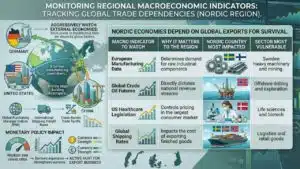
Tracking Global Trade Dependencies
Nordic countries generally have very small domestic populations, meaning they simply do not consume enough internally to support the massive multi-billion dollar companies listed on their exchanges. Therefore, these economies are entirely dependent on exporting their goods to the rest of the world to survive. You cannot just look at what is happening locally in Stockholm or Oslo to figure out stock prices. You have to aggressively watch what is happening with factory orders in Germany, consumer spending in the United States, and real estate development in China to accurately predict how Nordic stocks will perform in the coming quarters.
If the German manufacturing sector slows down, they immediately stop buying truck parts and raw steel from Swedish suppliers, which tanks Swedish stock prices. If China stops building skyscrapers due to a credit crunch, they stop buying high-end elevators and heavy forestry equipment from Finland. You need to keep a close eye on global purchasing manager indices, international shipping freight rates, and cross-border trade tariffs. Also, pay attention to the local central banks like the Swedish Riksbank, because when they raise interest rates to fight inflation, it makes borrowing more expensive for local companies and usually strengthens their currency, which actively hurts their massive export businesses.
| Macro Indicator to Watch | Why It Matters to the Region | Nordic Country Most Impacted | Sector Most Vulnerable |
| European Manufacturing Data | Determines demand for raw industrial components | Sweden and Finland | Heavy machinery and mining |
| Global Crude Oil Futures | Directly dictates national revenue streams | Norway | Offshore drilling and exploration |
| US Healthcare Legislation | Controls pricing in the largest consumer market | Denmark | Life sciences and biotech |
| Global Shipping Rates | Impacts the cost of exporting finished goods | All Nordic Countries | Logistics and retail goods |
9. Choose the Right Brokerage and Account Type
Selecting Software for Direct Market Access
You can spend hundreds of hours doing perfect fundamental research, but if your brokerage platform is terrible, you will absolutely fail at international investing. Many standard retail brokers based in the United States or the United Kingdom make buying direct European shares incredibly difficult, opaque, and wildly expensive. Choosing a modern broker that specializes in cheap international access is the most critical logistical step for investing in Nordic stock exchanges. You need a platform that grants you direct market access to the actual local order books, rather than filtering you through shady third-party clearing houses that skim money off the top of your trades.
Do not settle for buying American Depositary Receipts just because they are easy to click on. ADRs are substitute shares that trade on US exchanges in dollars, but they charge hidden ongoing administrative fees, suffer from terrible trading volume, and only cover a tiny handful of massive Nordic companies, locking you out of smaller growth stocks entirely. Look for robust platforms that let you hold actual cash balances in Swedish Krona or Danish Krone. This is a vital feature because it means when a Swedish company pays you a dividend in Krona, the cash stays in Krona, allowing you to reinvest it immediately without your broker forcing a currency conversion and stealing a massive fee on the spread.
| Broker Feature Requirement | Why It Is Absolutely Essential | The Trap to Avoid | Result of Using Bad Brokers |
| Direct Market Access | Ensures you get the actual real-time local price | Avoid over-the-counter proxy trading desks | Overpaying due to massive spread markups |
| Multi-Currency Wallets | Allows holding local fiat without forced conversions | Avoid brokers charging one percent FX fees | Losing your entire dividend yield to fees |
| Automated Tax Treaty Support | Guarantees you pay the lowest legal withholding tax | Avoid brokers that ignore international treaties | Double taxation on all your investment income |
10. Adopt a Long-Term Investment Mindset
Surviving Volatility Through Patient Compounding
The Nordic markets are absolutely not the place for getting rich quick or gambling on overnight penny stock explosions. They do not have the wild, meme-stock volatility or aggressive short-squeeze culture you sometimes see dominating the American financial news cycle. These are incredibly mature, heavily regulated markets full of sensible companies that plan their business strategies out over decades, not just looking at the next three months. If you try to aggressively day-trade Swedish industrials or Norwegian oil drillers, the daily currency fluctuations and cross-border trading fees will slowly but surely bleed your account completely dry.
You have to be patient and train your brain to ignore short-term noise. You will experience frustrating months where a stock goes up in its local currency, but your actual account balance drops simply because your home currency got stronger that week. The real financial power of the Nordic market is slow, relentless compounding. Buy shares of companies that dominate their specific global niches, let them pay you their generous spring dividends, and religiously reinvest those dividends back into more shares. Over a timeline of five or ten years, the short-term currency swings will completely even out, leaving you with a massive ownership stake in some of the most resilient and well-governed businesses on earth.
| Mindset Shift Required | The Amateur Retail Approach | The Professional Institutional Approach | Long-Term Financial Outcome |
| Time Horizon Expectations | Checking prices daily or weekly | Planning holding periods of five to ten years | Capturing full business cycle growth |
| Reaction to Currency Dips | Panic selling out of fear of loss | Buying more shares at a currency discount | Lowering average cost basis over time |
| Dividend Cash Flow Strategy | Spending the cash on consumer goods | Automatically reinvesting to buy more equity | Exponential compounding of total wealth |
Final Thoughts
Expanding your portfolio beyond your home country is essential for protecting your wealth, and the Nordic region offers a distinct blend of safety, high dividend yields, and global industrial leadership. By understanding the technological quirks of the local exchanges, respecting their absolute commitment to sustainability, and managing the frustrating tax rules properly, you can unlock massive value that most retail investors ignore.
Whether you are buying Danish pharmaceutical giants to protect against recessions or Norwegian oil rigs to capture economic booms, successful investing in Nordic stock exchanges comes down to patience, sector diversification, and using the right brokerage software. Keep your fees as low as possible, reinvest those massive spring dividends without fail, and let these world-class companies compound your wealth over the next decade.
Frequently Asked Questions (FAQs) About Investing in Nordic Stock Exchanges
1. What is the VPC system in Sweden?
VPC stands for Värdepapperscentralen. It is the Swedish central securities depository. Unlike some markets where shares are held entirely in street name by brokers, the VPC system allows for high transparency regarding who actually owns shares in Swedish companies. Your broker handles the interface, but the VPC ensures clear registration and accurate dividend payouts.
2. Can I buy Nordic stocks through an IRA or ISA tax-advantaged account?
Yes, but with restrictions. Many US IRAs and UK ISAs allow you to hold international stocks, but they do not automatically protect you from foreign withholding taxes. While an IRA shields you from US taxes, Sweden or Denmark will still take their cut before the dividend arrives. Furthermore, you usually cannot claim a foreign tax credit inside a tax-advantaged account, meaning that withheld money is gone forever.
3. Do Nordic companies report their quarterly earnings in English?
Yes. Virtually all mid-cap and large-cap companies listed on Nasdaq Nordic and the Oslo Børs publish their annual reports, quarterly earnings, and investor presentations in English. The investor relations culture is highly professional, and they actively cater to international capital, so language is rarely a barrier to doing fundamental research.
Sweden has a long history of dual-class share structures. Usually, A-shares carry significantly more voting power (sometimes 10 times more) than B-shares, allowing founding families to maintain control of the company without owning the majority of the total equity. For retail investors, you should almost always buy the B-shares, as they are vastly more liquid and easier to trade, while paying the exact same dividend.





















