
Have you ever noticed your team dragging their feet on a Monday morning? It happens to the best of us. When productivity drops and mistakes pile up, your best workers might start looking elsewhere. You watch your company’s performance slip, wondering what went wrong. The simple truth is that unhappy people do not do their best work. When your team struggles, your business feels it too.
Here is a striking fact: companies with highly engaged teams see 21% greater profitability. That number matters. It shows a direct link between how your workers feel and your bottom line. The ROI of employee well-being is no longer a soft concept. It is a hard financial reality. I am going to walk you through exactly how prioritizing your people drives better results. You will learn what wellbeing means today, how it boosts output, and why smart leaders track its impact.
We will look at real examples from organizations that invested in their staff and watched their profits grow. So, grab a cup of coffee, and let’s go through it together. I will show you everything you need to know to build a program that works, even on a tight budget. By the end, you will see why taking care of your people is essential for your company’s future.
The Importance of Employee Wellbeing
In my years helping companies build HR strategies, I have found that prioritizing your people transforms corporate culture into something genuinely special. Well-being is the foundation of success.
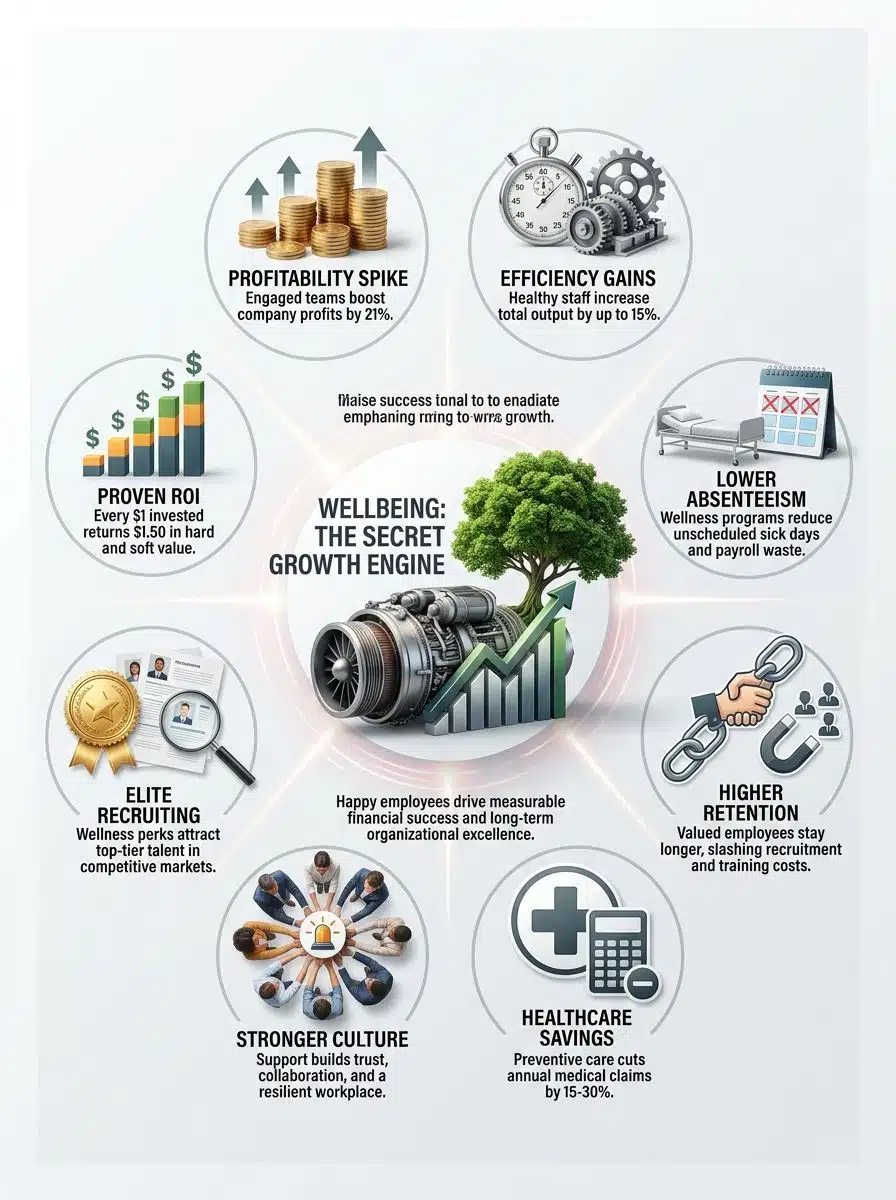
Definition and key components of employee wellbeing
Employee well-being covers physical health, mental wellness, and work-life balance all in one package. It is no longer just about gym memberships. According to the 2026 Wellhub State of Work-Life Wellness report, 86% of employees now consider their well-being just as important as their salary. To meet this massive shift in expectations, companies must provide comprehensive support:
- Physical Health: This includes preventive care, fitness incentives, and nutrition support.
- Mental Wellness: You need to offer stress management resources, counseling services, and mindfulness training.
- Financial Stability: Programs that help staff manage money stress make a huge difference in their daily focus.
When you combine these components, organizational performance rises. Workplace wellness initiatives reduce sick days and boost staff retention across the board. Mental health support prevents burnout. Physical well-being programs create a more energetic workforce. When management listens, engagement skyrockets. Companies that invest in comprehensive strategies see their turnover drop in ways competitors simply cannot match.
Why companies prioritize employee well-being
Companies invest heavily in workplace wellbeing because healthy workers simply produce better results. Staff who feel good show up ready to work hard. They miss fewer days, stay focused longer, and complete tasks faster. Profitability grows when workers feel valued and cared for.
There is often a disconnect between what leaders think and what employees feel. A 2025 Prudential Benefits & Beyond study found that 86% of employers believe their benefits are modern, but only 59% of employees agree. Smart leaders prioritize these programs to close that gap. Top performers want jobs where they can thrive.
Organizations that support work-life balance attract better candidates and keep them longer. The link between worker engagement and business profitability is crystal clear.
The greatest wealth of a company is its people, and their wellbeing is the foundation of success.
The Impact of Wellbeing on Company Performance
When workers feel good, they work better. Healthy employees drive real economic value for your bottom line.

Improved productivity and efficiency
Healthy employees work faster and smarter. They stay focused and complete tasks with greater accuracy. Workplace wellbeing programs boost organizational productivity because workers feel supported. Studies show that companies investing in employee health see massive output gains.
A 2025 McKinsey Health Institute report found that employees with high wellbeing and longer tenure have between 12% and 30% higher output than newer, less engaged workers.
This means more work gets done in the same amount of time. That directly impacts business profitability. Engagement rises when workers feel their employer cares. Productive teams accomplish goals faster and deliver higher-quality results. Staff retention improves, too. Mental health support and fitness programs fuel this engine of productivity.
Better worker satisfaction leads to stronger organizational performance and measurable gains. Companies create cultures where people want to show up every single day.
Reduced absenteeism and presenteeism
Productivity gains mean nothing if your team stays home sick. Absenteeism costs American companies a fortune. A 2026 report from Turnozo and the CDC Foundation reveals the staggering financial impact of these empty desks:
- The total annual cost of absenteeism to US employers is $225.8 billion.
- That breaks down to about $1,685 per employee per year.
- Nearly 47% of all overtime paid is spent simply covering for absent coworkers.
Presenteeism is when workers drag themselves to the office while ill or burned out. They spread illness to coworkers and accomplish little work. Companies that invest in workplace wellbeing programs see fewer unscheduled days off. Workers recover faster from illness.
Mental health support and physical well-being initiatives shrink absenteeism rates. Employees with flexible schedules report better job satisfaction. They miss fewer days. The math is simple: healthier workers equal fewer empty desks and stronger engagement.
Enhanced employee engagement and morale
Happy employees show up and do their best work. They feel connected to their teams and the company’s mission. When staff members experience strong workplace wellness programs, they develop real pride in their roles. Job satisfaction climbs higher.
A 2025 Deloitte survey found that 8 out of 10 Gen Z and Millennial workers cite mental health policies as a top factor when considering an employer.
This enthusiasm spreads through the office. Colleagues feed off each other’s energy. Employee engagement transforms ordinary workplaces into places where people actually want to be. Strong morale means workers tackle challenges with confidence. They collaborate more freely and support one another.
Companies that invest in staff retention see their teams stay longer. This builds deeper knowledge of company systems. When people feel valued, they pour energy into their work. This positive attitude directly lifts business profitability.
Measuring the ROI of Employee Well-being Programs
Organizations track value differently today. They look beyond simple dollars to capture real business impact.
Traditional financial metrics
When measuring returns, traditional financial metrics remain the foundation of most corporate evaluations. Organizations track concrete numbers to prove their investment pays off.
According to 2025 research highlighted by PTO Exchange, workplace wellness programs yield about $3.27 in reduced healthcare costs and $2.73 in reduced absenteeism for every dollar invested.
| Metric | What It Measures | Why It Matters |
|---|---|---|
| Absenteeism Reduction | Days employees miss work due to illness or personal issues | Lower absenteeism directly cuts payroll waste. Healthier workers show up more consistently. Every day an employee attends adds value to operations. |
| Healthcare Cost Savings | Reduction in medical claims, insurance premiums, and treatment expenses | Preventive wellbeing programs lower long-term healthcare spending. Organizations save thousands per employee annually. Insurance carriers reward companies with better rates. |
| Turnover Costs | Expenses tied to recruiting, hiring, and training replacement staff | Retaining talent costs far less than replacing it. Replacing one employee can cost 50 to 200 percent of their salary. Wellbeing programs keep people from leaving. |
| Productivity Gains | Output per employee, project completion rates, and revenue generation | Engaged employees accomplish more in less time. Presenteeism (working while unwell) drops significantly. Teams hit deadlines faster and deliver better results. |
| Disability Claims | Number and cost of short and long-term disability payouts | Mental and physical wellness programs prevent disabilities. Fewer claims mean lower insurance premiums. Organizations reduce financial exposure substantially. |
| Workers’ Compensation Claims | Injuries and workplace accidents leading to compensation payouts | Stress management and fitness initiatives prevent injuries. Safer, healthier workers file fewer claims. Insurance costs decrease as claim frequency drops. |
These metrics speak the language business leaders understand. Finance teams can track them quarterly. Traditional metrics offer clarity and measurable proof that investments generate returns. Boards of directors scrutinize these calculations closely. Yet, numbers alone do not tell the full story.
The shift towards VOI (Value on Investment) metrics
Companies now measure employee well-being programs differently. Traditional financial metrics tell only part of the story. Organizations shift to Value on Investment, or VOI, metrics. These capture the full picture of what wellbeing initiatives accomplish. According to Macorva’s 2025 industry report, nearly 70% of surveyed organizations have moved to a VOI-centric approach. Instead of just counting dollars, they prioritize metrics like:
- Employee morale and daily enthusiasm.
- Psychological safety within team meetings.
- General job satisfaction and personal growth.
VOI metrics reveal how workplace wellness programs strengthen corporate culture. The real value shows up when worker satisfaction climbs and productivity soars. VOI thinking recognizes that healthier employees create stronger organizations. This shift reflects a deeper truth about modern business.
Leaders understand that employee health directly connects to long-term success. Data analytics platforms like Forma help companies calculate this impact. Forma uses a VOI Assessment Framework that tracks impact multipliers like workplace culture improvements. This transforms employee engagement into a strategic priority. Organizations that use VOI metrics gain competitive advantages in talent management. The benefits reach across every level of the company.
Key Benefits of Employee Wellbeing Initiatives
When companies invest in worker health programs, they attract top talent and keep their best people. Smart organizations also cut healthcare costs and build stronger teams.
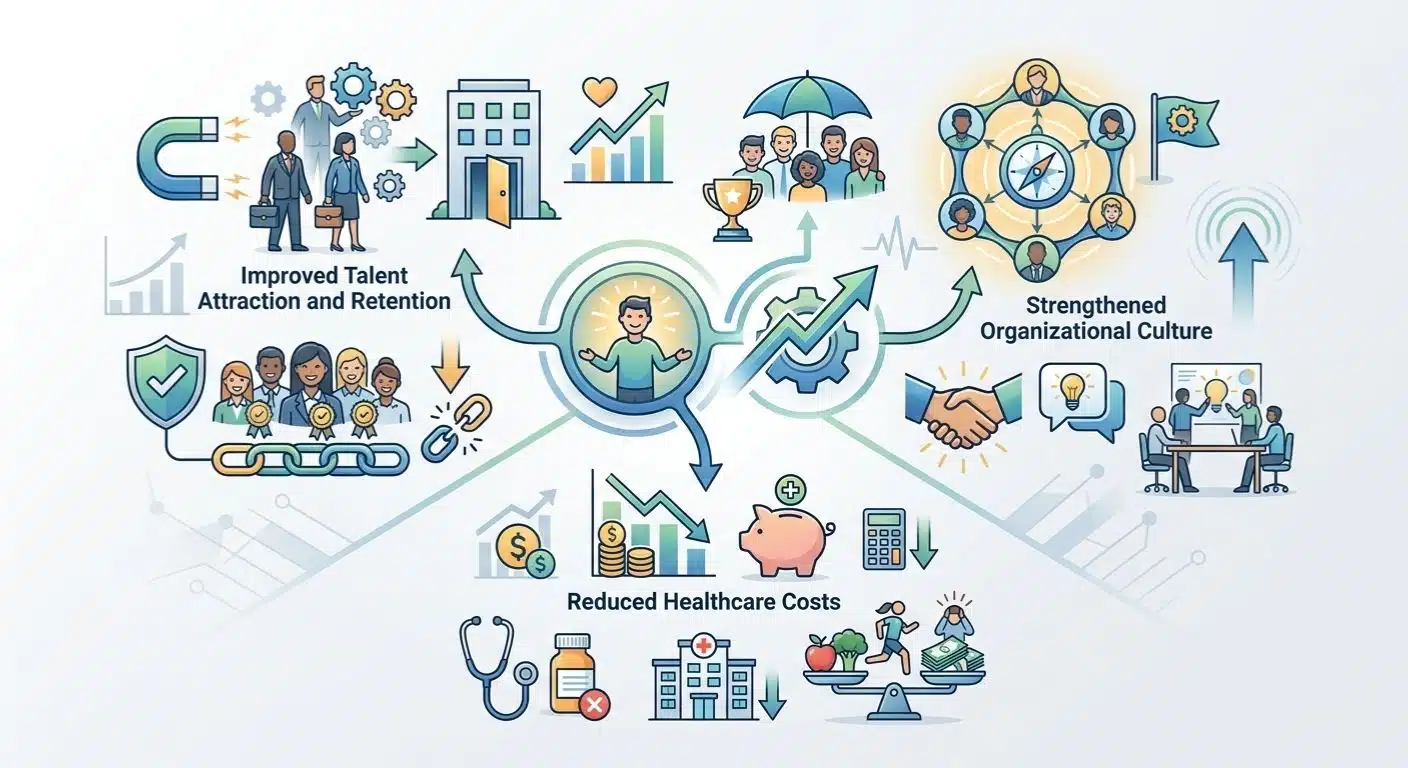
Improved talent attraction and retention
Top talent wants more than a paycheck. They search for employers who invest in their happiness. Candidates notice when organizations offer mental health support and flexible options. These perks signal that leadership cares about staff retention.
In fact, the 2025 Wellhub Return on Wellbeing Report shows that 80% of CEOs report stronger talent attraction directly linked to their wellness programs.
Job satisfaction climbs when workers feel supported. Turnover rates drop significantly when employees experience genuine care. Retaining experienced staff saves money on hiring and training. Workers who feel valued stay longer. This means less disruption to operations and organizational performance. Engaged employees become brand ambassadors who recruit their friends.
This creates a positive cycle where business profitability grows alongside employee health. Organizations that master workplace productivity through wellness outpace competitors. Talent management and employee well-being drive economic value for everyone involved.
Reduced healthcare costs
Healthy employees spend less time in doctors’ offices. This means your company’s healthcare bills drop significantly.
| Cost Reduction Area | Impact on Company Finances | Key Takeaway |
|---|---|---|
| Medical Claims | Preventive wellness programs cut medical claims by 15-30 percent annually | Investing in prevention beats paying for treatment every time |
| Prescription Drug Spending | Employees in well-being programs reduce medication use by managing chronic conditions better | Better health habits lower pharmacy bills substantially |
| Mental Health Services | Companies offering mental health support see 25-30 percent fewer stress-related claims | Mental wellness programs pay for themselves quickly |
| Insurance Premiums | Healthier workforce demographics lead to lower group insurance rates year over year | Your claims history directly affects future premium costs |
| Emergency Room Visits | Preventive care reduces unnecessary ER trips by connecting employees with primary care | ER visits cost five times more than office visits |
| Disability Claims | Fit employees file fewer short-term and long-term disability claims | Wellness initiatives reduce time away from work permanently |
A 2025 report from Kaiser Permanente highlights the stakes clearly. Productivity losses linked to chronic illnesses and injuries cost US employers $2,945 per employee per year. Companies that launch fitness programs and stress management workshops recoup their investment quickly. Employees participating in these programs file fewer claims and recover faster.
When workers catch health problems early, they prevent expensive emergencies. Blood pressure and cholesterol checks prevent costly interventions. Mental health support carries enormous financial weight. Anxiety and depression drain productivity. Companies offering counseling services and meditation apps watch their mental health claims shrink. Employees get help before small problems explode.
Chronic disease management programs target conditions like diabetes and hypertension. Better management means fewer complications and lower costs. Your human resources team tracks these savings carefully. The math works out favorably across all industries.
Strengthened organizational culture
A strong organizational culture acts like glue. It holds your team together. Employees who feel valued develop deeper connections with their company’s mission. Staff retention improves dramatically when people genuinely enjoy coming to work.
According to a 2025 Gallup poll, workers who are “thriving” in comprehensive wellbeing are 32% more likely to stay with their employer.
Your workplace becomes a destination, not just a stepping stone. Long-term employees mentor newcomers and share institutional knowledge. Mental health improves when workers feel they belong to something bigger. Job satisfaction rises naturally. Company culture transforms into a competitive advantage that money cannot easily buy. Talented professionals actively seek out organizations known for caring about work-life balance.
Your reputation spreads through word-of-mouth. Teams that trust each other collaborate better and solve problems faster. Engagement levels soar when leadership prioritizes physical well-being. The organizational performance metrics reflect this strength. Companies with thriving cultures consistently outperform their competitors.
Case Studies: Success Stories of Companies Investing in Wellbeing
Real companies see real results when they invest in employee wellbeing. Their stories prove that happy workers drive business growth.
Examples of measurable ROI and VOI outcomes
Leading companies have transformed their bottom lines by investing in employee well-being programs. They turn wellness initiatives into tangible financial gains.
| Company | Wellbeing Initiative | Measurable ROI Outcome | VOI Outcome |
|---|---|---|---|
| Johnson & Johnson | Comprehensive health and fitness programs | $1.50 returned for every dollar spent on wellness programs over a decade of implementation | Reduced healthcare costs by $250 million; improved employee satisfaction scores by 20% |
| Mental health support, on-site fitness facilities, and nutrition programs | Absenteeism decreased by 37%; presenteeism dropped significantly | Employee retention rates increased to 95%; workplace culture strengthened with higher engagement metrics | |
| Microsoft | Flexible work arrangements and wellness stipends | Productivity gains of 25%; turnover costs reduced by $8 million annually | Talent attraction improved; employer brand strengthened in competitive tech sector |
| Patagonia | Work-life balance policies, paid time off, mental wellness resources | Employee retention reached 90%; recruitment expenses fell by 40% | Organizational culture became legendary; employee advocacy grew organically through social channels |
| Salesforce | Mindfulness programs, career development, and holistic health initiatives | Sick leave usage declined by 33%; healthcare claims dropped by 15% | Employee Net Promoter Score increased by 35%; internal promotion rates rose |
| Accenture | Mental health awareness campaigns, fitness challenges, wellness coaching | Productivity improvements of 18%; absenteeism reduced by 29% | Organizational commitment scores climbed; diversity hiring accelerated through improved employer reputation |
These organizations discovered something powerful. Investing in people pays huge dividends. Johnson & Johnson’s long-term commitment generated $1.50 back for every dollar spent. Google’s mental health programs slashed absenteeism by 37%.
Microsoft’s flexible arrangements saved $8 million annually in turnover costs alone. Patagonia built a legendary status through work-life balance. Salesforce saw sick leave usage plummet by 33%. Accenture boosted productivity by 18%. Each success story reveals a consistent pattern. Wellbeing programs generate immediate financial returns and long-term cultural advantages.
Lessons learned from successful programs
Companies that invest in workplace wellness discover powerful truths about employee health. These lessons shape how businesses build stronger teams.
- Leadership commitment matters more than fancy perks. Executives must actively support mental health initiatives from the top down.
- Employee engagement skyrockets when workers help design the programs. You must give staff a voice in what wellness options actually get offered.
- Measuring job satisfaction through regular surveys helps companies track success. You need to know if your staff retention efforts truly work.
- Flexibility fuels consistency. The 2026 Wellhub report shows 25% of employees now use a hybrid of in-person and digital wellbeing options, proving that flexible access drives long-term engagement.
- Mental health support programs reduce absenteeism significantly. They cut down on missed workdays and keep productivity high.
- Flexible work arrangements boost work-life balance. They allow employees to manage personal responsibilities easily.
- Onboarding new hires with clear information about wellness benefits increases participation rates. This helps talent management efforts succeed faster.
- Peer support groups create community within the workplace. They make staff feel valued and connected.
- Tracking performance metrics consistently reveals what works. You will see which initiatives drive real business profitability.
- Combining physical wellness activities with mental health resources creates comprehensive programs. You must address all aspects of employee well-being.
- Communicating program results to staff builds trust. It shows employees that their health directly impacts economic value.
- Offering personalized health coaching helps workers develop sustainable habits. They will improve their quality of life everywhere.
Overcoming Common Challenges in Implementing Wellbeing Programs
Budgets get tight, and workers can be skeptical. Smart companies succeed by starting small and proving real value to their teams.
Addressing budget constraints
Budget limits often stop companies from launching workplace wellbeing programs. Smart planning can change that outcome completely. A 2024 Wellable report notes that 52% of companies plan to adopt Lifestyle Spending Accounts (LSAs). These accounts offer a controlled, flexible way to manage budgets.
You can stretch your dollars further with strategic choices:
- Start with low-cost wellness initiatives. You can offer free mental health resources or online fitness classes without spending company funds.
- Partner with local gyms or health clinics. Negotiate group discounts that reduce per-employee costs.
- Leverage existing company resources. Convert unused office space into meditation rooms or quiet zones.
- Implement peer-led wellness programs. Trained employees can facilitate stress management workshops to eliminate expensive consultant fees.
- Use free digital platforms for tracking employee health metrics. You can measure organizational performance without costly software.
- Prioritize high-impact initiatives first. Focus your budget on programs that directly reduce turnover rates.
- Secure funding through health insurance providers. They often offer rebates to companies that implement workplace wellness programs.
- Create a phased rollout plan. Introduce employee engagement activities gradually across multiple budget cycles.
- Measure return on investment consistently. Prove that workplace wellbeing spending improves business profitability to justify future funding.
- Offer Lifestyle Spending Accounts (LSAs). They let employees choose their own perks within a set budget limit.
Ensuring employee participation and engagement
Money matters, but participation is crucial. Getting staff involved requires strategy and genuine commitment from leadership. According to Wellhub’s 2026 data, employees who participate in both onsite and digital activities show more than double the engagement levels compared to users stuck with just one format.
Variety is the secret to getting people involved:
- Create clear communication channels. Explain program benefits so workers understand how participation improves their health.
- Offer flexible program options. Allow remote staff and night shift workers to join activities that fit their schedules.
- Launch wellness initiatives during work hours. Make it easy for employees to attend fitness classes without sacrificing personal time.
- Recognize and celebrate participation. Public acknowledgment motivates staff to stay engaged with organizational performance initiatives.
- Gather feedback from workers constantly. Adjust programs based on their input to increase job satisfaction.
- Work with managers to support these efforts. Direct supervisors influence whether team members feel comfortable joining a program.
- Share success stories from colleagues. This makes participation feel normal and encourages others to join.
- Remove barriers to entry. Offer virtual sessions, in-person classes, and one-on-one coaching to boost staff retention.
The Future of Employee Wellbeing and Company Performance
Technology will reshape how companies measure and improve employee well-being. The tools available today are changing everything.
Emerging trends and innovations in wellbeing programs
Technology transforms how companies support employee well-being today. Artificial intelligence tools now track stress levels and exercise habits in real time.
According to 2025 statistics from the HIGH5 Review Team, 60% of HR leaders say AI will play a significant role in workplace mental health by 2030.
Even more, 77% of employees report they would willingly use an AI coach for guidance. Mobile apps deliver personalized wellness recommendations straight to workers’ phones. Virtual reality programs help employees manage anxiety and practice mindfulness. Wearable devices collect health information and reward workers for hitting fitness goals.
Companies integrate these tools into comprehensive workplace wellness strategies. Mental health support reaches workers through teletherapy platforms. Fitness tracking apps sync with company incentive programs to motivate staff. Workplace culture itself is shifting to holistic wellbeing approaches.
Companies now address work-life balance by offering flexible schedules. Managers receive training to spot signs of burnout in their teams. Peer support groups flourish to connect employees who face similar challenges. Staff retention improves dramatically when workers feel genuinely cared for. Business profitability and employee engagement rise together.
The evolving role of data analytics in measuring impact
Data analytics transforms how companies measure workplace wellbeing programs. Companies track real-time metrics across employee health and organizational performance. Dashboards show which initiatives drive results and which ones fall flat. Managers spot trends before problems grow into bigger issues.
Advanced platforms like Forma use precise VOI Assessment Frameworks. They connect mental health data with productivity numbers to reveal the true link between employee engagement and business profitability.
Organizations shift from guessing games to solid evidence by tracking a few key areas:
- Real-time engagement scores and daily mood trackers.
- Predictive models that flag early signs of burnout.
- Custom dashboards that link wellbeing program usage directly to retention.
Artificial intelligence digs deeper into workplace wellness data. These tools predict which employees might leave, allowing companies to step in early. Predictive analytics help leaders allocate budgets toward the initiatives that deliver real economic value. Companies spot patterns in work-life balance that humans might miss.
Data scientists now partner with HR teams to build custom dashboards. The ability to measure impact this way opens doors to smarter decisions. Leaders armed with solid data make choices that strengthen worker satisfaction. This sets the stage for the future of workplace wellness strategy.
The Bottom Line
Companies that prioritize employee health see real gains in their bottom line. Strong job satisfaction leads to higher organizational performance and stronger profitability. Employees who feel supported in their physical well-being show up with more focus. This is a solid business strategy.
Organizations that invest in workplace wellbeing programs reduce healthcare costs and attract better talent. The connection between staff retention and business profitability is measurable. Your organization does not need to choose between caring for people and making money. Employee engagement and business profitability go hand in hand.
Work-life balance matters because burned-out workers cost companies far more than wellness programs ever will. The data shows that companies with strong performance metrics around wellbeing outperform their competitors. Performance metrics tied to mental health tell the real story of organizational success. Talent management becomes easier when your workplace reputation attracts quality candidates. The link between employee well-being and company performance is a fact that shapes competitive advantage.
Frequently Asked Questions (FAQs) on The ROI Of Employee Well-being
1. How does employee well-being affect company performance?
When workers feel good, they do better work. A 2023 Gallup study found that companies with high employee well-being see 23% higher profitability compared to those with struggling employees.
2. What are some ways companies can support worker wellbeing?
You can offer flexible work hours, mental health days, and access to counseling services through employee assistance programs. Even small touches like healthy snacks or walking breaks help people recharge during the day.
3. Can poor employee health hurt business outcomes?
Absolutely. The American Psychological Association reported in 2024 that workplace stress costs US businesses around $300 billion annually in absenteeism, turnover, and lost productivity.
4. Why should leaders care about their team’s happiness at work?
If you ignore how your team feels, good people leave fast. But when you listen and create a supportive environment, folks stick around, and your bottom line usually benefits too.