


Feeling stuck with credit card debt that never moves? A balance transfer to pay off debt faster helps you pause heavy interest charges and apply more of each payment directly to your principal. Moving high-interest balances to a promotional 0% APR card creates a focused window to clear your debt without the constant drag of compounding interest.
However, success requires choosing the right card and managing details like transfer fees and the promotional deadline. Your credit score and credit limit significantly impact your results. If you cannot finish repayment before the offer ends, a personal loan or debt management plan might be a better, more sustainable choice for your financial situation.
What Is a Balance Transfer?
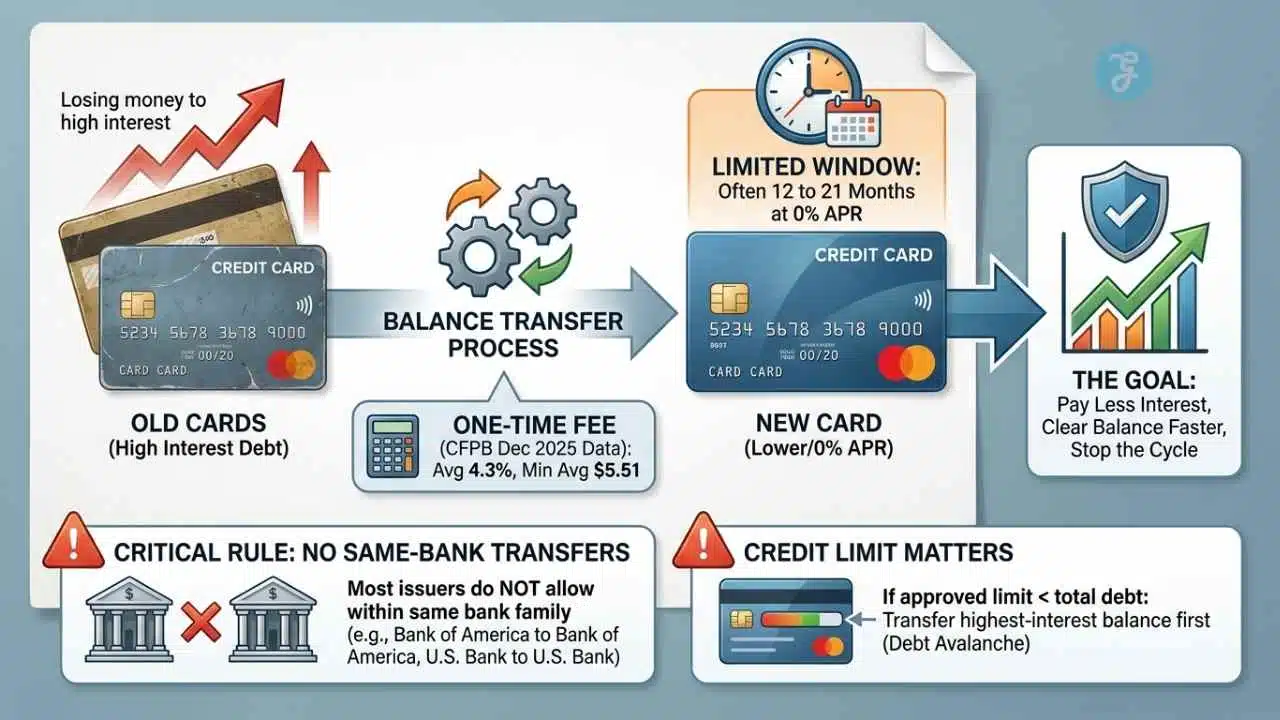
A balance transfer moves existing credit card debt from one card to another, usually to a new balance transfer card with a lower annual percentage rate, or APR. The goal is simple: stop losing money to high interest, so your payments cut the balance faster.
In its December 2025 market report, the CFPB said the average balance transfer fee among the 25 largest issuers was 4.3%, with an average minimum fee of $5.51. That means a transfer is rarely free, but it can still save you real money if your current interest rate is high and you have a clear payoff plan.
- You move debt from one or more old credit cards to a new card.
- You usually pay a one-time fee based on the amount transferred.
- You get a limited window, often 12 to 21 months, to attack the balance at 0% APR.
One more rule catches people off guard: most issuers do not let you transfer debt within the same bank family. Bank of America says its transfers cannot pay another Bank of America account, and U.S. Bank says transfers from its own accounts are not allowed either.
Your new card’s credit limit also matters. If the approved limit is lower than your total debt, transfer the highest-interest balance first and use the debt avalanche method on the rest.
Move the debt for a reason: to pay less interest, clear the balance on time, and stop the cycle from starting again.
How Balance Transfers Work
A balance transfer works like a targeted reset for high-interest debt. The new issuer pays off the old credit card balance you selected, then that amount shows up on the new card, along with any balance transfer fee.
- Choose the right offer: Look at the intro APR length, transfer fee, and whether the card gives you enough credit limit to move the debt you want to tackle.
- Apply and request the transfer: You usually enter the old account numbers and the amounts you want moved during the application or right after approval.
- Keep paying the old card until the transfer posts: Discover says the process can take anywhere from a few days to a couple of weeks. For new Discover accounts, the account must be open for 14 days before processing begins, and most transfers are then processed within four days.
- Pay the new card hard and fast: Once the transfer lands, treat that card like a payoff tool, not a spending card.
This is where many balance transfers go sideways. If you start using the new credit card for purchases, you can end up with mixed balances and new interest charges at the regular interest rate.
The CFPB explains that payments above the minimum generally go to the highest-APR balance first. That helps, but the minimum payment can still be applied differently, so keeping purchases off your payoff card is the cleaner move.
Benefits of Using a Balance Transfer
A balance transfer can lower interest costs, simplify your monthly bills, and give you a real shot at faster payoff. It works best when you have stable income, a payoff target, and enough discipline to avoid adding new debt.
Lower interest payments
If your current credit card debt sits near today’s typical rates, the savings can be meaningful. LendingTree reported the average APR on all credit cards was 21.00% in the first quarter of 2026, so a $5,000 balance can start with about $88 in interest in the first month alone.
Now compare that with a 3% balance transfer fee. On a $5,000 transfer, that fee is $150. If the transfer stops months of double-digit interest charges, the upfront fee can be cheaper than staying put.
Faster debt repayment
When the intro APR is 0%, your payment goes to the balance instead of getting chewed up by finance charges. A $5,000 transfer with a 3% fee becomes $5,150, so you would need to pay about $286 a month to clear it in 18 months.
The deadline matters. The CFPB found that 79% of accounts with introductory promotions that expired in 2024 still had a balance after the promo ended, which is a good reminder that a balance transfer helps only if you use the window aggressively.
- It works best when you can divide the full transfer amount by the promo months and actually afford that payment.
- It works best when you stop using the old cards for new spending.
- It works best when your transferred balance fits within the new card’s credit limit.
Simplified monthly payments
Rolling several credit cards into one balance transfer card can make debt management a lot easier. You have one due date, one monthly target, and one balance to watch.
If an old card has no annual fee, keeping it open can sometimes help your credit utilization ratio because your total available credit stays higher. That said, if an open card tempts you to spend again, close the loop another way, store it out of reach, freeze it in your app, or remove it from your wallet.
Potential credit score improvement
A new application can cause a small, temporary dip because of the hard inquiry. After that, the upside can be real if the transfer lowers your utilization and you keep making on-time payments.
myFICO says the amounts you owe make up about 30% of a typical FICO score, and higher utilization signals more risk. Lower balances and steady payments can help over time, especially if your old cards were close to maxed out.
How To Choose the Best Balance Transfer Card
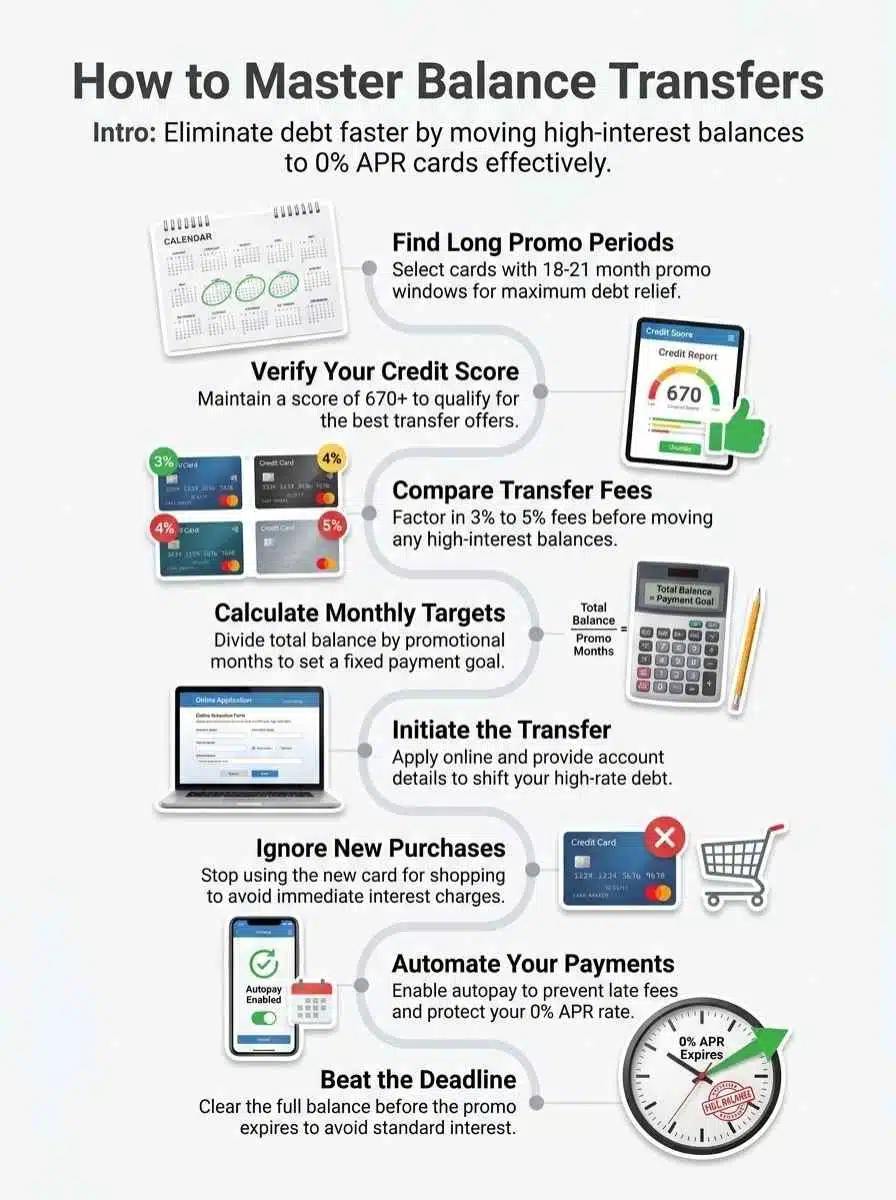
The best card is not always the one with the flashiest ad. You want the offer that gives you enough time to finish the job, with a fee low enough that the math still works in your favor.
| Card | Intro balance transfer offer | Transfer fee | Best fit |
|---|---|---|---|
| U.S. Bank Shield™ Visa® Card, the card many readers still call the U.S. Bank Visa® Platinum Card | 0% APR for 21 billing cycles on transfers made within 60 days of account opening | 5% of each transfer, $5 minimum | You want one of the longest payoff windows available right now |
| BankAmericard® from Bank of America | 0% APR for 21 billing cycles on transfers made within 60 days of account opening | Current offer page lists a 5% transfer fee | You want a long intro period and a straightforward low-interest card |
| Citi Double Cash® Card | 0% intro APR for 18 months on balance transfers from account opening | Either $5 or 3% of each transfer, whichever is greater | You want a lower fee and a card you may keep using later for simple cash back |
Look for the longest 0% APR period
Longer is better only if you use the time. A 21-month offer can beat an 18-month offer on a big balance, but if you can pay the debt off in 12 months anyway, a lower fee may matter more than a longer runway.
Citi Simplicity® Card is still a popular option to check when you want a long intro period and a simpler feature set. Citi Double Cash® Card can be more appealing if you care about the lower ongoing fee structure and future rewards.
Compare balance transfer fees
This is where the math gets real. On a $5,000 transfer, a 3% fee is $150, while a 5% fee is $250. That $100 gap can wipe out a chunk of your savings if your current balance is small or you plan to pay it off quickly.
A good shortcut is this: if you can erase the debt well before the promo ends, the lower balance transfer fee often wins. If you need every extra month you can get, a longer 0% period may still be worth the higher fee.
Do the math before you apply: transfer amount + fee, divided by promo months, should equal a payment you can afford every month.
Check eligibility requirements
Most strong balance transfer offers go to people with good to excellent credit. Experian notes that generally means a 670+ credit score, and U.S. Bank says its credit cards are typically for customers in the good-to-excellent range.
Before you apply, review your reports from the three major bureaus, fix any errors, and make sure there are no fraud issues or identity theft problems dragging your score down. If the issuer offers prequalification or pre-approval without affecting your credit, use it.
Steps to Use a Balance Transfer Effectively
A balance transfer works best when you treat it like a payoff project with a deadline. These steps keep the process simple and keep expensive mistakes out of your way.
- Check your credit score first: Review your score and your full credit reports before you apply. The CFPB says credit reports remain available weekly, and Equifax is offering six extra free reports every 12 months through December 31, 2026, so there is no good reason to skip this step.
- Calculate your savings before you move anything: Add the transfer fee to the balance, then divide by the promo months. If you want to move $10,000 with a 3% fee, your new balance is $10,300, so you would need to pay about $490 a month to clear it in 21 months.
- Apply, then start the transfer right away: Some offers require you to complete the transfer within a short window after account opening. Keep making payments on the old card until the transfer shows as complete, because late payments can still hurt you during the crossover period.
- Put the payoff on autopilot: Set up automatic payments from your checking account for at least the required monthly target, then add a calendar reminder one month before the promo expires. That buffer gives you time to make a final catch-up payment if life gets busy.
If your approved credit limit is smaller than expected, transfer the highest-interest debt first. That keeps the biggest interest charges from growing while you work through the rest.
Common Mistakes to Avoid
Most balance transfer problems come from three things: missing payments, missing the deadline, or using the new card like a regular spending card. Keep your eyes on those, and the strategy stays much safer.
- Missing payments during the 0% APR period: Even one late payment can trigger fees, hurt your credit score, and put your promo at risk depending on the card terms. The CFPB says a credit card payment is generally on time if the issuer receives it by 5 p.m. on the due date, so set autopay for at least the minimum and never cut it close.
- Ignoring the promotional deadline: When the intro period ends, any unpaid balance starts accruing interest at the regular APR. Put the end date in your calendar the day you open the account, then set a second alert 30 days earlier so you still have time to adjust.
- Using the new card for purchases: Citi warns that if you transfer a balance, interest will be charged on purchases unless you pay your entire balance, including the transfer, by the due date each month. In plain English, a card used for payoff should usually be a card you do not swipe.
If you need a simple rule, use this one: make the transfer, stop new spending, and keep paying until the balance hits zero.
Alternatives to Balance Transfers
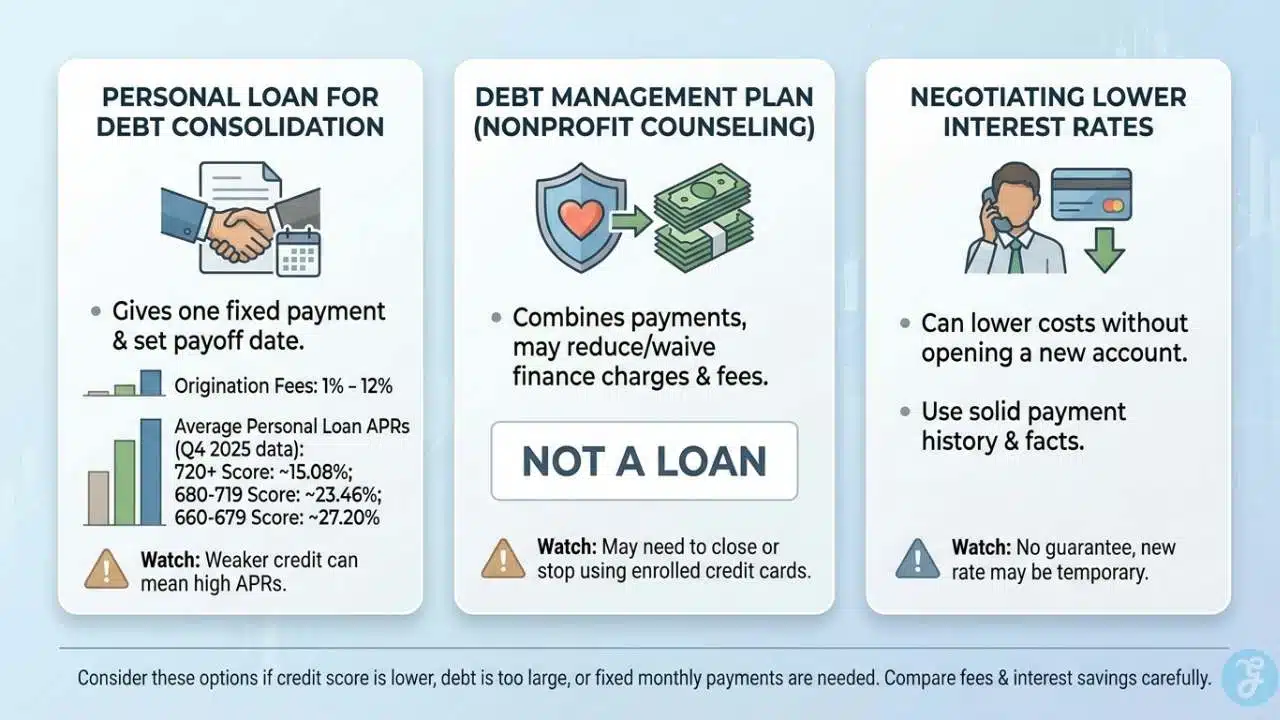
A balance transfer is powerful, but it is not the only way to handle credit card debt. If your credit score is lower, your debt is too large for one card, or you need fixed monthly payments, another option may fit better.
| Option | What it does well | What to watch |
|---|---|---|
| Personal loan for debt consolidation | Gives you one fixed payment and a set payoff date | Origination fees can range from 1% to 12%, and weaker credit can mean high APRs |
| Debt management plan through nonprofit credit counseling | Combines payments and may reduce or waive finance charges and fees | It is not a loan, and you may need to close or stop using enrolled credit cards |
| Negotiating lower interest rates with creditors | Can lower costs without opening a new account | There is no guarantee, and the new rate may be temporary |
Debt consolidation loans
A personal loan can make more sense when you want a fixed finish line and do not trust yourself with another revolving credit card. Experian noted in May 2026 that debt consolidation loan origination fees can run from 1% to 12%, so you need to compare the fee against the interest savings.
LendingTree’s Q4 2025 data showed average personal loan APRs around 15.08% for borrowers with scores of 720 or higher, 23.46% for scores of 680 to 719, and 27.20% for scores of 660 to 679. That means a personal loan can beat a credit card for some borrowers, but it will not always beat a strong 0% balance transfer offer.
It can also work for debts that a transfer card cannot solve well, such as larger debt consolidation needs that go beyond your approved credit limit. It is usually a better fit than trying to juggle credit cards for expenses like student loans, auto loans, or home loans, which are structured very differently.
Negotiating lower interest rates with creditors
If you have a solid payment history, call your issuer before you apply anywhere else. Ask whether they can lower your APR, match a competing offer, or place you on a hardship program.
This works best when you can point to facts, your current interest rate, your recent on-time payments, and your credit score. If you need more help, a nonprofit credit counselor can review your options and help set up a debt management plan, which the NFCC notes is not a loan.
Final Thoughts
A balance transfer can be one of the fastest ways to cut interest charges and pay off credit card debt faster, but only if the math works and your plan is realistic. Check your credit score, compare the fee against the intro APR window, and know your monthly target before you apply.
Then keep it simple.
Pick the card that gives you the best path to zero, move the balance, and pay more than the minimum every month until it is gone. If a balance transfer does not fit, a personal loan or debt management plan may still help you reclaim control.
Frequently Asked Questions (FAQs) About Using a Balance Transfer to Pay Off Debt Faster
1. What is a balance transfer and how does it help me pay off debt faster?
A balance transfer moves debt from one credit card to another, often onto a card with a low or 0% promotional APR. That cuts interest, so more of each payment reduces the principal, and you can pay off debt faster. Think of it like moving water to a less leaky bucket.
2. How do I pick the right card for a balance transfer?
Pick a card with a long 0% promotional APR and a low balance transfer fee. Read the fine print, check the credit limit, and watch the transfer deadline.
3. Are there costs or risks I should watch for?
Yes. Watch balance transfer fees, high interest after the promotional period, and penalty APRs if you miss a payment. New charges or missed payments can wreck your payoff plan and hurt your credit score.
4. How do I make a plan to pay off debt during the promotional period?
Divide the transferred amount by the number of promo months, to get a monthly payoff target. Set up automatic payments for at least that amount, avoid new card charges, and track progress each month.





















