
Do you feel stuck in your romantic life right now? Maybe you push people away when they get close, or you worry constantly that your partner will leave you. Perhaps you struggle to trust others, even when they show you genuine kindness. These feelings are incredibly common.
Many people repeat the exact same dating struggles over and over, wondering why they cannot break free from the cycle. It is an exhausting process. Here is a fascinating piece of data: a 2026 national survey found that only about 56% of adults in the US exhibit a secure attachment style.
The good news is that learning about psychology and somatic therapy can help you rewire these patterns. Understanding attachment styles and how they affect relationships is the first step to making real changes. So, grab a cup of coffee, and let us go through it together.
Understanding Attachment Styles and Their Impact on Relationships
Your attachment style shapes how you connect with others, starting from your earliest relationships. These patterns stick with you into adulthood and influence everything from how you communicate to how you handle an argument.
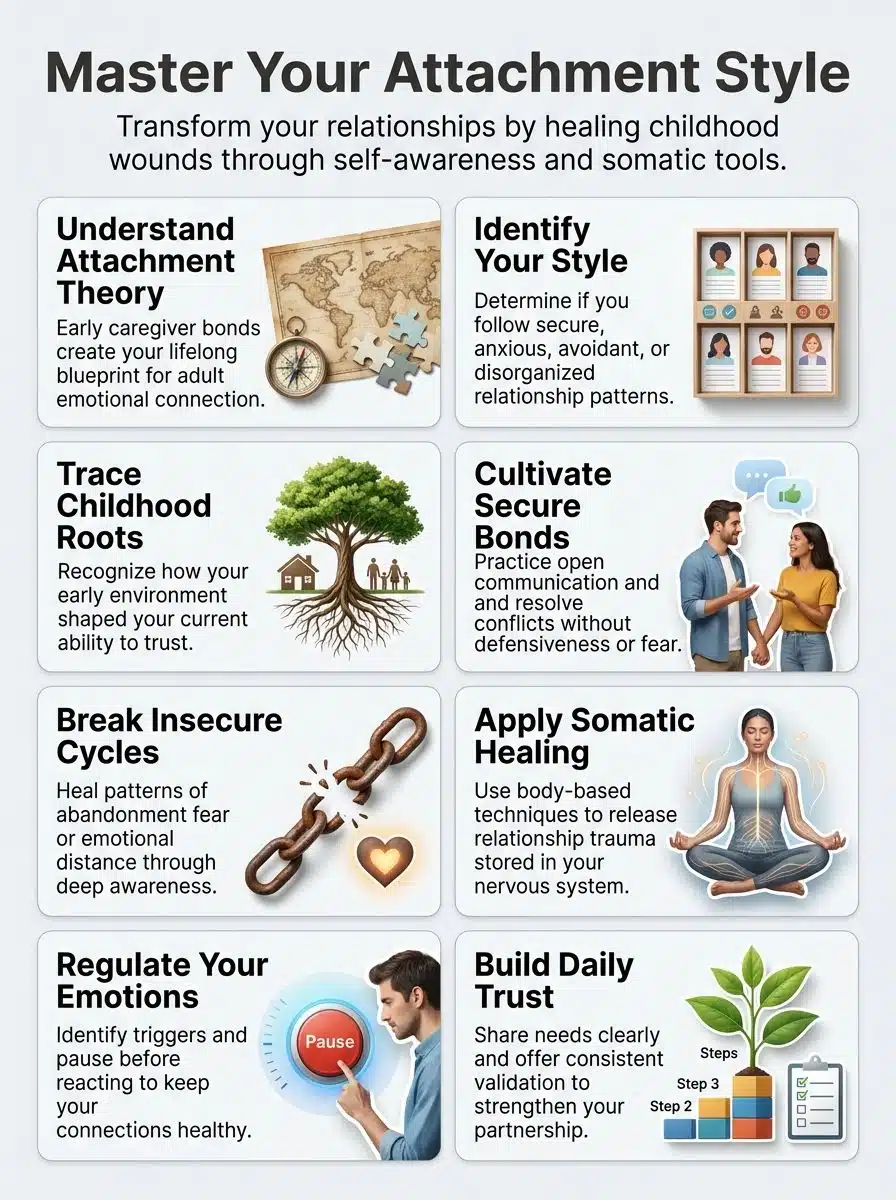
Definition and overview of attachment theory
Attachment theory explains how early bonds between children and caregivers shape relationship patterns throughout life. British psychologist John Bowlby developed this theory in the 1950s. He discovered that babies form deep emotional connections with their primary caregivers, and these connections act like a blueprint for all future relationships.
In the 1970s, Dr. Mary Ainsworth expanded on this work with her famous Strange Situation study. She showed exactly how a child responds to separation and reunion with a parent. The theory suggests that our attachment style, formed in childhood, influences how we connect with others, handle conflict, and express intimacy as adults.
Secure attachment develops when caregivers respond consistently to a child’s needs. This creates a strong foundation of trust and emotional safety.
Attachment is not spoiling a child; it is meeting their needs so they can grow into secure, confident adults.
Insecure attachment styles emerge when caregivers fail to meet a child’s emotional needs consistently. Someone with anxious attachment may crave constant reassurance. An avoidant person tends to withdraw emotionally, while a disorganized attachment combines elements of both.
The four main attachment styles: secure, anxious, avoidant, and disorganized
Understanding the four main attachment styles gives you insight into how you connect with others. Each style shows up differently in your relationships.
Recent US data from 2026 provides a clear picture of how these styles break down across the population. About 56% of US adults have a secure attachment style, roughly 25% show avoidant traits, 19% lean anxious, and a smaller percentage fall into the disorganized category.
| Attachment Style | Key Characteristics | Relationship Patterns | Common Behaviors |
|---|---|---|---|
| Secure |
|
|
|
| Anxious |
|
|
|
| Avoidant |
|
|
|
| Disorganized |
|
|
|
How Attachment Styles Develop
Your attachment style forms during your earliest years, shaped by how your caregivers responded to your needs. The environment you grew up in plants seeds that bloom throughout your entire life.
The role of early childhood experiences
Your early years shape how you connect with others for the rest of your life. The people who cared for you taught you what to expect from relationships.
The emotional bonds we form in our first years of life create a literal neural map for how we give and receive love as adults.
These early interactions literally rewire your brain. Attachment theory shows us that your caregivers’ behavior became your emotional blueprint. Dr. Mary Ainsworth’s observational research confirmed that a mother’s sensitivity to her infant’s signals during the first year directly predicts the child’s attachment security later on.
The environment you grew up in matters just as much. A chaotic household teaches you different relationship dynamics than a stable one does.
Influence of caregivers and environment
Your caregivers shape how you handle vulnerability. Kids who receive consistent care develop secure attachment patterns and learn to express their feelings without fear.
In contrast, caregivers who ignore a child’s emotional needs create insecure attachment styles. A 2026 report verified that 70% of insecurely attached children had unresponsive caregivers in infancy.
A home filled with conflict makes children feel unsafe. Kids growing up in such settings often struggle with emotional bonding. Understanding these patterns helps adults recognize where their attachment style comes from so they can begin to heal.
The Impact of Attachment Styles on Relationships
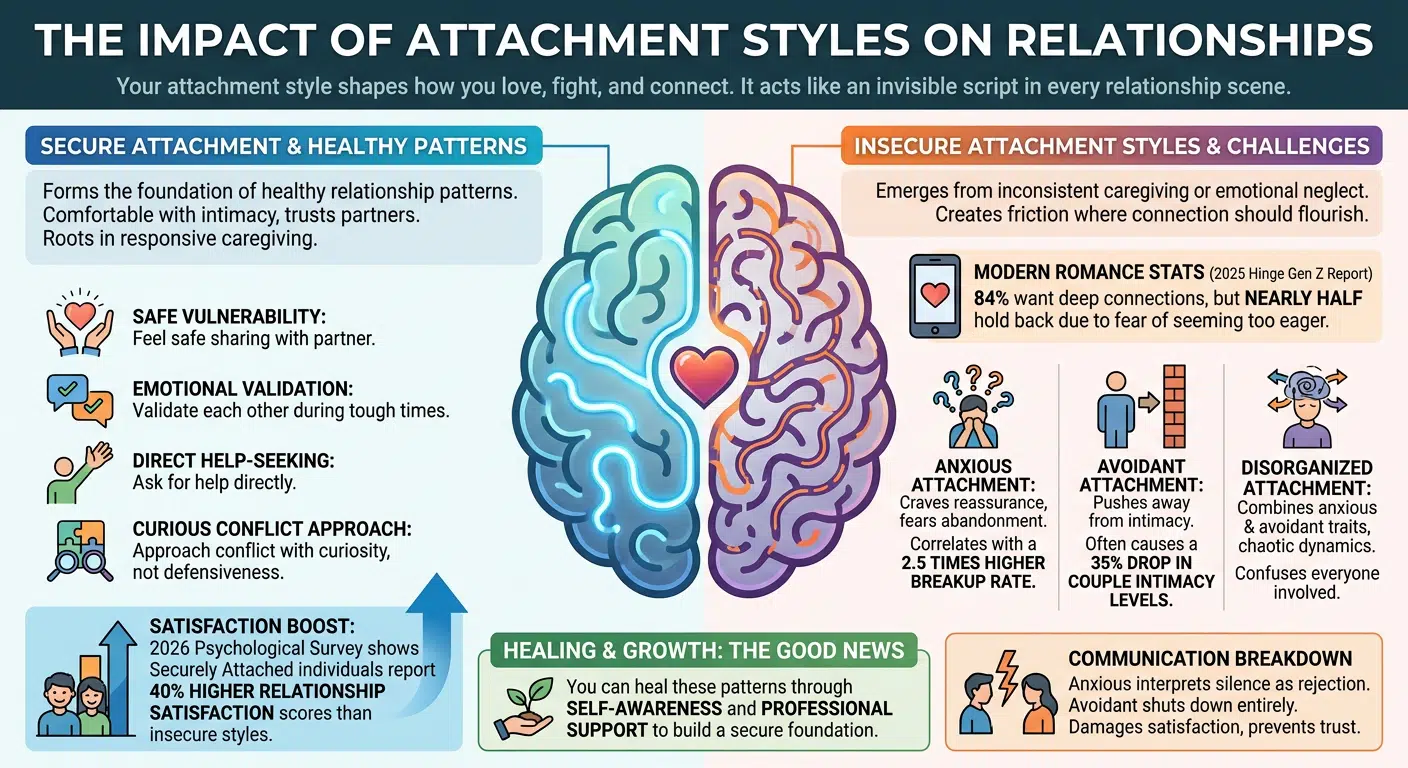
Your attachment style shapes how you love, fight, and connect with your partner. It acts like an invisible script in every relationship scene you enter.
Secure attachment and healthy relationship patterns
Secure attachment forms the foundation of healthy relationship patterns. People with this style feel comfortable with intimacy and trust their partners. These individuals grew up with caregivers who responded to their emotions in caring ways. Secure partners share several key traits:
- They feel safe being vulnerable with their partner.
- They validate each other’s feelings during tough times.
- They ask for help directly when they need it.
- They approach conflict with curiosity rather than defensiveness.
Relationship satisfaction increases significantly when both people bring this secure foundation to the table. A 2026 psychological survey showed that securely attached individuals report 40% higher relationship satisfaction scores than those with insecure styles.
Insecure attachment styles and challenges in relationships
Insecure attachment styles emerge from inconsistent caregiving or emotional neglect. These patterns shape how people approach relationships as adults, often creating friction where connection should flourish.
Recent statistics highlight exactly how these styles affect modern romance. Hinge’s 2025 Gen Z dating report revealed that 84% of younger daters want to build deep emotional connections, but nearly half hold back because they fear seeming too eager.
Here is how insecure attachment styles typically disrupt relationships:
- Anxious attachment: Craves constant reassurance and fears abandonment. This style correlates with a 2.5 times higher breakup rate.
- Avoidant attachment: Pushes people away from intimacy. Avoidant partners often cause a 35% drop in couple intimacy levels.
- Disorganized attachment: Combines anxious and avoidant traits, creating chaotic dynamics that confuse everyone involved.
- Communication breakdown: Anxious partners interpret silence as rejection, while avoidant partners shut down entirely.
Both styles damage relationship satisfaction and prevent couples from building trust. The good news is that you can heal these patterns through self-awareness and professional support.
Healing Attachment Wounds
Attachment wounds run deep, often rooted in moments when you needed comfort but did not receive it. Healing these wounds requires you to face the pain and actively rewire how you connect with others.
Attachment-related trauma stems from painful experiences in early relationships. Your caregivers’ responses to your needs created deep patterns in your nervous system. If a parent ignored your cries for help, you learned that expressing needs brings rejection.
Dr. Bessel van der Kolk perfectly captured this in his landmark book, “The Body Keeps the Score”. He explains that trauma is not just a cognitive memory; it physically alters your nervous system.
Your brain learned survival strategies that once protected you but now create emotional distance. You might push people away before they leave you, or cling so tightly that partners feel suffocated. Understanding that your reactions come from old wounds shifts everything.
The importance of self-awareness and emotional regulation
Healing from attachment-related trauma requires you to look inward. Self-awareness and emotional regulation form the foundation that allows you to break free from old wounds.
- Recognize your physical triggers: Notice which situations make your chest tighten or your breathing shallow so you can pause before reacting.
- Name your emotions clearly: Using tools like the Rosenberg Self-Esteem Scale or a feeling wheel helps you accurately identify your internal state.
- Practice emotional regulation: Learn to feel your feelings without letting them control your actions, preventing destructive conflict.
- Track your daily responses: Keep a journal of your emotional peaks and valleys to discover what calms your nervous system down.
- Communicate core needs directly: Move away from dropping hints and start explicitly asking your partner for the support you require.
The Role of Somatic Therapy in Addressing Attachment Issues
Somatic therapy works with your body and mind together, helping you release attachment wounds that live in your muscles. This hands-on approach teaches you to notice what your body feels during emotional moments.
How somatic therapy works with the body and mind
Somatic therapy addresses your whole self, not just your thoughts. Your body stores stress, fear, and old pain from past relationships. Therapists who use this approach help you notice what your body communicates.
This method is heavily grounded in Dr. Stephen Porges’ Polyvagal Theory. His research proves that our autonomic nervous system constantly scans for safety or danger, and trauma can force it into a defensive state.
Healing attachment issues requires moving beyond talk alone. Your therapist might ask you to breathe slowly, move your body, or place your hands on your chest. As you practice these techniques, your body learns that intimacy is possible and safe.
Techniques used in somatic therapy for attachment healing
Now that you understand how somatic therapy connects the body and mind, let us explore specific techniques. These practical tools work directly with your nervous system to release old patterns.
- Body scanning: Your therapist guides you to slowly move awareness through your body, identifying where you hold relationship stress.
- Pendulation: Developed by Dr. Peter Levine, this involves shifting your focus back and forth between a tense area and a relaxed area to teach your body resilience.
- Titration: This breaks overwhelming feelings into smaller, manageable pieces so your nervous system can process trauma without shutting down.
- Grounding exercises: Techniques like feeling your feet firmly on the floor anchor you in the present moment when attachment anxiety spikes.
- Resourcing: Connecting with internal memories of safety and support to build your capacity for healthy intimacy and conflict resolution.
Benefits of Healing Attachment Styles
When you heal your attachment wounds, your relationships transform. You start trusting others more deeply, and they feel that shift right away.

Improved emotional connection in relationships
Healing your attachment style transforms how you bond with others. You start to show up more fully, listen better, and share your real feelings without fear. Secure attachment lets you feel safe enough to be vulnerable.
True intimacy happens when you stop playing defense and start letting your partner see the real, unfiltered version of you.
Biologically, this sense of safety boosts your brain’s production of oxytocin. This powerful neurochemical enhances your desire to bond and collaborate. Strong emotional bonds happen when you drop the walls. Couples report feeling happier and genuinely connected in ways they never thought possible.
Enhanced self-esteem and personal growth
Fixing your attachment style opens doors to real personal growth. Your self-esteem climbs higher as you build secure patterns.
You stop seeking constant validation from others because you learn to give it to yourself. Dr. Kristin Neff’s extensive research on mindful self-compassion proves that treating yourself with kindness directly lowers relationship anxiety. This shift in how you view yourself changes everything.
Your relationship satisfaction skyrockets when you invest in healing your attachment wounds. You become more confident in who you are, and that confidence attracts healthier people into your life. Intimacy stops feeling scary and starts feeling like coming home.
Tips for Cultivating Secure Attachment
You can build a stronger, more stable foundation in your relationships by learning practical skills. Small, consistent actions transform your attachment patterns over time.
Building trust and communication skills
Trust forms the foundation of every healthy relationship, and communication skills are the tools that build it. Strong relationships grow when both people feel safe expressing their thoughts.
- Use “I” statements: Name your feelings using direct language, such as “I feel hurt when…”, rather than blaming your partner.
- Practice active listening: Put your phone away, make eye contact, and focus entirely on understanding your partner’s perspective.
- Make repair attempts: Dr. John Gottman’s research shows that using a joke or a gentle touch to de-escalate an argument is crucial for relationship survival.
- Ask clarifying questions: Prevent misunderstandings by asking things like, “How did that situation make you feel?”
- Share your needs explicitly: Tell your partner exactly what you need instead of expecting them to read your mind.
Practicing self-compassion and mindfulness
Self-compassion and mindfulness work together to heal your attachment wounds. These practices help you build a stronger, more secure foundation for your relationships.
- Use the 5-4-3-2-1 technique: Name five things you see, four you can touch, and three you hear to ground yourself during an anxious spiral.
- Challenge your inner critic: Notice self-critical thoughts and reframe them as if you were speaking to a dear friend.
- Start a breathwork routine: Focus on your breathing for just five minutes each morning to calm your autonomic nervous system.
- Track positive moments: Write down three things you did well today to reinforce positive self-regard and counter insecurity.
- Take a mindful pause: Stop and take three deep breaths before reacting during a disagreement to avoid defensive communication.
Final Words
Your attachment style shapes how you love, communicate, and handle conflict in relationships. You learned that secure attachment builds trust and emotional connection, while anxious, avoidant, and disorganized styles create predictable dating struggles.
Somatic therapy, self-awareness, and mindfulness offer practical tools you can start using today to rewire old patterns. Your journey toward secure attachment does not require perfection; it requires honest reflection, small daily actions, and patience with yourself as you heal.
Understanding attachment styles gives you the power to break old cycles. Start today by noticing your attachment patterns, reaching out to someone you trust, or exploring somatic therapy with a qualified professional. The relationships you build tomorrow depend on the work you do right now.
Frequently Asked Questions (FAQs) on Attachment Styles
1. What are attachment styles, and why do they matter in relationships?
Attachment styles are patterns of how you connect with others, shaped by early childhood bonds with caregivers. They influence how you trust, love, and handle conflict, and research shows that about half of adults develop secure attachment, while others lean anxious or avoidant.
2. How can knowing my attachment style help me have better relationships?
Knowing your attachment pattern helps you spot triggers faster, like when jealousy creeps in or when silence feels safer than talking. This awareness helps you and your partner understand reactions and break old cycles together.
3. Can two people with different attachment styles make it work?
Absolutely, and it happens more often than you’d think. The key is understanding each person’s needs and having honest conversations about how you both give and receive love.
4. Is it possible to change my attachment style over time?
Yes, attachment styles can shift over time with intentional effort and support. Therapists often use approaches like Emotionally Focused Therapy to help people develop more secure patterns. Many people see meaningful changes within several months of consistent work.