

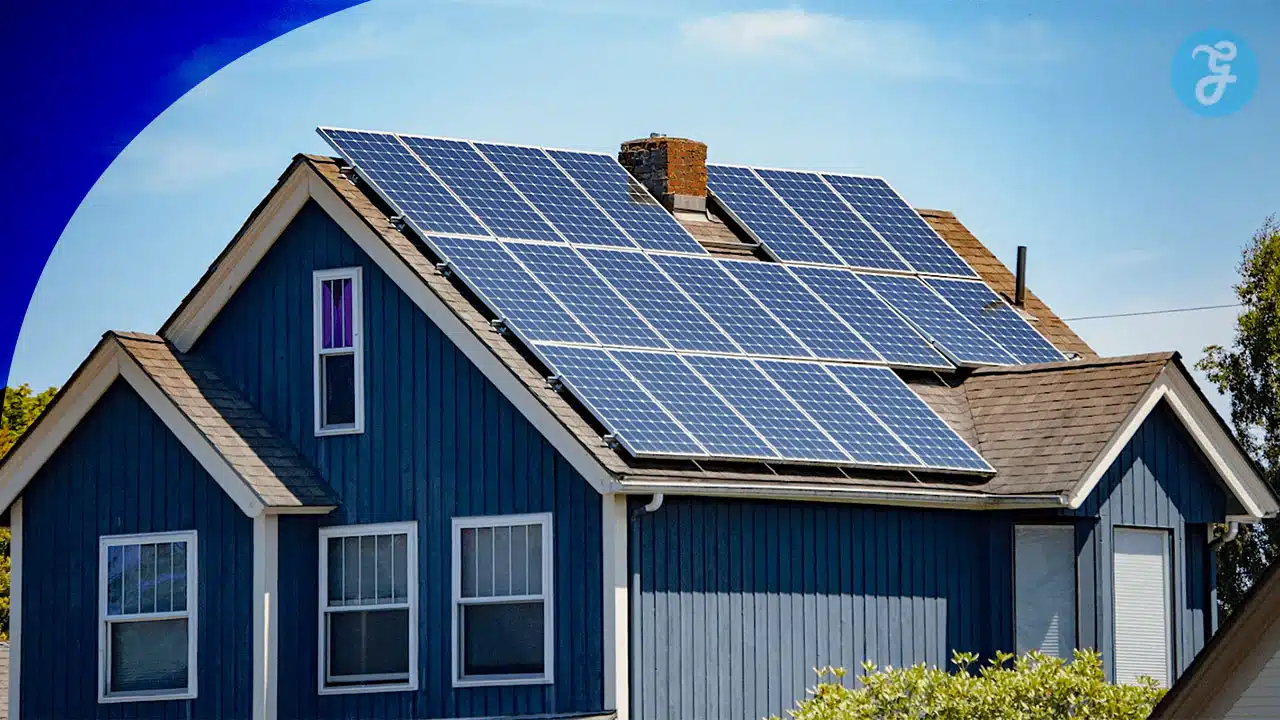
Wondering if solar panels increase home resale value? In most cases, yes! A recent 2025 analysis revealed that solar-equipped homes command a 6.9% premium, adding roughly $29,000 to average U.S. property sales. However, this financial boost isn’t guaranteed. Savvy buyers will carefully evaluate your system’s ownership status, hardware age, and local utility regulations before making an offer.
To maximize your sale, leverage tools like Aurora Solar or EnergySage data to prove your system’s worth. Highlighting premium tech—like Enphase IQ microinverters and the IQ Battery 5P—alongside SolarInsure warranties builds instant buyer confidence. Plus, since the federal clean energy credit expired in 2025, presenting flawless paperwork and documented utility savings is now crucial to closing the deal.
Do Solar Panels Increase Your Home’s Resale Value?
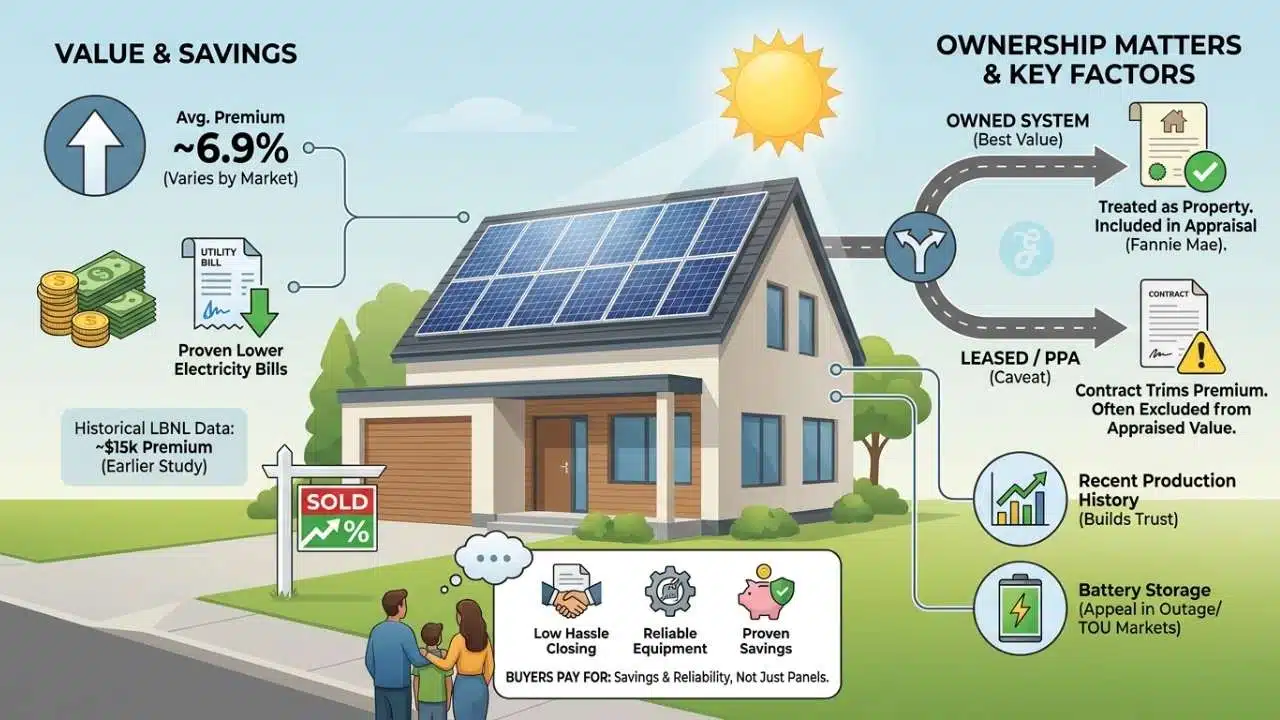
Yes, solar panels usually increase your home’s resale value. The clearest recent data comes from SolarReviews, which found a 6.9% average premium for solar homes, though the size of that premium varied a lot by state and local market.
That second part matters. Buyers are not paying extra just because they see panels on the roof, they are paying for lower electricity bills, reliable equipment, and a system that will not slow down closing.
Buyers usually pay for proven savings and low hassle, not just for panels sitting on the roof.
- Owned solar energy systems tend to add the most value because they can be treated as part of the property.
- Leased systems and power purchase agreements can still attract buyers, but the contract often trims the premium.
- Recent production history helps buyers trust the savings story.
- Battery storage can add appeal in outage-prone or time-of-use markets.
The Department of Energy still points to Lawrence Berkeley National Laboratory research showing that buyers have long paid a premium for solar homes, about $15,000 for an average-sized system in an earlier multi-state study. The newer SolarReviews numbers suggest that, in many markets, the resale story has gotten stronger as solar has become more familiar to homebuyers.
There is one major caveat for real estate value. Fannie Mae guidance allows appraisers to include the value of owned solar under standard appraisal rules, but leased panels and PPAs are treated differently and may not be counted in the appraised value at all.
Key Factors That Influence the Impact of Solar Panels on Home Value
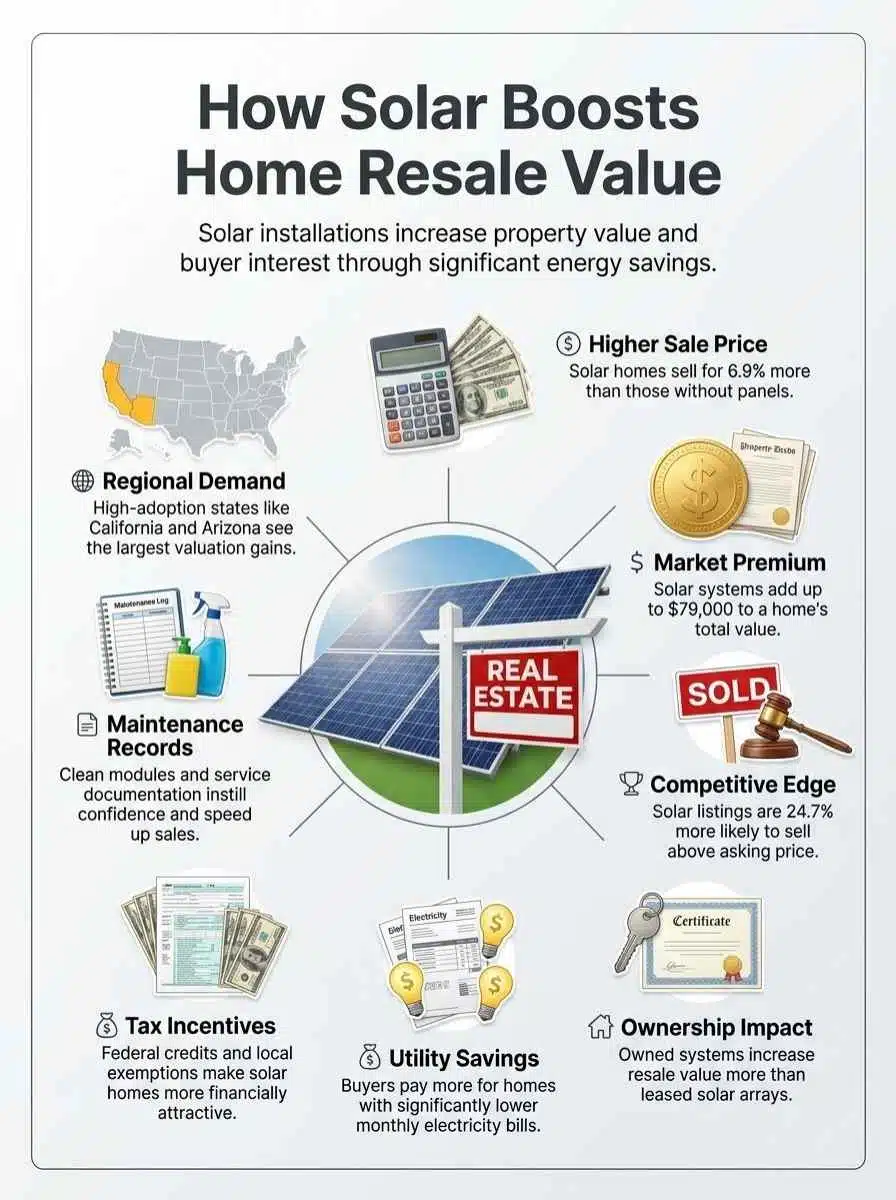
Your home value does not rise from solar panels in a vacuum. The biggest drivers are local electricity rates, the system’s output and age, and whether the buyer gets a clean asset or a messy contract.
Location and regional electricity prices
Location changes the savings story fast. EIA data for 2024 shows California residential electricity averaged 31.97 cents per kWh, while Washington averaged 11.90 cents, so the same solar installation usually delivers a much stronger bill-saving story in California.
Utility policy matters just as much as price. Washington still requires retail-rate net metering until June 30, 2029, or until a utility reaches its statutory threshold, while California moved new customers to net billing on April 15, 2023, which usually pays less for daytime exports.
- High-rate markets: show 12 months of electric bills and annual savings.
- Retail net metering markets: show utility credits and export history.
- Net billing markets: show how the home uses solar on site, especially with a battery.
Size and efficiency of the solar system
Buyers care less about panel count than they do about usable production. EnergySage reported that about 97% of home solar panels installed in 2025 fell between 400 and 460 watts, which gives buyers a simple benchmark for whether your equipment still feels current.
A well-sized system often sells better than an oversized one. If the array offsets most of the home’s real usage without creating confusing overproduction, the financial benefit is easier for buyers and appraisers to understand.
Aurora Solar can help explain that sizing. Its design platform uses LIDAR-based shade analysis and irradiance maps, so if you still have the original design report or shade report, include it with your sale documents because it shows why the system was built the way it was.
Age and condition of the solar panels
Age matters, but buyers should look at more than the panels. The Department of Energy says residential solar panels usually last 20 to 25 years, while string inverters often last 10 to 15 years, so inverter age can affect offers just as much as panel age.
Condition is where you can build trust fast. DOE also advises buyers to ask for monitoring access and to pay attention if production drops more than 10% from year to year, because that can point to shading changes, inverter trouble, or deferred maintenance.
A clean production record sells better than a vague promise that the system still works fine.
If your system uses Enphase IQ microinverters, say so in the listing packet. Buyers like knowing the system uses panel-level electronics instead of depending on one central inverter for the whole array.
If the home includes an Enphase IQ Battery 5P, be specific there too. Enphase lists 5.0 kWh of usable storage and 3.84 kW of continuous power, which gives buyers a much clearer idea of what the battery can support during an outage.
If you carry SolarInsure-backed coverage, transfer it quickly. SolarInsure’s 2026 warranty terms tell the new homeowner to notify the company within 30 days of the property transfer.
Ownership vs. leased solar systems
This is the factor that changes resale value most often. An owned system usually behaves like a home improvement, while a solar lease or power purchase agreement can feel like an extra debt or contract the buyer has to accept.
| Feature | Owned Solar System | Leased Solar System (PPA or Lease) |
|---|---|---|
| Appraisal treatment | Owned systems can often be included in appraised value if they meet lender and appraisal rules. | Fannie Mae says leased systems and PPAs may not be included in the appraised value of the property. |
| Buyer interest | Buyers usually prefer a system that transfers with the house and no third-party contract. | Some buyers walk away rather than assume a lease or a long PPA. |
| Monthly cost story | Lower electricity bills feel like a benefit that comes with the house. | The buyer may see a lease payment first and the energy savings second. |
| Tax benefit history | The original owner may have claimed a federal credit when the system was installed. | The third-party owner usually kept the tax benefits, not the homeowner. |
| Closing paperwork | Usually limited to ownership proof, warranty papers, and any payoff or lien release. | Often requires assignment documents, buyer approval, and lender review. |
| Best move before listing | Gather invoices, production reports, permits, and warranty transfers. | Request a buyout quote or full transfer packet before the home goes on the market. |
Financial Benefits of Solar Panels on Resale Value
Solar panels help resale value because they do two jobs at once. They can lower your electricity bills while you live in the house, and they can make the home more valuable when it is time to sell.
Potential increase in home sale price
The big headline number is still the 6.9% average resale premium from SolarReviews. On a median-value home, that came out to about $29,000, which is enough to get buyers and agents to pay attention.
That premium also makes more sense when you compare it with solar installation costs. EnergySage reported median quoted prices around $2.49 per watt in late 2025, so a 10 kW home solar system pencils out to about $24,900 before local incentives.
- Show the original contract price so buyers can see the scale of the upgrade.
- Show current output so they know the system is still earning its keep.
- Show warranty life left because remaining coverage protects their purchase.
That does not mean every seller gets a full payback at closing. It does mean solar panels can compete with the better-performing home improvements, especially in markets with higher electricity rates.
Lower utility bills as a selling point
Lower electricity bills are the easiest part of the value story for homebuyers to understand. If you can show one year of utility bills plus one year of solar production, you make the benefit feel real instead of theoretical.
This matters even more in states where policy rewards self-consumption. In the latest update from the California Public Utilities Commission, nearly 70% of net billing customers who paired solar with batteries by the end of 2024 were using storage to shift energy into higher-value hours.
That is why battery storage can make a listing stronger. The Enphase IQ Battery 5P also comes with a 15-year limited warranty, which helps reassure buyers that the storage side of the system still has useful life ahead.
Long-term return on investment
Owned solar usually offers a better long-term return than leased solar because you get the bill savings during ownership and a better shot at a resale premium later. That is a rare combination for a home upgrade.
Appraisers and agents also have better tools than they used to. DOE highlights the PV Value tool, and the Appraisal Institute supports it for the income approach, which helps connect solar production to real property value in a more structured way.
- Keep permits and final inspection records.
- Keep a full equipment list, including inverter and battery model numbers.
- Keep your monitoring reports and utility true-up statements.
- Keep proof that any solar loan or lien will be paid off at closing.
Environmental and Market Appeal
Solar panels do more than lower bills. They also make a home feel newer, more efficient, and more resilient, which can matter a lot in a competitive market.
Energy efficiency as a desirable feature for buyers
Most buyers do not start with climate goals. They start with monthly ownership costs, and solar makes those costs easier to control.
That buyer mindset is getting more common because solar is no longer a niche upgrade. SEIA reported that solar accounted for 69% of all new U.S. electricity-generating capacity added in the first quarter of 2025, so many homebuyers now see home solar as standard modern infrastructure rather than a novelty.
- Lower expected energy costs make the house easier to budget.
- Battery storage can improve outage readiness.
- Documented production makes the home feel more transparent and well maintained.
Contribution to sustainability goals
If a buyer cares about sustainability, solar still helps, but the message works best when it is concrete. Show annual production, show avoided grid use, and show whether the system includes storage or newer power electronics.
That simple approach works because it ties the environmental benefit to daily life. Buyers can picture lower grid dependence, less exposure to rising energy costs, and better energy independence during peak-price hours or outages.
The green story matters more when you can show the savings story right next to it.
Tax Implications of Solar Panels on Property Value
Taxes are one of the most misunderstood parts of selling a home with solar panels. The truth is simple: tax treatment depends on where you live, how the system is owned, and whether the incentive applies to a new installation or to a resale home.
Do solar panels raise property taxes?
Sometimes they can affect assessed value, but many states soften or remove that hit. The answer is local, which is why this is one of the first things you should verify before you list.
California is a good example of a favorable rule. The state Board of Equalization says the active solar energy system new construction exclusion runs through the 2025-26 fiscal year and is scheduled to sunset on January 1, 2027, so qualifying systems often do not increase the property’s assessment.
Florida also gives sellers a helpful talking point. Florida guidance excludes qualifying residential renewable energy devices from assessed value, and the state also exempts solar energy systems from sales tax.
- Call your county assessor before you list the home.
- Ask how your solar system is classified for local tax purposes.
- Keep permits, invoices, and ownership proof ready in case a buyer asks.
Tax incentives and credits for new buyers
This is where older solar advice can trip people up. In 2026, the federal tax credit conversation is very different from what it was a year earlier.
| Incentive or Rule | What It Means for a Resale Home |
|---|---|
| Federal residential clean energy credit | The IRS says you cannot claim this credit for expenditures made after December 31, 2025. |
| Buying a home with existing solar panels | The Department of Energy says the federal credit applies only to the original installation, so a later homebuyer generally cannot claim it again. |
| Form 5695 | This is the IRS form the original taxpayer used to claim eligible residential energy credits. It is not a resale bonus for the next buyer. |
| State and local incentives | These may still exist in some places, including rebates, sales tax breaks, or property tax exclusions, so they are worth checking by state and utility. |
| Net metering or net billing | Ongoing utility bill credits can matter more than a tax credit now, especially if the tariff transfers cleanly to the next owner. |
| Buyer tip | Market the actual electricity savings, ownership status, and warranty life. Those benefits transfer much more cleanly than expired federal tax perks. |
Common Concerns About Selling a Home with Solar Panels
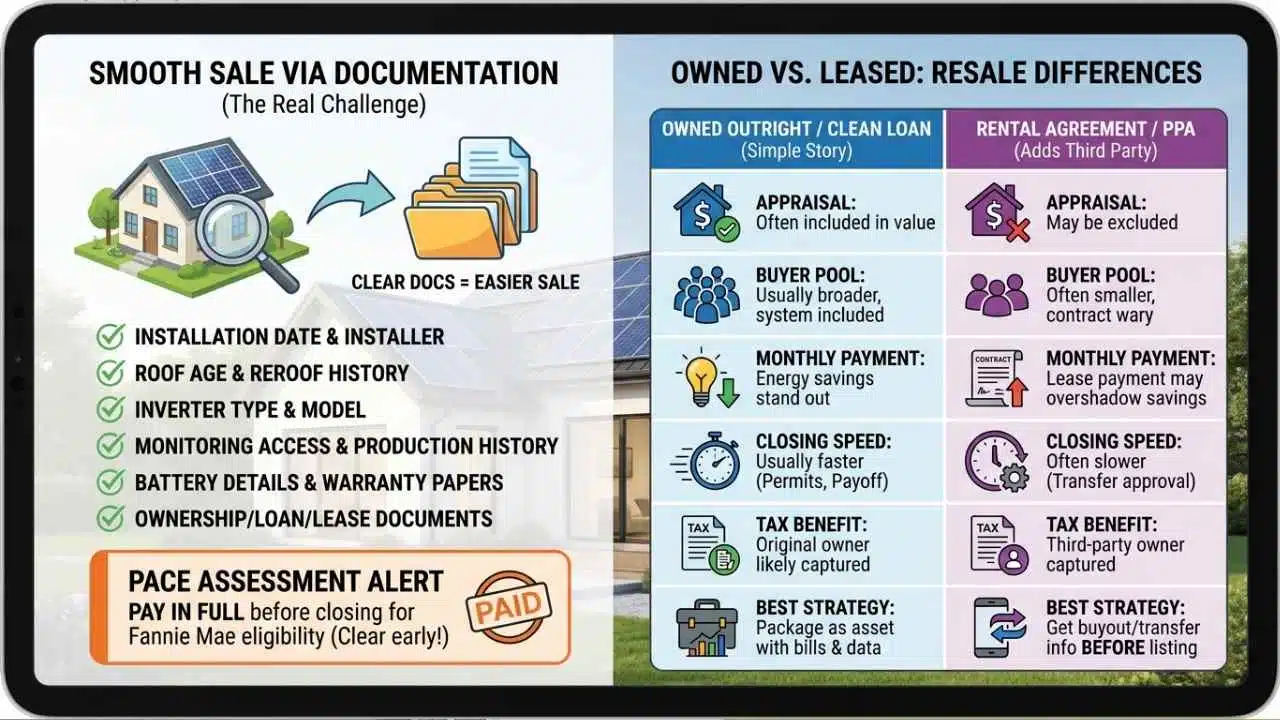
Most sales problems come from missing documents, not from the solar panels themselves. If buyers can quickly understand who owns the system, what it saves, and how it transfers, the home usually feels easier to buy.
Is it harder to sell a house with solar panels?
Usually no. In fact, owned solar often makes the home more appealing, especially when you can show clear bill savings and recent production.
The harder sales are the ones where buyers cannot tell whether the system is leased, whether a lien exists, or whether the roof and inverter are still in good shape. The Department of Energy’s buyer guide pushes the same checklist most smart sellers should prepare.
- Installation date and installer name
- Roof age and any reroof work since installation
- Inverter type and model
- Monitoring access and production history
- Battery details and warranty papers
- Ownership, loan payoff, or lease transfer documents
If a PACE assessment helped finance the system, clear that issue early. Fannie Mae says a property with a PACE loan is not eligible unless that obligation is paid in full before or at closing.
Differences between owned and leased systems during resale
Here is the quick version most sellers need. Ownership keeps the story simple, while a lease or PPA adds another party to the transaction.
| Topic | Owned Outright or with a Clean Transferable Loan | Rental Agreement / PPA |
|---|---|---|
| Appraisal | Can often be valued as part of the property. | May be excluded from appraised value. |
| Buyer pool | Usually broader because the buyer gets the system with the house. | Often smaller because some buyers do not want a third-party contract. |
| Monthly payment story | Energy savings stand out first. | Lease or PPA payment may overshadow the savings. |
| Closing speed | Usually faster with permits, warranty papers, and a payoff letter. | Often slower because transfer approval and contract review may be needed. |
| Tax benefit story | The original owner may already have captured available tax incentives. | The third-party owner usually captured those incentives. |
| Best seller strategy | Package the solar as a home asset with bills, production data, and warranties. | Get a buyout quote and transfer instructions before you go live on the market. |
Regional Variations in Solar Panel Impact on Home Value
Solar panels do not carry the same resale value in every market. Three local inputs matter most: electricity rates, utility compensation rules, and how familiar local buyers already are with home solar.
States with higher solar adoption rates
SEIA’s state data current through Q1 2025 puts California, Texas, Florida, Arizona, and North Carolina among the largest solar markets. In those states, buyers, agents, and appraisers are more likely to understand solar equipment and ask smart questions instead of treating the system like a mystery.
That familiarity helps resale. Mature solar markets usually have more comps, more experienced installers, and fewer surprises during underwriting and inspection.
Market demand for solar-powered homes in specific areas
The fastest way to judge demand is to look at what your local buyer will care about first. In some places that is monthly savings, and in others it is backup power or policy advantages.
| Market | What Drives Buyer Interest | What Sellers Should Highlight |
|---|---|---|
| California | High residential electricity prices, 31.97 cents per kWh in 2024, make solar savings easy to understand. New customers are on net billing, so storage matters more than it used to. | Show evening savings, battery specs, and any favorable utility rate setup that stays with the home. |
| Washington | Electricity is cheaper than California, but retail-rate net metering still exists until June 30, 2029, or until a utility hits its threshold, which can make exported solar power more valuable. | Show the utility credit history, annual production, and whether your utility still offers retail-rate treatment. |
| Florida | Strong solar adoption and friendly tax treatment improve the sales story, especially for owned systems with storm-ready documentation and clear warranties. | Highlight ownership, permits, insurance details, and the fact that Florida excludes qualifying residential renewable energy devices from assessed value. |
Final Thoughts
Solar panels usually help resale value, especially when the system is owned, documented well, and still producing meaningful savings. The big drivers are local electricity rates, utility rules, system age, and whether the buyer inherits an asset or a contract.
Your best next step is simple: gather the permits, invoices, production reports, utility bills, warranty transfers, and any loan payoff or lease papers before you list. When buyers can see the numbers clearly, your solar energy system becomes a real estate advantage instead of a question mark.
Do that, and your home value story gets a lot stronger.
Frequently Asked Questions (FAQs) About How Solar Panels Increase Home Resale Value
1. Will solar panels increase my home’s resale value?
Yes, owned solar panels often raise resale value, buyers like lower utility bills and a greener home. Think of solar as a wallet-friendly roof upgrade, it can make your listing stand out.
2. How much value do they add?
Owned systems can add about three to five percent to property value, though local market rules and demand matter.
3. Do buyers care about leased panels or bought panels?
Many buyers prefer owned panels, leases can scare them off, or slow a sale. Be ready to explain who pays the bills, and show warranties and system age. Clear records help buyers trust the offer.
4. Can solar panels ever hurt my home’s resale value?
Yes, poor installation, missing permits, or a complex lease can cut resale value and turn buyers away. A clean inspection, solid paperwork, and proof of energy savings keep your market appeal strong.





















