

Iranian state television has publicly called on citizens to remove the widely used messaging app WhatsApp from their smartphones, alleging—without presenting any direct evidence—that the platform collects personal information to share with Israel. The announcement comes amid heightened tensions in the region, particularly between Iran and Israel, following recent military escalations and ongoing cyberwarfare accusations.
The Iranian government did not offer technical proof to support its claim. However, the warning was broadcast nationally, raising alarms among citizens who rely heavily on WhatsApp for communication, especially during times of unrest or information blackouts. The report labeled WhatsApp as a “spyware tool” allegedly controlled by foreign intelligence networks, referencing Israel and its allies.
This is not the first time that Iranian authorities have targeted Western-made apps, especially those owned by Meta Platforms, Inc., the parent company of WhatsApp, Facebook, and Instagram. Iran has historically restricted digital freedom, particularly during periods of civil unrest, using both internet shutdowns and app bans to limit the flow of information.
WhatsApp Responds, Defending Its Privacy Standards
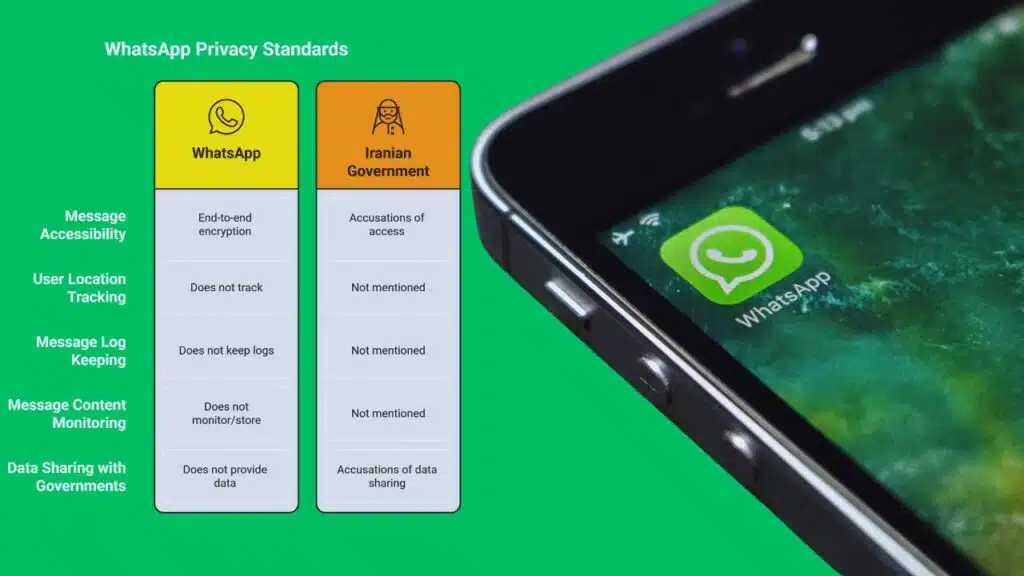
In a statement issued to global media outlets, including The Associated Press, WhatsApp firmly rejected the Iranian government’s accusations. A spokesperson stated that the company was “concerned these false reports will be an excuse for our services to be blocked at a time when people need them the most.”
The company emphasized that WhatsApp uses end-to-end encryption, a technology that ensures only the sender and recipient of a message can read its content. The encrypted format prevents third parties—including WhatsApp itself—from accessing messages, even if they are intercepted in transit.
The WhatsApp statement added that:
- The app does not track users’ precise locations.
- It does not keep logs of who users are messaging.
- It does not monitor or store the contents of messages.
- It does not provide bulk user data to any government, including the United States or Israel.
The messaging platform, used by over 2 billion people worldwide, reaffirmed its commitment to privacy and user safety, especially in regions where freedom of expression is under threat.
A Pattern of Restrictions: WhatsApp Bans Not New in Iran
Iran’s hostility toward WhatsApp is not unprecedented. In September 2022, following widespread protests over the death of 22-year-old Mahsa Amini in the custody of Iran’s morality police, the Iranian government imposed broad internet restrictions. WhatsApp, alongside Instagram, was banned during this time to curb the mobilization of protestors and the circulation of videos showing police brutality.
While those restrictions were later eased, they demonstrated the state’s willingness to target digital communication tools it cannot control. Telegram, another popular messaging app, has also faced periodic blocks in Iran over similar claims of national security threats and foreign manipulation.
In recent days, internet connectivity in Iran has deteriorated again, with reports from NetBlocks and other watchdog organizations confirming a 90% to 97% decrease in internet access across the country. These blackouts, reportedly tied to cyberattacks and military tension with Israel, have coincided with this new push to limit WhatsApp usage.
Expert Insight: Metadata and Data Sovereignty Under Scrutiny
While WhatsApp encrypts message content, cybersecurity professionals point out that metadata—information about message transmission such as timestamps, contact interactions, and user patterns—is not encrypted.
Dr. Gregory Falco, an assistant professor at Cornell University and an expert on cybersecurity and infrastructure resilience, weighed in on the controversy. He said, “It’s been demonstrated that it’s possible to understand metadata about WhatsApp that does not get encrypted.”
This means that while the content of a message remains hidden, observers—potentially including governments or malicious actors—can still analyze how frequently someone is communicating, with whom, and at what times.
Dr. Falco further emphasized concerns about data sovereignty, the principle that data related to a country’s citizens should be stored within its borders. “Countries need to house their data in-country and process the data in-country with their own algorithms,” he said. He argued that trust in global data infrastructure is rapidly eroding, and foreign-hosted services like WhatsApp often fall outside a nation’s regulatory reach.
Iran may be using these concerns as justification to promote domestic messaging apps or further surveillance-friendly platforms that operate under government oversight.
Broader Context: Digital Censorship Amid Political Crisis
This move by Iran to vilify and potentially restrict WhatsApp aligns with broader trends of digital authoritarianism. Over the past decade, the Iranian regime has created a digital firewall, designed to:
- Curb the spread of Western content.
- Promote state-controlled platforms.
- Increase surveillance capabilities over online behavior.
During previous periods of political unrest—such as the Green Movement in 2009, the 2017–18 protests, and the 2022 uprising—Iranian authorities shut down or throttled internet services to prevent protestors from organizing and communicating with international audiences.
Now, as Iran faces growing diplomatic isolation and military tension with Israel, the suppression of foreign communication tools could be a pre-emptive move to avoid internal dissent.
What It Means for Iranian Citizens
Iranian citizens who rely on WhatsApp for everyday communication—especially with family and friends abroad—are left in a difficult position. With internet access already limited, and foreign messaging apps under threat, their ability to share information, conduct business, or even access verified news is shrinking.
The Iranian government is simultaneously encouraging the use of homegrown messaging platforms, which critics warn may lack sufficient privacy protections and be vulnerable to state surveillance.
Digital rights activists argue that removing encrypted platforms like WhatsApp from public use would only further restrict freedom of speech and increase the Iranian government’s grip over digital life.
Privacy vs Control in a Time of Conflict
Iran’s latest move against WhatsApp reflects a growing global trend of state suspicion toward foreign technology companies, especially in volatile political climates. While WhatsApp continues to defend its encryption and privacy policies, the Iranian government’s narrative is shaping a national agenda focused on self-reliance, surveillance, and control.
As the country navigates a time of political pressure, military conflict, and economic hardship, its crackdown on digital communication tools may mark a new phase in the Iranian government’s strategy to control its information ecosystem, with long-term implications for civil liberties and freedom of expression.
The Information is Collected from AP News and MSN.





















