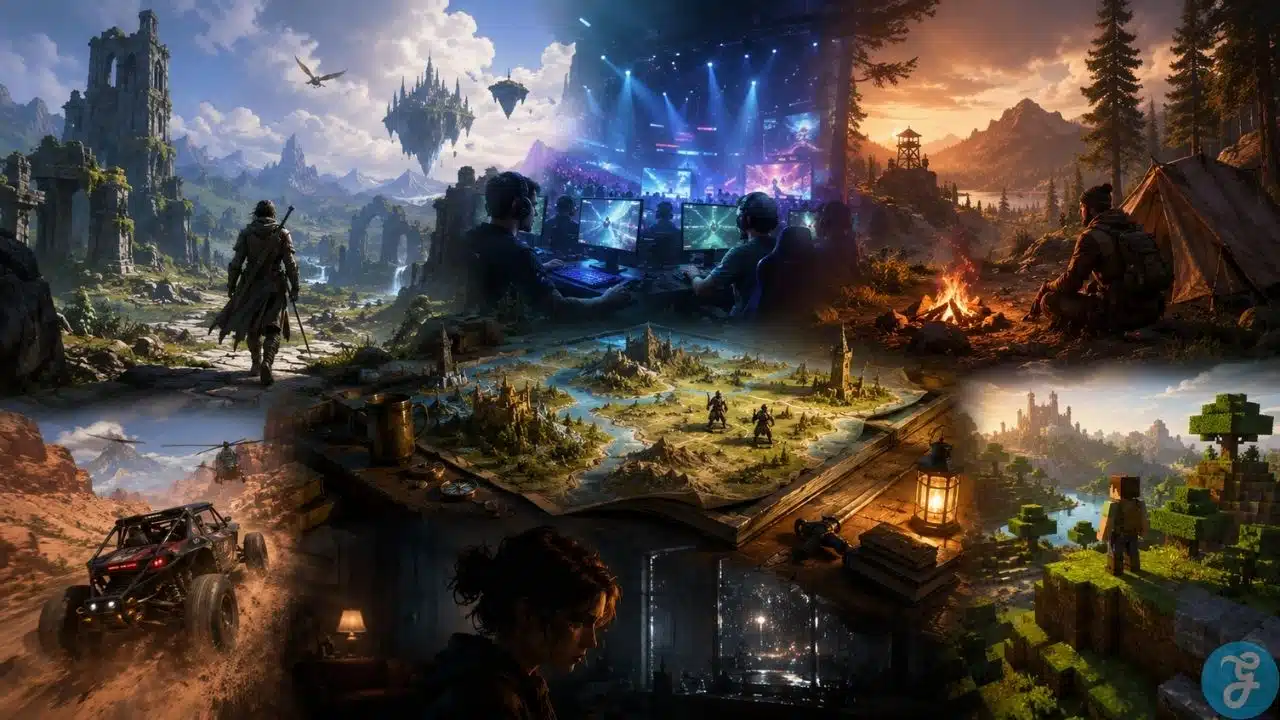
The gaming landscape has evolved from a fragmented collection of niche hobbies into a massive, interconnected cultural ecosystem. Understanding interactive entertainment requires looking at it holistically, from design frameworks to technical optimization and competitive discipline. This comprehensive gaming genres guide serves as an anchor for that ecosystem, mapping out how modern games are built, played, and mastered.
Role-Playing Games: Decoding Subgenres and Core Characteristics
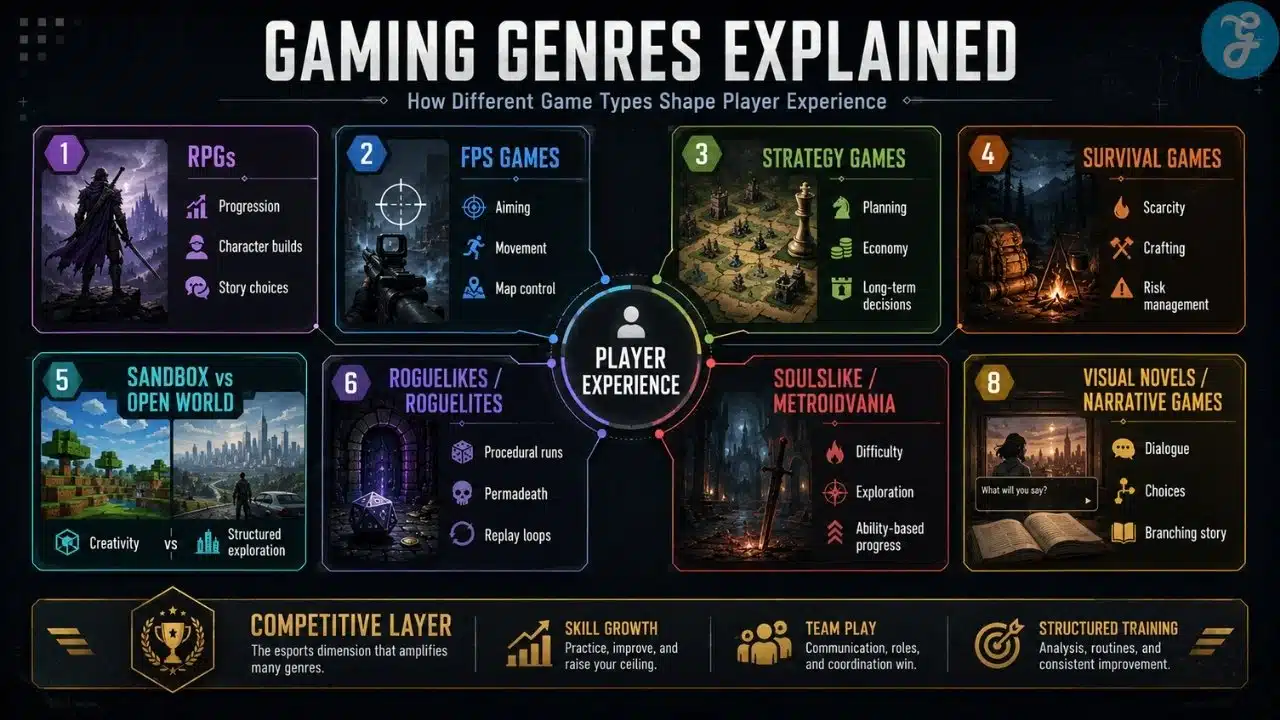
Role-Playing Games (RPGs) are anchored by the promise of player agency. They rely on mechanical progression systems, such as stats, level-ups, skill trees, and inventory management, to translate player choices into tangible in-game power. The execution varies wildly across subgenres, shifting the balance between tactical, numbers-driven design and fast-paced storytelling.
| Subgenre | Defining Combat Style | Narrative Approach | Character Progression Focus |
| CRPG | Turn-based or Real-Time with Pause, highly tactical. | Deeply branching, choice-driven, rooted in tabletop mechanics. | Complex stat sheets, multi-classing, and deep party synergy. |
| ARPG | Real-time, fast-paced, reflex-driven combat. | Often linear, serving as a backdrop for the core gameplay loop. | Loot optimization, build theorycrafting, and endgame power scaling. |
| JRPG | Traditionally turn-based or menu-driven systems. | Linear, deeply cinematic, character-driven epic narratives. | Pre-defined party roles with linear level-ups and specialized gear. |
| WRPG | Real-time action or hybrid tactical combat. | Open-ended exploration with a focus on player-defined morality. | Sandbox freedom, allowing highly customized player archetypes. |
First-Person Shooters: Mechanical Evolution and Tactical Depth
First-Person Shooters (FPS) represent a pure expression of mechanical skill, tracing a line from the frantic arena shooters of the 1990s to the pixel-perfect tactical execution of modern esports. The evolution of the genre is defined by a constant push and pull between speed, spatial physics, and tactical complexity.
Early arena shooters prioritized horizontal and vertical speed, turning physics quirks like bunny-hopping and rocket-jumping into essential survival tools. Combat was projectile-heavy, requiring players to calculate weapon travel time while tracking item spawn timers. Modern FPS design has split this framework into two distinct paradigms. Tactical shooters trade raw speed for methodical positioning, sound cues, and hitscan ballistics where bullets register instantly. Meanwhile, the Battle Royale subgenre re-introduced projectile ballistics at a massive scale, forcing players to calculate bullet drop and travel over vast distances.
PC Performance Optimization: Maximizing Frame Rates and System Stability
A perfectly designed game means very little if your hardware struggles to render it consistently. True PC optimization is not just about maximizing average frames per second, it is about minimizing frame time variability, which causes the tiny, erratic stutters that ruin input responsiveness during intense gameplay.
To build a stable playing baseline, address hardware and software bottlenecks systematically:
-
Frame Time Synchronization: Sudden frame time spikes cause visible hitching. Variable refresh rate technologies, like G-Sync or FreeSync, align your monitor’s refresh rate with your GPU’s output to eliminate screen tearing without the severe input lag introduced by traditional V-Sync.
-
Upscaling Technologies: Modern performance management relies heavily on hardware-accelerated deep learning upscalers like DLSS, FSR, and XeSS. Rendering at a lower internal resolution and using AI spatial reconstruction reclaims massive amounts of GPU headroom.
-
System Latency Reduction: Enabling low-latency configurations within your graphics control panel bypasses the traditional CPU render queue, passing input data directly to the GPU to drop input delay significantly.
Data Preservation: Advanced Game Backup and Save Management
As games grow more mechanically complex, protecting your save data becomes a vital piece of operational maintenance. While automated cloud synchronization has made data loss less common, local hardware failures, mod conflicts, or corrupted cloud states can instantly erase hundreds of hours of progress.
True save management requires knowing exactly where your data lives. PC games distribute files across multiple hidden system paths, including the user AppData folder, the Documents directory, or specific subfolders inside your platform client’s program files. For heavily modded games, manual version control is essential. Mod installations frequently rewrite save data structures, meaning a single game update can render an existing save file unreadable. Maintaining dated, offline zip backups of your raw save files and mod configuration profiles ensures you can always roll back your environment to a stable state.
Roguelikes vs. Roguelites: The Meta-Progression Divide Explained
The boundary between a true Roguelike and a Roguelite is a major point of debate in game design theory. Both subgenres share a core foundation consisting of procedurally generated environments, permadeath, and high mechanical difficulty. The divergence lies entirely in how they handle player failure.
A classic Roguelike adheres strictly to the traditional “Berlin Interpretation,” featuring turn-based combat, grid-based movement, and absolute, uncompromising permadeath. When your character dies, your entire run is erased. You start the next attempt with zero mechanical advantages, meaning your only carry-over asset is your own personal knowledge of the game’s systems. A Roguelite, by contrast, introduces persistent meta-progression. Resources collected during a run are brought back to a persistent hub world to permanently unlock stat upgrades, better starting gear, or new abilities, making the game mathematically easier over time.
The Metroidvania Blueprint: Mastering Ability-Gated Exploration
The Metroidvania genre is defined by a unique architectural philosophy where the map itself is the puzzle. Merging the design frameworks of Metroid and Castlevania, these games reject linear stage structures in favor of a massive, continuously interconnected two-dimensional world that players are structurally blocked from fully accessing out of the gate.
The defining characteristic here is ability-gated progression. Instead of restricting exploration with keys or story triggers, a Metroidvania blocks progress using physical obstacles that require specific movement upgrades to bypass, such as a ledge that is too high or a gap that is too wide. This layout forces a continuous loop of exploration, soft-blocking, discovery, and backtracking. When you unlock a new ability, like a double jump or a dash, old pathways suddenly become viable routes to entirely new zones.
The Soulslike Formula: Deliberate Combat and High-Stakes Tension
Emerging from FromSoftware’s groundbreaking design choices, the Soulslike has crystallized into a distinct genre defined by deliberate action, high-stakes environmental tension, and minimalist, passive storytelling.
At the heart of any Soulslike is strict resource management, usually governed by a stamina meter. Every single action costs a finite amount of energy, and combat completely rejects animation-canceling. When you commit to an attack, you are locked into that animation frame, leaving you vulnerable if your timing is incorrect. This combat is paired with a distinct corpse-run penalty system. Dying drops all accumulated currency at the point of failure, giving you exactly one chance to fight your way back to reclaim it. Dying a second time erases those resources permanently.
The Strategic Arena: Turn-Based Tactics vs. Real-Time Macro Control
The strategy genre is a broad analytical arena where success is determined by resource allocation, map control, and long-term planning rather than raw mechanical reflexes. The genre is split down the middle by how time itself is managed.
Real-Time Strategy (RTS) games force players to balance macro-management, including economy building and tech-tree progression, with micro-management of individual units in live combat simultaneously. Success is heavily tied to mechanical efficiency, measured in Actions Per Minute (APM). Turn-Based Strategy (TBS) and Grand Strategy games completely remove the element of real-time panic, shifting the focus toward pure systemic optimization. In a turn-based format, players use the luxury of time to analyze map data, manage complex diplomatic relationships, and calculate military logistics across massive scales.
The Survival Spectrum: Comparing Environmental and Extraction Subgenres
The survival genre strips away the traditional hero narrative, casting the player as an underdog fighting directly against an actively hostile environment. At its baseline, the genre relies on a continuous loop of resource gathering, tool crafting, and base building, all while managing depleting survival metrics like hunger, thirst, and exposure.
The genre has splintered into distinct experiential subgenres. The traditional “Open-World Survival Craft” emphasizes persistent environmental dominance where players start with nothing, gradually tech up from stone tools to advanced machinery, and establish permanent fortresses. Conversely, the “Extraction Survival” subgenre injects high-stakes military simulation into the loop. Persistence is fragile, as players deploy into hostile instances to scavenge high-value gear knowing that if they die before reaching an extraction point, every piece of equipment they carry is permanently lost.
The Esports Landscape: An Overview of Leading Competitive Disciplines
The professional esports ecosystem mirrors traditional sports, broken down into highly specialized competitive disciplines that each require a fundamentally different cognitive and mechanical skillset.
-
MOBAs: Titles like League of Legends and Dota 2 are deep strategic simulations masked as isometric action games. Five-player teams must balance real-time mechanical execution with long-term macro-strategy, tracking map rotation timings and managing fluid, map-wide economic resources.
-
Tactical Shooters: Counter-Strike 2 and Valorant represent the peak of round-based precision, relying on flawless crosshair placement, meticulous team communication, utility coordination, and millisecond-level reaction times.
-
Fighting Games: Street Fighter 6 and Tekken 8 strip away the team dynamic entirely, presenting a pure 1v1 psychological battle that requires deep frame-data literacy, instant spacing adjustments, and intense mid-match adaptation.
The Competitive Crucible: How Pro Esports Players Train
Esports training is often misunderstood as just playing more games or grinding ranked matches for hours. In reality, professional players treat training as a structured process that includes practice, analysis, physical and mental preparation, and controlled repetition of specific skills. The difference between casual play and structured esports training is how that practice time is used. Players do not plateau because they stop playing, they plateau because they stop training with intention.
The Illusion of the Grind: Why Simply Playing Isn’t Real Training
Hitting the matchmaking button repeatedly eventually hits a hard wall of diminishing returns. Professional training breaks the game down into isolated blocks, dedicating specific sessions to mechanical execution, tactical decision-making, or reviewing mistakes rather than treating every match as the same activity.
Mechanical Isolation: Building Flawless Execution Through Repetition
True mechanical work is about building consistency under pressure by drilling the exact same micro-actions in sterile environments until execution becomes automatic. This translates to rigid aim routines in FPS titles or perfecting lane control and skill timings in MOBAs.
The VOD Review: Ruthlessly Dissecting Tactical Errors
Players study their own match footage to dissect what actually happened, completely removing the emotional bias of memory. Slowing down the tape makes poor positioning, delayed map rotations, and forced fights stand out in sharp relief, turning mistakes into actionable fixes.
Decoding Game Sense: The Science Behind Pattern Recognition
Game sense is an advanced layer of pattern recognition built through massive repetition and conscious observation. Over time, an attentive player’s brain starts automatically mapping out trends, allowing them to anticipate enemy movements, objective timings, and tactical setups before they happen.
Coordinated Macro: Synchronizing Team Communication and Execution
In team esports, collective coordination overrides individual mechanics. Teams must meticulously practice communication protocols, spacing, utility timing, and macro-level choice mapping, because a highly coordinated group will easily dismantle a disorganized team of mechanically superior players.
Holistic Preparation: Managing Physical Conditioning and Mental Durability
Your physical and mental condition directly dictates your performance ceiling during long, high-intensity gaming sessions. Professional organizations integrate physical fitness routines, ergonomic adjustments, and sports psychology to protect players from fatigue, burnout, and chronic mental tilt.
Debunking Myths: Correcting Common Misconceptions About Esports Practice
The most persistent misconception is that gaming skill is entirely about raw reaction time or aim scores. Mechanics are merely one layer of the competitive pyramid, and dumping mindless hours into a game without structure simply reinforces bad habits.
Active Goals vs. Relaxation: Differentiating Casual Play and Structured Training
Casual play is flexible, allowing players to experiment and unwind without strict goals hanging over their heads. Structured training is laser-focused, meaning every session is approached with a definitive purpose, whether that involves fixing a mechanical quirk or running specific tactical scenarios.
The Layered Strategy: Why Deliberate Practice Yields Permanent Improvement
This structured approach works because it breaks the overwhelming task of improvement into manageable pieces. By isolating specific skills and refining them in a controlled environment, players build a stable baseline of performance that remains measurable rather than random.
Setting Absolute Boundaries: A Deep Dive Into Play vs. Practice Mindsets
High-level development requires treating casual play and structured practice as mutually exclusive environments. Mixing these mindsets, such as trying to relax during a practice block or letting yourself tilt during a casual lobby, instantly degrades competitive consistency.
The Systemic Architecture of Continuous Competitive Longevity
The longevity of an esports athlete depends entirely on the robust architecture of their training loop. Weapon metas will shift and balance patches will alter the landscape, but a player who knows how to systematically deconstruct their own performance will always find a path back to the top.
The Bottom Line: Transforming Accidental Success into Absolute Mastery
Mechanical training builds execution, VOD review builds awareness, team practice refines coordination, and mental control locks in consistency. Together, these elements form a complete development system, ensuring that real improvement happens when practice is entirely intentional, never accidental.
Geography vs. Rulesets: Separating Open World Design from the Sandbox
The terms “Sandbox” and “Open World” are frequently used interchangeably in many a gaming genres guide, but they refer to completely separate vectors of player freedom. One defines a freedom of geography, while the other defines a freedom of systemic rules.
An Open World game focuses on spatial freedom. The developers construct a massive, geographically seamless world filled with pre-authored content, quests, and storylines. While you have absolute freedom regarding where you travel and when you complete tasks, your interactions are ultimately constrained by a programmed narrative structure. A Sandbox game focuses on mechanical and systemic freedom, providing a highly reactive physics and logic toolkit instead of scripted story content. Players are encouraged to manipulate interlocking systems, like chemistry engines or crafting frameworks, to create emergent, unscripted solutions.
Narrative-First Architecture: The Choice Logic of Visual Novels
At the opposite end of the mechanical spectrum sit Visual Novels (VNs) and high-concept narrative games. These experiences intentionally de-emphasize real-time reflexes, complex physics, and resource management to elevate choice architecture, prose, and psychological pacing to the primary gameplay mechanics.
The design power of a narrative game rests entirely on the integrity of its branching paths. Player choices do not simply change a cosmetic line of dialogue, they re-route the entire logic structure of the story. High-level entries use invisible point-tracking matrices and hidden emotional variables to map user decisions over hours of text, creating highly divergent narrative realities where an early conversational choice can cascade into completely unique mid-game arcs and final outcomes.
The Future Layout of Interactive Entertainment
The structural boundaries defining modern game design are becoming increasingly fluid. Elements that once belonged exclusively to hardcore RPGs, like detailed stat tracking and skill progression, now form the baseline retention mechanics for sports titles, racing simulators, and tactical shooters alike. Similarly, the open-ended emergent freedom of sandbox design is continuously finding its way into heavily scripted narrative titles.
As hardware barriers lower and machine learning upscalers normalize high performance across modest systems, the focus of game evolution has shifted firmly onto systemic depth. The most successful modern experiences are those that understand how to borrow strengths from multiple categories, balancing player agency with mechanical structure. For players and developers navigating this space, understanding the rigid foundations of genre architecture is the first step toward appreciating the next wave of hybrid digital experiences.