US LLC banking can become a business emergency long before a company runs out of customers. An account closes, incoming payments lose their destination, and the founder discovers that a US registration certificate does not guarantee somewhere to keep the money. For owners living in India and Bangladesh, the next move depends on why the account was closed—and whether a replacement provider accepts the actual business, owner and operating location.
Two Mercury notices supplied for this article show how different those problems can be. Editorialge Media LLCEditorialge Media LLC received confirmation that its account had closed. Tech Unico Solutions LLCTech Unico Solutions LLC received a notice identifying the absence of US operations and setting a withdrawal deadline of December 4, 2026.
Those are not interchangeable cases. A founder facing a residence restriction needs a different search strategy from a company that cannot satisfy an operating-presence requirement. Neither problem is solved simply by buying another US mailing address.
Editorial disclosure: Editorialge Media LLC is the publisher’s company. Founder-supplied Gmail PDF notices were reviewed for this guide; personal names and email addresses are redacted in the reproduced excerpts. The notices have not been independently authenticated through Mercury’s systems. Provider policies were reviewed in November 2026; application decisions remain individual.
What the Two Mercury Notices Actually Show
Editorialge Media LLC: A Closed Account and a Residence Restriction
Sukanta Kundu, founder and CEO of Editorialge Media LLC, is a Bangladeshi founder living in Bangladesh. He reports losing access to normal account operations around the beginning of May 2026.
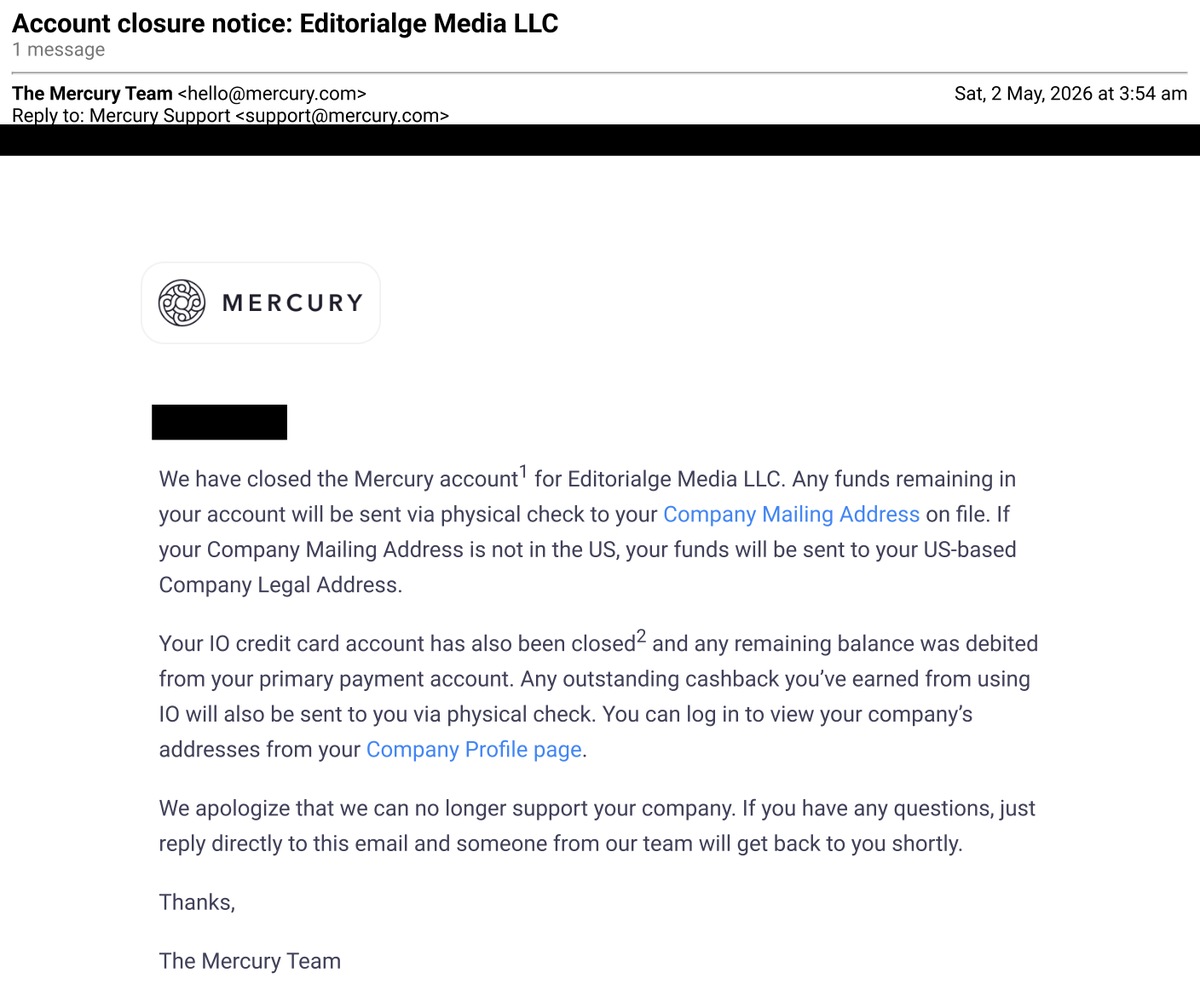
The supplied notice displays a May 2, 2026 date and confirms that the company’s Mercury account had closed. It explains that any remaining balance would be sent by physical check to the company’s mailing address, or to its US legal address if the mailing address was outside the United States.
Kundu attributes the loss of access to the Bangladesh restriction. Mercury’s published prohibited-countries policy lists Bangladesh among the restricted places of residence. However, this particular closure email does not state a reason. It establishes the closure and the instructions for remaining funds; the founder’s explanation and the published country policy provide separate context.
That distinction matters. It allows readers to understand the practical problem without turning an inference into a quotation from the notice.
Tech Unico Solutions LLC: No US Operations
Aushnik Das, founder and CEO of Tech Unico Solutions LLC, is an Indian founder living in India. The notice supplied for his company is dated November 4, 2026. It says Mercury is proceeding with closure because the company confirmed it currently had no US operations.
The stated withdrawal deadline is December 4, 2026. The document lists ACH, physical check and domestic or international wire as withdrawal options. It also says international wires must go to an account owned by the recipient or their business, and that third-party transfers may delay disbursement.
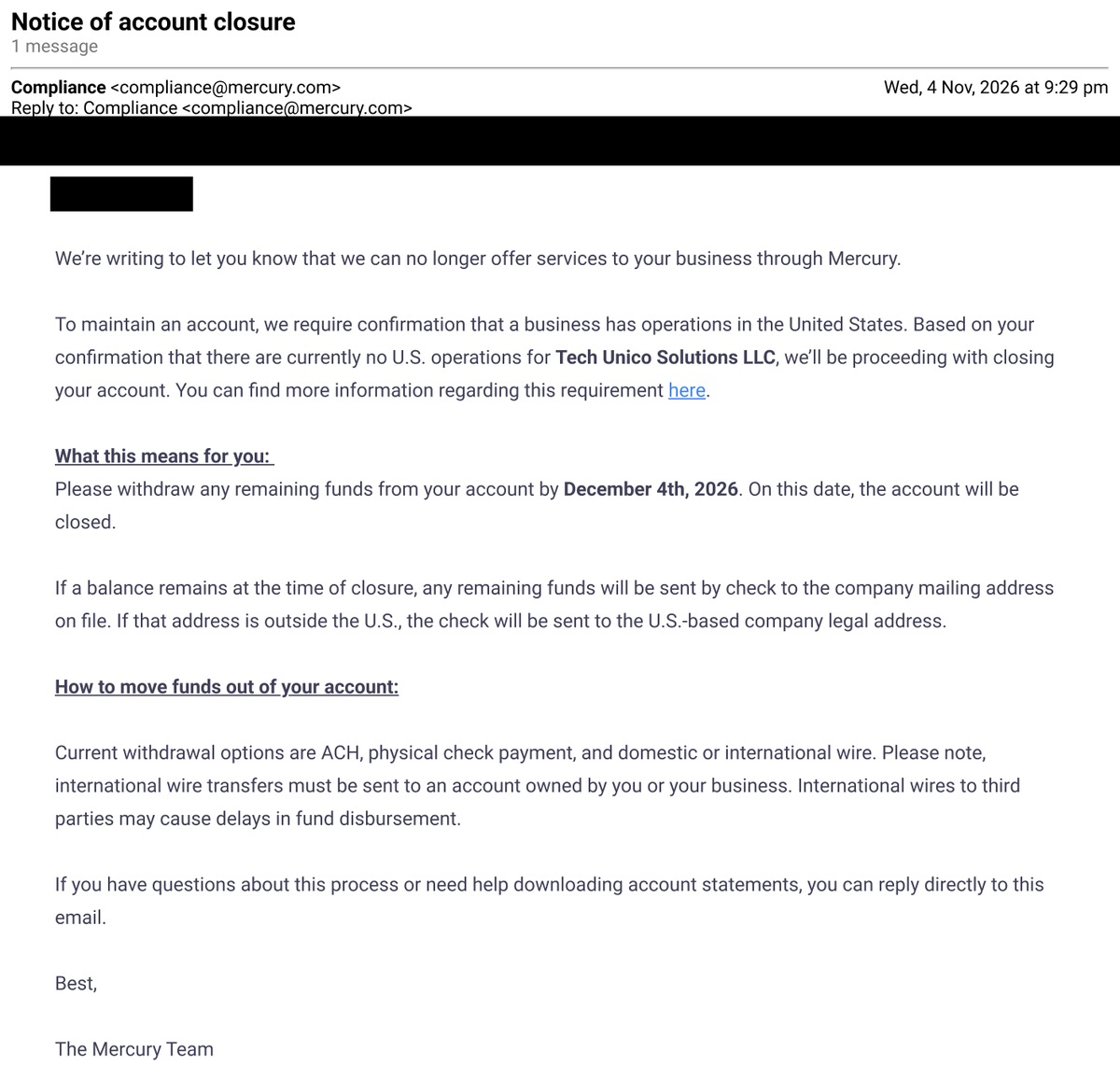
The wording identifies an operating-presence problem. It does not say that Indian citizenship itself caused the closure. India is not on the Mercury prohibited-country list reviewed for this article.
Neither notice dissolves the underlying LLC. Account closure and company closure are separate events, with different consequences and paperwork.
US LLC Banking Depends on More Than Incorporation
A US company can have a registered agent in one state, a founder living overseas and customers in several countries. A financial provider will examine how those facts fit together. Filing the incorporation documents answers only one part of that assessment.
| Detail | What it establishes | What it does not establish |
|---|---|---|
| US registration and EIN | The entity’s legal and tax identity | Automatic banking eligibility |
| Registered-agent address | An address for designated legal communications | A genuine operating office |
| Founder’s residential address | Where the owner actually lives | That the company operates in the US |
| Contracts, staff, premises or other business evidence | Facts about the operating business | Acceptance by every provider |
Mercury’s general eligibility page refers to existing or planned US operations. It also allows a principal business address in the US or internationally, including a residential address, while excluding registered-agent addresses, PO boxes and similar mailbox services for that purpose. A requirement for US operations therefore should not be rewritten as a universal requirement to own or rent a US office.
For the Indian company in this article, the notice’s precise reason is the absence of US operations. If a founder believes the provider has misunderstood genuine operations, the useful response is documentary clarification—not changing the address label on the same mailbox.
An ITIN has limits too. The IRS explanation of ITINs describes a tax-processing identifier. It is not a promise that a bank, PayPal or another payment business must accept its holder.
Nor do these two notices establish a government-wide “yellow list” banning all Indian or Bangladeshi founders from US corporate accounts. The evidence here concerns particular provider policies and individual company notices. Citizenship, residence, company registration and operating location must be checked separately.
Readers still working through the basic documentation can consult our guide to opening a US bank account as a nonresident. The closure cases here show why that preparation needs a provider-specific eligibility check.
First Decide What the Replacement Must Do
“I need an account” can mean several things. A software company may need card checkout and somewhere for the processor to settle the proceeds. A media business may mostly receive invoices paid by bank transfer. A company paying contractors also needs reliable outgoing payments.
| Service | Job it performs | Question to ask |
|---|---|---|
| Business bank account or fintech business account | Holds business funds and supports permitted transfers | Will it accept this US LLC and every relevant owner’s residence? |
| Receiving-account service | Provides details for approved types of incoming payment | Which senders and payment purposes are permitted? |
| Payment gateway or processor | Collects customer payments through checkout or other supported methods | Where can it settle funds in the company’s name? |
A receiving service is not necessarily a full bank account. A checkout account does not solve a missing settlement account. For businesses whose clients prefer bank transfers, our comparison of ACH collection tools explains another part of the collection process; the underlying account still has to meet its own eligibility rules.
For Founders Living in India: Start With the Operating-Presence Question
The first task is to establish what the company can truthfully document. Does it have US operations, or is it an overseas business using a US legal entity? That answer will narrow the search faster than a list of banking logos.
Relay is worth investigating where the company can meet its operating-presence requirements. India is absent from its published prohibited-country list, but passing that check is only a starting point. Its documentation also raises address and US-presence requirements that need clarification for an overseas founder.
Airwallex is another conditional candidate. Its US onboarding guidance generally requires a genuine US principal place of business, with stated exceptions for e-commerce businesses and businesses incorporated within the previous year. Whether a particular company fits an exception is an onboarding decision.
For invoice collection, an approved Payoneer business account may meet a narrower need. That does not establish that it will replace every feature of the closed account. A direct corporate-bank application may also be worth the work when transaction volume justifies individual review.
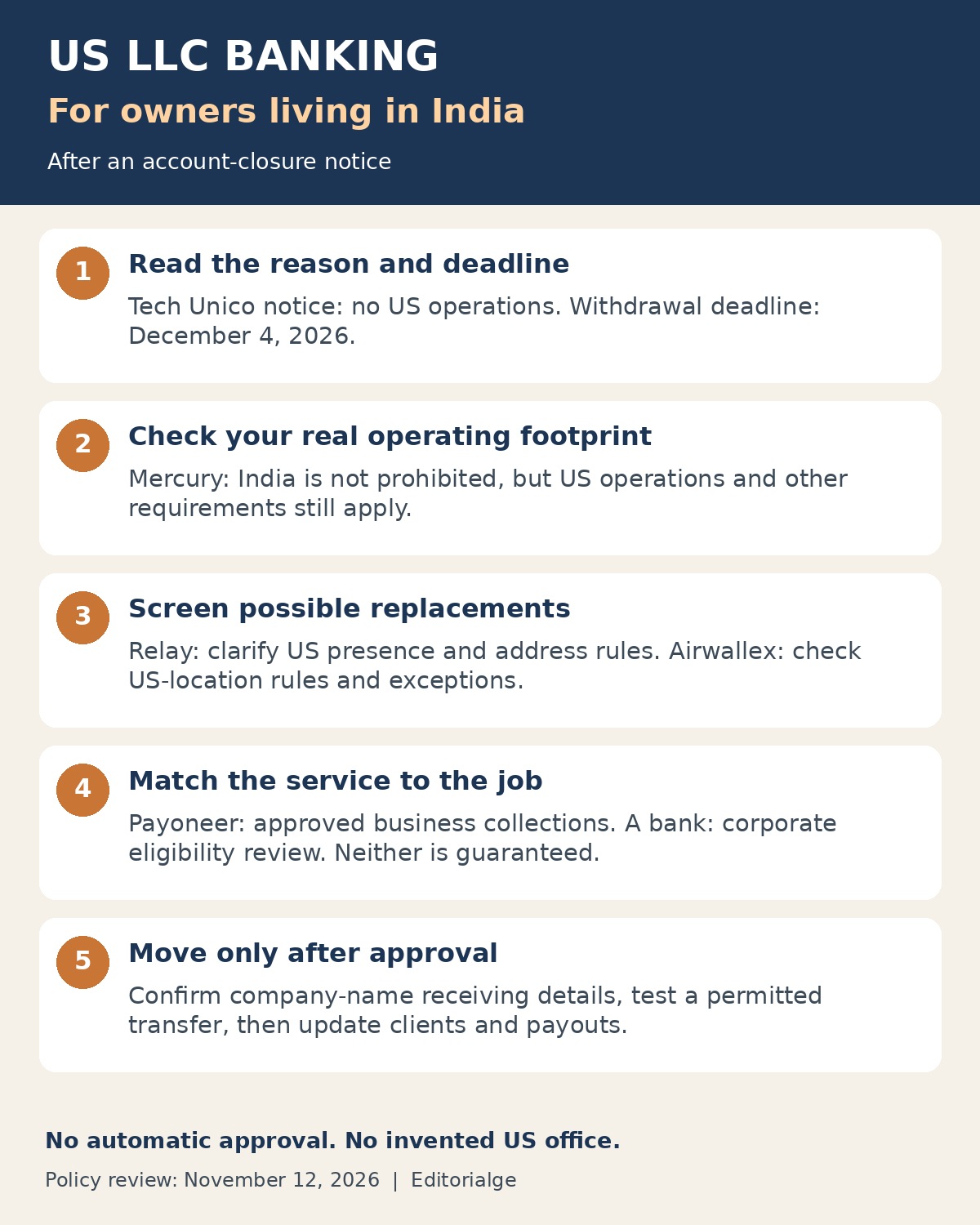
The useful shortlist for an India-resident founder is therefore conditional: Relay for a company that can resolve its presence and address requirements; Airwallex where its US criteria or exceptions fit; Payoneer for an approved collection workflow; and a corporate bank willing to assess the exact structure. None should be described as guaranteed or effortless.
For Founders Living in Bangladesh: Remove the Known Dead Ends First
A Bangladesh-resident owner should not spend money changing a US company address in the hope that this alone will overcome Mercury’s residence restriction. The owner’s actual residence remains part of the assessment.
Wise also needs particular caution. Its USD account-details guidance contains restrictions involving Bangladesh addresses, including relevant US business and personal-profile situations. It should not be presented as a dependable USD receiving replacement for this founder profile.
Relay’s published prohibited-country list does not include Bangladesh. That makes it reasonable to investigate—not reasonable to announce that Bangladesh-resident owners are approved. Its separate US-presence and address requirements still need to be satisfied.
Payoneer and Airwallex require a company-specific assessment. Neither a service being accessible in Bangladesh nor a provider accepting US-incorporated companies proves that this combination of company, beneficial owner, residence and business activity will pass review.
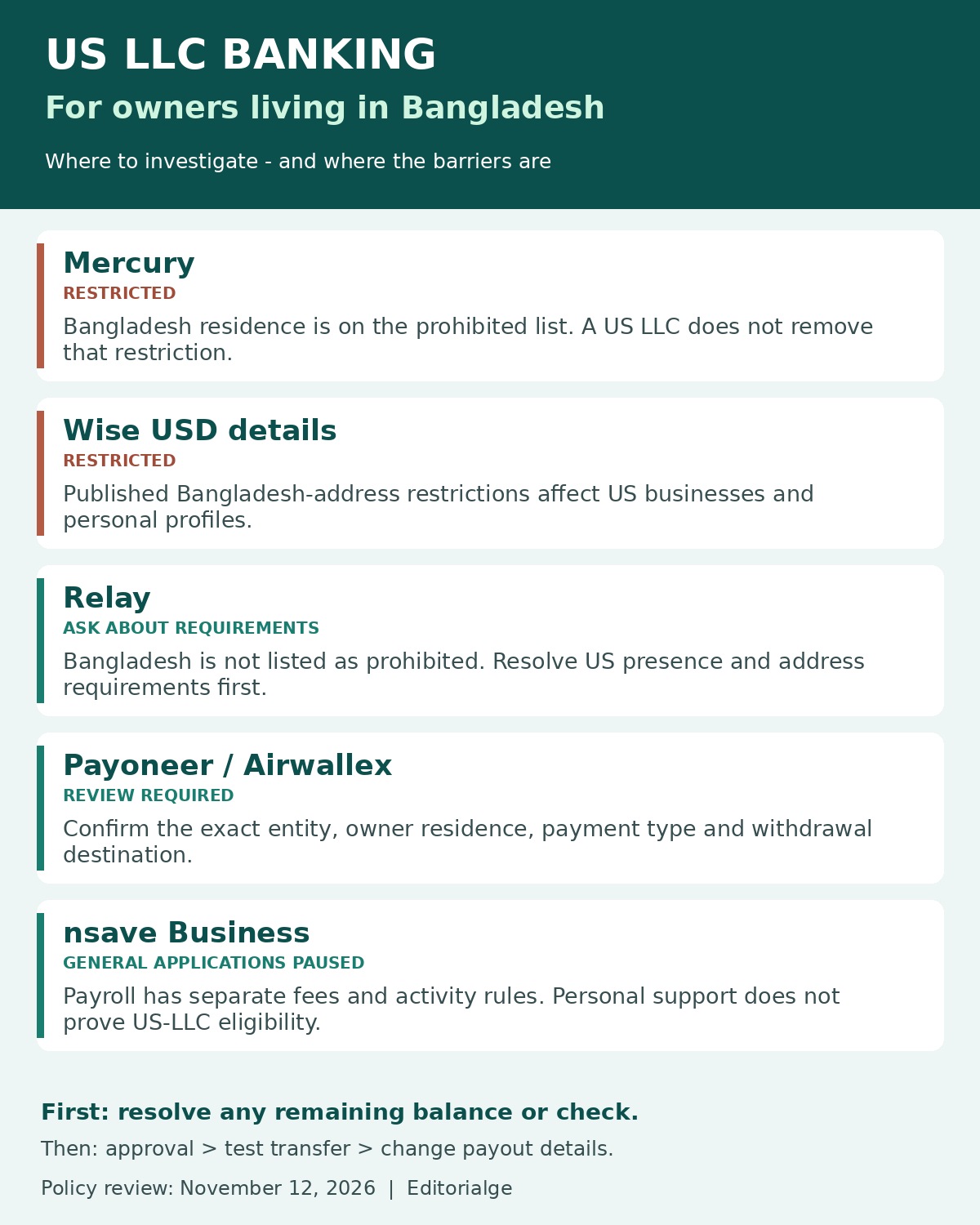
For an already closed account, resolving the remaining balance may be more urgent than opening another one. The Editorialge notice refers to a physical check. The company should establish whether a check was issued, where it was sent and what permitted options exist if it cannot be deposited. A service offering ACH details may still be unable to accept that check.
How the Main Options Compare
This comparison identifies where to investigate and where a known barrier exists. “Review required” means eligibility for the exact founder profile has not been established; it is not a recommendation to move funds.
| Provider or route | India-resident owner | Bangladesh-resident owner | Most useful potential role |
|---|---|---|---|
| Mercury | Country check alone does not exclude India; US operations and other criteria apply | Published residence restriction | Only where the business and owners satisfy its criteria |
| Relay | Country not listed; presence and address checks remain | Country not listed; presence and address checks remain | Business-account candidate after requirements are resolved |
| Airwallex | Conditional US-company review | Exact owner-residence eligibility needs confirmation through review | International business payments where onboarding criteria fit |
| Payoneer | Business account and services subject to approval | Business account and services subject to approval | Permitted business collections and withdrawals |
| Wise USD details | Exact company and profile assessment required | Published Bangladesh-address restrictions | Do not assume personal-account access establishes business eligibility |
| nsave Business | General applications paused; separate payroll conditions | Same pause; personal availability does not prove US-LLC acceptance | A payroll inquiry only where the actual business fits |
| Direct corporate bank | Individual bank review | Individual bank review | A documented banking relationship for an eligible company |
Relay: Clarify the Address Rules Before Building a Migration Plan
Relay’s operating-address guidance permits domestic or international residential addresses in certain circumstances. Its entity-document checklist also refers to US physical-address and operating-presence requirements. Those statements should not be flattened into “no US address needed.”
Ask how the requirements apply to your owners and entity type. Give the real operating address and explain any US activity. If the answer remains unclear, treat the application as unresolved and keep looking. Being absent from a prohibited-country list cannot settle a separate documentation requirement.
Airwallex: The Exception Must Fit the Business
A company selling online may have a different onboarding path from a remote consultancy. A recently incorporated company may fall under a different exception from an established LLC. Describe the business accurately rather than choosing a convenient category.
Airwallex says it cannot confirm eligibility before an application. Policy questions can help avoid an obvious mismatch, but they are not preapproval. Do not redirect customer payments until the account and the required receiving services are actually active.
Payoneer: Judge the Approved Workflow, Not the Brand Alone
Payoneer can be relevant when the main requirement is collecting eligible commercial payments. Its receiving-account services are payment services rather than a conventional bank account, and availability varies.
Check the legal account holder, permitted incoming payments, withdrawal destination and conversion terms. Kundu reports difficulty obtaining approval and concerns about conversion value. Those are reasons to examine the actual offer carefully; they do not establish a universal rejection policy or a single exchange rate for every user.
nsave: Personal Access and Business Access Are Different
nsave’s support for an individual customer does not establish that it accepts the customer’s US LLC. Its published business payroll terms say general business applications are paused. The same page contains inconsistent reopening references, so this should not be treated as an immediate general-purpose replacement.
The payroll route has separate conditions, including a $200 setup fee and recurring activity involving more than 10 transfers to individuals per calendar month. A founder who only needs to collect a few client invoices should not assume that this product is suitable.
A Direct Bank: Ask About the Company, Not a Personal Account
Some founders may benefit from a traditional corporate-bank review despite more paperwork. Dukascopy Bank, for example, advertises corporate account services. That establishes the existence of a corporate product, not confirmed eligibility for an India- or Bangladesh-resident owner’s US LLC.
Ask the bank about that exact combination. Also confirm whether it provides the receiving rails customers need: a corporate account with international wires is not automatically a substitute for US domestic ACH details. Do not buy travel or an intermediary package on the strength of a personal-account success story.
A Practical Migration Plan After a Closure Notice
1. Record the Deadline and Preserve the Account History
Save the notice, recent statements, transaction history, balances and support correspondence. Identify incoming invoices, processor settlements, subscriptions and contractor payments that still depend on the old details.
For Tech Unico, the supplied notice gives December 4, 2026 as the deadline. Work backward from the document’s date rather than a date remembered from a conversation. For Editorialge, the notice describes an account already closed, so the next step is to resolve the stated balance-return process.
2. Build One Accurate Application File
Prepare the formation documents, EIN confirmation, ownership details, identification, real residential and operating addresses, website and representative contracts or invoices. Explain where the work happens, who pays the company and how funds are used.
Keep that account consistent across the application. A registered agent is not an employee, a forwarding address is not an office, and an intended expansion is not an existing operation. If a provider accepts planned operations, explain the plan as a plan.
3. Ask Questions That Can Eliminate a Bad Fit
A useful inquiry is specific: “Our company is a US LLC. Its beneficial owner lives in Bangladesh [or India], and its work is performed from that country. We have [describe actual US operations, or state that there are none]. Do your published requirements allow this profile to apply, and what evidence is required?”
Then ask whether the approved service supports the necessary ACH payments, wires, processor settlements, checks and outgoing transfers. Some providers will only reach a final decision through onboarding. Keep a record of the answer without presenting it to clients as approval.
4. Test the Approved Account Before Redirecting Everything
Confirm the beneficiary name and payment instructions. Make a small permitted transfer and verify that the money arrives and can be used or withdrawn as required. Check fees and settlement timing.
Only then update processor payouts, invoice templates and customers. Ask important clients to confirm the change through an established contact channel. A sudden bank-details update can resemble invoice fraud, so a clear confirmation process protects both sides.
5. Keep the Exit Documented
Follow the closing provider’s permitted withdrawal instructions. Do not improvise by routing company revenue through a friend’s account or an unrelated business. If the notice offers a check that the company cannot deposit, ask the provider what alternatives it permits.
Retain the final statements and evidence of where the remaining funds went. Where possible, develop a second approved payment route so one account closure does not stop every collection channel.
Compare the Amount Received, Not Just the Advertised Fee
Foreign exchange can make an apparently inexpensive service costly. Compare quotes for the same payment amount, currency pair and time, then subtract collection fees, withdrawal charges and any intermediary costs.
The following is an illustration, not a live exchange-rate comparison or a quote from Payoneer or another provider.
| Example | USD converted | Illustrative rate | Amount before other fees |
|---|---|---|---|
| Route A | $1,000 | BDT 120 per USD | BDT 120,000 |
| Route B | $1,000 | BDT 124 per USD | BDT 124,000 |
That hypothetical difference is BDT 4,000. Additional fees could change the result. An India-resident founder should make the same comparison in INR using actual quotes, rather than assuming that a Bangladesh payout example predicts an Indian payout.
Cost comes after eligibility. A better conversion rate is of little help if the account cannot legally receive the company’s payments or if the desired withdrawal route is unavailable.
Should You Keep the US LLC?
Sukanta Kundu’s question is understandable: why keep paying for a company if it cannot receive business revenue reliably? The answer depends on what the entity still does for the business.
A company with important contracts, customers, assets or a realistic expansion plan may justify the work of securing another approved banking relationship. A company formed mainly to obtain a payment account may deserve a more fundamental review if that access is no longer available.
| Situation | Reasonable next step |
|---|---|
| The LLC serves an ongoing commercial purpose | Price the compliance and banking work against the value it provides |
| The business needs a different operating structure | Review contracts, tax consequences and payment eligibility before restructuring |
| The entity no longer has a viable purpose | Plan an orderly closure with appropriate US and local advice |
Do not simply abandon filings because the bank account has closed. The IRS guide to closing a business explains federal steps, while state obligations also need attention. The right process depends on the entity and its tax treatment.
A Workable Account Matters More Than a Long Shortlist
For US LLC banking, the best next move is the one that matches the real company. India-resident founders need to examine operating-presence and address requirements carefully. Bangladesh-resident founders also need to rule out explicit residence restrictions before investing in applications.
The two Mercury notices make that difference concrete. One confirms an account already closed; the other identifies no US operations and sets a specific deadline. A useful response starts with those facts, protects the remaining funds and moves through verified eligibility, approval and a successful test payment.
There is no responsible promise of a smooth account for every founder in either country. There is a practical way to reduce wasted applications—and to decide whether the US company still earns its place in the business.