Fleet maintenance SaaS platforms earn their place when the morning dispatch board changes because a truck needs attention. A useful system shows which vehicle is due for service, what the driver reported, who owns the repair and when the vehicle can return to work. For Singapore logistics operators, the choice spans dedicated maintenance software, automotive ERP and connected-vehicle platforms. These 10 options offer different routes to that outcome.
A delivery business with outsourced servicing needs a different setup from a transport company running its own workshop. Both need reliable records. The workshop also needs job allocation, parts, labor and purchasing. A tracker can supply mileage and fault information, while a maintenance system manages what happens next. Define the missing part of that process before comparing demonstrations.
How we built this Singapore shortlist
We checked official vendor pages, regional offerings and relevant Singapore government guidance on November 11, 2026. Inclusion required cloud-delivered software or a cloud-connected service, a documented maintenance-related capability and a Singapore offering or documented international use suitable for evaluation by a Singapore buyer.
The list contains 10 independent offerings, arranged by operating model rather than ranked by tested performance. Dedicated maintenance systems, ERP modules and telematics subscriptions differ substantially in depth. For each entry we explain its likely fit and the implementation questions that remain.
This is a research-based comparison. We did not install vehicle hardware, operate workshop trials or obtain quotations. Product features are attributed to their vendors. Recommendations about fit are editorial judgments. A regional product page establishes a route for enquiry, while the commercial proposal must establish the actual service, hosting, support and contractual terms.
Compare the maintenance workflow first
| Platform | Useful starting point | Check carefully |
|---|---|---|
| Fleetio | Maintenance records, inspections and work orders | Singapore integrations and outsourced-service coverage |
| Ramco | Enterprise fleet and workshop operations | Modules, implementation effort and migration |
| Fleetnetics | Singapore automotive and workshop ERP | Internal-fleet versus customer-workshop workflows |
| HashMicro | Fleet operations linked to broader ERP | Included maintenance features and configuration |
| ScaleOcean | ERP-connected maintenance and cost records | Sensor integrations and repair-workflow detail |
| Cartrack | Local telematics and service reminders | Hardware, workshop handoff and package scope |
| Geotab | Vehicle data and maintenance monitoring | Vehicle compatibility and reseller support |
| V3Nity | Singapore fleet visibility and health alerts | Actual data feeds and repair closure process |
| Overdrive | Vehicles within a wider IoT platform | Data quality, maintenance scope and integrations |
| MobiX | Locally installed telematics and diagnostics | Subscription terms and work-order capability |
For a broader introduction to the operational reasons for keeping these records, see our article on why a startup needs fleet maintenance software.
10 fleet maintenance SaaS platforms to evaluate
1. Fleetio
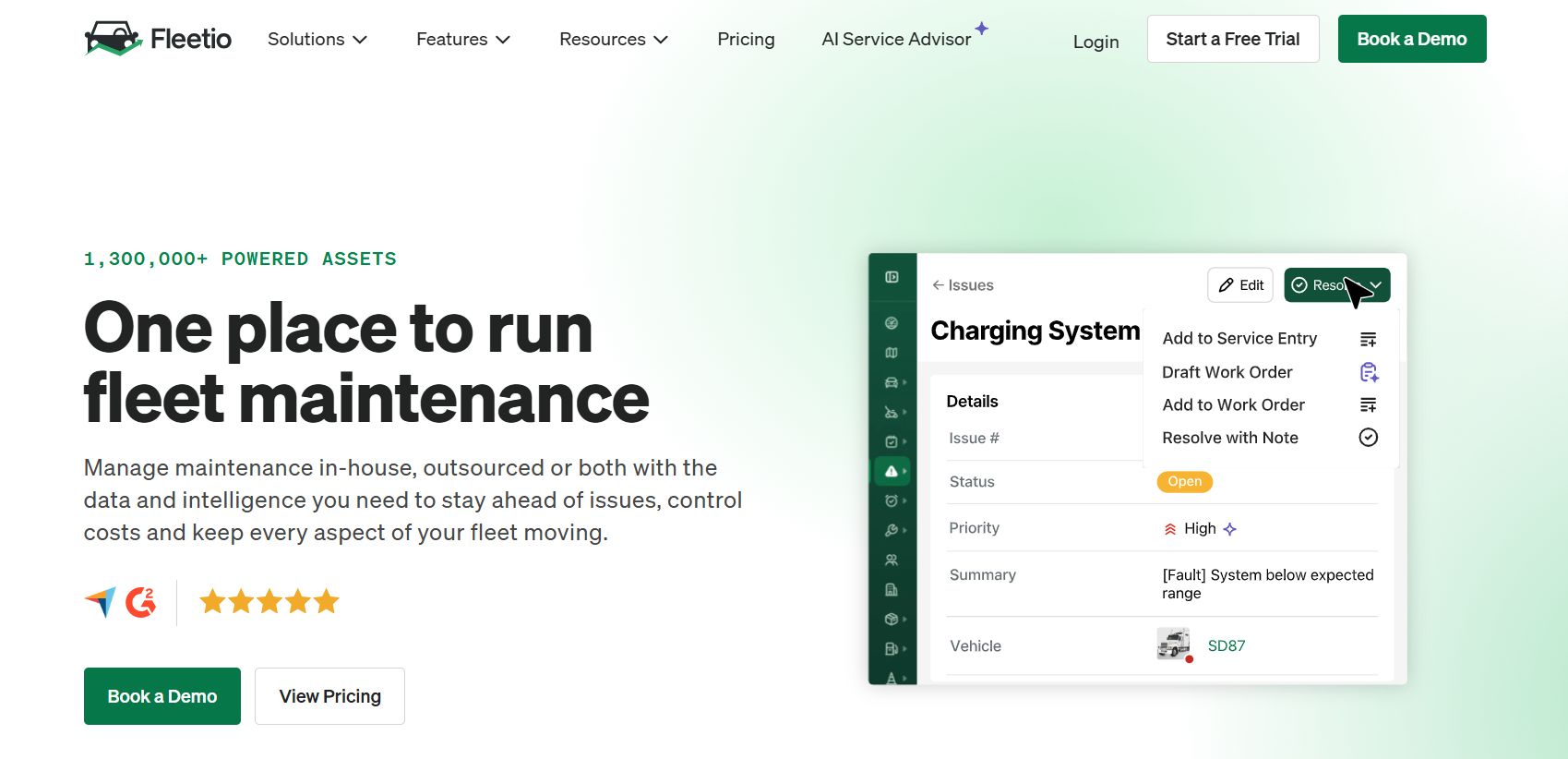
Fleetio organizes maintenance around vehicle records, preventive work, inspections, parts and work orders. Its official FAQ confirms cloud delivery and international use, with metric units, currency and time-zone settings. Its integration directory includes Geotab connectivity (Fleetio, n.d.).
Best for a logistics team seeking a dedicated maintenance system while retaining its current telematics. A team might choose it to make service history and outstanding defects accessible to drivers, managers and maintenance staff.
Check the precise integration for your installed devices. Ask which features work in Singapore, particularly anything involving repair-shop networks, payments or local service vendors. International software access does not establish local workshop coverage. Demonstrate kilometers, liters, Singapore dollars, permissions and export formats. Compare the plan that includes your required work-order and inspection features.
2. Ramco Fleet and Asset Management
Ramco’s Singapore fleet offering describes an integrated workshop module covering operations, inventory, parts and billing, alongside fleet maintenance and allocation. The company describes multi-tenant cloud and mobile delivery (Ramco Systems, n.d.).
Why a team might choose it is the need to connect maintenance decisions with a larger logistics operation. A business operating several depots may need fleet availability, workshop workload and parts costs to inform planning together.
Ask the implementation team to demonstrate the complete journey of a failed inspection, from the initial defect through repair and return to service. Establish which functions are standard, separately licensed or configured for the project. Include vehicle-history migration, asset coding and parts-master cleanup in the scope. A broad enterprise platform needs a clear rollout plan and a named process owner.
3. Fleetnetics
Fleetnetics is developed in Singapore by DewTouch Innovations and brings automotive functions such as workshop, rental, parts, inventory and finance into one platform. Its workshop materials describe job orders, digital health checklists and visibility of mechanics and job status. A published Singapore case study describes cloud deployment (Fleetnetics, n.d., 2026).
Best for an operator whose maintenance problem overlaps with workshop administration, rental vehicles or parts stock. The reason to shortlist it is the connection between the service job and the automotive back office.
Distinguish your own-fleet requirements from a workshop serving paying customers. Ask how internal jobs, warranty repairs, outsourced work and replacement vehicles are recorded. Confirm subscription structure, integrations and access for drivers. Demonstrate how the planner knows a vehicle is available after the workshop finishes a job.
4. HashMicro Fleet Management
HashMicro’s Singapore fleet page describes maintenance information alongside vehicle allocation, routes, driver availability and operational cost monitoring. The offering sits within its wider ERP product family (HashMicro, n.d.).
Why a team might choose it is the opportunity to connect fleet information with purchasing, inventory and accounting. This matters when the same repair is currently recorded separately by the workshop and finance team.
Ask for a demonstration using a real maintenance scenario rather than a general dashboard tour. Require clarity on work orders, approvals, parts consumption and service-history exports. Establish the cloud hosting and subscription arrangement for your proposed deployment. Treat predictive or AI-assisted recommendations as capabilities to test, and verify whether the quoted plan includes the underlying data feeds and integrations.
5. ScaleOcean Fleet Management
ScaleOcean’s Singapore fleet offering describes routine-maintenance scheduling, odometer-based reminders, operating-cost records and connections to GPS and sensor information. Its product page lists cloud deployment (ScaleOcean, n.d.).
Best for a business evaluating fleet processes as part of a wider operational system. A team might choose it when managers want maintenance costs to appear alongside other vehicle transactions and reports.
Verify how much repair detail the system holds. Ask whether the implementation includes technician assignments, labor, parts, approvals and a usable service-history export. Sensor information depends on the installed equipment and supported connections, so request a demonstration with your vehicle models. Obtain a quotation separating recurring software charges from setup, customization, data migration and support.
6. Cartrack

Cartrack has a Singapore fleet offering combining location, fuel and driver information with maintenance-related reminders. The official SMEs Go Digital listing describes a subscription package with reminders for maintenance, inspection, road tax and insurance (Cartrack, n.d., IMDA, n.d.).
Why a team might choose it is the need for local connected-vehicle installation and fleet visibility together with service reminders. It may suit operators whose first gap is knowing when vehicles require attention.
Check how an alert becomes a booked repair and how the completed work is recorded. Establish whether a separate workshop or maintenance system is needed. Compare hardware, installation, connectivity, subscription duration and replacement-device costs. The government’s official Cartrack solution listing is a useful reference for the listed package. Confirm current grant eligibility and terms directly before committing.
7. Geotab
Geotab’s APAC offering explicitly includes Singapore and describes vehicle tracking, maintenance-related monitoring and access through local authorized resellers. Its open platform provides a route for connecting vehicle information to other applications (Geotab, n.d.).
Best for a fleet that wants vehicle usage and condition data to inform maintenance. A team might choose it when mileage collection and fault visibility are weak points, particularly if the maintenance application can use the data.
Ask the reseller to confirm the supported signals for every vehicle model and installation method. A device connection does not guarantee that every engine field is available. Define responsibility for installation, calibration, connectivity and support. If you also use Fleetio or another maintenance system, demonstrate how defects and service updates move between them without creating competing records.
8. V3Nity from V3 Smart Technologies
Singapore-based V3 Smart Technologies offers a cloud fleet platform using telematics, with published features covering vehicle health monitoring, alerts and operational reporting. Its V3Nity-FMS offering also appears in the official SMEs Go Digital directory (V3 Smart Technologies, n.d., IMDA, n.d.).
Why a team might choose it is a local fleet-management implementation where maintenance alerts sit beside route, fuel and vehicle visibility. Its relevance increases when the operator needs installed devices or additional sensors.
Ask which maintenance alerts are based on elapsed time, mileage, engine faults or other signals. Request evidence for any predictive claim using a comparable vehicle and duty cycle. Verify the process for closing a defect after servicing. Confirm the proposed package and support responsibilities independently of any general grant or marketing statement.
9. Overdrive IoT
Overdrive offers Singapore fleet-management services within a wider IoT platform. Its published fleet features include vehicle-health and service-interval alerts, while its company page describes cloud-based dashboards connecting vehicles, equipment and other assets (Overdrive IoT, n.d.).
Best for an operator considering vehicle maintenance information alongside other connected assets. A logistics site might want to evaluate trucks and supporting equipment within a common monitoring environment.
Establish the exact maintenance workflow included in the proposal. An alert dashboard may still need integration with work orders, spare parts or an external workshop. Ask who checks missing sensor data and how the system behaves when a vehicle loses connectivity. Confirm that any forecast can be traced to understandable inputs before using it to change a maintenance schedule.
10. MobiX Fleet Command Centre
MobiX’s Singapore telematics offering describes a cloud Fleet Command Centre, engine-fault alerts and maintenance reminders based on mileage or engine hours. It also describes local installation and support services (MobiX, n.d.).
Why a team might choose it is a need for a locally implemented connected-vehicle service that combines diagnostic information with operational visibility. The maintenance value depends on whether staff can act on those signals consistently.
Ask for a live demonstration of an alert becoming an assigned task and a completed service record. Verify hardware compatibility, data retention, exports, subscription duration and the support commitment in the contract. Confirm whether work orders, stock and labor are native functions or need another system. Evaluate cameras separately against your actual operational needs and data-handling requirements.
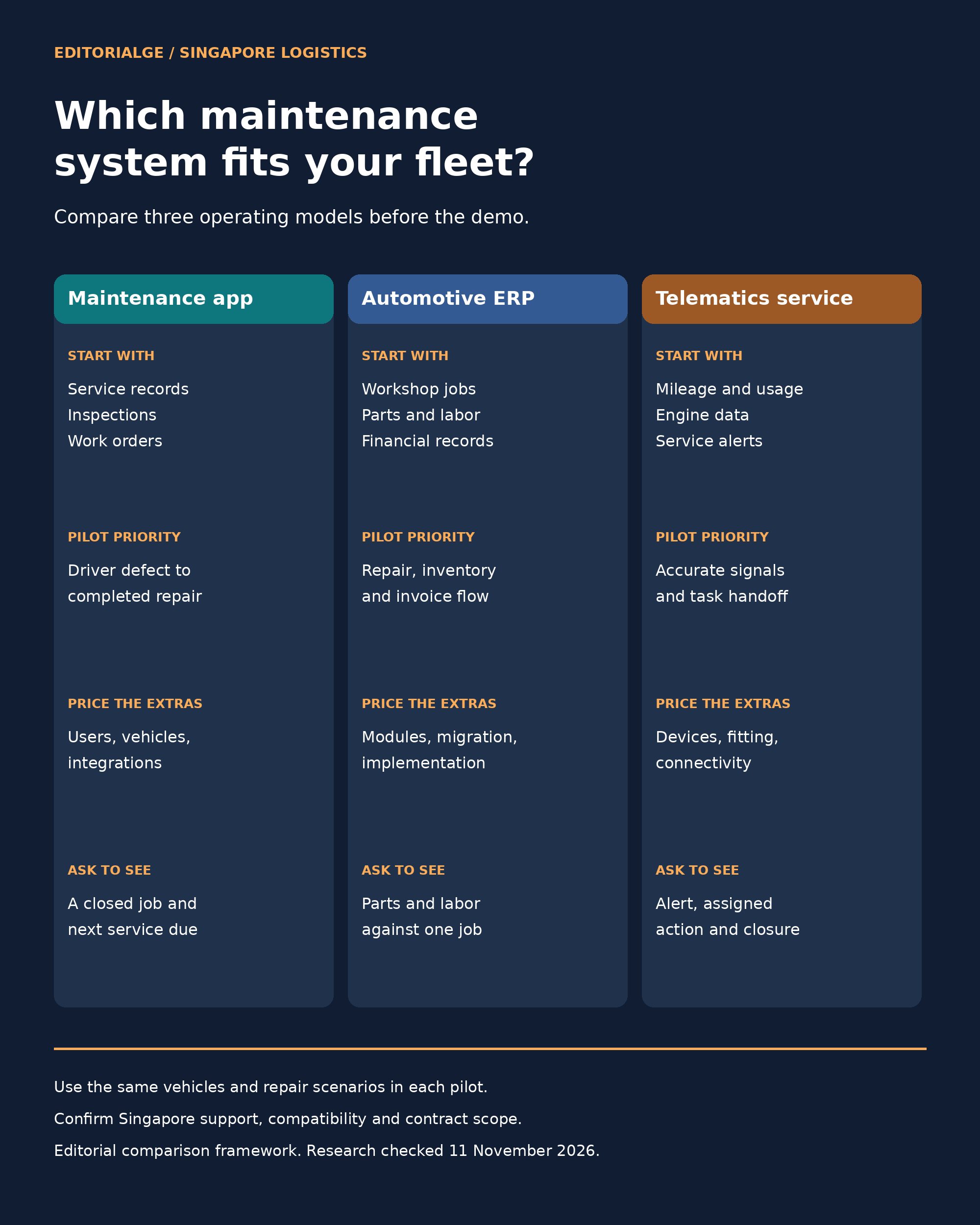
A maintenance application starts with service records and work orders. Automotive ERP connects workshop jobs with parts and finance. Telematics supplies usage and vehicle-condition signals. Check how each proposed system carries a repair to completion.
Put Singapore inspection requirements into the asset record
LTA says periodic inspection frequency depends on vehicle type and age. Its guidance lists different inspection intervals for goods vehicles and trailers, among other vehicle classes (LTA, n.d.). Use the current LTA inspection guidance to configure the correct record for each vehicle.
Keep statutory inspection dates, manufacturer service intervals and internal defect follow-up as separate fields with named owners. A recurring service reminder cannot establish that the correct statutory inspection has been completed. Retain the actual result and supporting documents, and make exceptions visible to the person planning dispatch.
Run a pilot that follows a repair to closure
Choose a small group of representative vehicles, including different ages and duty cycles. Import their service history and current outstanding work. Then have drivers, maintenance staff and dispatch planners use the same process for several weeks.
- A driver reports a defect with the vehicle identifier and a useful description.
- The responsible person assesses the report and records the next action.
- A repair is assigned internally or booked with the external workshop.
- Parts, labor, invoices and work details are attached to the service record.
- The authorized person records the vehicle’s return to service and updates the next due work.
During the pilot, test missing mileage, duplicate reports, an amended workshop invoice and an alert received outside office hours. A good demonstration should show how staff resolve those cases. Record how much manual reconciliation remains between the software and the dispatch board.
Write down the owner of each handoff. Our guide to choosing a business automation approach can help determine which steps to automate first.
Compare the complete subscription cost
Ask every provider to quote the same fleet size and required workflow. Separate per-vehicle subscriptions, per-user fees, modules, hardware, installation, connectivity, training and migration. Confirm the treatment of replacement vehicles, inactive assets, additional depots and contract renewal.
For a hypothetical 40-vehicle fleet, an assumed software price of S$20 per vehicle per month would be S$800 monthly or S$9,600 yearly before taxes and other costs. This is budgeting arithmetic, not a quoted price for any platform. Add implementation, devices and staff time before comparing proposals.
Measure a baseline before claiming a return. Useful measures include overdue preventive jobs, time from defect report to assignment, time awaiting parts, repeat repairs and unplanned vehicle downtime. Distinguish administrative delays from mechanical failures, and keep the same definitions during the pilot.
Questions about fleet maintenance SaaS platforms
Do we need new tracking hardware?
A dedicated maintenance application can begin with manual readings and existing records. Automated vehicle data needs a supported integration or device. Ask for the compatibility list and a working demonstration before assuming your current hardware can be reused.
What if all repairs are outsourced?
Prioritize service booking, approval, invoice capture and history rather than workshop stock functions you will not use. Your staff should still be able to see the open issue, the responsible garage and the evidence of completed work.
Can software predict every breakdown?
Forecasts depend on available signals and the models behind them. Ask what is being predicted and how false alerts are handled. Continue manufacturer servicing, driver reporting and professional assessment when deciding whether a vehicle is fit for use.
Choose the platform your team can keep current
The strongest choice among fleet maintenance SaaS platforms is the one that fits the people responsible for the work. Start with dedicated maintenance software if service records and work orders are the gap. Examine automotive or enterprise ERP when workshop and financial processes need to connect. Consider telematics-led services when reliable vehicle data is missing. Use the same pilot to check that every alert leads to a recorded decision and every completed repair reaches the planner.