Game account trading is still growing. In 2025, sales revenue in China’s online game asset trading market reached USD 5.68 billion and is projected to reach USD 12.479 billion by 2032, with a compound annual growth rate of 11.9%. Account trading accounts for about 28.7% of the segment, and the entire account market is worth around RMB 80 billion in trading volume. The bigger the pie, the more mixed the participants—but when most buyers make decisions, they still fix their eyes on only one number: the listed price.
Cross-border trading magnifies this problem. When a seller quotes a price in another time zone and another currency, the distance between the listed price and the real cost is often far greater than imagined.
The Industry Is Growing, but the Information Gap Between “Price” and “Cost” Has Not Narrowed
The old problems in domestic account trading are account recovery and private transfers. Cross-border trading adds another layer of structural information asymmetry: buyers are unfamiliar with the seller’s language, unfamiliar with the platform’s fee structure, and unfamiliar with the handling cycle after a dispute arises. In February 2026, a player spent RMB 5,800 on an account on a third-party platform. The seller provided the password and bound phone number, and the buyer paid after confirming everything was correct. Two weeks later, the account was recovered by the seller through an appeal using the original registration ID card, and the buyer had already been blocked. The case at the Tianjin Jinghai Court is even more direct: the seller induced the buyer to exit the original link and re-list and pay through a new link; the buyer complied and fell into a passive position.
The common thread in these cases is not “the absence of a platform,” but that the buyer looked only at the listed price when making the decision and did not factor in “if this transaction goes wrong, what cards do I have to play?”
The Essence of the Pain Point Is That You Are Paying for “The Invisible Parts”
The real cost structure of cross-border account buying has at least three layers hidden by the listed price.
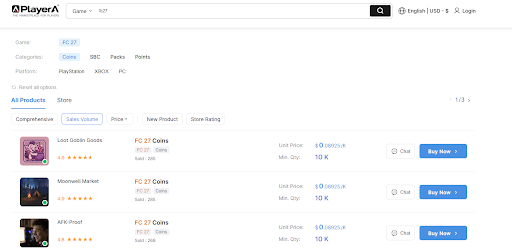
The first layer is currency and payment friction. Playera prices are in US dollars. When domestic buyers pay by bank card, the card issuer’s exchange rate and cross-border fees they actually bear often do not appear on the product page. The platform itself accepts cryptocurrency USDC payments and offers a discounted service fee of 2.99%, but not every buyer is willing or able to use that channel.
The second layer is the time cost of disputes. Playera’s arbitration handling period is usually 3 to 7 days, and the seller’s withdrawal settlement period can take 3 to 10 business days; some withdrawal methods also incur an additional 2% to 5% fee. This means that if a transaction worth several hundred dollars enters the dispute process, the funds may be locked for weeks. What the listed price does not tell you is that this money cannot be used for anything else during that time.
The third layer is the boundary of “protection.” Playera’s basic buyer-side service fee is 4.99% of the order price + USD 0.39, covering fraud protection and after-sale support. If a dispute leads to a refund, what is refunded is the protected amount; the after-sale protection fee itself is not refunded. This is not wordplay but the basic logic of insurance: the premium buys risk coverage, not principal return. Equating “bought protection” with “zero risk” is itself a misjudgment.
How to Use Playera.com: Put “The Invisible” on the Table
Founded in 1999, Playera claims 3.4 million registered traders, coverage of 135 buying and selling countries, and 215 games. The significance of these numbers is not that it is “big,” but that it provides a transaction structure that can be checked and calculated.
First, escrow means “money first or account first” no longer depends on personal character. Under the PlayerGuardian mechanism, the buyer’s payment goes to the platform rather than the seller’s account. After the seller delivers, the buyer confirms, and only then does the platform release the funds. If the seller does not deliver or the item is not as described, the buyer can receive a refund. This mechanism cannot eliminate all risks, but it turns the most fragile step in a transaction from a private game into a link constrained by process.
Second, the 72-hour inspection period is an active tool, not passive waiting. Playera provides a 72-hour account inspection window, which is the designated time for checking binding status, real-name information, and in-game assets. The root of many recovery disputes is precisely that the buyer clicked confirm receipt before inspection was complete, voluntarily closing the window for platform intervention. The window is there; whether and how to use it is the buyer’s own decision.
Third, seller verification and the fee structure are themselves filters. Playera requires sellers to complete identity, address, phone, and email verification before listing, and verified sellers receive a badge and search priority. The seller-side fee for account transactions starts at 12.99% + USD 0.99, and for some games reaches 17.99% + USD 0.99. A seller who continuously bears this fee on the platform and accepts verification operates at a completely different level of default cost from a private seller who is here today and gone tomorrow. The fee is not “how much the platform took from you,” but a quantifiable cost you pay to filter out part of the unquantifiable counterparty risk.
A Rational View of Trading: The Platform Is a Tool; Judgment Is the Principal
There is one thing Playera cannot do, and it says so clearly itself: it is not endorsed by any game developer, and third-party account trading still carries ban risk under the terms of service of most games. The platform can escrow funds, provide an inspection window, and handle disputes, but it cannot judge for the buyer whether an “ultimate account” priced far below market is a trap, nor can it change publishers’ stance on account trading.
The rationality of cross-border trading ultimately comes down to restoring the “listed price” to a “total cost”: item price + service fee + payment friction + time cost of disputes + non-transferable ban risk. Adding up these items and then deciding whether the transaction is worth doing is the most basic responsibility a buyer can take for their own wallet.
Playera platform does not promise zero risk, nor does it pretend to be an official channel. What it does is more modest: write the fee structure clearly, make the escrow process work, put verification and dispute mechanisms in place, and then return the responsibility for using these tools to the buyer. In cross-border account buying, the listed price is only the starting point; what really determines profit and loss is whether, before clicking “buy,” you have first calculated the things that are not in the listed price.