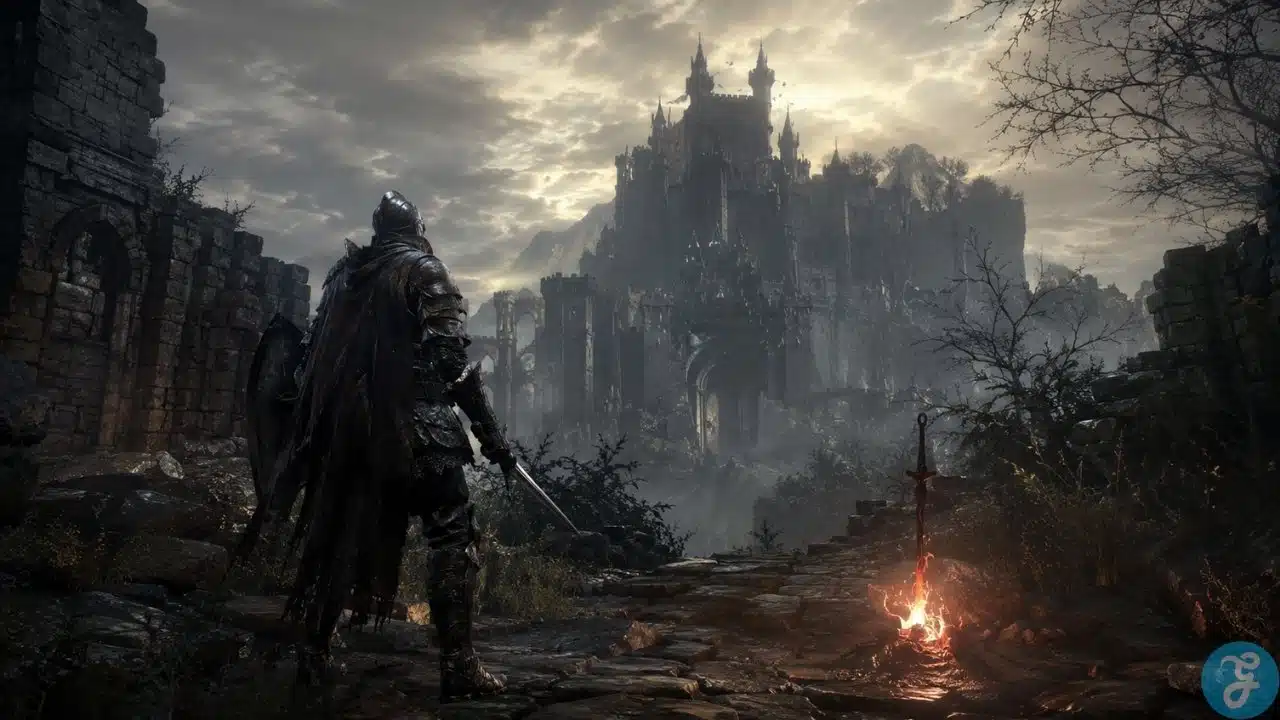
Most people first encounter Soulslike games through a wave of pure frustration. You drop into a bleak world, take three steps, and get immediately flattened by a basic hollow holding a broken sword. The game offers no apology, no lengthy tutorial, and no immediate explanation. But then something shifts. You try again. You watch the enemy’s shoulders tilt, anticipate the swing, dodge, and land a counterattack. Progress in these games isn’t about arbitrary stat scaling…it’s about your own personal growth as a player.
Ever since FromSoftware unleashed Demon’s Souls and Dark Souls onto the world, the gaming landscape has been flooded with imitators and innovators alike. From the gothic, blood-drenched streets of Bloodborne to the theatrical puppetry of Lies of P, the influence of the genre is undeniable.
Yet, many critics and players get the definition completely wrong. A hard game is not automatically a Soulslike. If cranked-up difficulty was the only metric, Ninja Gaiden or Cuphead would qualify. Instead, true Soulslike games are defined by an incredibly specific architecture of risk, spatial design, and psychological tension.
The Core Loop: Risk, Reward, and the Dreaded “Run Back”
At the absolute center of all Soulslike games is a constant, high-stakes psychological gamble.
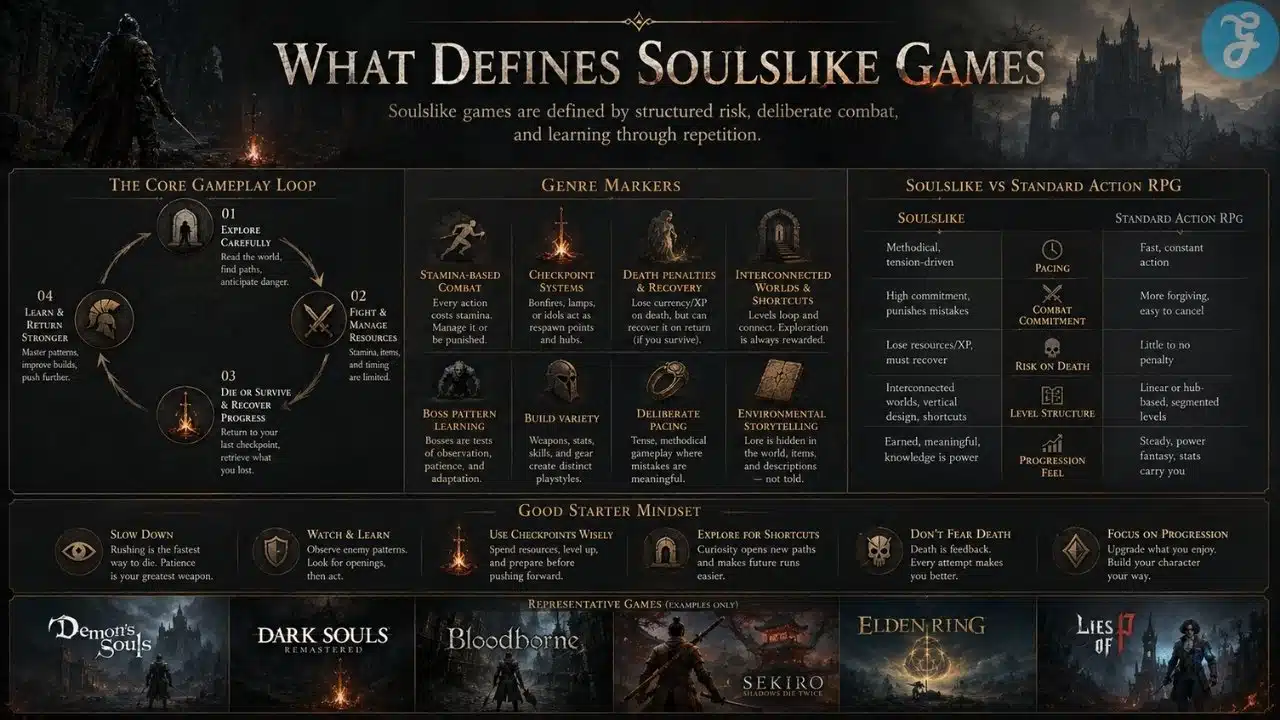
The loop itself is straightforward: explore, accumulate currency, find a checkpoint, and level up. The catch? Resting at a checkpoint, whether it’s a bonfire, a lamp, or a Stargazer—completely resets the world, respawning every basic enemy you just fought so hard to clear.
This creates a brilliant, agonizing tension. Do you push forward into the dark with half a health bar to see what’s around the corner, or do you retreat to safety, knowing you’ll have to fight your way back through the gauntlet all over again? Because of this system, you can’t just zone out. You are forced to pay attention to the environment, map out enemy patrol routes in your head, and respect the world around you.
Combat as a Critical Conversation (and Why Mashing Fails)
If you treat combat in Soulslike games like a standard hack-and-slash, you will die. Repeatedly.
Combat in this genre functions more like a rhythmic, high-stakes conversation where you have to let the opponent speak first. Every single action—swinging a massive greatsword, rolling out of harm’s way, or sprinting to safety—is governed by a stamina bar. Managing this green bar is arguably more important than managing your actual health. Run out of stamina at the wrong moment, and your character stands completely defenseless.
The Exception that Proves the Rule: While games like Sekiro: Shadows Die Twice swap traditional stamina for a “Posture” deflection system, the underlying philosophy remains identical: you must learn the specific cadence of the fight rather than trying to overpower it with raw aggression.
Because even a low-level goblin can end your run in three hits, boss fights become masterclasses in patience. You aren’t looking to melt their health bar in five seconds; you are studying telegraphs, waiting for that one specific window where the boss recovers from a heavy slam, landing two precise hits, and backing off.
Death is an Inventory Mechanic, Not a Game Over
In most traditional action RPGs, dying is a minor annoyance that boots you back to a quicksave from thirty seconds ago. In Soulslike games, death is a foundational teaching tool.
When you fall, you drop every piece of unspent currency (Souls, Runes, Ergo) on the ground at that exact coordinate. You get exactly one chance to make it back to your corpse to reclaim your hard-earned progress. Die on the way there? Those resources vanish forever.
This simple mechanic changes how the player experiences fear. The game doesn’t need to jump-scare you; the terrifying reality of losing two hours’ worth of leveling material makes every dark corridor genuinely nerve-wracking. But more importantly, it reframes failure. If you lose your currency, you haven’t actually lost everything, because the physical mechanical knowledge of how to dodge that specific trap or enemy stays in your brain.
Level Design: The Intricate Geometry of the Shortcut
One of the greatest joys of a well-crafted Soulslike is the sudden realization of where you are.
Instead of guiding you down a straight, linear hallway or scattering thousands of meaningless icons across a massive checklist map, these worlds are built like layered, vertical puzzle boxes. You might spend forty minutes fighting upward through a grueling, treacherous castle tower, only to open a heavy iron door and find an elevator that drops you right back down to the very first checkpoint you discovered hours ago.
-
Verticality over Breadth: Levels use ladders, hidden drops, and secret elevator shafts to pack immense depth into small geographical spaces.
-
Mental Mapping: By withholding a traditional mini-map, the game forces you to actually look at the architecture, landmarks, and horizons to navigate.
Even when Elden Ring blew the genre up into a massive open world, it retained this exact DNA by burying massive, interconnected “Legacy Dungeons” seamlessly into its landscape.
Storytelling Through Ruins and Artifacts
If you want a traditional narrative with twenty-minute cutscenes and explicit exposition dumps, Soulslike games might frustrate you. They treat storytelling like an archaeological dig.
The world is already dead or dying by the time you arrive. The narrative isn’t handed to you; it is shattered and scattered across item descriptions, the specific placement of a corpse in a ruined church, or the cryptic, laughing dialogue of a lonely NPC sitting by a swamp.
| Storytelling Style | Traditional Action RPG | Soulslike Games |
| Delivery | Cinematic cutscenes & explicit dialogue | Item descriptions & environmental layout |
| Player Role | The chosen hero is driving the active plot | An outsider piecing together a past tragedy |
| Atmosphere | Guided, clear, and narrative-driven | Mysterious, bleak, and deeply atmospheric |
Surviving the First Five Hours: A Practical Guide
Getting past the initial wall of frustration requires a complete shift in expectation. If you are diving into the genre for the first time, keep these three rules in mind:
-
Ditch the Shield Early: Beginners often cling to heavy shields, but blocking eats massive amounts of stamina and leaves you vulnerable to guard-breaks. Learning the invincibility frames (i-frames) of a well-timed dodge roll is always more reliable in the long run.
-
Explore Vertically, Not Just Horizontally: If a boss feels completely impossible, you are likely under-leveled or missing vital weapon upgrade materials. Backtrack, look for hidden paths, and search for the upgrade items that scale your damage.
-
Expect the Trick: Assume every blind corner has an enemy waiting to push you off a cliff, and assume every solitary treasure chest is a trap. Checking your corners isn’t paranoia, it’s survival.
Ultimately, the magic of these games lies in how earned your victories feel. When you finally take down a boss that has killed you twenty times, it isn’t because your numbers got bigger. It’s because you cracked the code.