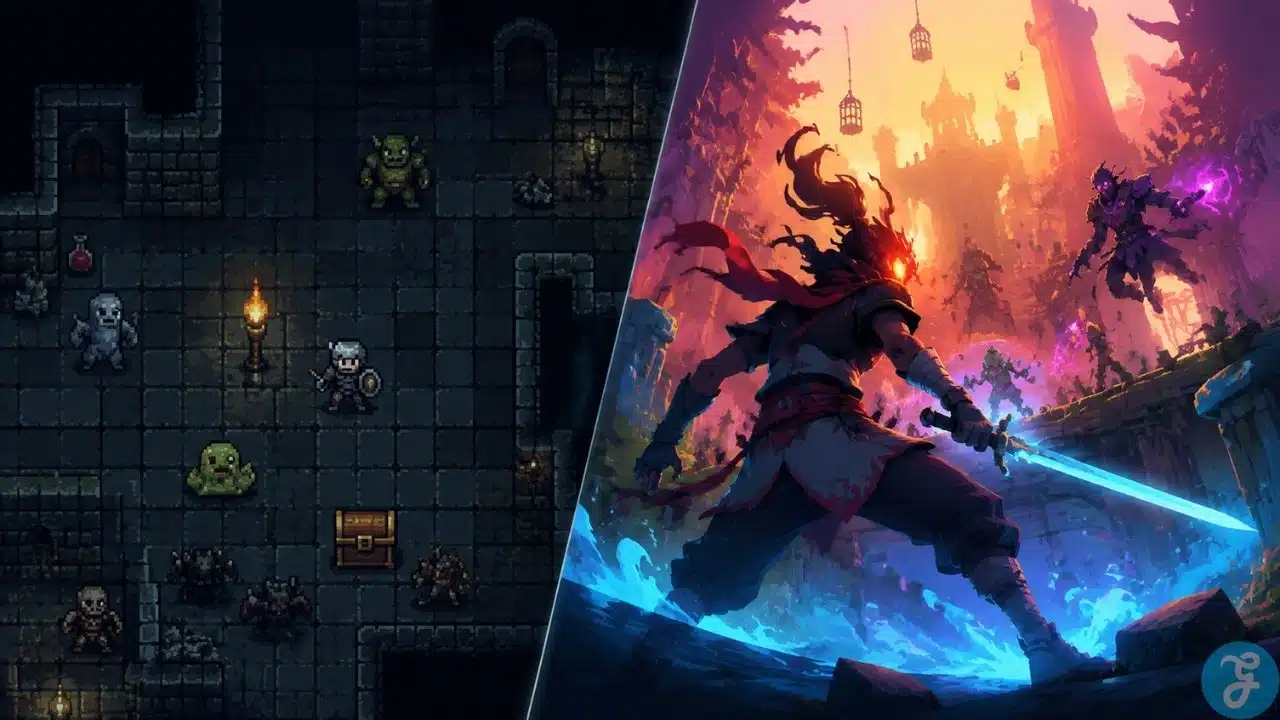
Spending three hours meticulously building a character only to watch them vanish forever because you stepped on a hidden pressure plate is a brutal gaming rite of passage. If you hang around community forums long enough, you will constantly see players debating the nuances of Roguelikes vs Roguelites.
It often looks like semantic nitpicking, but that single vowel change completely dictates what your next twenty hours of gameplay will feel like. One forces you into a punishing, turn-based test of patience, while the other turns every failure into a stepping stone toward a shiny new upgrade.
The Grid-Locked Brutality of Traditional Roguelikes
The purist side of the family goes all the way back to 1980 with a text-based dungeon crawler named Rogue. Games that strictly copy this blueprint, such as NetHack, ADOM, and the deeply complex Caves of Qud, maintain a very specific, uncompromising design philosophy.
In these worlds, the game engine only moves when you do. If you stop to stretch or plan your next three steps, the monsters waiting in the corridor will wait with you. It is a slow, grid-locked, highly analytical affair where spatial awareness is everything.
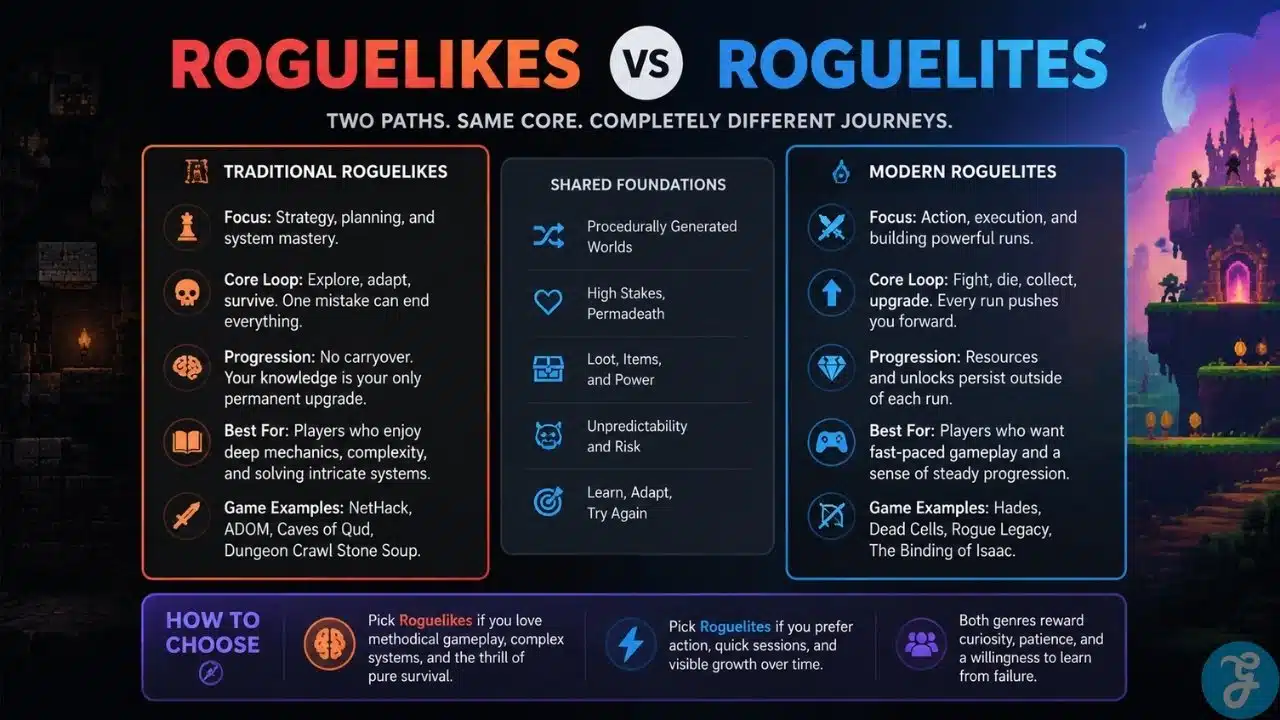
But the real defining trait of a traditional roguelike is total finality. When your character drops to zero health, that run is completely wiped from existence. There are no persistent gold reserves, no unlockable starting weapons, and no permanent health buffs waiting to carry over into your next attempt. Your only permanent asset is your own real-world memory of how the game systems interact. You survive the next run because you learned how to handle a specific crisis, not because your character’s stats got higher.
How Roguelites Softened the Blow
Wiping a player’s hard work down to absolute zero is a tough sell for a broader audience. Eventually, developers looked for a compromise that kept the thrill of randomized levels but respected the player’s time investment. This compromise created the roguelite.
Modern juggernauts like Hades, Dead Cells, and Rogue Legacy completely abandon the slow, calculated grid. Instead, they substitute it with lightning-fast real-time combat, platforming, and twitch reflexes.
More importantly, they give you a safety net called permanent meta-progression. Dying still ends your current attempt, but you haul a bag of collected crystals, souls, or blueprints back to a central hub area. You spend those resources to buy permanent stat boosts, unlock better item pools, or open up entirely new mechanics. Over time, you do not just get better at the game; your character becomes mathematically stronger, eventually allowing you to brute force challenges that used to kill you instantly.
The Mechanical Divide: Roguelikes vs Roguelites
The structural differences between these two subgenres directly alter your minute-to-minute habits at the keyboard.
| Feature | Traditional Roguelikes | Modern Roguelites |
| Combat Pacing | Turn-based and analytical | Real-time and reflex-driven |
| Movement Layout | Strict tile-based grid system | Free-flowing or side-scrolling |
| Death Impact | Absolute wipe of stats and gear | Currency retained for permanent buffs |
| Item Logic | High risk with blind identification | High synergy with stacking builds |
Which Design Philosophy Fits Your Brain?
Because these two styles target entirely different preferences, choosing between them depends on what kind of challenge you want to overcome.
If you view video games as intricate math puzzles where you manipulate overlapping systems, traditional roguelikes are unmatched. You might use a freezing spell on a puddle of water to make an enemy slip, causing them to crash into a wall. It is pure strategy without the pressure of quick reflexes, though you have to tolerate dense menus and retro visuals that often rely on simple icons.
If you care more about mechanical execution, tight parry windows, and the dopamine hit of a guaranteed reward loop, choose a roguelite. They are vastly more approachable, visually spectacular, and respectful of a short gaming session. Just know that out-leveling a boss through permanent stat upgrades can sometimes take the raw edge off the survival panic.
A Few Tips Before You Jump In
-
Stop viewing the game over screen as a failure state. In both styles, dying is just the intended gameplay loop. Use each run to figure out what item combos work or what trap patterns to avoid next time around.
-
If you are playing a grid-based game, remember that standing in the middle of an open room is an absolute death sentence. Back into narrow doorways to force enemies into a single-file line. For action games, focus entirely on learning your dodge-roll invincibility frames before you worry about maximizing your damage output.
-
Beginners should probably pick up a polished action-lite first. It is way easier to get used to the rhythm of losing gear when you still get to keep some gold at the end of the night to unlock permanent upgrades.
-
Be ready to shift your attention span. A classic roguelike requires you to slow down and treat every tile like a tactical puzzle, while a lite entry wants you to lean into pure muscle memory and speed.
The Final Verdict
Deciding where to spend your time comes down to a simple question: do you want to conquer a dungeon with your mind, or defeat it with your reflexes? Pure roguelikes offer an uncompromising chess match where victory feels completely earned through raw systemic knowledge. Roguelites offer a chaotic, highly rewarding ride that makes sure you never walk away empty-handed. Both are brilliant, but they demand a completely different mindset the second you hit the start button.