You have a smart speaker or phone helper that answers when you talk, and you may wonder if voice commerce is safe enough to trust with your money. Maybe you ask it about the weather every day but still shop on a screen.
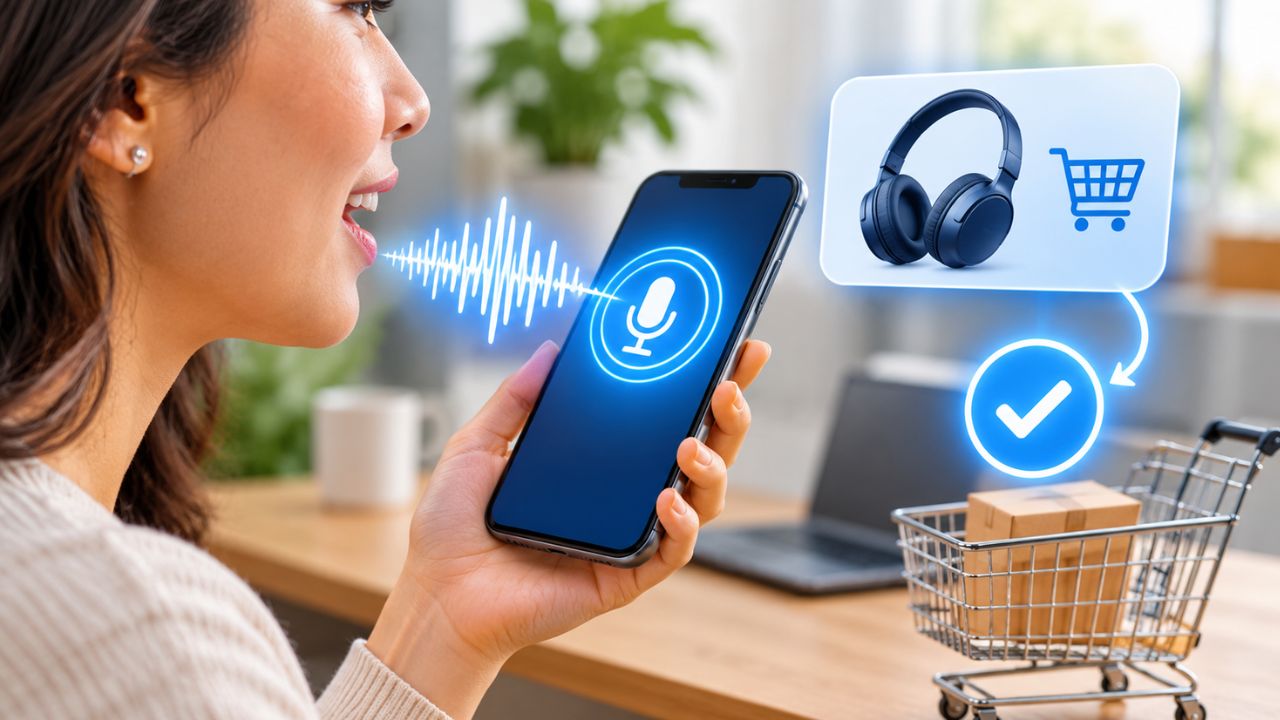
Here is the plain answer. Voice commerce means you search for, research, reorder, and buy products by talking to a voice assistant such as Alexa, Google Assistant, or Siri. So far, it has changed how people look up products and restock the basics much more than how they make big purchases.
About half of voice shoppers use it to research products. Fewer than 4 in 10 smart device users have actually bought something by voice. Below, you will see where voice saves you time, where it still makes mistakes, which purchases fit it, and simple steps to keep your account safe.
What Is Voice Commerce?
Voice commerce is the part of online shopping where people buy, reorder, or research products by talking to a device. You may also see it called v-commerce. You speak in place of typing, tapping, or clicking.
The device can be a smart speaker, a smartphone, a tablet, or a laptop. The helper inside it is a voice assistant, such as Amazon Alexa, Google Assistant, or Apple’s Siri.
The key tool behind all of this is natural language processing, or NLP. It is software that picks up human speech and uses it to place orders. Put simply, it is how a machine figures out what you mean when you ask it to buy more paper towels.
Voice shopping works because three pieces fit together:
- A voice-enabled device that hears your request.
- A product catalog linked to the store, so the assistant can find the right item.
- A saved payment method and address, so the order can go through without a form.
Several big brands have tried voice shopping. One industry guide names Domino’s, Walmart, Tide, Sephora, and Nike as voice commerce leaders.
That tells you large stores take it seriously. It does not mean every store supports it.
How Voice Commerce Works, Step by Step
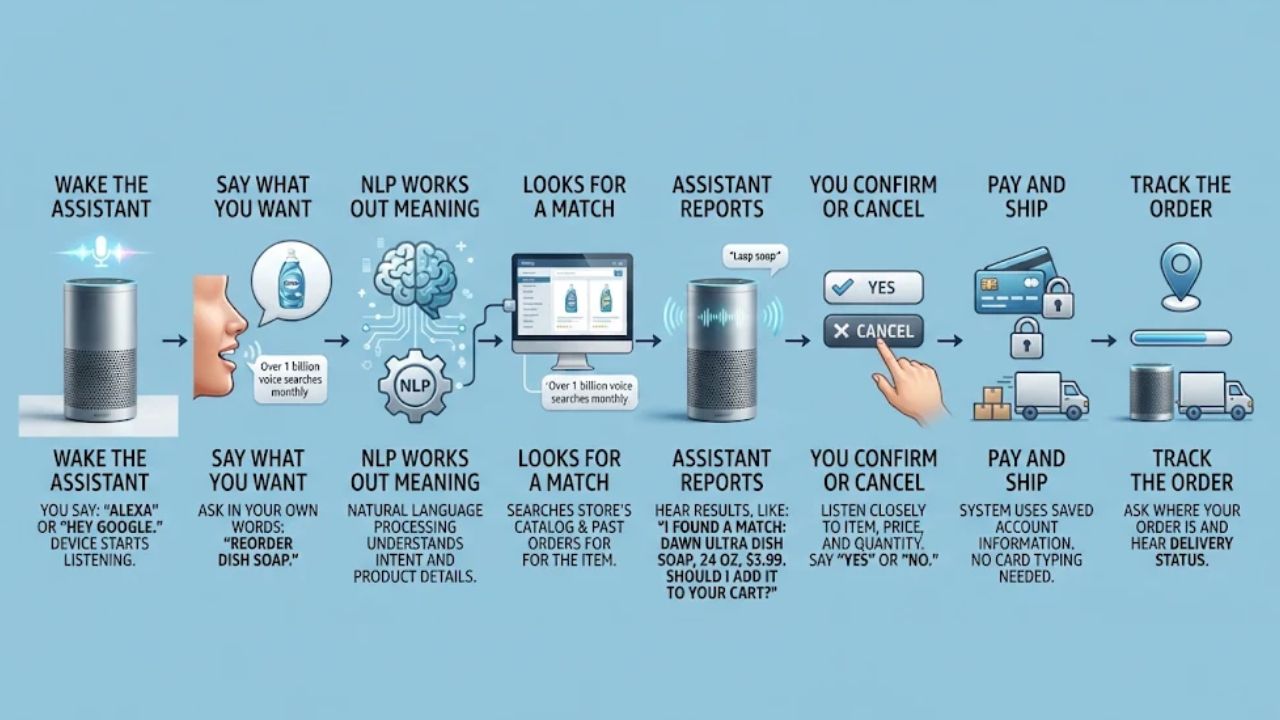
The steps differ by assistant and by store. Here is an example of how a voice order can work when your assistant and the store both support voice shopping.
- You wake the assistant. You say the wake word, such as “Alexa” or “Hey Google.” The device starts listening.
- You say what you want. For example, you might ask it to reorder your dish soap, or ask which running shoes suit flat feet. You speak in your own words.
- The assistant works out your meaning. NLP turns your words into a request it can act on. You can help it by speaking clearly and naming the exact product.
- It looks for a match. The assistant searches the store’s catalog. It may check your past orders too.
- It tells you what it found. On a speaker with no screen, you hear the result but can’t see photos.
- You confirm or cancel. Many setups ask you to confirm before they charge you. Listen for the item, size, amount, and price before you say yes.
- It pays and ships. The system uses the card and address saved in your account. You skip typing card numbers.
- You track the order. On many devices, you can ask where your order is and hear a delivery update.
Smart speakers are the main tool for this. They held over 44% of voice commerce revenue in 2023.
People already talk to their devices a lot. Over 1 billion voice searches are made every month. Not all of them are about shopping, but the number shows how normal talking to a device has become.
Some systems add a layer called voice recognition, or voice biometrics. It tries to check that the voice giving the order belongs to the account owner. Treat it as a helpful extra, not a lock you can fully count on.
How Voice Shopping Makes Buying Easier for Customers
Voice shopping has real perks. One industry guide sums up the main benefits as convenience, speed, accuracy, and personalization.
Convenience and speed hold up for most shoppers. Accuracy is still a work in progress, as you will see later.
Here is where voice truly helps:
- Your hands stay free. Voice shopping lets you buy while you cook, drive, or juggle other tasks. Say you run out of olive oil mid-recipe. You can add it to your cart without washing your hands first.
- Talking beats typing for many people. 71% of consumers prefer voice search to typing out their questions. Speaking a full question is often faster than tapping it out on a small screen.
- Reorders take seconds. Because your card and address are saved, a reorder can be one short sentence. There are no forms to fill in.
- Suggestions match your habits. The assistant learns from what you bought before. For example, if you often buy coffee beans, it may suggest filters when you reorder.
- It helps people with disabilities. Shoppers who find keyboards or touchscreens hard to use can shop on their own by voice. They need their hands and eyes less, so more people can shop with ease.
Notice the pattern. Most of these perks are about finding things and buying the same things again. They are less about making big, careful choices.
What Shoppers Really Use Voice For: Research First, Reorders Second
Most articles on this topic jump straight to the idea that people buy by voice. The numbers tell a different story. One report finds that research is the top use case, not buying.
Think of voice as a helpful store clerk you can ask questions. Many people ask the clerk, then finish the purchase on a screen.
The Numbers Behind How People Shop by Voice
| What Shoppers Do | The Number | What It Means for You |
| Use voice search at all (U.S.) | 56.1% of U.S. consumers | Talking to a device is now normal for most people. |
| Use voice search for shopping (U.S.) | 49.6% of U.S. consumers | About half of shoppers ask a device about products. |
| Research products by voice | 51% of voice shopping users | Looking things up is a very common use. |
| Finish part of the buying process with voice AI | 74% of consumers who use voice AI | Most users let voice handle a step, like search or adding to cart. |
| Have made a purchase by voice | 39% of smart device users | Fewer people go all the way to checkout by voice. |
| Shop by voice every week (Gen Z) | 30% | Young shoppers use it the most. |
| Shop by voice every week (Boomers) | 6.8% | Older shoppers rarely use it as a habit. |
One word of caution. These numbers come from different surveys of different groups, so don’t read them as steps in one shopping trip.
Each one still tells you something useful. Lots of people talk to their devices, and many use voice for a step like search. Fewer than 4 in 10 smart device users have actually paid by voice.
Age makes a big difference, too. Younger consumers are more likely to shop by voice or use voice tools. If you are older and voice shopping feels odd, the low Boomer number shows you are in good company.
Which Purchases Fit Voice, and Which Don’t
Voice works best when you know exactly what you want. It struggles when you need to see, compare, or pick from many options. Here is a simple guide.
| Type of Purchase | Good Fit for Voice? | Why |
| Reorders of things you buy often (coffee, soap, pet food) | Yes, if it finds the exact item | Works well when the assistant matches what you bought before. Still check the size, count, and price. |
| Household staples (paper towels, batteries, trash bags) | Yes | Simple items with clear names are easier to hear and match. Check the pack size. |
| Product research (for example, asking for a good blender in your price range) | Yes | Quick answers while you multitask. Finish the buy on a screen if you want. |
| Adding items to a shopping list or cart | Yes | Low risk. You can check the list later before you pay. |
| Order tracking | Yes | A fast spoken update with no app to open. |
| Clothes and shoes with sizes and colors | Not really | Easy to get the wrong size, color, or fit. You can’t see the item. |
| High-value items (laptops, TVs, furniture) | No | You need photos, specs, reviews, and price checks side by side. |
| First-time buys from a new brand | Not really | The assistant may pick a different brand than you expect. |
| Gifts | Research only | Great for ideas. Buy on a screen so you can see what you are sending. |
A good rule: use voice for familiar items you can name precisely, and use a screen when you need to look at or compare options.
Where Voice Shopping Still Falls Short (and How to Stay Safe)
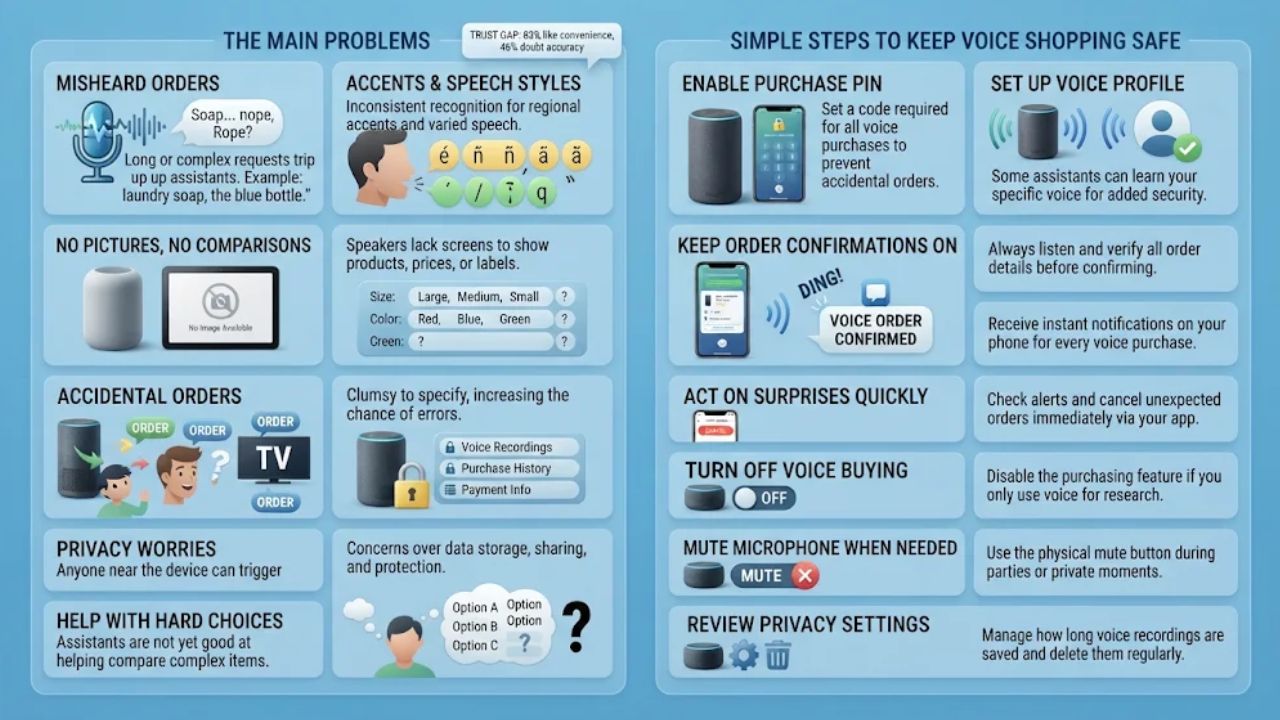
Here is the trust gap. In one survey, 83% of consumers say voice shopping adds convenience. In another, 46% of shoppers say they don’t trust voice assistants to understand and handle their orders correctly.
These come from different studies, so they are not the same people. Still, together they suggest many shoppers like the ease but doubt the accuracy. That may help explain why research is the top use, not buying.
The Main Problems
- Misheard orders. NLP keeps getting better, but it still makes mistakes. Long requests with several items, or product names that sound alike, can trip it up.
- Accents and speech styles. Some assistants have a harder time with certain accents. That means not every shopper gets the same results.
- No pictures. On a speaker with no screen, you can’t see the product, compare prices, or read the label. Say you ask for a laptop. The assistant can’t show you features without extra steps.
- Sizes, colors, and details. Saying size, color, and fit out loud is clumsy. Errors are more likely with these choices.
- Accidental orders. Anyone near the device can speak to it. A child, a guest, or even a voice on the TV could start an order.
- Privacy worries. Assistants store data such as voice recordings, purchase history, and payment details. Some people worry about how that data is kept, shared, or protected.
- Help with hard choices. One tech firm says “entirely new customer-aiding mechanisms are needed to help people with their purchase decisions”. In plain words, voice tools are not yet great at helping you weigh options.
Simple Steps to Keep Voice Shopping Safe
You don’t need to be a tech expert to protect yourself. Settings differ by assistant and by store, and not every one offers all of these. Look in your assistant’s app under shopping, purchasing, or account settings to see what you have.
- Turn on a purchase PIN or code, if offered. This makes the assistant ask for a code before it buys. It helps stop orders from kids or guests who don’t know the code.
- Set up a voice profile, if offered. Some assistants can learn your voice. It can help, but don’t treat it as a sure way to block other people.
- Keep order confirmations on. Before you say yes, check the item, the amount, the size or type, the total price, and the delivery address.
- Turn on order alerts. Have your phone or email notify you right away for every voice order. Alerts don’t stop an order, but they help you spot one fast.
- Act on surprises quickly. If an alert shows an order you didn’t expect, open your order history right away and cancel it if you can.
- Turn off voice buying if you don’t use it. If you only use voice for research, you can switch off purchasing on many devices. You lose nothing.
- Mute the microphone when needed. Most smart speakers have a mute button. Use it during parties or when you want privacy.
- Review your privacy settings. Look at how long your voice recordings are saved and whether you can delete them.
We’d recommend starting with a purchase PIN, if your device has one, and instant order alerts. Then make a habit of listening closely to every confirmation.
How Big Will Voice Commerce Get?
Voice commerce is growing, but be careful with big forecasts. Research firms count things in different ways, so their numbers don’t always match. The table below shows each figure and who said it.
| Measure | Figure | Who Estimated It |
| Global market size, 2023 | $42.8 billion | Grand View Research |
| Global market forecast, 2030 | $186.3 billion | Grand View Research |
| Yearly growth rate forecast, 2024 to 2030 | 24.6% | Grand View Research |
| Global voice shopping market, 2026 (forecast) | $77.3 billion | Capital One Shopping |
| U.S. voice commerce market, 2026 (estimate) | $22.4 billion | Grand View Research, as cited by Ringly |
Market size is not the same as money spent on voice orders. One report tracks voice transaction volume, which grew from $4.6 billion in 2021 to $19.4 billion in 2023. That is about 4 times in two years, which points to real use, not just hype.
North America held the biggest share of revenue in 2023, at 37.0%. Consumer goods led the market with over 39.2%. That fits the pattern in this article: people use voice most for everyday items they buy again and again.
The growth comes from more homes owning smart speakers, smartphones, and other connected devices that respond to voice. As people get comfortable talking to these tools, more of them may try buying, too.
What does this mean for you? Expect voice options to show up in more stores and devices. Better accuracy may help close the trust gap over time, but for now the safety steps above still matter.
A Short Note for Small-Store Owners
If you run an online store, shoppers may hear about your products through voice before they see your site. The easy win needs no code. Write short, clear answers to common questions, and use the plain product names your customers would say out loud.
One tech firm puts it this way: “This is a new channel, governed by a new set of rules. Here, communication is key.” Companies should also think about voice SEO alongside regular text SEO, so their pages can rank for spoken questions.
For the more technical side, there is speakable schema. It is a small piece of code that marks which parts of a page are best suited for reading aloud by text-to-speech. Google suggests about 20 to 30 seconds of content per section, or roughly two to three sentences.
Google labels this feature as beta, so it may change. Also note that it only marks text for audio. It does not promise that an assistant will pick your page, and it does not set up voice checkout.
The Bottom Line on Voice Shopping
Voice commerce is changing how you shop, but mostly in small, daily ways. It shines for quick research, hands-free questions, and reorders of things you already know and like.
It is still weak for big purchases and items with sizes or colors. Nearly half of shoppers in one survey don’t trust it to get orders right, and that doubt is fair today.
Here is a simple way to use it well:
- Use voice to research anything you are curious about.
- Use voice to reorder staples you can name exactly, and check the details each time.
- Use a screen for costly items, clothes, and first-time buys.
- Before you let voice spend money, turn on a purchase PIN and instant order alerts where your device offers them.
- Before you confirm, listen for the item, amount, total price, and address.
Voice shopping isn’t ready to replace your screen. But as a hands-free helper for research and reorders, it can already save you time. Set it up with care, use it for what it does well, and let it earn your trust one small order at a time.
Frequently Asked Questions About Voice Commerce
1. What is voice commerce?
Voice commerce means shopping by talking to a smart speaker or phone. According to eMarketer, US voice commerce sales reached $19.4 billion in 2023 and continue growing as more shoppers use devices like Amazon Alexa and Google Assistant.
2. How does voice shopping change the user experience (UX)?
Voice shopping makes the user experience (UX) fast, simple, and hands-free, since shoppers do not need to type, scroll, or tap. Research from PwC shows voice commands can cut shopping time by up to 50% compared to traditional mobile browsing.
3. What role do tools like ChatGPT play in voice commerce?
AI tools like ChatGPT help voice assistants understand what people mean, even when they talk in a casual way. A shopper can ask, “What is a good gift for my mom?” and get useful ideas back. According to OpenAI, GPT-4 can process conversational queries with 40% better context understanding than earlier models.
4. How can stores get ready for voice shoppers?
Stores should keep clear product facts in a PIM and use frameworks like Next.js to build fast-loading websites. According to Google, 53% of voice searches are abandoned if a site takes longer than three seconds to load.