
AI document processing for Singapore trade businesses becomes useful at a very ordinary moment. A supplier sends a revised invoice, the packing list uses a different reference, and someone has to decide which values belong in the shipment record. The right provider can reduce that retyping while keeping a clear route for staff to check quantities, currencies and exceptions. These 10 options cover trade filing, business workflows and developer platforms, with different levels of implementation work.
A freight forwarder and a small importer can have similar paperwork but very different buying needs. One may need customs-connected processing across several markets. The other may need a reliable way to turn emailed supplier invoices into accounting drafts. Choosing between them starts with the destination of the data.
How we selected these providers
This is a research-based shortlist, checked on November 11, 2026. Inclusion required a documented document-processing capability and a credible Singapore connection through local services, a regional product offering or an explicitly listed cloud region. The numbered order organizes the choices by workflow and does not rank measured performance.
We reviewed official product descriptions and regional documentation. We have not run a comparative accuracy test or obtained commercial proposals. Best-fit judgments below are editorial inferences from the documented capabilities. A Singapore office or endpoint does not establish that every feature, support service or subprocess runs locally. Confirm those points for the specific contract.
The shortlist includes software platforms and implementation services. They are different procurement models, so compare the complete operating arrangement, including who builds the integration and handles failures. Our guide to choosing a business automation approach can help frame that decision.
Singapore trade documents need more than text extraction
Singapore Customs describes TradeNet as the national single window for trade declarations. Traders submit permit and Certificate of Origin applications through front-end solutions, with declaring agents having specific submission functions (Singapore Customs, 2026). Ask a provider to demonstrate the handoff to your actual filing workflow.
Invoices also arrive in different forms. IMDA describes InvoiceNow as an exchange of structured invoice data between systems (IMDA, n.d.). Preserve that structured data when it is available. Reserve extraction for PDFs, scans, photographs and other inputs that still need interpretation. Converting structured messages into images creates avoidable work.
| Provider | Most relevant starting point | Singapore connection to verify in procurement |
|---|---|---|
| CrimsonLogic | Trade-document intake and regulatory filing | Singapore trade connectivity and filing scope |
| Staple | Document verification and reconciliation | Singapore company and implementation arrangement |
| ABBYY Vantage | Reusable extraction skills | Singapore sales presence, chosen deployment region |
| UiPath | Extraction within an automation program | Singapore endpoints, feature-specific availability |
| Esker | Customer orders flowing into ERP | Singapore regional offering and integration scope |
| Microsoft | API-based invoice extraction | Azure model and region availability |
| Amazon Web Services | Document extraction inside AWS applications | Textract Singapore endpoint and API quotas |
| Google Cloud | Custom document processors | Limited Singapore processor support |
| KYN | Locally implemented accounts workflows | Company-owned Singapore cloud arrangement |
| FYAdvisers | Defined extraction and approval projects | Named delivery team and agreed processing location |
10 providers to consider
1. CrimsonLogic

CrimsonLogic is worth examining when the document problem sits directly beside customs filing. Its Regulatory Filing service accepts trade documents through API or SFTP and describes using OCR and AI to digitize trade data. Its published connectivity coverage includes Singapore (CrimsonLogic, n.d.).
Best for trade teams that want to evaluate document intake alongside their declaration workflow. The reason to choose it would be the connection between extracted shipment information and filing operations, especially where staff currently re-enter similar details across systems.
Ask for a demonstration using your routes, document bundle and declaring-agent arrangement. Confirm which customs connections are live for your service, what requires implementation, and where staff approve corrections. Get a scoped quotation that separates document processing, integrations and filing services.
2. Staple
Staple places extraction alongside document classification, table interpretation, business rules and reconciliation across sources. Its Singapore connection is supported by its company information and SAP partner profile. The product description emphasizes checking information before passing it downstream (Staple, n.d.).
Why a team might choose it is the need to compare related records rather than simply read an invoice. An importer could assess how invoice lines are matched against purchase orders and other supporting records, with disagreements routed for review.
Bring examples with split shipments, changed quantities and mixed currencies to the demonstration. Establish which checks are configured rules and which are model judgments. Confirm hosting, retention, reviewers’ access and the work needed to connect your ERP. Vendor claims about accuracy or fraud detection need validation on your own documents.
3. ABBYY Vantage
ABBYY Vantage offers prebuilt extraction skills and tools for creating custom skills, with connections to automation and enterprise systems. ABBYY lists a Singapore presence. Its Vantage deployment information describes cloud locations outside Singapore and alternative private-cloud or on-premises arrangements (ABBYY, n.d.).
Best for an established business building repeatable processing across several document types. A team might choose it to maintain reusable extraction skills as suppliers change layouts, while connecting the output to existing workflows.
Assess the work needed to configure document classes and maintain them over time. Request a written deployment design before assuming Singapore processing. Include licensing, implementation, exception handling and ongoing model maintenance in the commercial comparison. Broad document support still needs a pilot with your actual languages, scans and line-item structures.
4. UiPath Document Understanding
UiPath is a practical candidate for organizations already running a UiPath automation program. Its documentation lists Singapore public endpoints for OCR and several document models, including invoices. Availability varies by extractor and deployment type (UiPath, n.d.).
Why a team might choose it is the opportunity to keep extraction and subsequent business-system actions in an existing automation environment. For example, an approved invoice record might be passed into an established ERP workflow.
Check the exact model and project type in the Singapore tenant. A regional endpoint for one service does not prove availability of every generative feature. Ask how consumption is billed and how staff validate uncertain fields. Include retry behavior and duplicate posting in the design, particularly when an automation fails after the destination system has accepted a record.
5. Esker
Esker is especially relevant when customer purchase orders are the main source of rekeying. Its Order Management offering describes intake from multiple channels, header and line-item extraction, validation against ERP information and routing of discrepancies. Esker also maintains a Singapore regional offering (Esker, n.d.).
Best for distributors and trading companies whose customer-service staff translate incoming orders into ERP sales orders. The attraction is a defined order-management workflow around extraction.
Test customer-specific product codes, delivery instructions, changed orders and exceptions to agreed pricing. Clarify what happens when a customer request conflicts with master data. Request a proposal for the exact ERP version and Singapore operating entity. A wider order-management implementation may be difficult to justify when the immediate need is a small, isolated OCR task.
6. Microsoft Azure Document Intelligence
Microsoft’s invoice model returns structured information, including invoice fields and line items, from supported inputs. Microsoft also documents custom extraction options and model-specific regional availability (Microsoft, n.d.).
Why a team might choose it is a development team that already manages Azure applications and wants extraction as a component of its own workflow. It offers a starting point for connecting invoice data to internal validation, approvals and accounting records.
The implementation team still needs to build or configure that surrounding workflow. Check the selected API version, model availability, file limits and processing region. A model that reads invoices does not automatically resolve shipment references or approve payment. Budget for storage, orchestration, support and human review alongside extraction consumption.
7. Amazon Textract
Amazon Textract provides APIs for extracting text and document structure, with specialized analysis capabilities. AWS explicitly lists a Singapore endpoint in the ap-southeast-1 region (Amazon Web Services, n.d.).
Best for engineering teams that already operate on AWS and want to assemble their own document pipeline. The reason to shortlist it is control over how documents enter the system, how results are checked and how approved data reaches the destination.
Ask the developer to demonstrate the specific APIs on your invoice and packing-list samples. Check language support, quotas, asynchronous processing and error handling. Textract supplies a building block, so estimate the cost of the reviewer interface, business rules and monitoring. Keep a stable document identifier to prevent a retried job from creating a second accounting record.
8. Google Cloud Document AI
Google Cloud Document AI offers OCR, classification, splitting and extraction processors. Its region documentation lists Singapore, asia-southeast1, with limited support and capability differences by processor and version (Google Cloud, n.d.).
Why a team might choose it is a need to develop custom document processing within an existing Google Cloud environment. Classification and splitting may be useful when a shipment arrives as one PDF containing several document types.
Start procurement with the exact processor and model version. Verify that both development and production requirements are supported in the chosen location. Ask how schema changes are tested and deployed, and measure the corrections required on unfamiliar supplier layouts. Include reviewer work and downstream integration in the estimate rather than comparing a page-processing rate alone.
9. KYN
KYN describes an implemented document-processing service for Singapore businesses that reads invoices, receipts, quotes and statements into records for human approval. Its published approach includes email intake, accounting integrations and a cloud account in the customer’s name in the Singapore region (KYN, n.d.).
Best for a smaller trading business seeking help with a defined accounts workflow. A team might choose it when staff need an implemented process and someone responsible for maintaining it.
Check the exact ledger connection, document types and approval rules in a written scope. Ask who owns the code, credentials and exports, and what support continues after delivery. Confirm that purchase-order matching and delivery-order handling cover your real workflow. Published examples of operating costs should be treated as examples rather than a quotation for your company.
10. FYAdvisers
FYAdvisers describes Singapore-focused projects that extract fields from invoices, purchase orders, tenders and forms, showing values beside their sources for human checking. Its service page also distinguishes structured InvoiceNow inputs from documents that require extraction (FYAdvisers, 2026).
Why a team might choose it is the need to scope a manageable project with explicit approval steps. It may suit an operations team that knows which records it needs but needs help designing the route from source document to destination system.
Clarify the contracting party and named delivery team because the business also operates a provider-introduction service. Establish the underlying technology, processing location, recurring charges and support ownership. Define acceptance criteria in terms of the records your staff can confidently approve and export.
How to compare AI document processing for Singapore trade businesses
Give each shortlisted provider the same representative document bundle. Include clean PDFs, poor scans, amendments and examples from smaller suppliers. Keep sensitive details out of an informal sales demonstration, and agree how any pilot data will be handled.
Score results by field and business consequence. A misplaced comma in a description and a wrong currency code need different treatment. Record whether the system identifies uncertain values, preserves the source and lets a reviewer correct the result before posting.
- Map the fields you need into the ERP, shipment record or filing workflow.
- Test documents with similar references but different quantities, units or currencies.
- Measure staff review time as well as successful extraction.
- Test duplicate files, interrupted jobs and corrected invoices.
- Require an export of source documents, results and correction history.
For a hypothetical monthly workload of 4,000 documents, three minutes of manual entry per document represents 200 staff hours. If a pilot reduces average handling to one minute, the arithmetic suggests about 133 hours released. Those are assumptions for building a business case, not measured savings from any provider. Compare the value of that time with software, setup, review and maintenance costs.
Document the process owner and recovery steps before launch. Our guide to automating repetitive work tasks provides a starting point for mapping the work.
Keep data handling in the buying decision
Trade documents can contain names and other personal data. PDPC’s guidance covers protection, retention and overseas transfers, including requirements for comparable protection when personal data is transferred abroad (PDPC, n.d.). Ask your data-protection lead to assess the proposed arrangement against the PDPC’s data-protection obligations.
Request a diagram showing where documents, extracted fields, logs and backups travel. Include support access and any additional model providers. Agree retention, deletion, incident notification and access controls before moving real customer documents into production.
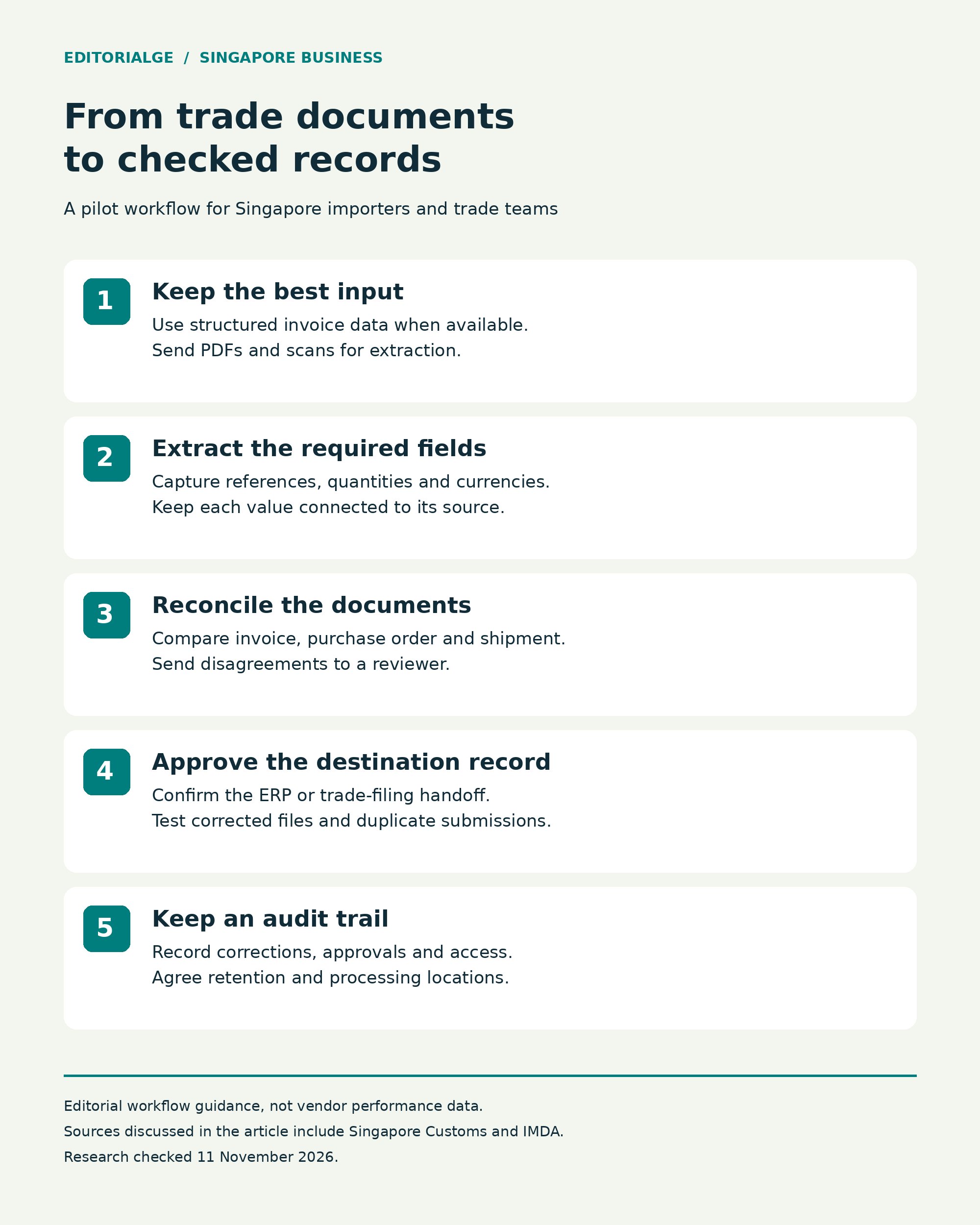
The workflow moves from choosing the right input to extracting fields, reconciling documents, approving the record and retaining an audit trail.
Questions to settle before signing
Does every provider connect to TradeNet?
The shortlist covers several kinds of document processing. Require a demonstration of any proposed TradeNet connection and confirm the approved front end and declaring-agent responsibilities for your business.
Can an extraction accuracy claim decide the purchase?
A published percentage rarely describes your document mix or the cost of reviewing errors. Use a common sample, a defined field schema and recorded handling time to compare providers fairly.
Which pricing model should we compare?
Request a complete monthly estimate at your expected page volume, with setup, integrations, users, minimum commitments, review effort and support itemized. Separate a cloud API’s usage charges from the cost of operating the finished system.
Choose around the record your team needs
The most useful shortlist for AI document processing for Singapore trade businesses follows the data from arrival to approval. Start with CrimsonLogic for a trade-filing discussion, workflow platforms for broader business processing, cloud services for an engineering-led build, or a local implementer for a tightly defined project. Let the pilot show which arrangement leaves your staff with fewer corrections and a clearer record of each decision.