

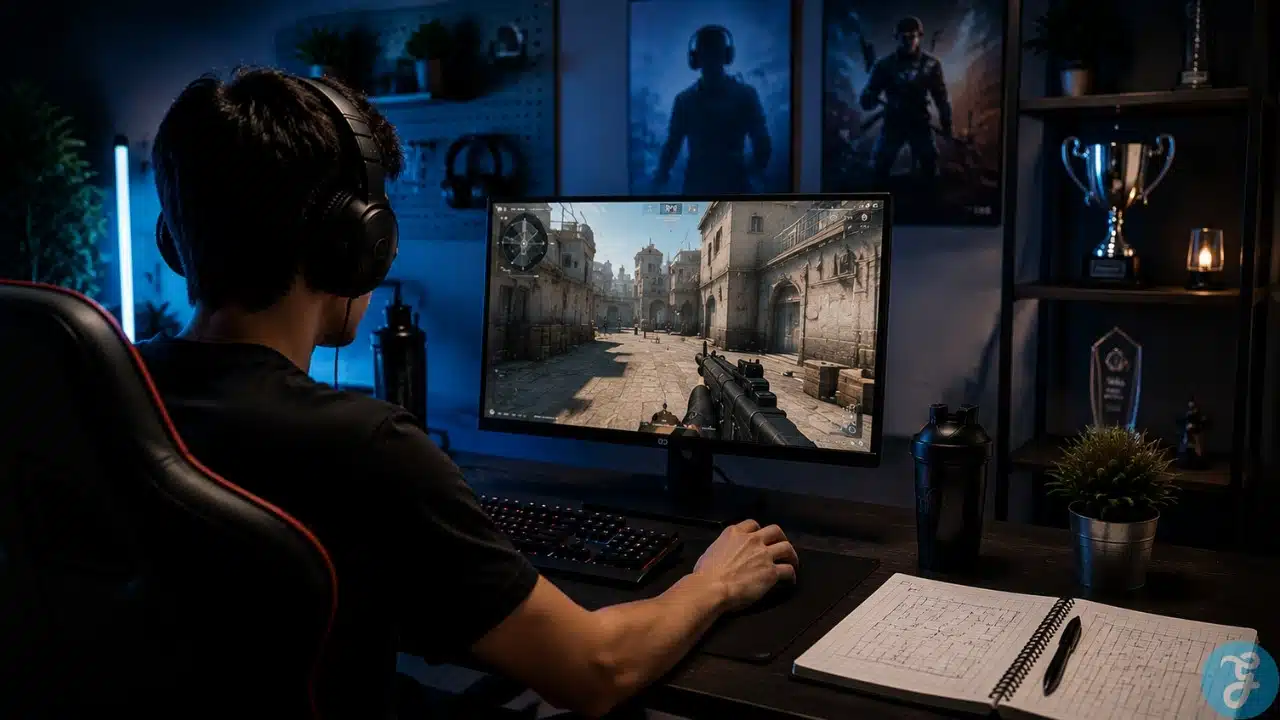
There’s a massive misconception about what it actually takes to make it in esports. Most casual players look at pros and assume they just got there by locked-in, 14-hour days of mindless grinding in ranked queues.
But honestly? That’s not training. That’s just playing.
The real differentiator between a hardstuck Diamond player and a signed professional isn’t just the hours on the clock—it’s how those hours are weaponized. I’ve spent years embedded in tactical shooters like Counter-Strike and Valorant, and plenty of time watching the map in League of Legends. If there is one universal truth I’ve learned, it’s this: players don’t plateau because they stop playing. They plateau because they stop practicing with intention.
The “More Games” Trap
If just slamming the “Play Next” button made you a god, anyone with a summer break would be in the LCS or VCT.
Unstructured play has a strict ceiling. When you just queue up match after match, you’re trying to absorb everything at once: positioning, aim, economy, communication. It’s overwhelming, and your brain defaults to autopilot.
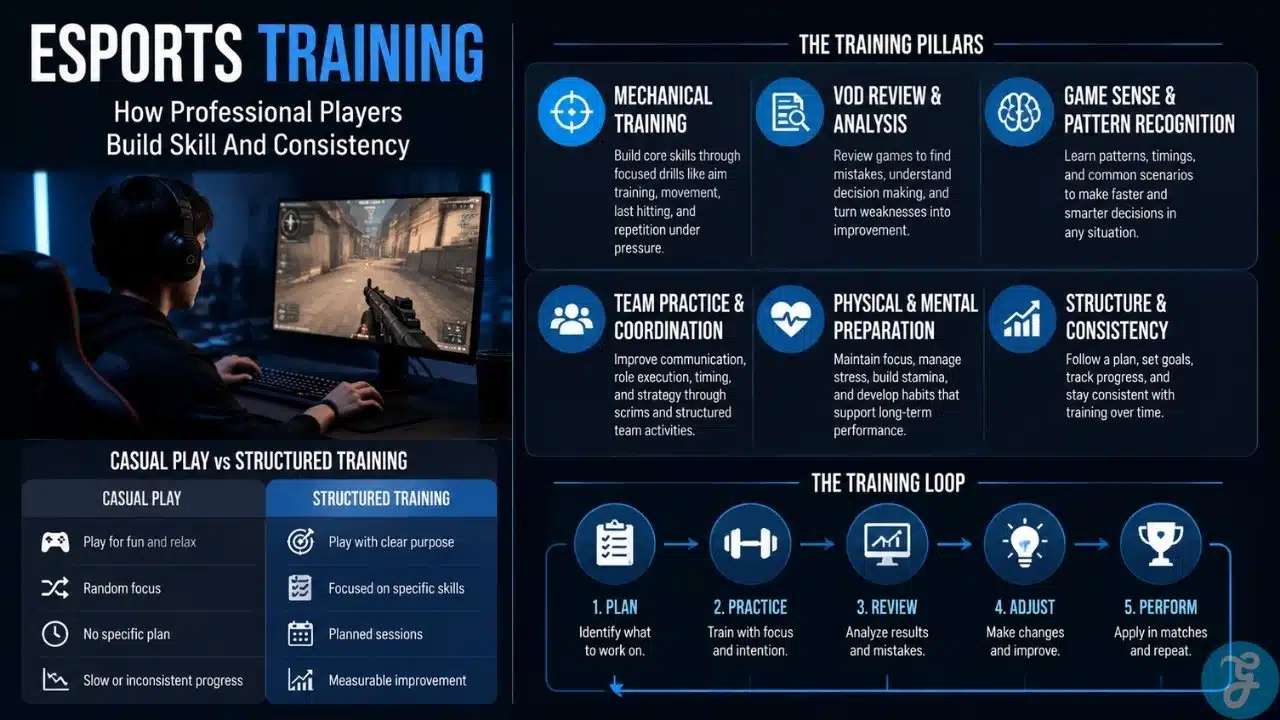
True esports training is about isolation. Pros don’t treat a five-hour block as “gaming time.” They slice it up. One hour might be strictly mechanical execution. The next might be a deep-dive theory session. Another is purely for reviewing mistakes. By breaking the game into bite-sized components, you actually give your brain a chance to fix specific flaws rather than repeating them out of habit.
Deconstructing Muscle Memory
We all love a flashy highlight reel, but behind every clean 1v3 clutch is hours of mind-numbing repetition.
Mechanical training isn’t just about having cracked reaction times; it’s about building consistency so deep that your hands move before your conscious mind even registers the threat.
-
In FPS titles (CS, Valorant): This looks like rigid crosshair placement drills, movement discipline (like counter-strafing), and tailored aim-trainer routines.
-
In MOBAs (League, DOTA): It’s practicing last-hitting under intense pressure, perfecting skill-shot timings, and micro-managing lane manipulation.
The goal isn’t to play perfectly when everything is going well. The goal is to make your mechanics so automatic that they don’t fail you when your heart is pounding at 130 BPM in a match-point situation.
The Brutal Honesty of VOD Reviews
You can’t fix what you don’t notice, and when you’re in the heat of a match, your memory is completely unreliable. You’ll swear you got “robbed” by a hitreg issue or that your teammate baited you.
That’s why VOD review is the backbone of any serious team.
Sitting down and watching your own gameplay in cold, hard, slow-motion is a humbling experience. Suddenly, you see the real culprits: a delayed rotation, a greedy peek when you had the spike down, or an unnecessary fight taken without utility support. Most mistakes that cost games aren’t a missed shot—they’re just bad decisions. If you aren’t actively reviewing your losses, you’re essentially playing blindfolded.
Decoding “Game Sense”
People talk about game sense like it’s some mystical sixth sense you’re either born with or you aren’t. It’s not. Game sense is just a fancy word for high-level pattern recognition, built through thousands of hours of hyper-focused observation.
When a pro player predicts a jungle pathing in League, or reads an eco-round stack in Counter-Strike, they aren’t guessing. Their brain has seen that exact setup a thousand times before. Dedicated training forces you to look for these cues actively, rather than just reacting to things as they happen on your screen.
Syncing the Collective Hivemind
Being a mechanical demon is useless if you don’t know how to play on a chessboard with four other people.
Team practice (or scrimming) is an entirely different beast than solo queue. It’s not about popping off; it’s about micro-coordination. Teams spend hours practicing how to flood information into the comms channel without clogging it, how to layer utility so they don’t waste flashes, and how to execute specific site takes on a dime.
Without this structured coordination, a team of five individual prodigies will get systematically dismantled by a mediocre team that actually knows how to trade kills efficiently.
The Hidden Half: Mental and Physical Stamina
Your brain is a muscle, and competitive gaming burns an immense amount of cognitive fuel.
You can have the best aim in the world, but if you’re fatigued, your decision-making crumbles. This is why modern esports organizations emphasize physical fitness, proper sleep schedules, and strict break routines.
Equally vital is emotional regulation. “Tilt” is a competitive death sentence. Learning how to reset your mental state after a horrific round or a heartbreaking loss is just as much a trained skill as clicking a head. If you can’t control your emotions under pressure, you’re a liability to your team, plain and simple.
Changing the Mindset
At the end of the day, casual play and structured training are two completely different sports. Casual play is about comfort—you hop on, play your favorite agent or champion, and chase the dopamine hit of a win.
Training is uncomfortable. It forces you to look directly at the weakest parts of your game and do the boring, repetitive work required to fix them.
If you want to see measurable, long-term improvement, you have to stop chasing rank points and start chasing structure. The players who consistently climb aren’t getting lucky; they’ve simply built a system that makes improvement inevitable.





















