The first-person shooter has done more to shape the trajectory of modern gaming culture than almost any other genre. What began as a primitive technical showcase in the early nineties has transformed into a multi-billion dollar global phenomenon. This growth drove massive innovations in hardware, networking infrastructure, and competitive esports. The perspective itself is uniquely powerful because it entirely removes the buffer between the player and the virtual world. When you look directly down the barrel of a weapon, the camera becomes your eyes. Every split-second decision and physical reflex feels immediately consequential.
However, looking back at the evolution of FPS games reveals a story far deeper than just improved graphics and faster hardware. Many overviews look at first-person shooters as simple tests of physical reaction time. They completely ignore the deep tactical intelligence, spatial awareness, and systemic math that actually govern high-level play. To truly understand how this genre ticks, we must move past basic summaries. We need to examine the historical shifts that built the framework, the intricate mechanics that define gunplay, and the strategic leaps that turned digital combat into a professional sport.
The Architectural Foundations of Virtual Combat
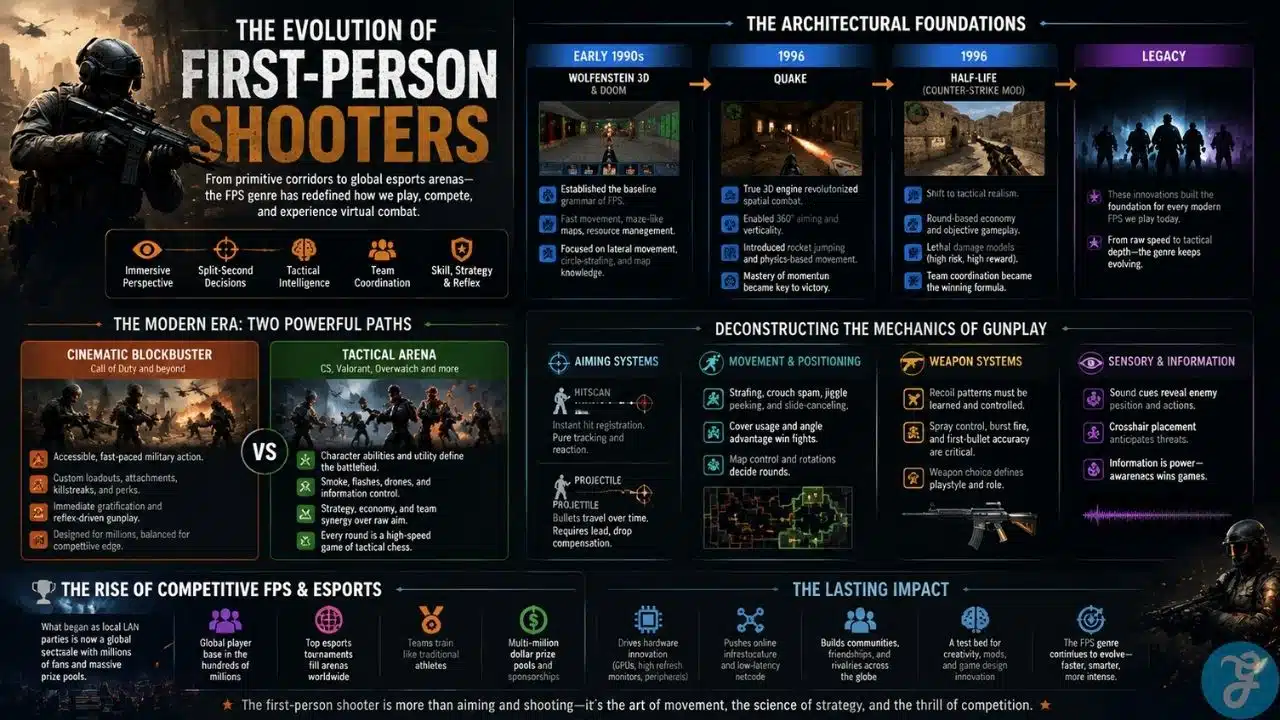
To understand the sophisticated tactical arenas of the modern competitive scene, we have to look back at the radical technical shifts of the early 1990s. The foundational era was not just about virtual violence. It was an ongoing battle to solve complex spatial geometry on highly limited computer hardware.
The arrival of Wolfenstein 3D and Doom established the baseline grammar of the genre. Doom pioneered a brilliant loop of fast-paced movement, maze-like verticality, and tight resource management. Players could not look up or down due to engine limitations. Therefore, the gameplay focused entirely on lateral movement. Players would circle strafe to avoid enemy projectiles and memorize complex map layouts to locate hidden keys and ammunition caches. It was a style of design that treated the player like a pinball bouncing through abstract corridors at breakneck speeds.
The genre underwent a massive structural shift with the release of Quake. By introducing a true three-dimensional engine, developers changed the geometry of virtual combat forever. Players could now aim anywhere in a full sphere, which birthed vertical combat mechanics like rocket jumping. This specific technique required players to fire an explosive at their own feet while jumping, using the physics blast to launch themselves onto high ledges. Quake turned spatial positioning into a fluid, expressive art form. Mastery of momentum and map physics separated the elite from the casual crowd.
As the nineties drew to a close, a massive counter movement emerged from the modding community of Half-Life. The original Counter-Strike stripped away the hyper-fast physics of arena shooters in favor of grounded, punishing tactical realism. It introduced round-based economic systems, objective-driven bomb defusal maps, and lethal weapon damage models. A single headshot meant permanent elimination until the next round. This shift forced players to transition from individual athletic movement to disciplined team coordination. It created the precise blueprint that still governs competitive tactical shooters today.
The Modern Era of Tactical and Cinematic Expansion
The turn of the century brought a massive expansion in scope. The evolution of FPS games split the genre into two dominant philosophies. We saw the rise of the cinematic blockbuster and the highly specialized tactical arena. Developers began layering complex character progression and ability systems on top of traditional shooting fundamentals. This cross-pollination forever blurred the lines between pure action and tactical strategy.
The Call of Duty franchise perfected the accessible, cinematic military shooter. It shifted the focus away from sparse map pickups and introduced customizable loadouts, weapon attachments, and killstreak rewards. The gameplay model prioritized immediate gratification and fast-paced, reflex-driven gunplay. This design choice democratized the genre. It made the mechanics incredibly appealing to millions of casual players while maintaining a highly competitive high ground through tight map choke points and predictable spawn trapping loops.
Simultaneously, the competitive tactical scene evolved toward character-driven complexity. Modern hits like Valorant and Overwatch proved that pure aim is no longer the sole variable in a shooter. By combining precise gunplay with character abilities like smoke screens, flashbangs, and scouting drones, these games turned every match into a high-speed game of tactical chess. A team cannot win on mechanical aim alone. They must understand utility economy, execute complex site takes, and combine different character skill sets to completely shut down a crosshair angle.
Deconstructing the Mechanics of Digital Gunplay
At its absolute core, a first-person shooter lives or dies by the kinetic feel of its weapon systems. This feeling is not a random accident. It is the direct result of intricate programming variables working beneath the digital surface to simulate friction, weight, and precision.
There are two primary methods developers use to calculate whether a shot hits a target. These are hitscan and projectile physics. Hitscan weapons calculate the trajectory instantly. The moment a player presses the trigger, the game engine draws an invisible mathematical line from the crosshair. If an enemy box intersects that line at that exact millisecond, the damage registers immediately. This system requires pure, instantaneous tracking and click timing.
Conversely, projectile weapons treat the bullet as a physical object traveling through digital space. Players must factor in bullet travel time, visual drop over long distances, and enemy movement speed. This specific physics engine forces them to lead their shots ahead of the moving target.
To prevent weapons from feeling like weightless laser pointers, modern shooters employ complex recoil models. In games like Counter-Strike, weapons feature completely predictable, repeatable recoil spray patterns. If a player holds down the trigger, the bullets will travel upward and break heavily to one side in a specific geometric shape. Elite players spend hundreds of hours building muscle memory to pull their mouse in the exact opposite direction of this pattern. Other titles utilize bloom or randomized bullet spread. In these systems, your crosshair remains centered but the potential area of impact expands the longer you fire, forcing players to burst fire to maintain precision.
The Physicality of Virtual Movement
Movement in a first-person shooter is never just a way to travel from point A to point B. It functions as an active defensive and offensive tool. The relationship between your movement velocity and your accuracy is one of the most critical balance points in any shooter engine.
In tactical shooters, movement and accuracy are inversely related. If a player attempts to shoot while running, their bullet spread expands drastically, making hit registration completely random. This design necessitates a mechanical technique called counter-strafing. To fire an accurate shot, a player moving left must instantly tap the right movement key to bring their velocity down to absolute zero in a fraction of a second. They fire the weapon at the exact moment their momentum stops.
Arcade and battle royale shooters celebrate high-velocity movement instead. Their systems allow players to slide cancel, sprint up vertical structures, and use parkour mechanics to cross long distances. In these environments, the skill gap shifts away from stopping to shoot. It moves entirely toward your ability to track a fast-moving target while you are flying through the air or sliding around a corner at maximum speed.
Spatial Intelligence and Map Architecture
An open field does not make for an interesting shooter encounter. The brilliance of the genre relies entirely on map architecture, sightlines, and choke points. Level designers build maps to channel players into specific zones of conflict. This structured funneling ensures that matches have a predictable emotional rhythm of tension and release.
Understanding geometry is essential for survival in any first-person environment. The concept of peeker advantage dictates how players approach a physical corner. Because the player camera is positioned in the center of the character model, a player standing closer to a wall will have their shoulder exposed to an opponent standing further back before they can actually see that opponent around the corner. High-level play requires a deep understanding of these angles. It forces players to clear rooms systematically, slice the pie angle by angle, and protect their flanks from unpredictable spawn flips.
The Rise of the Competitive Esports Ecosystem
The mechanical depth of the genre made it a natural fit for professional competition. First-person shooters were among the very first digital titles to draw massive live spectatorship. They transformed casual local area network tournaments into massive arena events broadcast to millions of viewers worldwide.
Professional play has entirely redefined how communication functions in gaming. Teams utilize highly specific callouts. They name every single room, hallway, box stack, and sightline on a map to pass critical information across the team in a single word. A callout must be instantaneous, objective, and completely devoid of emotional panic. Competitive ranking systems, algorithmic matchmaking, and detailed performance metrics have turned the genre into a pure meritocracy. These specific systems ensure that players are constantly pushed to their absolute limits against opponents of equal skill.
The Unstoppable Trajectory of Digital Gunplay
As technology marches forward, the evolution of FPS games continues to accelerate. The integration of advanced physics engines allows for completely destructible environments. A tactical team can now blow a hole directly through a concrete ceiling to completely bypass a heavily defended doorway. Furthermore, developers are utilizing advanced spatial audio technologies to give players flawless directional awareness. You can pinpoint the exact location of an enemy footstep through multiple layers of walls and floors.
The enduring appeal of the shooter lies in this perfect, unforgiving marriage of physical execution and mental strategy. It is a genre that demands complete presence of mind. The moment your attention wanders or your muscle memory fails, an opponent will capitalize on your mistake in a fraction of a second. Whether you are holding a narrow sightline in a tactical arena, navigating a chaotic battle royale drop zone, or running through a beautifully crafted single-player campaign, the view from behind the crosshairs remains the most visceral canvas for personal skill in all of interactive media.