A trainee electrician can describe how to isolate a circuit without being able to carry out the procedure safely. An automotive apprentice might identify a faulty component in a written test but struggle to diagnose the same problem under workshop conditions. A polished assignment does not necessarily demonstrate occupational competence.
Generative artificial intelligence is giving technical and vocational education and training (TVET) providers new ways to design assessments around those differences. Instead of relying exclusively on fixed questions and completed assignments, educators can use AI to help create workplace scenarios, adapt assessments, generate feedback, and examine how learners make decisions.
The technology is also exposing an uncomfortable weakness in assessment design: a system that produces convincing questions is not necessarily capable of determining whether those questions measure the right skills.
Research from New Zealand provides a useful warning. In a project involving the Manukau Institute of Technology and the Construction and Infrastructure Centre of Vocational Excellence, AI-generated baseline assessments for a Trades Essentials micro-credential failed national moderation. Yet expert reviewers responded positively to AI-personalized versions of assessments, particularly adaptations for different learner needs.
The lesson is not that AI can replace vocational assessors. It is that some assessment tasks may benefit from generative AI considerably more than others.
The OECD’s June 2026 report on AI in vocational education similarly describes adoption as uneven and largely experimental. The following 20 developments include documented applications, emerging practices, and practical uses institutions could evaluate before wider adoption.
Changing How Vocational Assessments Are Designed
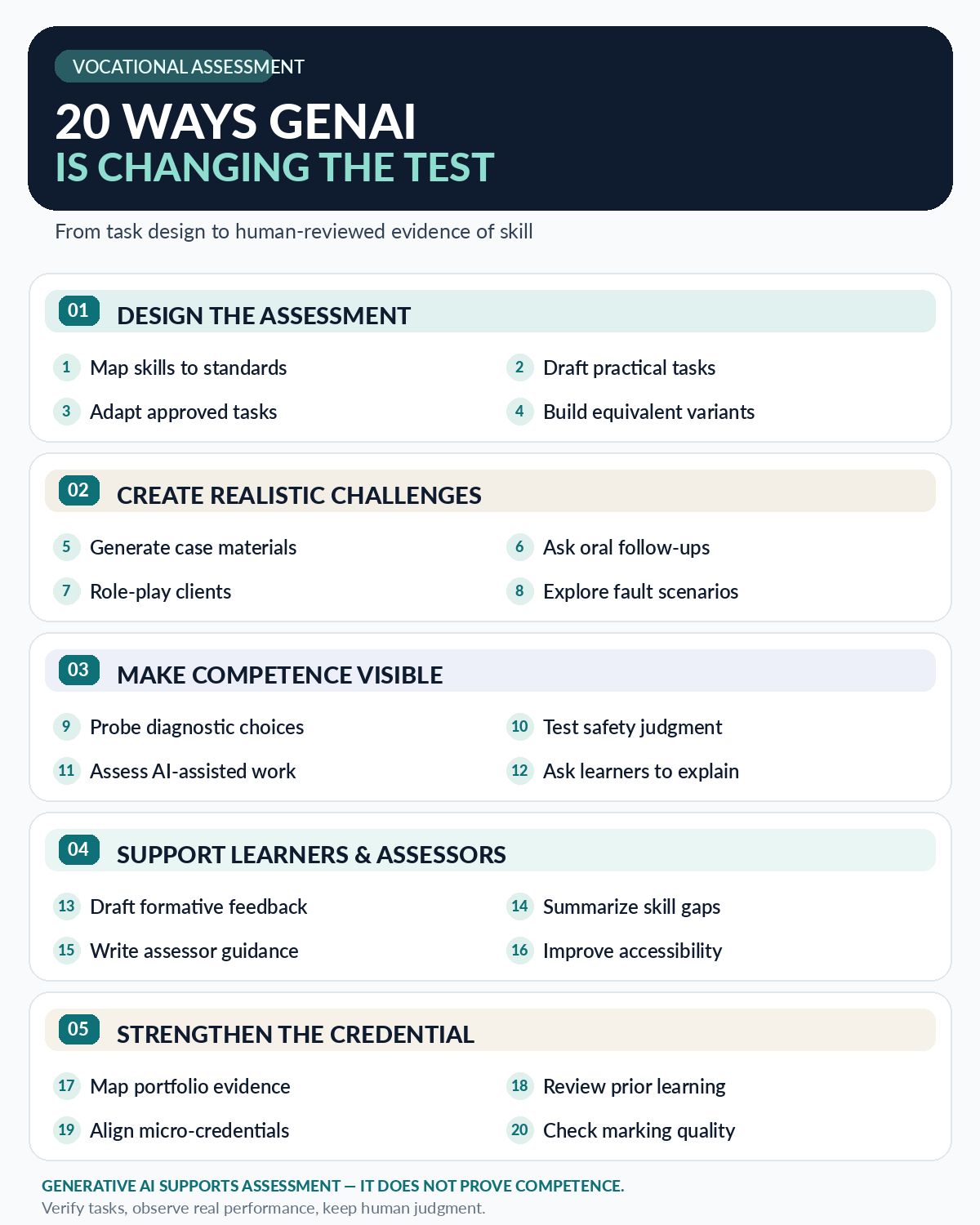
1. Turning Occupational Standards Into Assessable Competencies
Vocational qualifications typically begin with occupational standards: what a worker needs to know, demonstrate, and perform under defined conditions.
Those standards are not always straightforward to translate into assessment tasks.
Generative AI can help analyze qualification documents and organize requirements into draft competency maps. An assessor developing an industrial electrical maintenance test, for example, could ask a system to identify requirements relating to fault diagnosis, documentation, equipment inspection, and safe working procedures.
The resulting map could help reveal whether an assessment covers the intended competencies.
This application is already emerging in qualification development. The OECD documents AI-assisted competency mapping, document comparison, and alignment work across vocational systems.
However, occupational standards must remain the authoritative source. An AI-generated map cannot establish compliance merely because its terminology resembles the official framework.
2. Drafting Practical Assessment Tasks More Quickly
Writing a useful practical assessment requires more than producing a question.
An assessor must specify the task, equipment, conditions, acceptable evidence, performance criteria, and limits on assistance.
Generative AI can help create initial drafts from an approved assessment specification. For an automotive servicing course, it might prepare an exercise involving a vehicle with an electrical charging fault, including a candidate brief and preliminary assessor instructions.
The assessor would then check whether the exercise is technically accurate, appropriately demanding, feasible with available equipment, and aligned with the qualification.
This distinction between drafting and approving is important.
The 2025 New Zealand research on AI-generated vocational assessments showed that AI could produce assessment material while still misunderstanding the educational level and practical evidence requirements. Both workforce development councils involved rejected the baseline AI-generated assessments during moderation.
Faster drafting is useful only when it does not create more correction work than it saves.
3. Personalizing Approved Assessments for Different Learners
Personalization appears particularly promising when AI adapts an existing, validated assessment rather than inventing an entirely new one.
Consider a learner who understands a mechanical procedure but has difficulty interpreting complex written instructions.
A generative AI system could help an assessor simplify the wording, organize instructions into shorter steps, or produce supplementary explanations. The essential competency and required performance standard would remain unchanged.
In the New Zealand project, expert reviewers praised personalized assessment materials prepared for learners with particular needs, including English-as-an-additional-language learners and an autistic learner.
That finding does not establish that every AI-generated accommodation is appropriate. The learner’s needs, qualification rules, and assessor judgment still determine whether an adaptation is valid.
The goal is to remove unnecessary barriers to demonstrating competence, not reduce the skill level required.
4. Creating Different Versions of Equivalent Assessment Tasks
Technical instructors often need several versions of an assessment that test the same competency without repeating identical scenarios.
Generative AI can produce candidate variations using an approved assessment blueprint.
For example, refrigeration students could receive different equipment fault descriptions while each version still requires them to demonstrate the same diagnostic reasoning.
This may support preparation of larger assessment banks and reduce reliance on a small collection of predictable questions.
But AI-generated variety does not guarantee equivalence. One fault may be substantially easier to diagnose than another. Differences in available evidence or technical complexity can unintentionally change the difficulty.
Educators therefore need to review each version against the same performance criteria and check comparability before using it for consequential decisions.
5. Producing More Realistic Workplace Assessment Materials
A vocational assessment often becomes more useful when learners work with information resembling what they would encounter on the job.
Generative AI can help create fictional maintenance reports, customer complaints, job cards, incident descriptions, technical correspondence, and equipment histories for assessment purposes.
A logistics trainee, for instance, might receive a shipment discrepancy report and be asked to determine which documentation needs correcting.
A hospitality trainee could examine a fictional booking complaint and propose an appropriate response.
These materials should be clearly identified as simulated records. Technical specifications and safety-sensitive information require independent checking.
England’s qualifications regulator, Ofqual, identified assessment-item generation and stimulus-material generation—including images, audio, and video—among the AI use cases being explored by awarding organizations in 2025–2026.
Making Assessments More Interactive
6. Supporting Oral Questioning With Generated Follow-Up Questions
Practical competence sometimes depends on whether a learner understands why a procedure is appropriate, not simply whether they can reproduce it.
A generative AI system could prepare follow-up questions for an assessor based on an approved competency rubric.
After a plumbing trainee completes a diagnostic exercise, the assessor might ask why one fault was ruled out, what additional evidence would change the diagnosis, or what safety precautions were necessary.
AI can help draft those questions or suggest relevant probes.
An autonomous AI examiner is a different proposition. Voice recognition errors, misleading interpretations, language differences, and inconsistent responses could affect fairness.
For consequential assessments, a qualified assessor should control questioning and determine what the learner’s answers demonstrate.
7. Simulating Customers, Patients, and Workplace Stakeholders
Not every vocational skill involves machinery.
Hospitality, retail, business administration, and some healthcare support roles require communication, problem-solving, and professional judgment.
Generative AI can be used to build simulated conversations in which learners respond to a customer complaint, an incomplete service request, or a workplace misunderstanding.
For example, a hotel reception trainee could practice explaining an unavailable booking while maintaining professional standards.
A simulated conversation offers repeatable practice and can help instructors examine how the learner responds to changing information.
It does not fully reproduce human behavior. In healthcare-related or emotionally sensitive situations, AI simulation should not be treated as a substitute for required supervised practical assessments involving appropriate human participants.
8. Generating Technical Fault-Diagnosis Scenarios
Fault diagnosis is a natural setting for scenario-based assessment because competent workers must interpret evidence rather than merely recall definitions.
Generative AI can help instructors write descriptions of equipment faults, symptoms, maintenance histories, and test results.
An automotive learner might be asked to distinguish between a discharged battery, charging-system failure, and poor electrical connection using an assessor-approved evidence package.
The learner must identify which checks are justified and explain the reasoning.
A language model does not automatically function as a physically accurate equipment simulator. Generated scenarios need technical validation, particularly when they include electrical measurements, mechanical tolerances, or manufacturer-specific procedures.
Actual equipment performance should be measured through the relevant practical assessment.
9. Building Branching Assessments Around Learner Decisions
Traditional scenarios usually present all the information at once.
A branching assessment reveals additional information after the learner chooses an action.
For instance, an industrial maintenance candidate may decide which diagnostic test to perform. The system then presents the next approved observation and asks what the candidate would do.
Generative AI can assist with writing alternate responses and explanations. A rule-based simulation engine may still be needed to guarantee that technical states, results, and scoring remain consistent.
This approach can reveal the sequence of decisions a learner makes.
It also creates a validity challenge. If the system improvises an unexpected result, two candidates may face materially different assessments.
High-stakes branching tasks require controlled scenario logic, standardized evidence rules, and careful testing before deployment.
10. Testing Safety Judgment Without Exposing Learners to Hazards
Safety-related assessment often needs both knowledge and demonstrated behavior.
A generative system can help create hypothetical hazard-identification cases involving unsafe work arrangements, missing protective equipment, or unsuitable maintenance procedures.
Candidates might be asked to identify the hazard, explain its consequences, and select an appropriate response.
Such cases can support preparatory assessment and discussion without intentionally exposing learners to dangerous situations.
They cannot establish that someone will act safely in a real workshop.
Competence involving lockout procedures, machinery guarding, electrical isolation, clinical safety, or other critical procedures must still be assessed through appropriate supervised methods.
The distinction matters because a convincing written explanation is not evidence of safe physical execution.
11. Assessing How Learners Work With AI Tools
Generative AI is also becoming part of the work being assessed.
Some technical occupations increasingly involve using AI systems to draft documentation, analyze information, generate code, or support troubleshooting.
An assessment may therefore need to evaluate responsible tool use rather than prohibit it in every circumstance.
A software-development trainee, for example, could be required to use an AI coding assistant, inspect the output, identify a security issue, test the corrected code, and document the changes.
The essential competence would be the learner’s ability to evaluate, verify, and take responsibility for the work.
UNESCO’s guidance on generative AI in education emphasizes reconsidering learning outcomes as occupational demands change.
Editorialge’s guide to teaching AI literacy also examines why generating an answer is different from evaluating whether that answer can be trusted.
Assessment rules should make permitted AI assistance explicit and preserve tasks that learners must perform independently.
12. Making Learners Explain Their Decisions and Work Processes
An impressive final product can conceal weak understanding.
Generative AI makes that problem more pressing because learners can now obtain finished reports, code, designs, and explanations with relatively little effort.
An assessor may need to examine the process behind the submission.
A fabrication trainee could be asked to explain the selected measurement method. A programming student might defend a debugging decision. A construction learner could describe why a particular sequence of work was chosen.
AI can help draft questions tailored to the submitted evidence, but the assessor must establish which questions are appropriate and how responses will be judged.
This approach is related to broader changes in university assessments in the AI era, where final submissions increasingly need to be supported by evidence of the learner’s own thinking.
For vocational education, process explanations are particularly useful when combined with actual observation of work.
Changing Feedback and Assessor Support
13. Producing Draft Formative Feedback
Formative assessment helps learners understand what to improve before a final competency decision.
Generative AI can assist instructors by converting structured observations into clearer feedback.
Suppose a trainer records that an apprentice selected an appropriate measuring instrument but did not explain how the result supported the diagnosis.
An AI-generated feedback draft might identify the missing explanation and suggest an additional practice task.
The assessor must verify the feedback against the actual observation. A model should not invent a performance error or praise an action that did not occur.
This use is particularly suitable for low-stakes learning support, provided privacy requirements are met and instructors remain responsible for the feedback delivered.
14. Identifying Repeated Skill Gaps Across Assessment Evidence
A training provider may accumulate substantial information through practical checklists, short-answer exercises, observation notes, and reassessment records.
Generative AI can help summarize that information when the underlying evidence is available and appropriately structured.
For example, instructors might examine whether a group of automotive learners repeatedly struggles with interpreting diagnostic measurements while performing better at identifying components.
The system could produce a preliminary summary for curriculum and teaching review.
However, the quality of that summary depends on the original records. Missing observations, inconsistent rubrics, and poorly defined competency labels can produce misleading conclusions.
AI can help describe a pattern. It does not establish the cause of the pattern without additional investigation.
15. Preparing Better Guidance for Human Assessors
Assessor guidance is one of the more concrete opportunities identified in the New Zealand research.
The project found that AI-assisted personalization could produce useful instructions for assessors working with learners who had different support needs.
In a technical assessment, such guidance might clarify how to present instructions, document observations, maintain task consistency, or handle an approved accommodation.
This is valuable because assessment quality depends partly on how consistently assessors understand and apply standards.
Still, AI-generated guidance requires approval by people familiar with the qualification, learner needs, accessibility obligations, and applicable institutional policies.
Good assessor guidance improves professional judgment. It does not replace it.
16. Making Assessment Instructions More Accessible
Technical education serves learners with different language backgrounds, disabilities, educational histories, and communication needs.
Generative AI can help prepare plain-language instructions, draft translations, structured task summaries, and alternative explanations.
A welding assessment, for example, may contain complicated administrative wording that is not itself part of the competency being tested. Simplifying that wording could help the learner understand the task without changing the welding standard.
But accessibility adaptations need boundaries.
If interpreting technical English is an explicit occupational requirement, translating every instruction may change what is being assessed. If a translation alters a safety instruction, the consequences can be serious.
Qualified educators and accessibility specialists should review adjustments and verify that the required evidence remains equivalent.
Changing How Skills Evidence Becomes a Credential
17. Organizing Digital Portfolios Against Competency Requirements
Many vocational qualifications rely on collections of evidence rather than one written examination.
A learner may submit photographs, work records, supervisor reports, project documents, and signed observation sheets.
Generative AI can help organize authorized portfolio information into draft summaries aligned with competency requirements.
An assessor could see which standard each document appears to address and where supporting evidence may be missing.
That is an administrative aid, not proof of competence.
A generated summary cannot authenticate a photograph, verify that a learner personally completed the work, or establish that a supervisor’s statement is accurate. Original records and required verification remain essential.
18. Supporting Recognition of Prior Learning
Experienced workers sometimes seek formal recognition for skills developed through employment rather than conventional coursework.
Recognition of prior learning can require substantial evidence mapping.
Generative AI could help compare a candidate’s documented work history, project descriptions, and supporting records against relevant occupational competencies.
For example, an experienced maintenance technician may have completed many tasks covered by a qualification without having studied them in a formal classroom.
The system could help identify areas where records appear relevant and where an assessor may need further evidence.
It must not award recognition simply because a candidate’s description resembles a competency statement. Independent verification, demonstrations, interviews, and the governing recognition process remain necessary.
This is a promising workflow rather than a universally validated AI recognition method.
19. Connecting Assessment Evidence With Modular Credentials
Vocational programs increasingly need to respond to changing occupational requirements.
Modular courses and micro-credentials can help recognize narrower sets of competencies, but each credential still needs credible assessment and clear standards.
Generative AI can support drafting, comparing, and aligning assessment requirements across these modules.
A technical institution developing a renewable-energy maintenance pathway, for example, might examine where existing electrical competencies overlap with new equipment-specific training requirements.
The OECD’s 2026 research highlights how AI-assisted curriculum and qualification development may support more responsive vocational systems, including modular provision.
However, institutions and awarding bodies—not AI systems—must determine whether modules satisfy qualification and recognition requirements.
20. Supporting Moderation and Quality Assurance
The final and potentially most consequential change concerns the assessment process itself.
Generative AI can help reviewers compare draft assessment questions with approved standards, identify possible ambiguity, highlight inconsistent rubric wording, and flag evidence that may need closer examination.
It could also support quality checks on human marking, provided the system has been validated for the specific task.
Ofqual’s January 2026 working paper examines AI use in high-stakes marking and stresses assessment validity, fairness, accountability, and appropriate oversight.
In England, AI cannot be used as the sole mechanism for awarding marks in qualifications regulated by Ofqual.
The practical distinction is between using AI to support review and permitting it to make an unsupported certification decision.
A system that finds a possible inconsistency may be helpful. A system that independently declares a trainee competent without adequate evidence poses a much greater risk.
What the Evidence Actually Shows
Generative AI’s influence on vocational assessment should not be confused with proof that automated skill certification is reliable.
Traditional AI technologies have long supported some educational functions, including adaptive learning, performance analytics, and pattern recognition.
Generative AI adds particular capabilities in producing language, creating scenarios, transforming materials, and generating conversational responses. It can be combined with simulation engines, sensors, and other technologies, but those capabilities should not all be attributed to generative AI alone.
The available evidence also varies considerably by application.
| Application | Evidence and maturity | Important limitation |
|---|---|---|
| Assessment drafting and competency mapping | Documented exploratory use in VET development | Standards still require expert validation |
| Personalized assessment adaptation | Directly examined in the New Zealand research | Expert judgments are not proof of broad effectiveness |
| Assessor guidance generation | Promising findings from a specific research project | Local rules and learner needs still govern |
| Conversational and branching practical assessments | Plausible, developing applications | Assessment validity and consistency need testing |
| AI-supported marking | Research and regulatory evaluation underway | High-stakes outcomes require stronger evidence and oversight |
| Autonomous certification of practical skills | Not established as a generally reliable replacement for human assessment | Physical performance and authenticity must be verified |
There is no single answer to whether generative AI improves vocational assessment. The answer depends on the task, the learner population, the evidence collected, and how much authority the system receives.
What Vocational Institutions Should Do Before Adopting AI Assessment Tools
A vocational college evaluating generative AI does not need to begin with automated grading.
A safer starting point is a narrowly defined workflow that qualified assessors can review.
For example, the institution might test whether AI can adapt an existing, approved assessment for different learner needs.
The evaluation should establish whether the revised material preserves the original competency, technical accuracy, difficulty, safety requirements, and evidence expectations.
A practical pilot can compare AI-assisted preparation against the existing process and record the time required, errors introduced, revisions needed, and assessor judgments.
Institutions should also examine:
- Whether learner and assessment data can be processed securely.
- Whether the tool produces consistent and technically credible material.
- Whether accessibility adjustments preserve the assessment standard.
- Whether instructors can inspect, correct, and reject AI outputs.
- Whether learners are informed about permitted AI use.
- Whether disputes and appeals remain subject to meaningful human review.
Regulatory requirements vary.
The European Union’s AI Act identifies certain educational and vocational AI systems used to evaluate learning outcomes among its high-risk categories, subject to the regulation’s specific scope and conditions.
In England, Ofqual expects awarding organizations to demonstrate valid, reliable, and fair outcomes when AI is involved in regulated qualifications.
UNESCO-UNEVOC’s 2026 practical guide to integrating AI in TVET similarly emphasizes institutional governance, human agency, equity, and safety.
These considerations are especially important when assessment results affect employment opportunities, occupational licensing, or progression into safety-critical work.
The Skill Still Has to Be Demonstrated
Generative AI may make vocational assessments easier to design, more adaptable, and more responsive to the realities of contemporary work.
Its greatest near-term contribution may be helping assessors prepare better tasks, understand submitted evidence, and support learners who would otherwise encounter unnecessary barriers.
The difficult question remains unchanged: What evidence demonstrates that this person can perform the work competently?
For a technical qualification, the answer may require an actual repair, supervised procedure, observable workplace decision, validated simulation, or a carefully reviewed combination of evidence.
Generative AI can help organize and interpret parts of that process. It cannot make missing performance evidence appear.
A useful vocational assessment system should make skilled human judgment more informed—not make it unnecessary.