


The Dignity Act of 2025 is a new bipartisan immigration reform bill introduced in the U.S. House of Representatives by Rep. Maria Elvira Salazar (Republican, Florida) and Rep. Veronica Escobar (Democrat, Texas). It has attracted both attention and controversy, particularly over a proposal that would allow certain green card applicants to pay a $20,000 fee to skip long wait times.
The bill seeks to modernize U.S. immigration laws, clear massive application backlogs, and provide fairer opportunities for both legal immigrants and undocumented residents.
The $20,000 Premium Processing Proposal
One of the most talked-about provisions would let family-based and employment-based green card applicants who have already been waiting over 10 years pay a $20,000 fast-track fee to have their cases processed ahead of the queue.
- Eligibility: Applies only to those in existing backlogs for more than a decade.
- Purpose: Reduce maximum wait times and eliminate green card backlogs by 2035.
- Expected Impact: By allowing those with resources to move forward, more spaces would open for others in the queue, theoretically reducing delays for everyone.
While lawmakers behind the proposal argue that this is a practical solution to an overloaded system, immigrant advocacy groups have expressed concerns that it creates a “pay-to-play” path to citizenship, benefiting those who can afford it while others continue to wait.
Why the Backlog Exists
Currently, U.S. law caps the number of green cards available each year in both family and employment categories. The per-country limit is set at 7% of the total, regardless of a nation’s population size.
This disproportionately impacts countries with high demand, like India, China, Mexico, and the Philippines. For example:
- Employment-based applicants from India can face decades-long waits due to per-country quotas.
- Family-based petitions, especially for adult children or siblings of U.S. citizens, also suffer significant delays.
The Dignity Act aims to ease these bottlenecks through both fast-tracking and changes to green card distribution rules.
Raising Per-Country Caps and Excluding Dependents
To address systemic delays, the bill proposes:
- Increasing the per-country cap from 7% to 15% for both family-based and employment-based green cards.
- Excluding spouses and children (derivatives) from counting toward the annual caps, ensuring that only the principal applicant occupies a visa slot.
If passed, these changes could significantly speed up processing for high-demand countries and prevent families from being penalized for applying together.
Protecting Documented Dreamers
Another major provision addresses the plight of “Documented Dreamers”—children of long-term work visa holders (such as H-1B) who risk losing legal status when they “age out” at 21.
And here we have it, ladies & gentlemen🚨
📌 The “Staple the Green Card to a Diploma” Act
📌 The “Sell Out Americans for $20K” Act
📌 The “Replace American Workers” Act@RepMariaSalazar I think you misspelled “Disgusting.”This is not a reform. It’s a betrayal. pic.twitter.com/9gdCVlmQvR
— Alb (@amandalouise416) August 8, 2025
Under the Dignity Act:
- Children who have lived lawfully in the U.S. for at least 10 cumulative years would be able to apply for lawful permanent residency.
- This would end the uncertainty faced by thousands of young people who have grown up in the U.S. but currently have no guaranteed path to remain.
Reforms for Students and Skilled Workers
The bill also focuses on improving opportunities for international students and highly skilled professionals:
- Dual-Intent F-1 Student Visas
- Currently, F-1 visa holders must prove they intend to return home after studies.
- Under the Dignity Act, they could express intent to stay and work, removing a major barrier to long-term employment.
- OPT Students Paying FICA Taxes
- Optional Practical Training (OPT) participants would be required to pay Social Security and Medicare taxes, aligning them with other workers.
- Expanded O-Visa Eligibility
- STEM and medical doctoral graduates from U.S. institutions would receive presumption of extraordinary ability, easing their path to O-1 visas.
These reforms aim to retain top talent in the U.S., especially in critical sectors like science, technology, and healthcare.
Funding and Infrastructure Changes
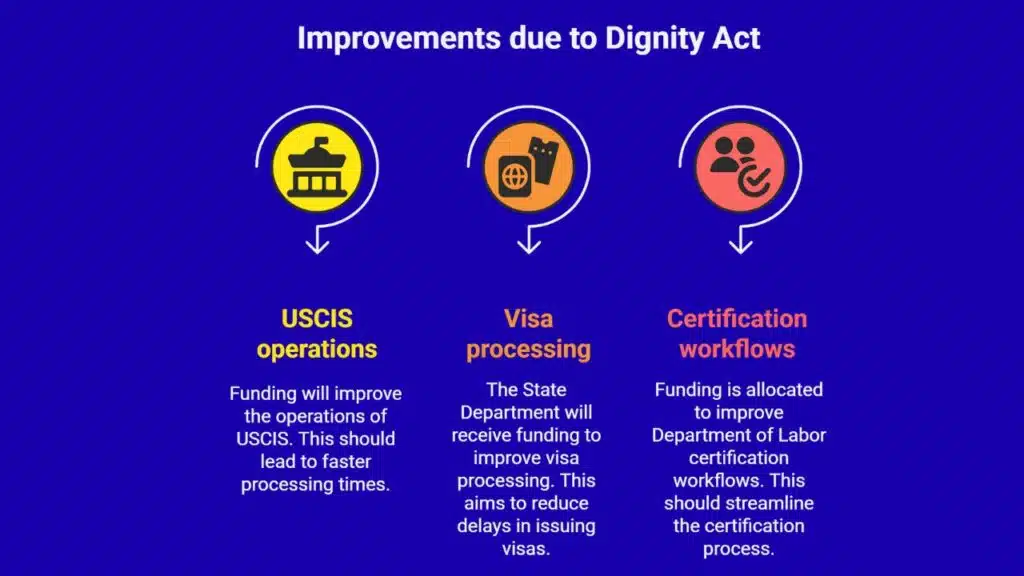
Recognizing that slow processing is a major problem, the Dignity Act allocates $3.6 billion to improve:
- USCIS operations
- State Department visa processing
- Department of Labor certification workflows
It would also create a new federal Immigration Agency Coordinator to ensure better communication between agencies and reduce redundant procedures.
Border Security and Broader Scope
While much of the media attention has focused on legal immigration, the Dignity Act also contains measures related to border security and the status of undocumented immigrants. These include:
- Pathways to legal status for certain long-term undocumented residents.
- Increased funding for border enforcement and technology.
This dual approach—expanding legal pathways while enforcing immigration laws—is intended to make the bill more acceptable to a wide political audience.
Supporters vs Critics
- Supporters argue the bill balances compassion with practicality. They say the $20,000 option would unlock bottlenecks without increasing overall green card numbers, and new rules would give fairer access to high-demand countries.
- Critics counter that charging a premium fee risks favoring wealthy applicants, turning permanent residency into a commodity, and setting a precedent for “buying” faster immigration benefits.
Advocates also worry about whether the changes will truly eliminate backlogs or simply shift waiting times to other parts of the system.
Summary of Key Provisions
| Area | Change | Goal |
| Fast-Track Option | $20,000 fee for applicants waiting >10 years | Clear backlog by 2035 |
| Per-Country Caps | Increase from 7% to 15% | Shorten waits for high-demand countries |
| Dependent Counting | Remove spouses/children from visa cap counts | Free up more green cards |
| Documented Dreamers | 10-year lawful stay = LPR eligibility | Prevent aging out |
| Student Visas | Dual-intent F-1 | Allow study-to-residency pathways |
| OPT Taxation | Require FICA contributions | Align with workforce |
| Skilled Visas | O-Visa presumption for STEM/medical PhDs | Retain talent |
| Processing Funding | $3.6B investment | Speed up adjudication |
| Coordination | New federal agency role | Improve efficiency |
The Road Ahead
The Dignity Act of 2025 is still under consideration in Congress. If passed, it would be one of the most significant U.S. immigration reforms in decades. But with the presidential election season underway and immigration a politically charged topic, the bill faces an uncertain future.
For now, its $20,000 green card fast-track proposal remains the centerpiece of debate—symbolizing the tension between efficiency, fairness, and accessibility in U.S. immigration policy.
If you want, I can also prepare a second version that compares the Dignity Act to the current U.S. immigration rules, so readers can see exactly what would change and how it affects different applicant groups. That would make the article even more comprehensive.
The Information is Collected from Times of India and India Today.





















