Someone has stolen the golden key from the Number Museum. Four clues remain: a card covered in dots, a broken number path, two baskets of treasure, and a mysterious collection of stars.
To solve the case, a young detective must discover what the numbers are trying to say.
That simple premise can turn familiar preschool math activities into a connected adventure. Instead of answering unrelated counting questions, children have a reason to match quantities, recognize numerals, compare groups, and work out how smaller numbers fit together.
Gamified math learning works best when the mathematical challenge is the adventure, not merely a way to earn digital coins or colorful badges. The mystery gives children a purpose. The adult provides guidance. The learning happens as children investigate, make mistakes, explain ideas, and try again.
Parents and teachers can create this experience with paper, crayons, blocks, and a little imagination. No subscription or screen is required.
What Makes a Math Adventure More Than a Game?
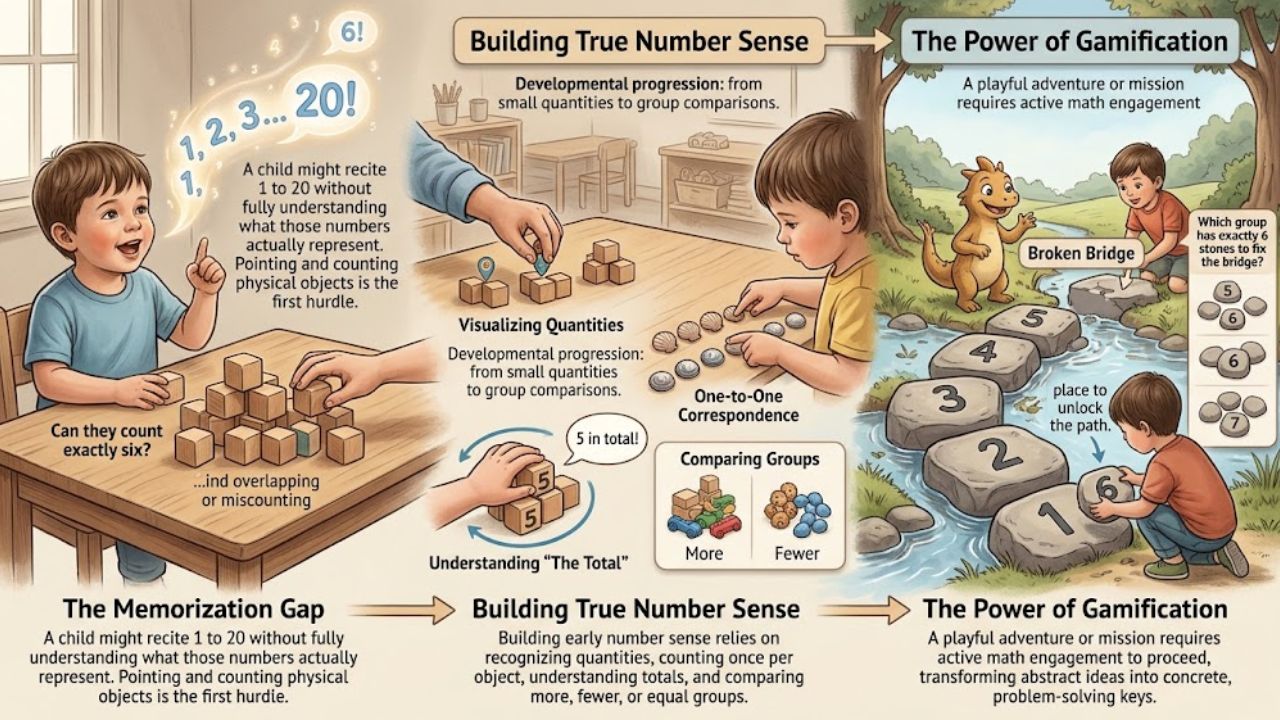
A child can recite the numbers from one to twenty without fully understanding what those numbers represent. Ask for exactly six blocks, and that same child may count too many, skip an object, or struggle to connect the spoken word six to a collection.
Early number sense involves more than memorizing a sequence. Children gradually learn to recognize small quantities, count objects once each, understand that the final count represents the total, and compare groups using ideas such as more, fewer, and equal.
The US Department of Education’s What Works Clearinghouse guidance on teaching mathematics to young children recommends building these skills through a developmental progression, integrating mathematics into everyday activities, and observing what individual learners already understand.
Gamification adds a playful structure around those goals. A mission might involve restoring a broken number bridge. A clue may require a child to identify which collection contains more objects. Solving the problem unlocks the next part of the story.
The activity does not have to be complicated. What matters is that children cannot complete the meaningful part of the challenge without engaging with the mathematical idea.
The Number Museum Mystery: An Adventure You Can Set Up at Home
The following activity is an original example for parents and early-years educators. It combines four connected number challenges into one fictional mystery and can be simplified or extended for different learning stages.
Prepare the Detective Kit
Gather a few sheets of paper, a marker, numeral cards, large counting blocks, two small containers, and a paper envelope. Draw a golden key, cut it out, and hide it in the envelope.
Prepare four clue cards that produce the answers 3, 4, 5, and 5. Write those answers on a private answer sheet so you can help when needed.
Tell the child that the Number Museum’s key has disappeared. A number detective can find it by solving the clues left behind.
For a child who is new to number games, use only the first two clues or reduce the numbers to one through three. There is no need to insist that every learner complete all four.
Clue One: The Secret of the Three Stars
Place a card showing three large stars on the table. Beside it, put cards displaying the numerals 2, 3, and 4.
The detective’s assignment is to choose the numeral that matches the collection of stars.
Some children may recognize three immediately. This ability to identify a small quantity without counting each item is called subitizing. Others may need to point to each star and count aloud.
Both approaches provide useful information about the child’s current understanding.
Once the child selects 3, ask how they knew. If they counted, invite them to touch each star once and explain how many there are altogether.
The first clue is solved: 3.
For additional practice, rearrange the same three stars. The quantity has not changed, even though the arrangement looks different.
Clue Two: The Broken Number Bridge
Draw a path of five connected stepping stones:
1 → 2 → 3 → ? → 5
The detective must repair the missing stone before crossing the bridge.
Rather than asking for an immediate answer, let the child point to each number and say the sequence. If necessary, provide a complete number path nearby as a reference.
The missing number is 4.
This kind of activity connects spoken number order with written numerals and spatial movement. The National Association for the Education of Young Children (NAEYC) describes number-path games as a way for preschool children to practice one-to-one counting, numeral recognition, and the relationships between numbers.
For a more active version, create the path on the floor with sheets of paper. A child can step from one numbered space to the next.
A learner ready for a harder challenge can work with a longer path or discover several missing numbers.
Clue Three: The Treasure Basket Puzzle
The detective encounters two treasure baskets. One contains two large blocks, and the other contains five.
Ask which basket holds more treasure and how the child can tell.
A child might recognize the difference by looking. Another may count both sets. If the quantities are confusing, invite the child to pair the blocks from each basket one by one.
After the child identifies the basket containing more blocks, ask how many blocks are in it.
The third clue is 5.
The mystery can continue with questions such as, “What would happen if we moved one block?” or “Could we make the two baskets equal?”
These questions encourage children to reason about quantities rather than guess which answer an adult wants.
Clue Four: The Five Missing Stars
For the final challenge, explain that five golden stars were divided between two treasure boxes.
Place two blocks in the first box and three in the second.
Ask the detective to determine how many stars there are altogether.
A beginner may combine both groups and count all five objects. A more confident learner might recognize that two and three make five without recounting.
The fourth clue is 5.
Then change the distribution. Put one block in one box and four in the other. Ask whether the total remains the same.
This introduces the idea that a number can be composed of smaller parts, an important foundation for addition and subtraction.
The adult can now reveal the completed sequence: 3–4–5–5. Each clue has supplied one number. Open the envelope and present the recovered golden key.
The mystery is solved—not because the child earned enough points, but because the child worked through four mathematical ideas.
The Research Behind Playful Number Challenges
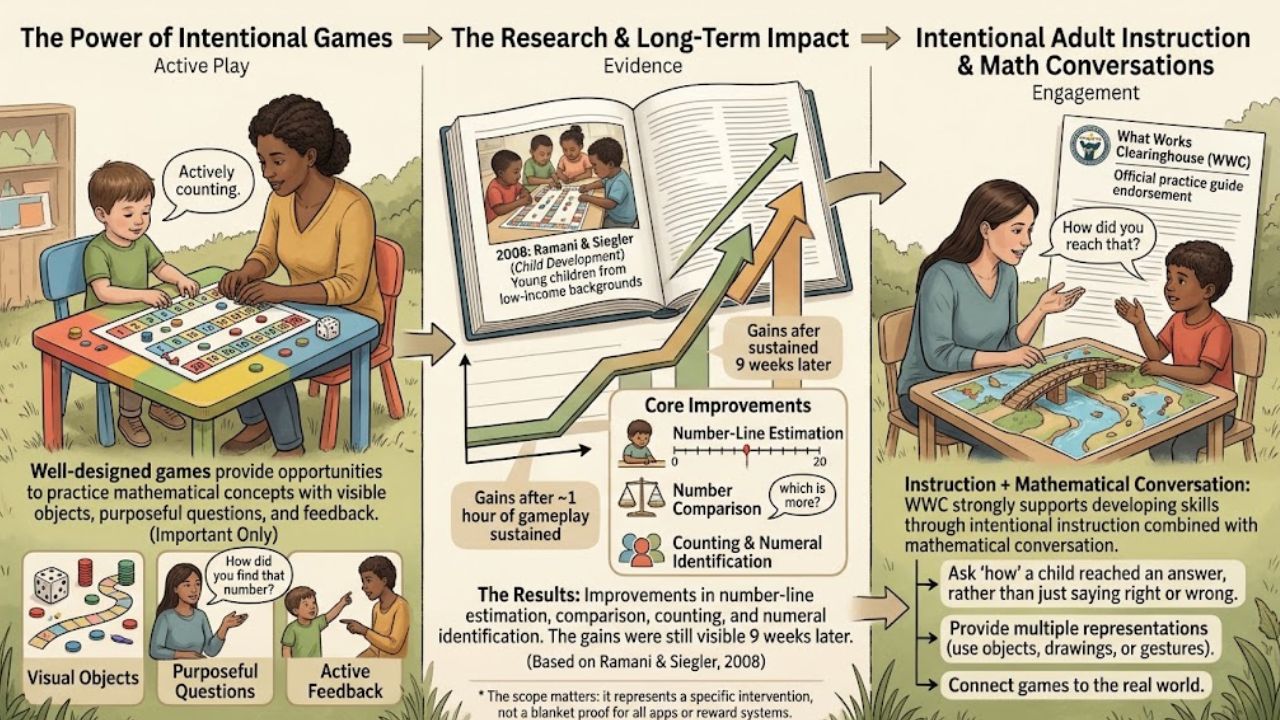
The strongest reason to use mathematical games is not simply that children appear entertained. Well-designed games provide opportunities to practice mathematical concepts with visible objects, purposeful questions, and feedback.
A 2008 study by Geetha B. Ramani and Robert S. Siegler, published in Child Development, examined linear number board games among preschoolers from low-income backgrounds. The researchers reported improvements in number-line estimation, number comparison, counting, and numeral identification after approximately an hour of gameplay. Gains were still observed nine weeks later.
The result is encouraging, but its scope matters. It was a particular intervention with a particular population and comparison activity—not proof that every educational game, app, or reward system improves mathematical achievement.
The 2022 What Works Clearinghouse school-readiness practice guide also gives strong evidential support to intentional instruction that develops mathematical ideas and skills, while separately recommending mathematical conversation.
Those principles are especially relevant to a mystery activity. The adult does not merely announce whether an answer is right. The adult asks how the child reached it, provides another representation when needed, and helps connect the problem with quantities in the real world.
How to Make the Adventure Fit Different Learners
A three-year-old who is beginning to identify small collections will not necessarily benefit from the same tasks as a six-year-old who is already comfortable adding small quantities.
For children just beginning to explore numbers, use collections of one to three objects, simple dot cards, and short clues. Allow pointing, movement, or spoken answers instead of expecting written numerals.
For more experienced preschoolers, extend number paths to ten, ask which group has one more or one fewer, and introduce simple combinations that make five.
For children ready for early elementary challenges, the mystery can involve missing numbers up to twenty, counting forward from a number other than one, and finding multiple ways to compose a given total.
The key is to increase the mathematical demand without making the mystery feel like a test.
A child who struggles with the bridge may need more time to connect spoken number words with their written symbols. A child who solves every clue immediately may be ready for a new relationship to investigate, not simply more of the same questions.
For a broader explanation of these developmental skills, Editorialge’s guide to early math skills for preschoolers explores how counting, comparison, patterns, and ordinary routines support emerging mathematical understanding.
Why Rewards Should Not Become the Main Attraction
A mystery needs suspense, discovery, and a satisfying ending. It does not need a leaderboard.
When children focus on collecting points, unlocking unrelated animations, or racing against a timer, the reward can begin to compete with the mathematical task.
A more useful form of feedback is connected directly to the problem.
If a child skips an object while counting, the adult can suggest lining up the objects and trying again. If two groups appear equal but contain different quantities, pairing their objects can make the difference visible.
Progress becomes something the child can explain: I counted each star once. I found the missing number. I made five in two different ways.
The NAEYC’s discussion of playful learning emphasizes meaningful engagement and guidance while preserving children’s active role in the experience.
A good math adventure gives children room to make choices, recover from errors, and develop their own strategies. The story should support that exploration rather than overwhelm it.
Where Digital Math Games Fit
A tablet can make a number mystery interactive through animated characters, immediate feedback, and changing challenges. But the presence of colorful graphics does not establish educational effectiveness.
Before choosing an app, examine the task itself. Does the child count, compare, predict, or explain? What happens after an incorrect answer? Can the child use the same skill with physical objects away from the screen?
A useful digital version of the treasure-basket puzzle might allow children to move objects between groups and observe how their quantities change. A weaker version might let them guess repeatedly until a celebratory animation appears.
Parents should also check advertising, in-app purchases, accessibility, data collection, and age suitability. Playing together gives adults an opportunity to understand what the child is practicing.
Editorialge’s guide on choosing learning apps that help children provides a practical checklist for distinguishing meaningful learning interactions from distracting app features.
Digital games can complement physical number play. They do not need to replace blocks, drawings, number paths, or conversations.
How to Tell Whether the Mystery Is Helping
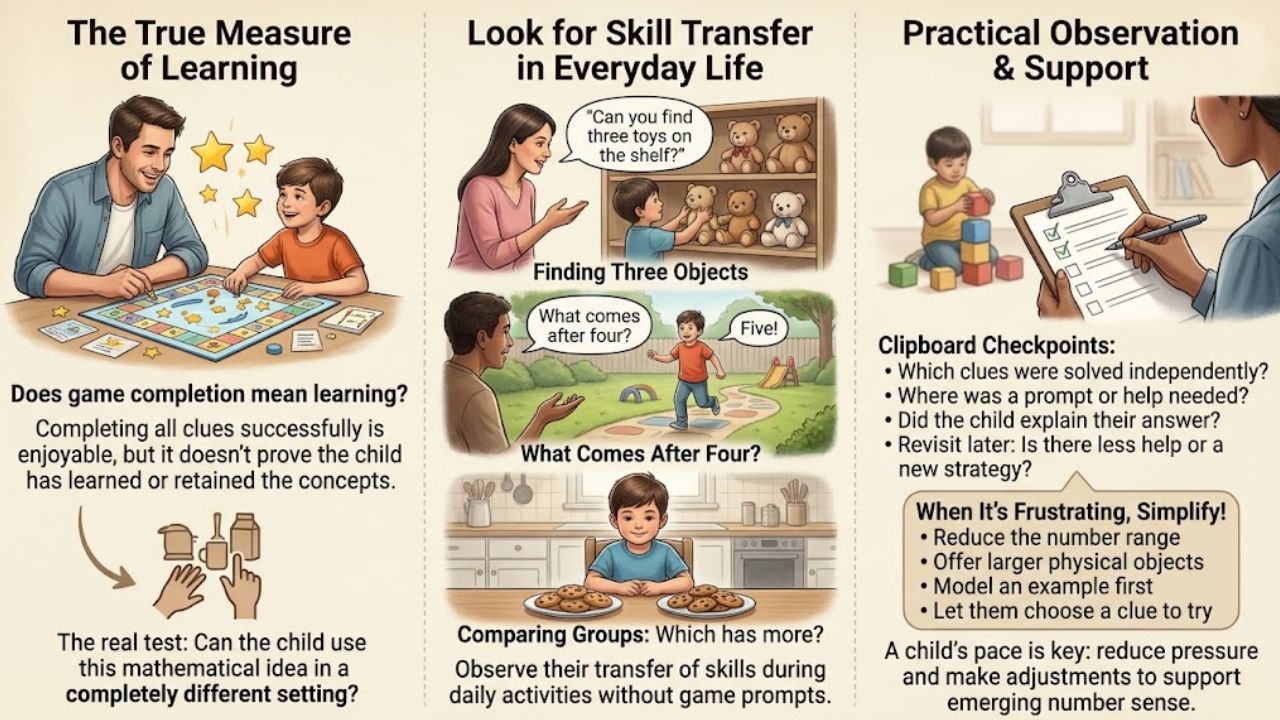
Completing all four clues successfully is enjoyable, but it does not necessarily prove that a child has learned or retained the concepts.
Look for what happens when the same mathematical idea appears in another setting.
After solving the star puzzle, can the child find three objects on a shelf? After repairing the number bridge, can they identify the number that comes after four during a different game? After comparing treasure baskets, can they explain which group of toys has more?
These observations are more informative than the number of rewards collected.
A parent or teacher can jot down a few simple details: which clues the child solved independently, where a prompt was necessary, and whether the child explained an answer. Revisit a similar challenge on another day and notice whether the child needs less help or uses a different strategy.
For additional developmental context, Editorialge explains signs of strong number sense in preschoolers.
If a child finds the mystery frustrating, simplify it. Reduce the number range, offer larger objects, model one example, or let the child choose which clue to investigate.
Successful play should build understanding at an appropriate pace—not pressure a child to demonstrate skills before they are ready.
The Mystery Continues Beyond the Game
The golden key may be back in the Number Museum, but mathematical mysteries can appear anywhere.
A missing fork at the dinner table creates a counting problem. A line of toy cars invites comparison. A staircase becomes a number path. A collection of blocks raises questions about how many different groups can make the same total.
The most useful math adventure is not necessarily the most elaborate one. It is one that makes a child curious enough to investigate a quantity, describe a pattern, or wonder what happens when a number changes.
When children begin treating numbers as clues to explore rather than answers to memorize, everyday play offers more opportunities to develop mathematical understanding.