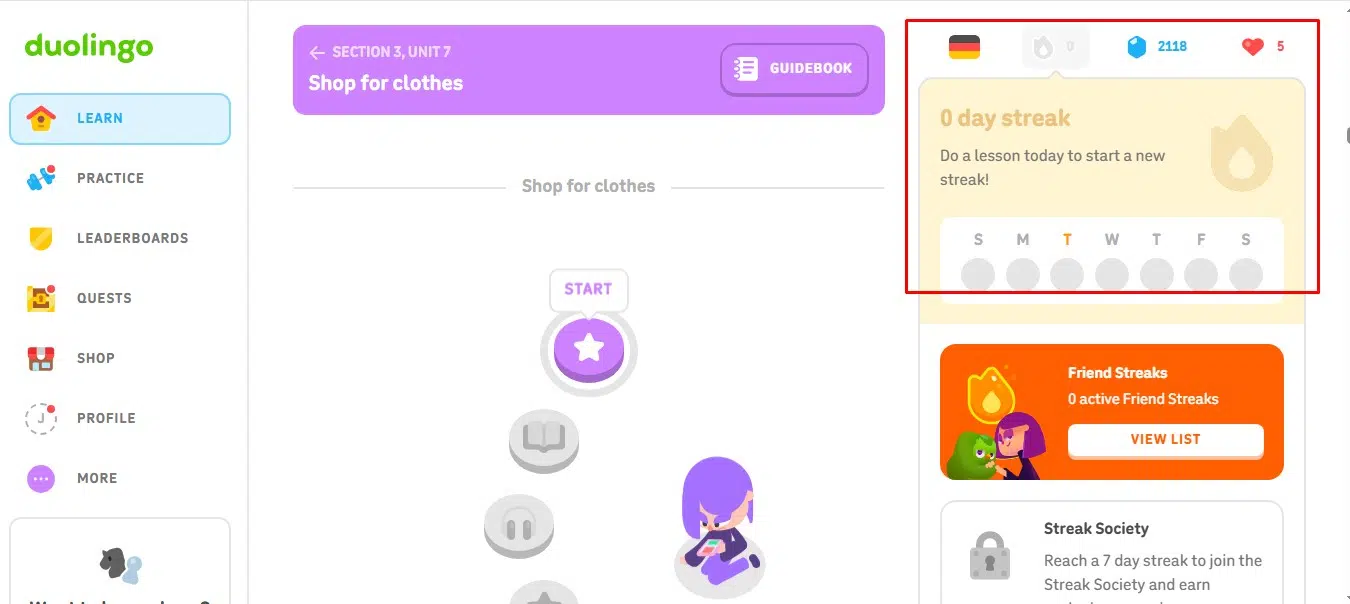
For six months, I used Duolingo to learn German and maintained a daily streak. Watching the number grow motivated me. I earned plenty of gems, returned regularly, enjoyed the lessons, and genuinely learned something.
Then I became busier. The gaps between lessons slowly increased, and the notifications that once encouraged me began to feel like pressure. As I fell behind, returning became harder. My interest started to fade even though I had enjoyed the learning itself.
My nephew had a different experience. I encouraged him into language learning when he was four, after he had learned phonics, letter tracing, and basic words through our in-house built Alphabet Magic Trace & Phonics app for kids’ learning. He was curious about the English lessons and still enjoys learning. Because we control his screen time and supervise him, the app supports a routine without taking control of it.
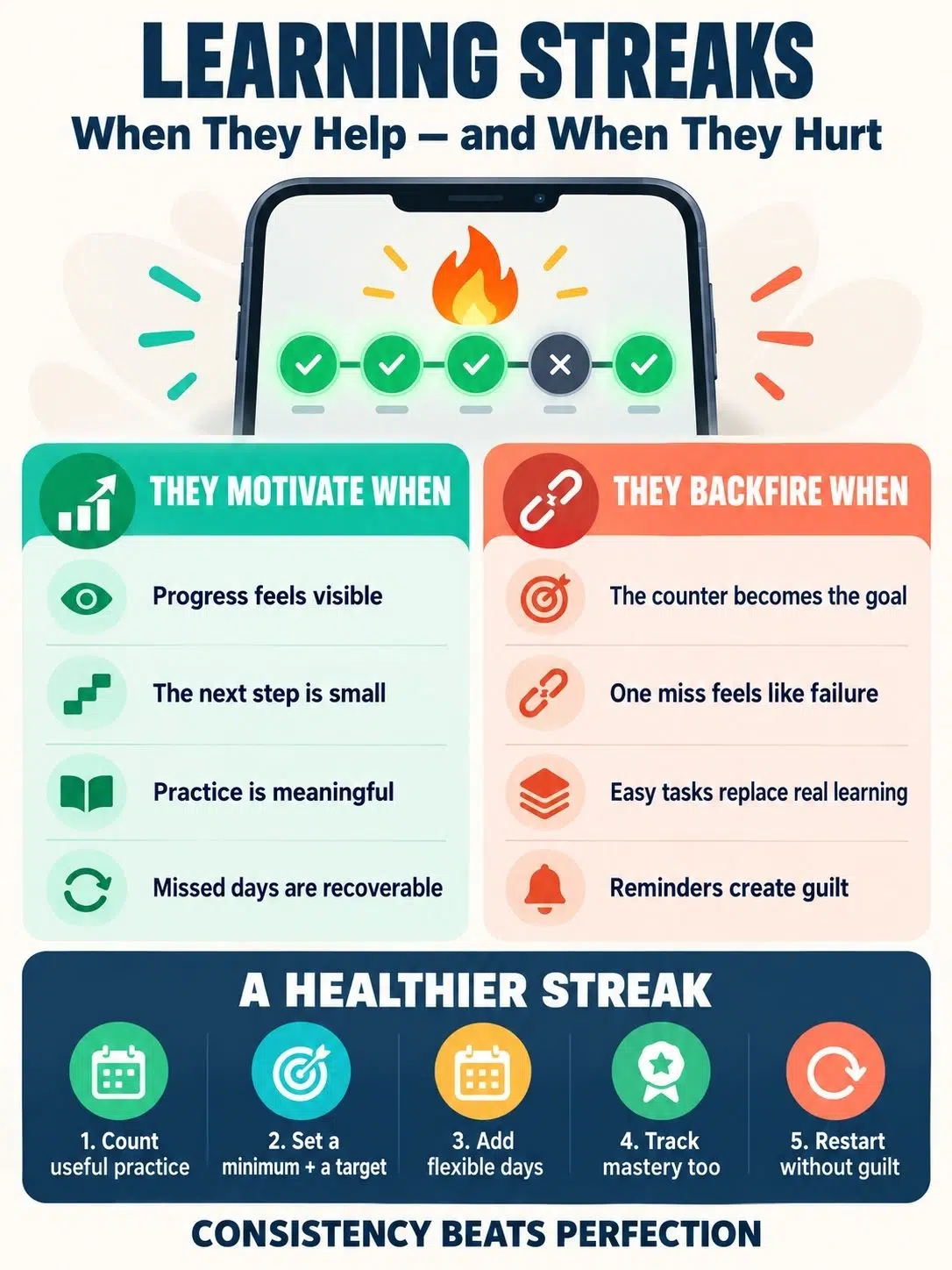
These two experiences show both sides of learning streaks. They can make progress visible and help learners return consistently. However, they can backfire when the number becomes more important than learning, a missed day feels like failure, or reminders begin to create guilt.
What Is a Learning Streak?
A learning streak records how often someone completes a learning activity across consecutive days, weeks, or sessions.
A language app may extend a streak after one completed lesson. A math platform may count each week in which a learner finishes a set of exercises. Someone studying independently might create a streak by reviewing vocabulary every weekday.
A streak can support a habit, but it is not the habit itself. A habit develops when a behavior becomes easier to start in a familiar context, such as reviewing flashcards after breakfast.
A streak is also not proof of mastery. It shows that an activity happened according to a particular rule. It does not automatically show what the learner understood, remembered, or could apply later.
Why Learning Streaks Feel So Motivating
Learning progress is often slow and difficult to see. A streak gives learners an immediate signal that their effort is accumulating.
They Make Progress Visible
Someone may need months of practice before holding a conversation in another language or solving an advanced math problem. A growing streak provides a smaller sign of progress along the way.
Research on progress monitoring supports this idea. A meta-analysis covering 138 randomized studies found that interventions encouraging people to monitor their progress improved goal attainment on average.
A streak is only one type of progress monitoring, but it gives learners a simple visual record: “I returned today.”
They Simplify the Next Decision
“I want to learn German” is a broad goal. It does not explain what to do right now. A streak turns that ambition into a smaller action: complete today’s practice.
This reduces the mental effort required to begin. Instead of planning an entire learning journey every day, the learner only needs to take the next step.
Maintaining the Streak Becomes a Goal
Once a streak grows, protecting it can feel rewarding. The learner is no longer starting from zero each day. There is visible progress to maintain.
Research on logged streaks found that people can begin treating streak maintenance as a goal of its own. That can create momentum while the streak remains intact.
The same effect also explains why losing a long streak can feel so discouraging. The learner has not only missed an activity. They may feel that they have lost something they spent weeks or months building.
They Can Encourage Spaced Practice
Learning generally becomes more durable when practice is spread across multiple sessions rather than concentrated into one large study block.
A major review of distributed practice included 317 experiments. It found clear benefits from spacing learning over time, although the best spacing depended on how long learners needed to retain the information.
Learning streaks can support this pattern by encouraging regular contact with a subject. However, the benefit comes from meaningful practice, not from opening an app or protecting a counter.
Do Learning Streaks Actually Work?
The evidence suggests that learning streaks can increase engagement. Evidence that they directly improve learning is promising but less certain.
A Journal of Consumer Research paper examined streak behavior across seven studies involving more than 4,000 people. Researchers found that participants were more likely to continue an activity when an intact streak was highlighted than when a broken streak was shown.
In one language-learning experiment, participants had completed the same pattern of activities. When the pattern appeared as an intact streak, about 92% continued with the target language. When it appeared as a broken streak, about 45% continued.
Without the streak log, the difference was much smaller. This suggests that the way previous behavior is displayed can influence the next decision.
However, many of these experiments involved short streaks in controlled settings. They do not fully represent what happens after someone loses a 300-day streak or studies a subject for several years.
A separate randomized study tested streak messages with 60,000 students in grades four to six in Peru. Messages highlighting streaks increased participation in an online math platform. They were particularly effective at encouraging continued use among students who had already started.
Students in the streak group also achieved higher math scores than the control group among those who completed the final test. That result requires caution because only about 1,500 students, or roughly 2.3% of the full sample, took the test. Test participation also differed between groups.
The strongest conclusion is that streaks increased platform use and may have supported learning. The study does not prove that every learning streak improves academic performance.
Another pair of randomized studies tested a more flexible method called “Counting Days.” Students received credit for each day on which they correctly answered at least 10 retrieval-practice questions. The days did not have to form an unbroken chain.
In one university course, students using this system practiced on an average of 38.5 days, compared with 17.3 days for students rewarded according to the number of questions answered. The Counting Days group also achieved higher final-exam scores.
This model may be more resilient than a traditional streak because it rewards spaced practice without treating one missed day as a complete reset.
A Learning Streak Is Not the Same as Learning
Learning apps can count lessons completed, questions answered, points earned, minutes spent, and days visited. These figures show activity, but they do not fully measure understanding or retention.
A learner may protect a streak by choosing an easy lesson at 11:55 p.m., repeating familiar material, or rushing through questions. The app records a completed session, although the learner may gain little from it.
Short sessions can still be useful when they require real thought. Recalling 10 vocabulary words, correcting three mistakes, explaining a short passage, or reviewing previous errors can keep knowledge active on a busy day. The same distinction matters when deciding how to choose a learning app.
A healthy streak should therefore count meaningful practice. Retention, independent problem-solving, and demonstrated proficiency need to be measured separately.
When Learning Streaks Backfire
The psychology that protects an intact streak can also make a broken streak unusually discouraging.
A Missed Day Feels Like Total Failure
When a 150-day streak resets to zero, the interface can make months of effort look as if they have disappeared. They have not. The learner retains the knowledge and practice those 150 days produced. Only the app’s counting rule has changed.
Research on logged streaks found that people were less likely to continue an activity when a broken streak was highlighted. Self-blame strengthened that effect, while the option to repair the streak weakened it.
This reflects what happened during my German learning. Becoming busy did not erase what I had learned, but the growing gap and repeated reminders made returning feel heavier than it should have.
The Counter Replaces the Original Goal
A learner may begin because they want to speak with relatives, pass an exam, understand books, or explore another culture.
After building a long streak, the daily question may change to, “Have I protected my number?”
Research on personal measurement shows why this shift matters. Across six experiments, measurement increased how much people did but sometimes reduced their enjoyment. Focusing on output made enjoyable activities feel more like work and could reduce later engagement.
A learning streak can therefore increase activity while weakening the curiosity that made the activity worthwhile.
This will not happen to everyone. Some people enjoy counters and find them helpful for years. The warning is simply that more logged activity does not always mean stronger motivation.
Learners Do the Minimum and Stop
A low daily requirement helps learners return on busy days, but it can also turn practice into a box-checking exercise. One short Duolingo lesson may preserve continuity without providing enough speaking, listening, writing, retrieval, and review for long-term progress.
The answer is not to make every daily session demanding. The minimum should be a meaningful fallback, not the entire learning goal. A separate target can define what a fuller session looks like when the learner has more time.
Notifications Begin to Feel Controlling
A reminder can help when it arrives at a suitable time and supports a goal the learner still values. It becomes counterproductive when it interrupts work, creates guilt, or focuses on what the learner may lose instead of the next useful action.
This is especially important for children. Adults, not app notifications, should decide when screen time fits. An app can support a routine, but it should not control the family’s schedule or turn learning into a source of conflict.
A Rigid Streak Ignores Real Life
Illness, travel, exams, family responsibilities, poor internet, and the need for rest are normal parts of life. A learning system that treats every interruption as failure is fragile.
One well-known habit-formation study followed 96 people for 12 weeks. Among participants whose behavior fit the study’s model, the estimated time required to approach automaticity ranged from 18 to 254 days.
Missing one opportunity did not materially disrupt the habit-formation process. There is no scientific rule saying that one missed day destroys a habit. The more important question is whether the learner returns.
Which Type of Learning Streak Works Best?
Not every learning goal needs an unbroken daily chain. The best model depends on the skill, the learner’s schedule, and what counts as useful practice.
| Streak Model | How It Works | Best For | Main Risk |
| Daily streak | Practice every calendar day | Vocabulary, pronunciation, and other brief activities | One missed day may feel like losing everything |
| Weekly streak | Meet a target during each week | Busy learners and subjects needing longer sessions | Work may be delayed until the end of the week |
| Cumulative active days | Count every meaningful practice day without resetting | Long-term goals where resilience matters | It may feel less urgent than a daily streak |
| Flexible streak | Include planned passes or repair days | Unpredictable schedules and family routines | Too many exceptions can weaken the structure |
Daily streaks are simple and motivating, but weekly or cumulative systems may reflect real learning more accurately.
Khan Academy has used weekly streaks, while the Counting Days research rewarded the total number of useful practice days. These models encourage regular participation without making perfection a requirement.
Flexibility does not remove accountability. It can prevent a small interruption from turning into abandonment. Research on “emergency reserves” found that people were more likely to continue pursuing a goal after missing a subgoal when their plan included a small amount of predefined flexibility.
Features such as streak freezes and repair options apply a similar idea. They acknowledge that interruptions happen while still encouraging the learner to return.
How to Build a Healthy Learning Streak
A useful streak should make meaningful practice easier to repeat and make returning easier after an interruption.
1. Count a Meaningful Action
Decide what qualifies before beginning the streak. Credit should require recall, explanation, problem-solving, error correction, or another active learning task. Simply opening the app should not count.
2. Set a Minimum and a Target
Create two levels of practice. The minimum is a useful action that remains manageable on a difficult day. The target is the fuller session that supports steady improvement.
For vocabulary learning, the minimum might be 10 retrieval attempts. The target could be a 20-minute lesson followed by a review of incorrect answers.
3. Use a Consistent Cue
Attach learning to something that already happens regularly. “After breakfast, I review vocabulary” gives the routine a clearer starting point than “I will study sometime today.”
4. Add Planned Flexibility
Decide how interruptions will work before they happen. A learner might aim for four meaningful study days each week or allow one planned pass each month.
This flexibility is part of the system, not an excuse created after a missed session.
5. Preserve Lifetime Progress
Keep long-term achievements visible even when the current streak resets. Useful records may include:
- Total active days
- Lessons completed
- Skills mastered
- Personal best
- Practice time
- Assessments passed
A broken streak should not hide the work completed before it.
6. Check Whether Learning Is Improving
Use a separate measure to evaluate progress. Depending on the subject, this could include delayed quiz accuracy, vocabulary recalled without help, problems solved independently, concepts explained clearly, or skills moved to proficiency.
The streak shows whether practice happened. The assessment shows whether that practice worked.
7. Keep Rewards in Perspective
Points, gems, badges, and celebrations can make practice enjoyable. Connect them to useful feedback, improvement, and meaningful achievements rather than perfect attendance alone.
8. Control Notifications
Adjust the timing, tone, and frequency of reminders, or turn them off when they create pressure. A useful notification points toward the next action. It does not shame the learner for missing the previous one.
9. Protect Sleep and Health
Do not complete a token lesson late at night simply to protect the counter. When a streak conflicts with sleep, illness, safety, school, or family responsibilities, the counter should come second.
How Parents, Teachers, and Learning Apps Should Use Streaks
Parents should treat a streak as one small part of a child’s learning environment. Appropriate content, short sessions, supervision, conversation, and screen-time limits matter more than the length of the counter.
Praise effort, curiosity, problem-solving, and improvement. Do not make perfect attendance the main achievement.
Teachers can use weekly participation goals or cumulative practice days to encourage spaced learning without punishing a single absence. Public streak rankings should be optional because they may embarrass some students or turn learning into unwanted competition.
Learning apps can create healthier streak systems by:
- Counting meaningful activity instead of logins
- Offering weekly or cumulative alternatives
- Preserving lifetime achievements after a reset
- Providing reasonable repair options
- Celebrating a learner’s return after a gap
- Allowing full control over notifications
- Showing mastery alongside engagement
- Avoiding shame-based messages
Gamification can support learning, but it should remain a tool. It should not become the entire reason someone studies.
Keep the Learning, Not Just the Number
Learning streaks make an invisible process visible. They show that someone returned, practiced, and continued building a routine. That can be genuinely useful.
My six months of German practice were not wasted because the streak eventually ended. I enjoyed the lessons and learned from them. My nephew’s experience shows how consistent app-based learning can remain positive when curiosity, supervision, and sensible screen-time limits shape the routine.
The goal is not to protect a counter at any cost. It is to keep returning to meaningful learning in a way that can survive missed days and real life.
If a streak helps you do that, keep it. If it starts creating guilt or replacing genuine progress, change the rule rather than giving up the subject.
Check out Does a Learning App Help Kid Learn or Just Keep Them Busy?
Commonly Asked Questions About Learning Streaks
Do Learning Streaks Actually Improve Learning?
Learning streaks can increase consistency and create more opportunities to practice. They may support learning when the qualifying activities involve retrieval, problem-solving, explanation, or useful feedback. The streak alone does not guarantee retention or mastery.
Why Are Streaks So Motivating?
Streaks make progress visible, simplify the next action, and create a separate goal of maintaining continuity. A growing streak can also provide a sense of momentum and accomplishment.
Is It Bad to Break a Study Streak?
No. Breaking a study streak resets a counting rule, not your knowledge. Research suggests that missing one opportunity does not automatically destroy a developing habit. Returning matters more than maintaining a perfect record.
How Long Does It Take to Build a Learning Habit?
There is no universal 21-day or 66-day rule. In one real-world study, the estimated time required to approach automatic behavior ranged from 18 to 254 days. The timeline depends on the learner, the activity, and the surrounding routine.
Are Streak Freezes Cheating?
No. Planned freezes or passes can make a learning system more resilient. They allow for normal interruptions without removing the expectation that the learner will return.
Is a Daily or Weekly Learning Streak Better?
A daily streak works well for brief activities that benefit from frequent contact. A weekly streak is often more suitable for busy learners and subjects that require longer sessions. Cumulative active days are useful when long-term consistency matters more than perfect continuity.
How Do You Restart After Losing a Long Streak?
Begin with one manageable, useful session. Do not attempt to recover every missed day at once. Identify what disrupted the routine, choose a more realistic schedule, and treat returning as the next achievement.