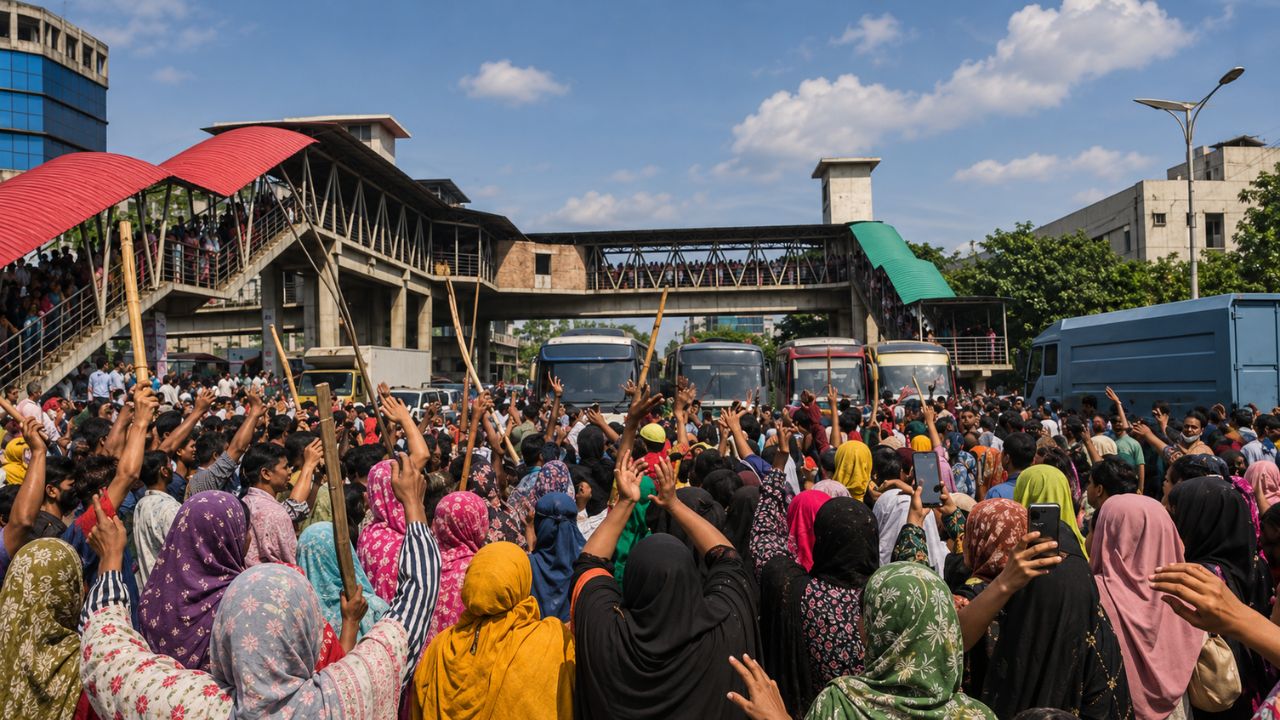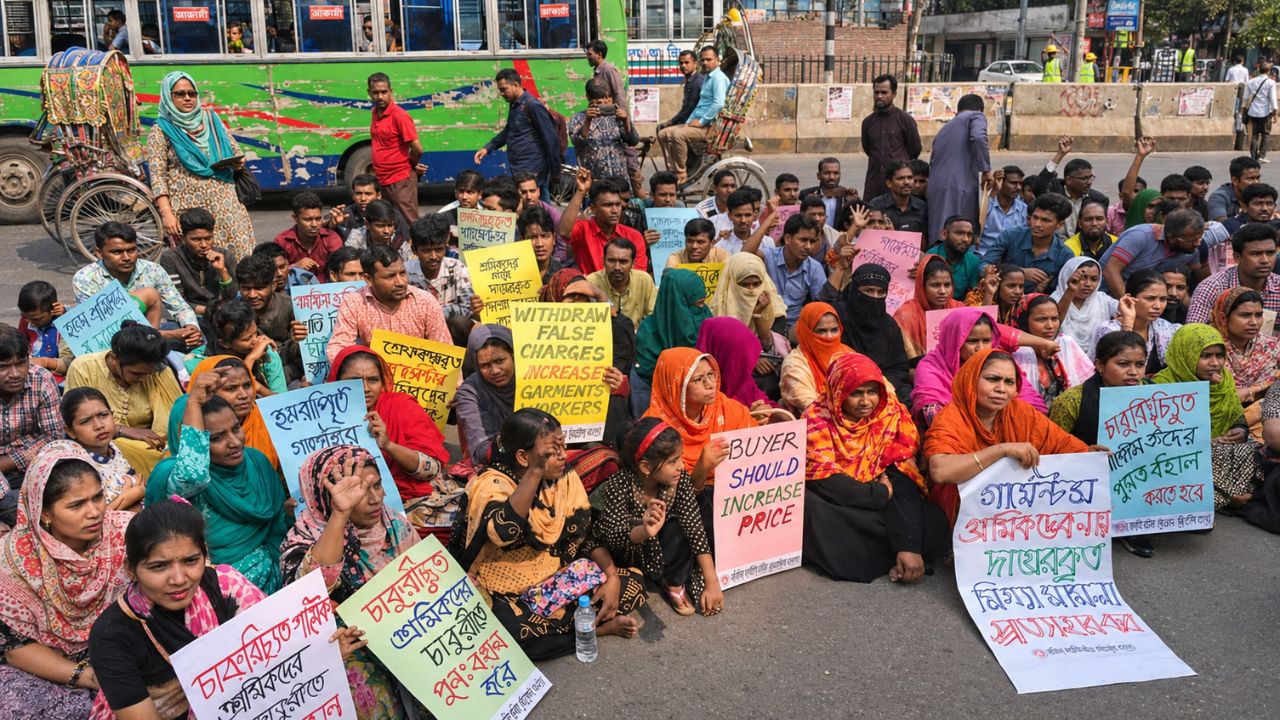
The wage amount at the center of the Bangladesh garment wage protests remained undecided as of November 6, 2026. This turns to the harder economic question: who can afford that correction? Workers say their earnings no longer cover basic household costs. Factory owners say international buyers continue to press down order prices while energy, freight, financing, and compliance costs rise. Global fashion brands publicly support fair wages, but their purchasing decisions influence whether suppliers have the financial room to pay them.
The answer matters far beyond Bangladesh’s industrial zones. World Trade Organization data show that Bangladesh remained the world’s second-largest apparel exporter in 2025, shipping garments worth $38.82 billion. In fiscal year 2025–26, ready-made garments generated $38.70 billion and provided more than 80% of the country’s merchandise export earnings. The industry employs about four million people and supports millions more through transport, housing, food, finance, and other services.
The wage dispute therefore cannot be reduced to a choice between workers and the industry. Workers are the industry. Factory owners, international buyers, and government policy determine how much of the value created by that industry reaches them.
Part 1 of this analysis explained how the protests spread, why workers are demanding Tk 30,000 instead of Tk 12,500, and how inflation weakened the existing wage floor. This second part examines whether factories can absorb a major wage increase, how global buyers influence supplier costs, whether higher wages would weaken Bangladesh’s competitiveness, and how the cost of fairer pay could be shared.
The Living-Wage Gap Behind the Bangladesh Garment Wage Protests
Part 1 showed how the Tk 12,500 wage floor has lost purchasing power since it was introduced in 2023. Inflation has outpaced national wage growth, while newly hired workers can still enter at the minimum even though the annual increment for existing employees was raised to 9%.
For this economic analysis, the more important distinction is between a legal minimum wage and a living wage. The minimum is what an employer must legally pay. A living wage estimates what a worker and family need for food, housing, healthcare, transport, education, and a modest margin for emergencies.
Research by the Fair Labor Association suggests that this gap is not theoretical. In four participating Bangladesh factories, average base wages remained below the living-wage benchmarks used by the researchers. Average earnings still failed to close the gap when overtime was included, despite workers often logging excessive hours. Interviewed workers described reducing food and housing expenses and relying on more than one earner to keep their households running.
That evidence does not prove that Tk 30,000 is the only defensible figure. It does show why the demand should be tested against a transparent household budget rather than dismissed merely because it represents a 140% increase from a low starting point.
Is Tk 30,000 Economically Possible?
The workers’ demand is understandable. That does not mean implementation would be simple.
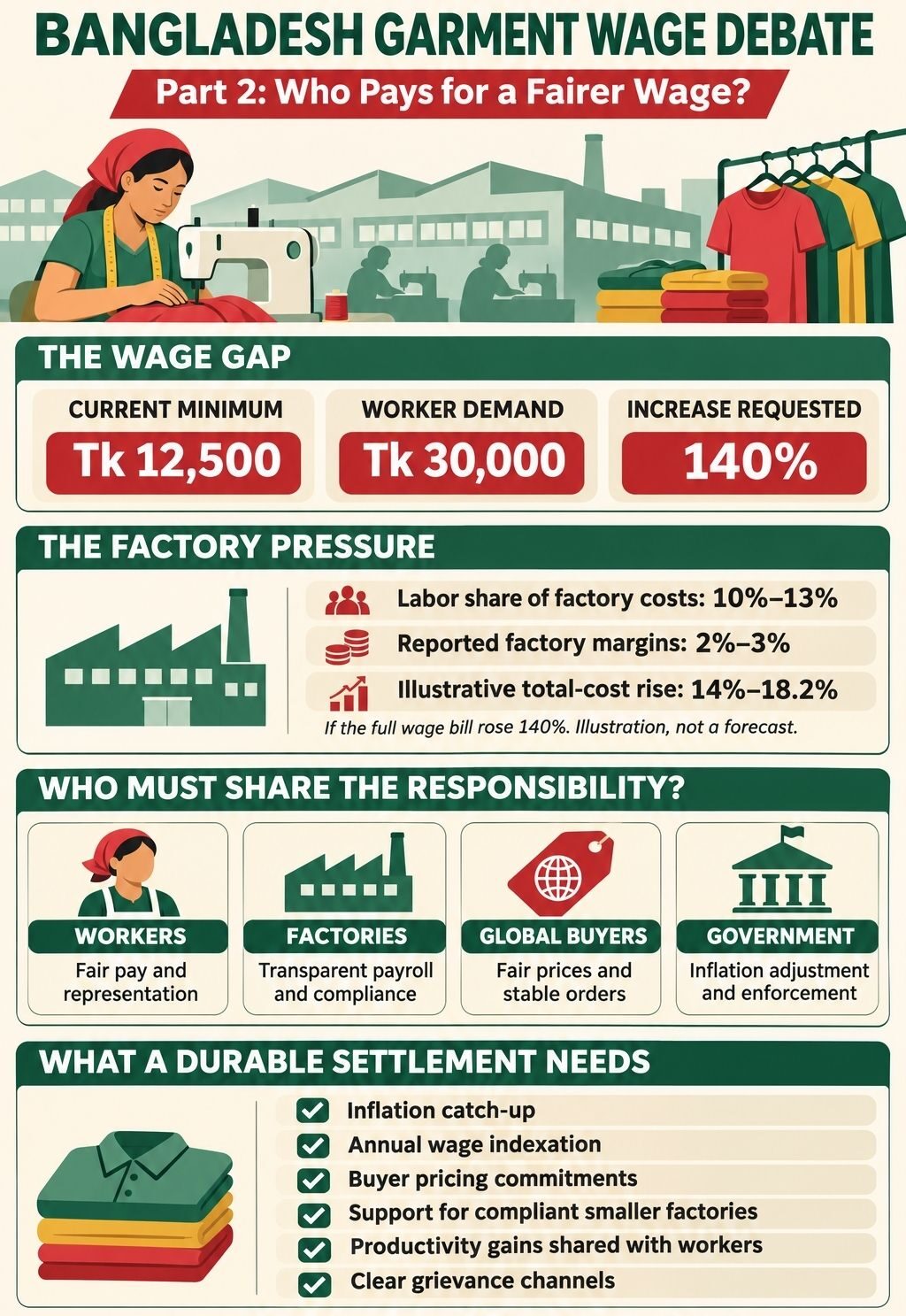
Reuters reported that labor represents about 10% to 13% of garment production costs and that factory profit margins are often only 2% to 3%. One manufacturer said logistics costs had risen by 5% to 7% over the previous year even as a US buyer sought a three-cent reduction on each garment.
A simplified calculation shows why the debate becomes tense. If the entire wage bill rose by 140%, and labor accounted for 10% to 13% of production costs, the direct increase in total production costs could be roughly 14% to 18.2%.
That is an illustration, not a forecast. The legal minimum does not represent every worker’s current wage. Changes across job grades may differ, productivity may improve, and benefits or overtime can alter the final result. Still, an increase of that scale would be much larger than a typical factory’s reported margin.
Two conclusions can therefore be true at the same time.
First, factories cannot reasonably absorb the full cost from profit alone if margins are as thin as industry figures suggest. Smaller factories and subcontractors would face the greatest risk.
Second, a large wage increase does not mean the retail price of a shirt must rise by the same percentage. Labor is only one part of the cost chain. Fabric, energy, finance, logistics, brand overhead, marketing, wholesale margins, and retail margins all sit between a worker’s wage and the price paid by a consumer.
| Indicator | What It Shows |
|---|---|
| Current entry minimum | Tk 12,500 a month |
| Worker demand | Tk 30,000 a month |
| Increase requested | 140% |
| Labor share of factory costs | About 10%–13% |
| Reported factory margins | Often 2%–3% |
| Illustrative total-cost effect if the full wage bill rose by 140% | Roughly 14%–18.2% before offsets |
The policy question is not whether higher wages affect competitiveness. They do. The question is whether Bangladesh’s competitiveness should depend mainly on low wages or on better productivity, energy reliability, logistics, skills, finance, design capability, and higher-value products.
International Brands Cannot Stay Outside the Wage Debate
Global fashion companies often describe wages as a matter for factories, workers, and the government. Legally, that position may be convenient. Economically, it is incomplete.
Buyers influence wages through the prices they pay, the lead times they allow, the size and stability of orders, payment terms, quality penalties, and last-minute design changes. A supplier asked to improve wages and compliance while accepting a lower unit price receives two conflicting instructions.
The Fair Labor Association recommends that brands account for living-wage costs during price negotiations, build longer-term supplier relationships, align purchasing teams with sustainability commitments, and support worker dialogue.
Those recommendations matter because a brand’s public labor policy has limited value when its sourcing team is rewarded mainly for reducing costs.
Bangladesh should make buyer responsibility more measurable. Brands that publicly support a higher minimum wage should be asked whether their future order prices will reflect it.
Longer contracts, predictable order volumes, faster payments, and limits on last-minute changes can give efficient factories more room to raise wages without losing financial stability. Multi-buyer factories also need coordination so that one responsible buyer does not subsidize competitors that continue to demand the lowest possible price.
This does not remove responsibility from factory owners. Suppliers must disclose wage compliance, end unlawful deductions, pay workers on time, protect organizing rights, and improve management. A fair analysis, however, cannot place every obligation at the factory gate while ignoring the companies that control orders.
The same tension appears in Bangladesh’s wider workers’ rights debate and in the conditions facing garment workers across South Asia.
Cheap clothing does not eliminate labor costs. It moves them to the people with the least bargaining power.
Bangladesh Competes on More Than Cheap Labor
Warnings that any major wage increase will immediately drive orders elsewhere should be treated carefully.
Bangladesh faces stronger competition. Vietnam and Cambodia recorded much faster apparel-export growth in 2025. India also benefits from domestic cotton and yarn capacity, government incentives, and a large manufacturing base. Buyers can move some orders when costs, delivery times, or political risks change.
But sourcing decisions are not based on wages alone.
Bangladesh offers industrial scale, deep knitwear capacity, experienced workers, established supplier relationships, and decades of knowledge about high-volume production. It also has 291 LEED-certified green garment factories, according to BGMEA, giving it the world’s largest concentration of such facilities.
As brands face closer scrutiny over sustainable clothing and supply-chain transparency, this green-factory base can become a stronger competitive advantage. For large retailers, the ability to deliver millions of pieces at consistent quality can matter more than a small price difference.
Reliability is equally important. A lower unit price loses its attraction if repeated shutdowns delay a seasonal collection.
This is why suppressing wages can become self-defeating. If inadequate pay produces recurring unrest, the supposedly cheap production model creates expensive disruptions.
Bangladesh’s export numbers show both strength and pressure. The country remained the second-largest apparel exporter in 2025, but its 0.89% growth lagged behind the 4.46% expansion of the global apparel market.
RMG exports then declined by 1.65% to $38.70 billion in FY2025–26 before rebounding by 6.1% in the July–September quarter of FY2026–27. The industry is not collapsing, but it cannot assume its past advantages will protect it automatically.
Bangladesh’s graduation from least-developed-country status has been extended to November 24, 2029. That provides more time before some trade preferences change, but it should not become an excuse to postpone reform.
The country needs to use this period to improve ports, power, customs, finance, worker skills, labor relations, and product complexity. A strategy based on higher productivity and value is more durable than one based mainly on lower pay.
A Wage Debate With a Gender Dimension
Women make up a large share of Bangladesh’s garment workforce, although estimates vary by source and factory segment.
A wage decision therefore affects much more than industrial costs. It can shape women’s control over household income, children’s education, nutrition, healthcare, and the security of families that depend on one or two earners.
Low wages can also push women out of the industry. Long hours, unsafe travel, rent near factories, and unpaid care work make poorly paid employment harder to sustain.
If the industry wants to retain experienced female workers, wage policy should be connected to safe transport, maternity protections, childcare, equal promotion opportunities, and protection from harassment.
Evidence suggests that better opportunities for women can also improve factory performance. An assessment of the Gender Equality and Returns program found that more than two-thirds of trained women were promoted to supervisory positions. Their salaries rose by about 40%. Production lines managed by trained participants were 2.5 to 4.3 percentage points more efficient than comparison lines.
That finding does not mean productivity programs can replace fair wages. It shows that investment in workers and factory performance can reinforce each other. The goal should be to share productivity gains with the people who help create them.
Why Wage Negotiations Keep Returning as a Crisis
Bangladesh has shortened the formal wage-review cycle from five years to three, but the underlying process remains reactive.
Workers often feel that street pressure is the only way to make their living costs visible. Employers fear that a sudden increase will arrive without higher buyer prices or policy support. The government intervenes after production has already been disrupted.
This pattern damages everyone. Workers lose income and face injury or arrest. Factories lose production days and buyer confidence. The government must manage unrest. Brands worry about delivery. The country’s reputation becomes tied to another emergency that could have been anticipated.
The solution is not to remove wage negotiations. It is to make them regular, evidence-based, and trusted.
A credible system would publish the household-cost basket used by the wage board, the inflation period it considers, the assumptions behind worker and employer proposals, and the likely effects on different types of factories.
It should also include independent worker consultation outside the boardroom. Formal representation matters, but one worker representative cannot substitute for listening to sewing operators, helpers, cutters, quality inspectors, and other employees across the main industrial zones.
Bangladesh should also consider annual inflation adjustments between full wage reviews. The complete structure could still be negotiated every three years, but an automatic annual adjustment would prevent the wage floor from losing so much real value that the next review begins with an explosive catch-up demand.
Such a system would also strengthen the wider framework of labor laws and enforcement by making wage revision more predictable for workers and employers.
What a Workable Settlement Could Include
The wage board cannot set a credible figure without detailed cost-of-living data, wage distributions, factory accounts, and written proposals. A durable agreement, however, should contain more than one headline number.
| Part of the Settlement | Why It Matters |
|---|---|
| Meaningful inflation catch-up | Restores some purchasing power lost since the 2023 wage was set |
| Transparent cost-of-living method | Gives workers and employers a common evidence base |
| Annual inflation adjustment | Reduces the need for disruptive, irregular corrections |
| Full review every three years | Allows broader changes to grades, allowances, and economic conditions |
| Written buyer commitments | Connects fair-wage promises to order prices and purchasing practices |
| Targeted support for compliant smaller factories | Prevents the transition from favoring only large suppliers |
| Productivity investment with shared gains | Links training and technology to higher worker income |
| Strong enforcement and grievance channels | Ensures the announced wage is paid without retaliation |
The government can help through faster VAT refunds, more reliable energy, improved port and customs performance, and affordable finance for factories that demonstrate wage and safety compliance.
Such assistance should be conditional. Public support should not subsidize owners who hide payroll records, delay wages, or punish lawful worker representation.
Brands should revise their costing where necessary and provide longer, more predictable orders. Factory owners should open relevant cost data to the wage process and commit to paying the final award. Worker representatives should have space to organize and communicate without blacklisting.
Law enforcement should protect people and property while using force only when necessary and proportionate. Allegations of violence should be investigated individually, not used to label all workers or every protest.
Most importantly, the final wage package must be explained clearly. A gross wage can look larger while changes to basic pay, allowances, grades, overtime, attendance bonuses, or deductions reduce its real value.
Workers need to see exactly how much money will enter their hands and how future increments will be calculated.
The Choice Bangladesh Is Really Making
The Bangladesh garment wage protests have exposed a contradiction that can no longer be managed through periodic wage boards alone.
Workers cannot indefinitely finance export competitiveness by accepting falling real incomes. Factories cannot fund a major wage correction from margins of 2% to 3% while buyers continue pressing prices downward. Brands cannot promise ethical supply chains while treating the labor cost inside each order as somebody else’s problem.
Bangladesh does not have to choose between fairer wages and a viable garment industry. It does have to choose what kind of garment industry it wants to build.
One path protects the old low-cost model until inflation, unrest, worker turnover, and international competition weaken it further. The other treats decent pay as part of a broader move toward productivity, stability, skills, greener factories, stronger labor relations, and higher-value production.
The wage board’s eventual number will matter greatly. Yet the deeper test is whether workers, factory owners, global brands, and the government agree to share the cost of keeping “Made in Bangladesh” competitive.
If the burden again falls mainly on workers, the next wage crisis will already be taking shape before this one is over.