
Sell 100 dollar-backed stablecoins at US$1 apiece, and exchange fees can leave you with less than US$100. The difference in CBDCs vs Stablecoins starts with what each balance represents. A central bank digital currency (CBDC) is official money issued in digital form by a central bank, while a stablecoin is a token designed to track the value of a currency or another asset.
USDC uses reserves to help it track the U.S. dollar. It’s one of the fiat-backed stablecoins being used for payments beyond crypto exchanges. Stablecoins that rely on crypto collateral or algorithms work differently and carry different risks.
1. Who Issues the Money?
You can get a JAM-DEX wallet through a Jamaican bank or an authorized payment provider. The balance inside it is money issued by the Bank of Jamaica and a direct liability of the central bank.
An exchange that holds your USDC is acting as your custodian. Circle issues the token. The exchange and the issuer have different roles, even if the exchange is the only company you deal with.
2. What Keeps Each Unit at Face Value?
Because JAM-DEX is denominated in Jamaican dollars, you can exchange it one-for-one for notes and coins. Inflation can still change what either form of that dollar buys.
For a dollar-backed stablecoin, US$1 is a target price. Reserves and redemption help keep the token near that target, but buyers and sellers can trade it for more or less. A move away from the target is known as a depeg.
3. How Do You Get Your Money Back?
Selling a token on an exchange and redeeming it with its issuer are two different routes to cash. Sell on an exchange and your payout depends on the quoted price and any fees. For USDC holders outside the European Economic Area, direct redemption with Circle requires an eligible, registered Circle Mint account and compliance with the terms.
With a retail CBDC such as JAM-DEX, the system and wallet provider determine your options. Check whether you can move the balance to a bank account, convert it to cash, or spend it directly.
4. What Rules and Protections Apply?
A wallet menu tells you how to cash out. Local law shapes the rights that come with the balance. Jamaica recognizes JAM-DEX as legal tender. The EU and the U.S. set out rules for specific types of stablecoins.
- European Union. Under Article 49 of the Markets in Crypto-Assets Regulation, holders of qualifying e-money tokens have a claim against the issuer and can redeem at face value.
- United States. The GENIUS Act sets reserve and redemption-policy requirements for covered payment stablecoins. Its general effective date is the earlier of 18 months after enactment or 120 days after the relevant federal regulators issue final implementing regulations.
5. Which Payment Network Moves the Balance?
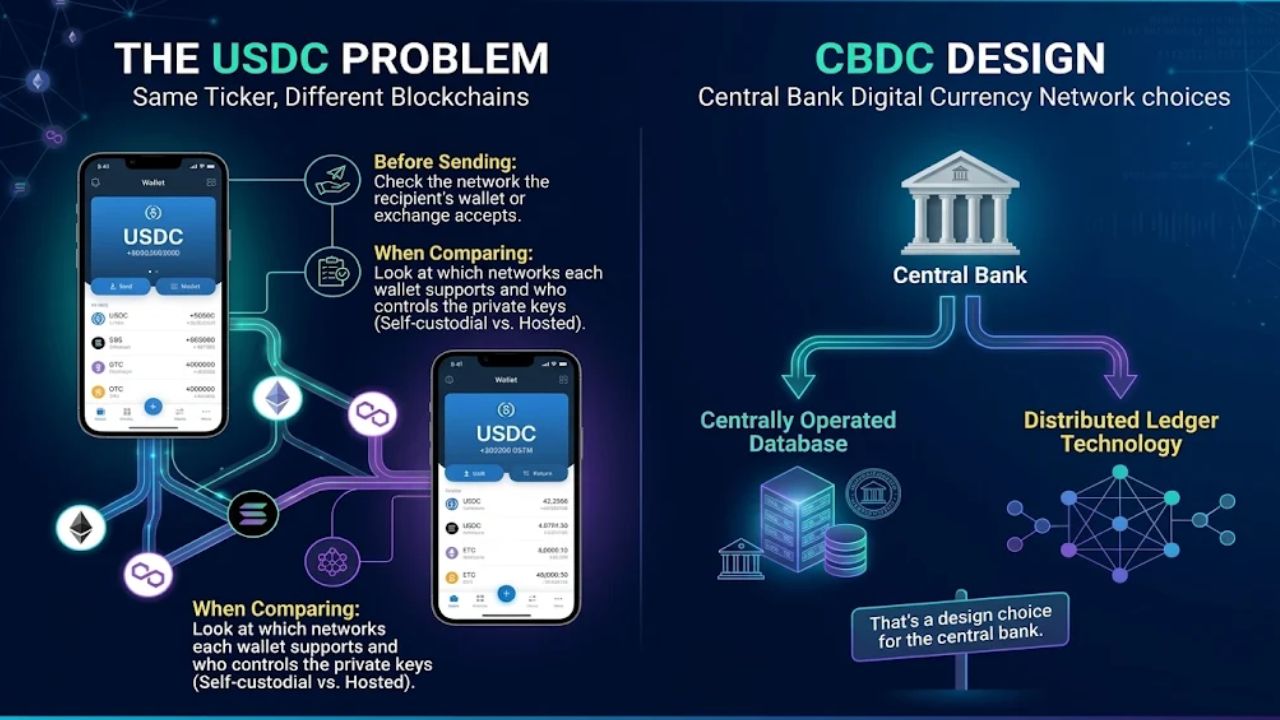
Two wallets can display the same USDC ticker and support different blockchains. Before sending USDC, check the network the recipient’s wallet or exchange accepts. If you’re comparing mobile crypto wallets, look at which networks each one supports and who controls the keys.
A CBDC can use a centrally operated database or a distributed ledger. That’s a design choice for the central bank.
6. Who Can See or Restrict a Payment?
The network you use can affect who sees the payment. On a public blockchain, a stablecoin transfer can expose the amount and wallet addresses, which may be linked to people or businesses. Who can restrict a transfer is a separate question. Circle, for instance, can block addresses under its USDC terms.
The proposed digital euro illustrates how a CBDC could handle privacy. The design calls for cash-like privacy for offline payments. Online transactions would follow different privacy rules and still involve payment providers.
7. Who Can Use Each One and Where?
A CBDC pilot can make headlines without giving the public a new way to pay. Retail CBDCs are designed for people and businesses where the system is available. Wholesale CBDCs serve eligible financial institutions, including for settlement between them. Check which kind of pilot is being discussed when you read about changes in digital finance.
Stablecoins already move between traders on crypto platforms, including decentralized exchanges. In a cross-border payment, the token may arrive long before the recipient can spend the proceeds. For someone who needs a local bank deposit, the exchange rate, cash-out fees, and payout time matter just as they do with other international payment tools. The provider also needs to serve the destination country.
8. What Can Go Wrong?
A central bank digital currency removes the risk of a private token issuer failing to honor a redemption. Operational risks remain. An outage or account takeover can cut off access to your wallet, and help with a mistaken payment depends on the provider and the system’s rules.
Holding your own stablecoin keys reduces your reliance on a custodian. You still depend on the issuer’s reserves and ability to redeem the token. An exchange or network problem can interrupt a sale or transfer. When many holders try to sell at once, buyers can be harder to find at the usual price.
CBDCs vs Stablecoins at a Glance
| Question | CBDCs | Fiat-Backed Stablecoins |
| Who issues it? | A central bank | Typically a private issuer |
| What determines its value? | Each unit is part of the official currency | The token aims to track a reference currency |
| How do you cash out? | Use the options the system provides | Redeem with the issuer if eligible, or sell through a platform |
| Which rules apply? | Local currency and payment rules | Rules for the issuer and token type vary by jurisdiction |
What the Recipient Can Actually Spend
A CBDC is useful where the recipient can spend it. A fiat-backed stablecoin can make sense when they want the token and have a wallet on the right network. For a bank deposit, agree on who’ll convert the balance before you send it. The conversion rate and fees determine how much the recipient gets.
Final Thoughts
The difference between CBDCs and stablecoins matters most when someone goes to use the money. A CBDC balance can go straight toward a purchase where it’s accepted. Someone who receives a stablecoin might be happy to keep it in their wallet. But if they’re counting on that payment to cover a bill from their bank account, the transfer is only part of the job. How much will actually reach the account once the balance is converted and the fees are paid?
Frequently Asked Questions About CBDCs and Stablecoins
Is USDC a CBDC?
No. USDC is a token issued by Circle that aims to track the U.S. dollar. A central bank issues a CBDC in its own currency.
Does a CBDC need a blockchain?
No. A central bank can choose a conventional database or use distributed-ledger technology.
Can a stablecoin lose its peg?
Yes. A stablecoin can trade above or below its target price. Reserve concerns, disrupted redemptions, or a rush to sell can contribute to a price gap.
Is FedNow a digital dollar?
No. FedNow is a service that lets participating financial institutions send and receive instant payments.
Will CBDCs replace cash?
That depends on local policy. The proposed digital euro is designed to be available alongside cash.