
A multi-model AI generation pipeline can begin with a model API that turns a prompt into an image or a paragraph in a few lines of code. Turning that call into a dependable SaaS feature is a different problem. Requests need to survive timeouts, customers need accurate balances, and your system needs to know what happened when a provider accepted a job, but the connection dropped before returning an ID.
A scalable pipeline puts a controlled layer between your product and its model providers. That layer validates requests, chooses an eligible model, tracks each job, handles failures, stores outputs, and reconciles costs. It also gives your team a way to add or retire a provider without rewriting the customer-facing product.
This guide outlines a practical architecture for teams building text, image, audio, or video generation into SaaS. The design is an engineering blueprint based on public documentation. It is not a report of a deployed or benchmarked system.
Start Your Multi-Model AI Generation Pipeline With One Job
Suppose a user asks your app to generate a product image. Your API accepts the request and returns a job ID. A worker submits the task to the selected provider, tracks its progress, stores the result in your approved storage, and updates the job record. The customer can close the browser and return later without losing the job.
The same pattern can support a video request, but it may need a much longer timeout, a different cost estimate, larger file handling, and asynchronous provider callbacks. A text response may need streaming instead. Treat these differences as part of the design from the beginning.
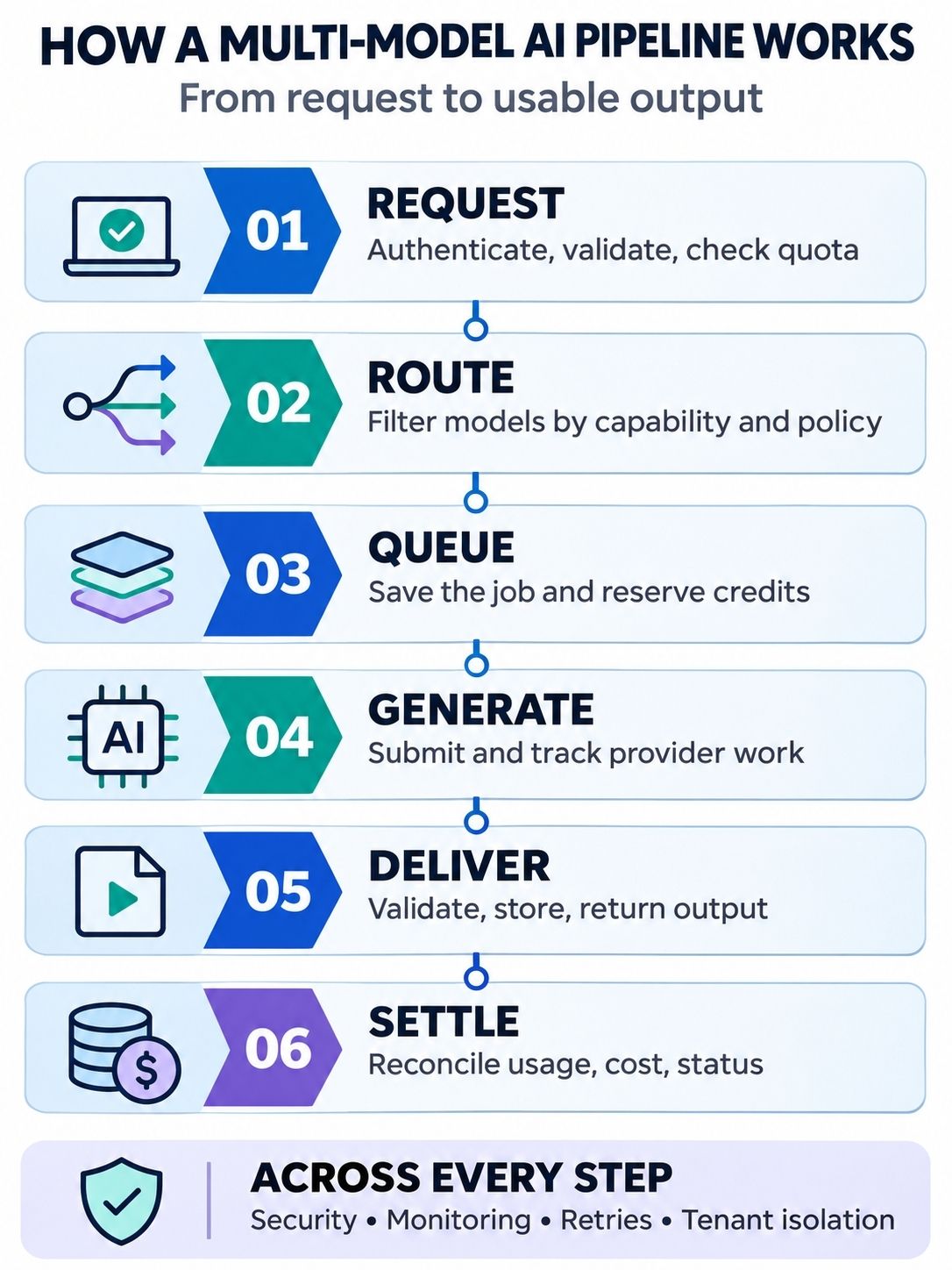
A useful starting architecture looks like this:
- Application and API: Authenticate the user and accept a generation request.
- Policy and routing: Check tenant permissions, model capabilities, region, quota, and budget; then select an eligible provider.
- Job store and queue: Persist the request, reserve its estimated cost, and schedule the work.
- Workers and provider adapters: Translate the request into the provider’s format and track the external operation.
- Output and delivery: Validate and store the result, settle usage, then notify the client or expose job status.
A gateway can centralize access and routing across different model backends. Google Cloud describes this pattern in its multi-backend inference architecture. A gateway alone, however, does not give your product a durable job record, customer billing, or a recovery strategy for ambiguous submissions. The broader principles of AI task automation architecture explain why intake, orchestration, model calls, durable state, and recovery should remain separate parts of the system.
A Small Pipeline Test and What It Showed
To examine the job flow, an Editorialge assistant ran a small, local Python and SQLite demonstration on November 5, 2026. Both providers were simulated. No real AI API was called, and no image was generated. The test ran sequentially on one machine and used an illustrative 20-credit amount.
The demonstration created job 1 and recorded a 20-credit reservation. Sending the same tenant and idempotency key again returned job 1 rather than creating a second job. A simple routing rule then skipped a disabled mock provider and chose a second enabled mock provider. Its first attempt was programmed to fail; its second was programmed to succeed. The final database record showed success, two attempts, and separate reserve and settlement records. The script assertions passed.
These observations show what this small sample did under controlled conditions. They do not prove duplicate prevention under concurrent traffic, durable message delivery, external billing, API compatibility, security, or production scalability. The credit entries are demonstration records, not a complete wallet or accounting system.
These controls also limit the hidden costs of APIs, where rate limits, unsafe retries, provider changes, and paid resource consumption can affect reliability and margins.
For an operational deployment, test these behaviors against your actual infrastructure and provider contracts. The reproducible script and recorded output accompany the editorial evidence pack.
1. Define the Contract Your Application Owns
Avoid making every product screen speak a provider’s API dialect. Instead, define an internal request with fields such as:
- tenant_id, user_id, and job_id for authorization and tracking.
- modality, such as text, image, audio, or video.
- Input content and references to authorized uploaded assets.
- Requested output properties, such as dimensions, duration, or format.
- Model choice or routing policy, maximum spend, and data-handling constraints.
- A client-supplied idempotency key for safely recognizing repeated submissions.
Store a request schema version, the policy version, and the selected provider and model version where available. These details help explain why a job ran the way it did after a model or routing rule changes.
The contract should normalize common operations without pretending that every model can do everything. One image model may accept reference images while another does not. One video provider may support a particular duration or region that another cannot.
Keep a capability registry and reject unsupported combinations before charging or submitting the job. A useful error tells the user what to change instead of returning a generic provider failure.
2. Separate Eligibility From Model Selection
Routing has two distinct steps. First, remove models that cannot meet the request. Then choose from the models that remain.
| Eligibility Check | Example |
| Capability | Does the model accept the input type and requested output dimensions? |
| Tenant access | Is the model available under this customer’s plan? |
| Data policy | Is the provider and processing region permitted for this tenant and request? |
| Operational state | Is the provider available, and is the relevant concurrency or rate limit open? |
| Budget | Can the request be reserved within the user’s and platform’s limits? |
Tenant access cannot stop at the account plan. Multi-tenancy in SaaS architecture also requires boundaries across APIs, files, queues, logs, worker capacity, monitoring, and recovery.
Only after those checks should a routing rule consider cost, latency, or quality. The rule might prefer the user’s explicitly chosen model, then choose an approved equivalent only if the user has permitted fallback.
Fallback is a product decision, not just an error handler. A second model may produce a different style, apply different safety rules, process data in another region, or cost more. A customer who selected a specific model may prefer to wait.
Define when substitution is allowed, display the actual model used, and never route private data to an unapproved provider simply because the first one is unavailable.
For high-volume workloads, evaluate routing rules against representative prompts and your own acceptance criteria. Do not assume the cheapest model produces acceptable output for every task.
3. Make Job State Durable
A practical job record might move through received → validated → queued → submitting → running → succeeded, with explicit failed, cancel_requested, cancelled, and unknown_submission states. The exact vocabulary matters less than clear definitions and permitted transitions.
The unknown_submission state deserves special attention. Imagine that your worker sends a paid request, the provider accepts it, and the network fails before the worker receives the response. Retrying immediately might create a second paid generation.
If the provider offers idempotency keys or lookup by client reference, use them according to its documentation. Otherwise, reconcile the ambiguous attempt through the provider’s available status or billing records before resubmitting. Some cases may need manual review.
Use a database uniqueness constraint scoped to the tenant and idempotency key to prevent duplicate client requests from creating multiple internal jobs. Persist job creation, quota reservation, and an outbox event in one database transaction. A separate publisher can deliver that event to the queue.
This reduces the risk of recording a job without scheduling it or scheduling work whose transaction never committed.
Queue consumers must still tolerate duplicate delivery. AWS documents that standard SQS queues can deliver a message more than once; visibility timeouts and FIFO deduplication also have limits.
Make state transitions and ledger entries idempotent, use worker leases with expiry and fencing or compare-and-swap, and verify the behavior of your chosen queue. These measures reduce duplicates, but they cannot guarantee exactly one charge at an external provider.
4. Build Adapters Around Real Provider Differences
Each adapter translates your internal request into one provider’s API format and translates the response back into your job model. Keep provider credentials on the server and use a secrets manager with least-privilege access and rotation.
An adapter typically needs operations for submission, status lookup, cancellation when supported, webhook verification when offered, and result retrieval. Not every provider supports all of them. Record those limitations in the registry rather than creating an interface that claims universal support.
For asynchronous jobs, store the provider’s task ID as soon as it is known. Verify webhook signatures using that provider’s documented method, accept repeated callbacks safely, and do not trust a callback merely because it contains a plausible job ID.
Poll as a recovery mechanism when callbacks are missed, while respecting provider rate limits. A callback and a poll can race, so finalization must be atomic and repeatable.
When a provider supplies a temporary output URL, fetch it through controlled egress, validate the file type and size, and copy it to authorized object storage when the terms permit. Apply malware scanning or other checks appropriate to the file type.
Protect against server-side request forgery. Allow only expected hosts and block redirects to private or internal addresses. Do not assume a provider’s temporary URL will remain usable indefinitely.
5. Design Retries Around the Failure
Retries help with transient failures, but an indiscriminate retry loop can create duplicate jobs and unexpected bills.
| Situation | Safer Response |
| Invalid input or unsupported setting | Return an actionable error; do not retry an unchanged request. |
| Authentication or permission failure | Stop and alert the operator; fix the credentials or access. |
| Rate limit | Respect provider retry guidance and headers where present; use bounded exponential backoff with jitter. |
| Temporary provider failure | Retry only if the request is safe to repeat and the retry budget permits it. |
| Timeout after a possibly accepted paid submission | Mark the attempt uncertain and reconcile it before making a new submission. |
| Moderation or policy rejection | Surface an appropriate status; do not automatically route around the restriction. |
Set separate timeouts for connecting, submitting, generating, and downloading the output. Add a circuit breaker so a failing provider does not absorb unlimited calls, but allow controlled recovery probes.
Use dead-letter handling for jobs that repeatedly fail, with an operator path to inspect and replay them safely.
6. Reserve Credits Before Generation and Settle Against Actual Use
A generation platform needs two related records: the customer’s entitlement or credit ledger and the provider-cost ledger. Keep them separate. Your credit conversion rate and a provider’s invoice are business rules, not the same unit of measure.
Before submission, calculate a conservative estimate using the model, modality, requested size or duration, and expected ancillary costs. Atomically reserve the required customer credits and enforce tenant and platform limits.
After completion, record actual usage when the provider supplies reliable usage data, then settle the reservation. If the job fails, apply the published refund rule. Remember that a provider may still charge for some failed or cancelled work.
For illustration only, if a customer is quoted 20 credits, reserve 20 before submitting. If your plan charges a fixed 20 credits for a successful result, settle 20 on completion. If the job fails and your policy promises a full refund, release the reservation.
Your provider may still bill the platform, so reconcile that cost separately. This is an example, not a market price or a recommendation for a particular margin.
Track costs for retries, fallback attempts, storage, bandwidth, moderation, and support, not only successful generations. Set maximum input size, output duration, concurrency, and spend per tenant. Give operators a way to pause a model or provider when invoices or error rates spike.
7. Protect Customer Data Across the Whole Path
A model request may contain private documents, personal information, proprietary code, or sensitive images. Minimize what you send to a provider and what you store.
Apply authorization checks to every job, input asset, output, and signed download URL. A hard-to-guess job ID is not authorization.
Review each provider’s actual retention terms, region options, subprocessors, training-use settings, and contractual commitments before routing customer data. Encrypt data in transit and at rest, restrict log access, define deletion periods, and avoid placing full prompts or API keys in ordinary logs.
Region selection is only one part of SaaS data residency. Prompts, backups, logs, support systems, AI providers, and subprocessors may follow different data paths.
Use tenant-isolated storage paths and test that one tenant cannot read another’s output. If your pipeline retrieves web pages or documents, treat their content as untrusted. OWASP’s prompt-injection guidance notes that retrieval and fine-tuning do not fully prevent prompt injection.
A practical prompt-injection defense should separate trusted instructions from external content, validate model output, restrict tool access, and require approval for high-impact actions.
Separate instructions from untrusted content, restrict tools and permissions, validate tool arguments, and require human approval for consequential actions. These controls reduce risk; no prompt alone guarantees isolation.
8. Measure the Customer Journey, Not Just API Uptime
A provider returning HTTP 200 does not necessarily mean the customer received a usable file. Follow a job from submission to delivery with a trace ID and a consistent set of events. Record provider request IDs when available, but avoid logging raw customer content by default.
As the multi-model AI generation pipeline expands, start with a small operational dashboard that tracks:
- Job completion and failure rates by provider, model, modality, and error category.
- Queue wait, provider processing time, and total time to usable output, including p50 and p95.
- Rate-limit events, retries, ambiguous submissions, and jobs awaiting reconciliation.
- Estimated versus actual provider cost, cost per completed job, and refunds.
- Output delivery failures and callback-versus-poll recovery rates.
- Quality checks and user-reported defects, segmented by model and version.
When choosing an observability stack, monitoring and observability tools for SaaS can be compared by their OpenTelemetry support, LLM tracing, alerting, error monitoring, and cost model.
Define a service-level objective around the customer’s outcome. For example, a team might choose a target for the percentage of eligible image jobs that become downloadable within a specified period.
The threshold should come from its product needs and measured baseline, not from another company’s benchmark. Exclude or separately report user cancellations and policy rejections only if the definition says so clearly.
9. Test the Unhappy Paths Before Increasing Traffic
Start with one modality and a small set of approved providers. In a staging environment, use synthetic inputs and test accounts to verify:
- Normal completion
- Duplicate submissions
- Timeouts
- Callbacks arriving twice
- Expired output URLs
- Worker crashes
- Provider rate limits
Simulate an accepted request whose response is lost. The test passes only if the system avoids blindly creating another paid request and exposes the unresolved state.
Then run a limited production rollout with spending caps and a rollback switch. Compare the new adapter against a fixed evaluation set for output quality, latency, failure rate, and actual cost.
Re-run the set when a provider changes model versions. Evaluate generated media for the attributes that matter to your product, and include human review where automated checks are insufficient.
For teams planning their wider infrastructure, Editorialge’s guide to choosing a SaaS tech stack covers related trade-offs.
A small team can begin with a modular application, a relational database, object storage, and a managed queue. Splitting every component into a separate service on day one adds operational work before it adds value.
Frequently Asked Questions about Multi-Model AI Generation Pipeline
What Is a Multi-Model AI Generation Pipeline?
A multi-model AI generation pipeline is the application layer that validates requests, selects an eligible model, schedules generation work, tracks provider jobs, stores outputs, and reconciles usage across one or more AI providers.
Why Should a SaaS Product Support More Than One AI Model?
Multiple models can give a SaaS product more flexibility across capability, cost, latency, region, and availability. However, fallback should occur only when the customer and the product’s data policy permit it.
How Can a Pipeline Prevent Duplicate AI Generation Charges?
Use tenant-scoped idempotency keys, database uniqueness constraints, idempotent state transitions, and provider-supported request identifiers. If a paid submission may have been accepted but no response returned, reconcile it before retrying.
How Should an AI Pipeline Handle Provider Failures?
Classify the failure first. Retry temporary failures only when the request is safe to repeat, stop on authentication or policy errors, respect rate-limit guidance, and isolate uncertain paid submissions for reconciliation.
What Metrics Matter for a Production AI Generation Pipeline?
Track completion rates, queue time, provider processing time, total time to usable output, retries, rate limits, ambiguous submissions, delivery failures, actual cost, refunds, and user-reported quality problems.
What Should the First Production Release Include?
Start with one generation type, one primary provider, durable job records, a queue, a credit reservation ledger, basic alerts, spending caps, and a rollback switch. Add a fallback provider only when substitution is explicitly allowed.
What the First Multi-Model AI Generation Pipeline Release Should Include
A sensible first release can support one generation type, one primary provider, and a second provider only where fallback is explicitly allowed. It should also include durable job records, a queue, a credit reservation ledger, and basic operational alerts.
Add streaming, more modalities, sophisticated routing, and regional deployments when real demand justifies their complexity.
The key design question is not how many model logos appear in the dashboard. A production-ready multi-model AI generation pipeline should explain, for every request, what was submitted, which provider handled it, what the customer received, and what each side was charged, even when the network fails halfway through.
How This Guide Was Prepared
This guide draws on provider, cloud infrastructure, and security documentation reviewed on November 5, 2026, and a local assistant-operated Python and SQLite demonstration.
The demonstration used mocked providers, a simulated failure, and a fictional credit amount. No live AI provider, production deployment, real billing, concurrent workload, or performance benchmark was tested. Teams should verify provider-specific capabilities and contracts before implementation.