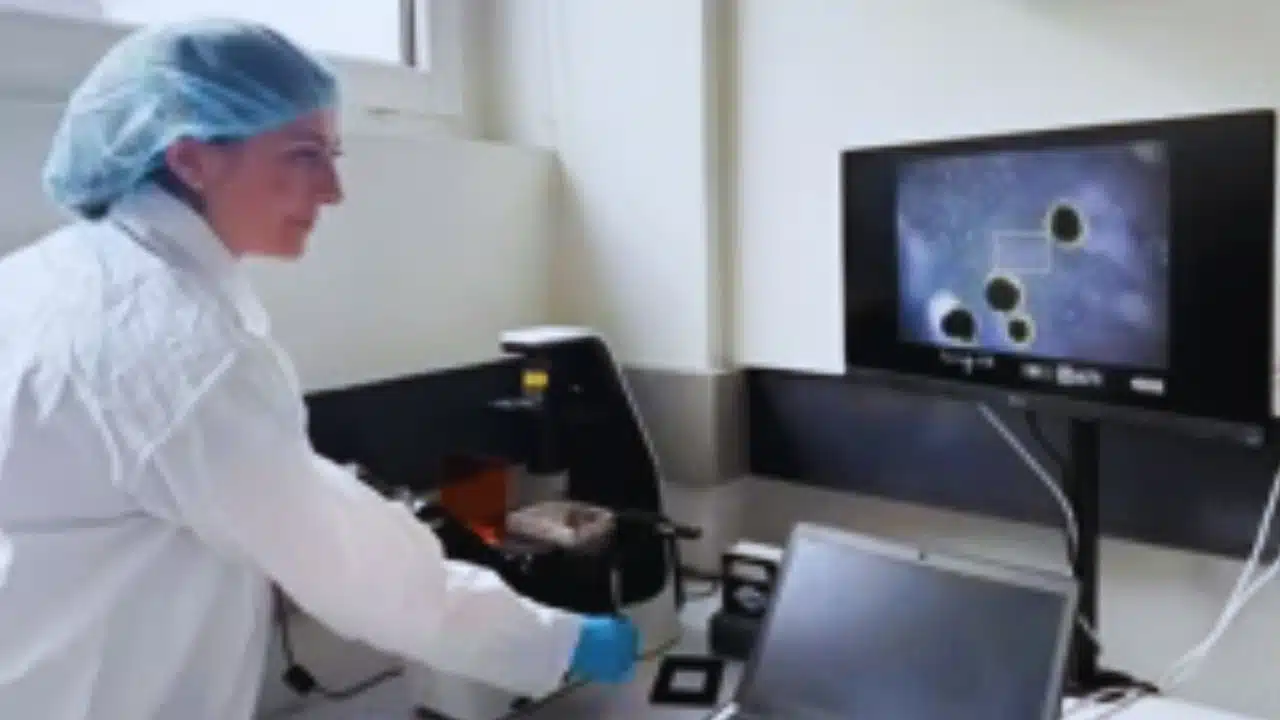
What once seemed like the plot of a futuristic science fiction film is gradually becoming a real scientific pursuit. Across the world, researchers are experimenting with living human neurons as computing units, creating what are known as biocomputers or “wetware” systems. These tiny lab-grown “mini-brains” could one day reshape how we think about artificial intelligence, data centers, and even drug discovery.
While the technology is still in its infancy, early breakthroughs are showing just how far science has come in blurring the boundaries between biology and machines.
A New Kind of Computer: From Hardware to “Wetware”
In traditional computing, we talk about hardware (physical devices) and software (the programs that run on them). Biocomputing adds a third concept: wetware, a term used to describe biological tissue—specifically neurons—grown in the lab and used to process information.
Unlike silicon chips, which rely on transistors, wetware uses human brain cells capable of transmitting electrical signals, forming networks, and even adapting over time. The potential here is staggering: a single human brain operates with about 86 billion neurons, each making thousands of connections, far outstripping the complexity of today’s most advanced supercomputers.
Dr. Fred Jordan, co-founder of FinalSpark, a Swiss biocomputing lab, describes the approach as both thrilling and unsettling:
“When you start to say, ‘I’m going to use a neuron like a little machine,’ it changes how we see the brain and raises profound questions about what we are.”
How Mini Brains Are Made: Stem Cells to Organoids
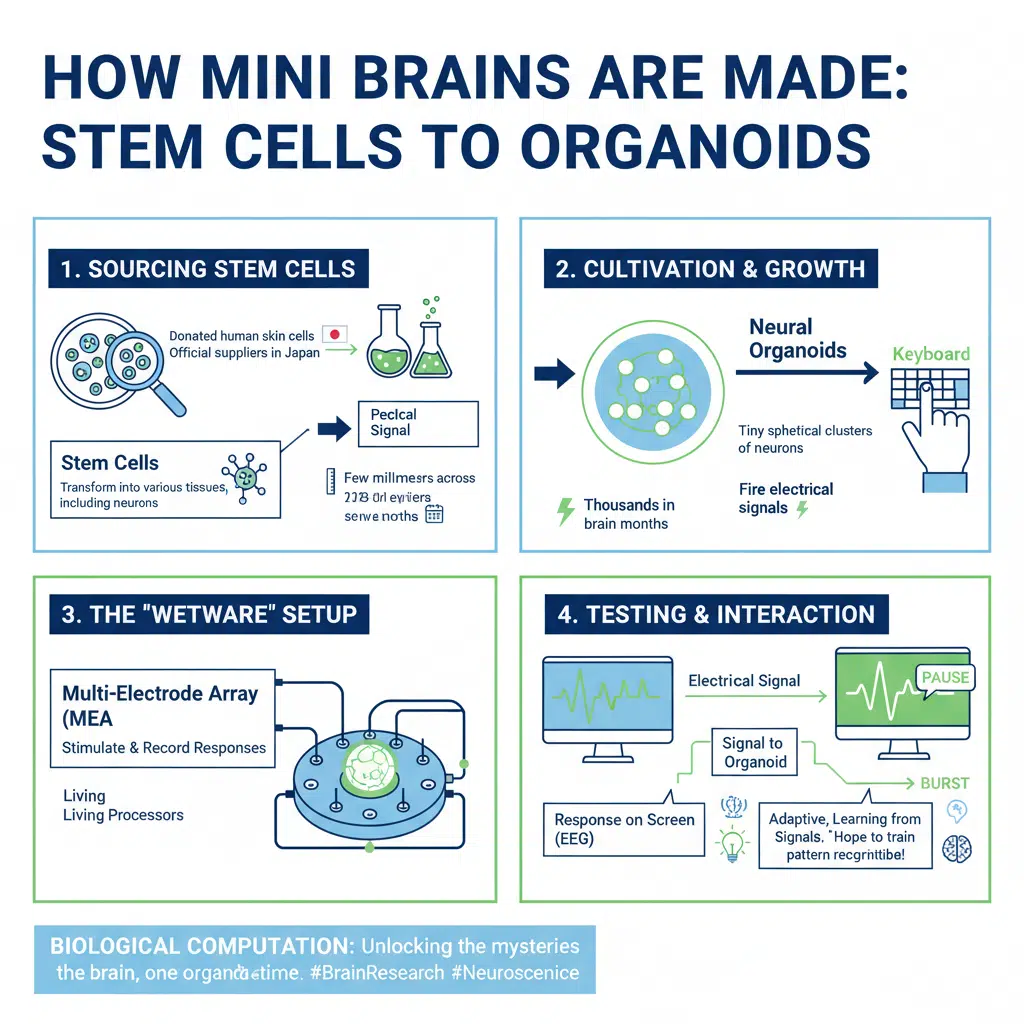
The journey of creating a mini human brain begins with stem cells. At FinalSpark, scientists source these cells from official suppliers in Japan, derived from donated human skin cells. Stem cells are special because they can transform into many types of tissue, including neurons.
Through careful cultivation, researchers encourage these stem cells to grow into neural organoids—tiny spherical clusters of neurons and support cells. Each organoid looks like a small white orb, only a few millimeters across, but it contains thousands of functioning brain cells.
Although these organoids are far less complex than an actual human brain, they share the same biological building blocks. And crucially, they can fire electrical signals, the basic language of neural communication.
Once matured (after several months), the organoids are placed on multi-electrode arrays that can both stimulate them and record their responses. This setup essentially transforms them into living processors, ready for experiments.
Testing the Signals: Teaching Organoids to Respond
In the lab, the process of interacting with these organoids is remarkably simple in principle:
- A researcher presses a keyboard key.
- The keystroke is converted into an electrical signal sent to the organoid via electrodes.
- If the neurons respond, their firing activity is displayed on a connected computer as a moving graph, resembling an EEG readout.
During one demonstration, repeated keystrokes led to an unexpected pause, followed by a distinctive burst of activity on the screen. Dr. Jordan admitted they didn’t fully understand why this happened—perhaps the organoid was “annoyed” by overstimulation.
This unpredictability highlights both the promise and mystery of wetware. Unlike silicon, biological neurons are adaptive, capable of reorganizing connections and potentially learning from repeated signals. Researchers hope to train organoids to recognize patterns, similar to how AI models classify images or speech.
The Big Challenge: Keeping Wetware Alive
One of the greatest barriers to biocomputing is not teaching organoids to compute, but keeping them alive long enough to be useful.
Human brains rely on an intricate network of blood vessels to supply oxygen and nutrients. Organoids, however, lack such a circulatory system. Without constant support, they quickly degrade.
- FinalSpark’s organoids currently survive for about four months under lab conditions.
- Other labs, like Cortical Labs in Australia, report lifespans of around six months with advanced life-support systems.
Researchers provide nutrients, remove waste, and carefully regulate the environment, but long-term survival remains the bottleneck.
Perhaps eerily, scientists have observed that organoids sometimes display a sudden spike in activity right before death—similar to what doctors see in dying human patients. Over the past five years, FinalSpark has recorded 1,000–2,000 such “death events”, adding another layer of intrigue to the field.
Ethical Questions: Are Mini Brains Just Machines?
For many, the idea of growing human brain tissue to power computers raises deep ethical questions. Could these organoids develop any form of consciousness? Should we treat them as simple machines, or living systems deserving moral consideration?
Prof. Simon Schultz, a neurotechnology expert at Imperial College London, stresses that current organoids are too simple to be conscious. They lack structures such as blood vessels, sensory organs, or higher brain regions required for awareness. For now, they are best thought of as biological models—not sentient entities.
Still, ethicists argue that as organoids grow larger and more sophisticated, society will need clear frameworks to address these concerns. This is especially important as companies begin to commercialize biocomputing.
From Pong to Cloud Wetware: Real-World Applications
Biocomputing may sound futuristic, but practical applications are already emerging:
- Game Playing and Learning: In 2022, Australian startup Cortical Labs made headlines when its DishBrain system taught neurons to play the classic game Pong by responding to feedback loops. This experiment showed that neurons can adapt behaviorally, not just electrically.
- Commercial Biocomputers: Cortical Labs recently launched the CL1 biocomputer, combining hundreds of thousands of human neurons with a silicon interface. The system can be purchased (around $35,000) or rented as “wetware-as-a-service”, giving global researchers remote access.
- Drug Discovery and Disease Research: Teams at Johns Hopkins University in the U.S. are using organoids to study neurological diseases like Alzheimer’s and autism. By observing how mini-brains process signals or respond to drugs, they hope to reduce reliance on animal testing.
- Energy-Efficient AI: One of the biggest promises is in energy consumption. Data centers running modern AI models consume enormous electricity. Biological neurons, by contrast, operate at a fraction of the energy cost, potentially making wetware a green alternative.
Silicon vs Wetware: Competition or Collaboration?
Experts caution that biocomputers are unlikely to replace silicon chips entirely. Instead, they may complement them.
- Silicon excels at precision, stability, and scalability.
- Wetware excels at adaptation, pattern recognition, and energy efficiency.
Future systems may combine both, forming hybrid data centers where wetware handles tasks requiring learning and adaptability, while silicon manages structured computation.
As Prof. Schultz puts it:
“They won’t out-compete silicon on most things, but they’ll find their niche.”
Looking Ahead: From Science Fiction to Reality
Dr. Jordan admits his fascination with biocomputing partly comes from his love of science fiction. For decades, books and films imagined living computers. Now, for the first time, researchers are truly building them.
FinalSpark has already launched the Neuroplatform, an online service where scientists can interact with organoids remotely, much like renting cloud computing power. Cortical Labs, meanwhile, is working on scaling wetware into racks of living servers.
The coming years may see experiments where AI and organoid intelligence merge, creating systems that are neither fully biological nor fully artificial.
The technology is still fragile and mysterious—but undeniably groundbreaking. Every time a researcher presses a key and watches neurons fire back, they are stepping into uncharted territory, where science fiction meets scientific reality.
The Information is Collected from BBC and Science Alert.