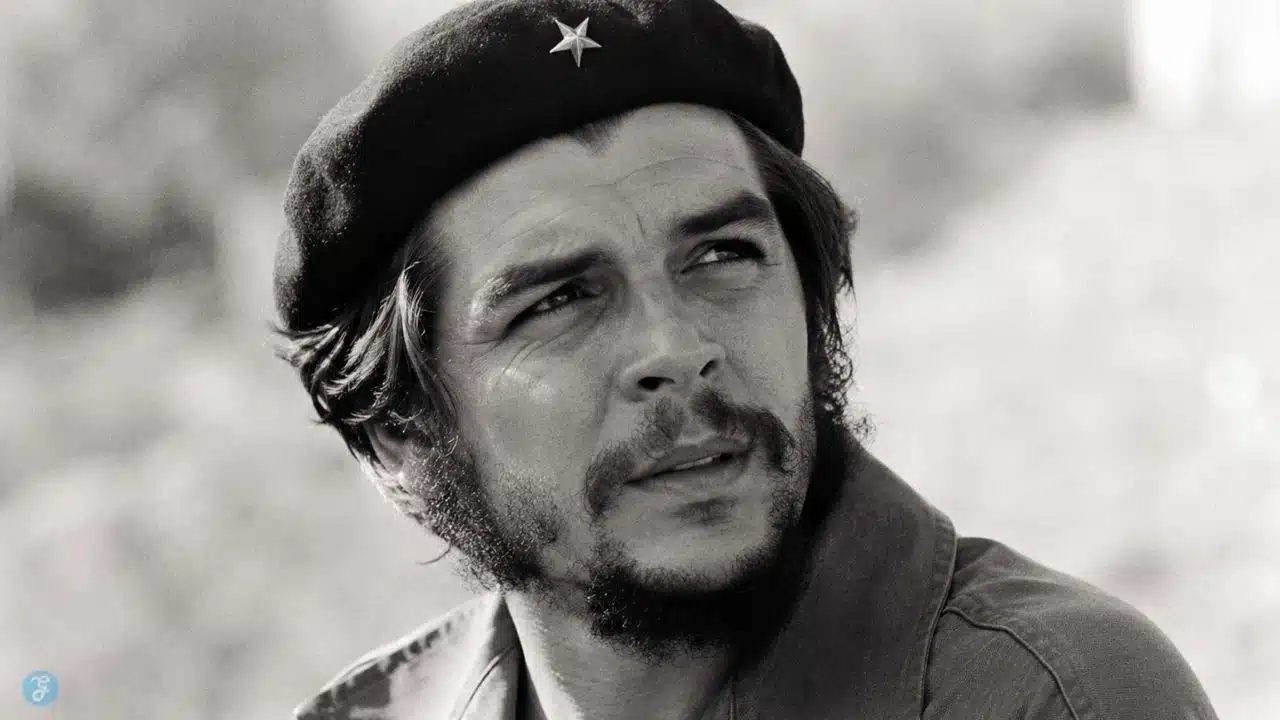
I have seen Che Guevara’s face so many times that, like many people, I sometimes forget there was a real man behind it. The black beret. The long hair. The fixed stare. The face that seems to look past the present and into some unfinished revolution. It appears on T-shirts, posters, murals, coffee mugs, stickers, college walls, protest banners, and street market souvenirs. For many people, Che is no longer a historical figure. He is a mood.
Rebellion. Defiance. Youth. Anger. Resistance. A raised fist without the fist.
But that is exactly where my discomfort begins. The image is easy to recognize. Life is not. I have met people who can identify Che Guevara’s face in a second but cannot explain what he believed, what he did, what he got wrong, or why he still divides people decades after his death.
So, on Che Guevara’s 98th birthday, I do not think the better tribute is blind praise. I also do not think it is a lazy condemnation. The better tribute is a harder question. Do we really understand Che Guevara? Or do we only understand the T-shirt?
Why Che Guevara Still Refuses to Fade Away
Most political figures lose their force with time. Their speeches age. Their slogans become museum labels. Their names survive in textbooks, but not in daily life. Che Guevara took a different route.
More than half a century after his death, his face still travels. It crosses borders with unusual ease. I see it in protest culture, student politics, fashion, music, street art, and social media. I see it in places where people know his politics and in places where people only know the face.
That kind of afterlife does not happen because of one photograph alone. It happens because people keep finding a use for him.
For some, Che represents the fight against imperialism. For others, he stands for the poor against the powerful. Some see him as a symbol of sacrifice. Some see him as a warning about revolutionary violence. Some wear his image simply because it looks bold.
That is the strange thing about icons. They can mean too much and too little at the same time. I think Che still refuses to disappear because he sits at the crossroads of several powerful ideas: injustice, youth, rebellion, violence, idealism, sacrifice, and myth. People may not agree with him, but they still react to him.
And in a world that keeps producing inequality, anger, and political disappointment, Che’s face still feels useful to many. But useful is not the same as understood.
Before “Che,” There Was Ernesto
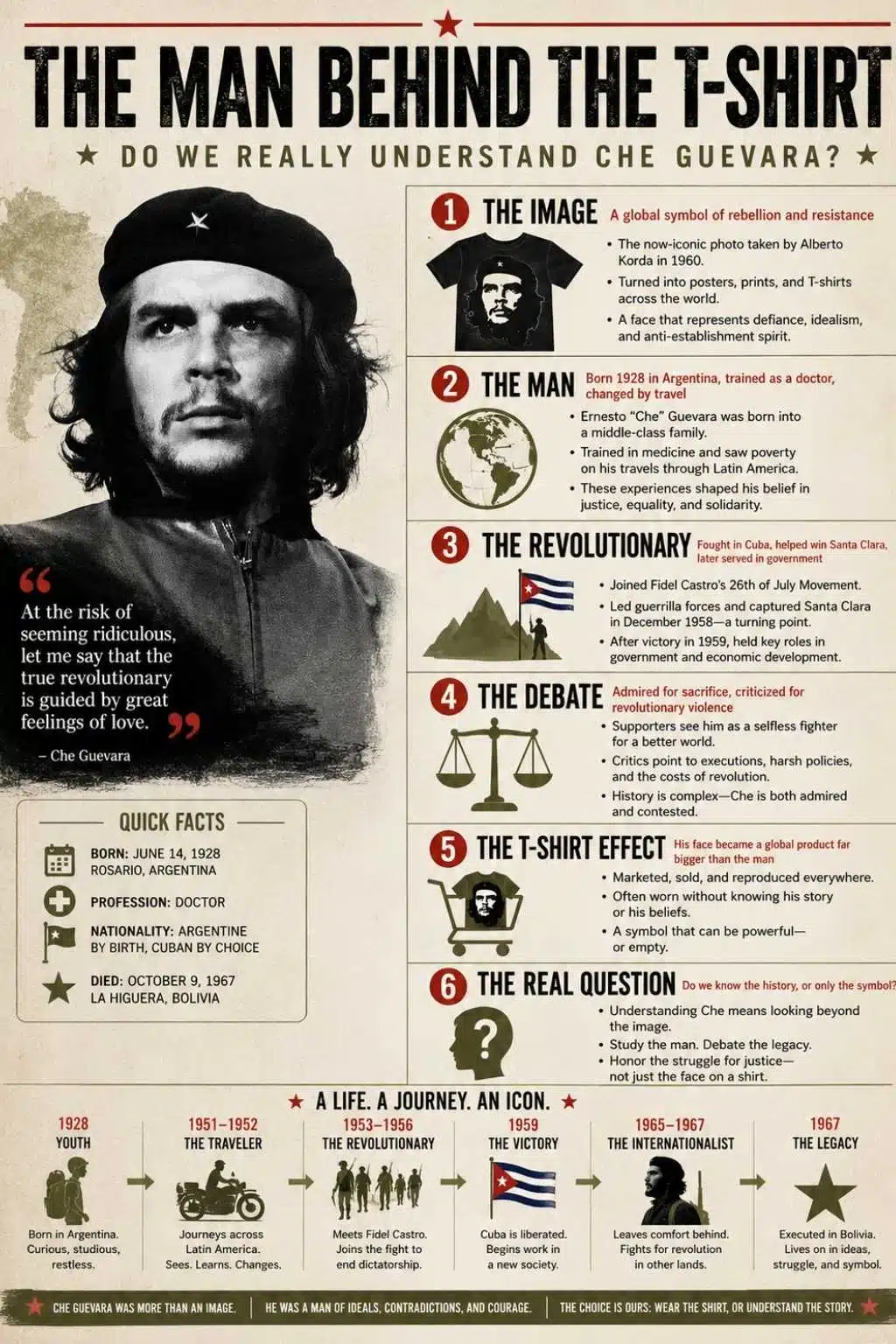
Before the poster, before Cuba, before the myth, there was Ernesto Guevara de la Serna. He was born on June 14, 1928, in Rosario, Argentina. He grew up in a middle-class family that valued books, politics, travel, and debate. He suffered from asthma, sometimes badly, but it never turned him into a passive person. If anything, it seemed to sharpen his stubbornness.
That early detail matters to me because the Che we usually see is almost too solid. He looks carved from certainty. The young Ernesto was not that simple. He was curious, restless, argumentative, and hungry for experience.
He studied medicine. He read widely. He played sports. He traveled. He was drawn to ideas, but also to the raw world outside comfortable rooms. At first, his path did not look like the path of a guerrilla commander. It looked like the path of a young doctor trying to understand suffering.
Then Latin America changed him.
The poverty he saw across the continent did not look like isolated bad luck. It looked structural. Workers were exploited. Indigenous communities were pushed aside. Sick people lacked basic care. Wealth and land sat in the hands of a few while millions lived with almost nothing.
For a medical student, that raised a brutal question. What is the point of treating symptoms if the disease is built into the system?
I think that question is one of the keys to understanding Che Guevara. It pushed him beyond medicine and toward politics. Then politics pushed him toward revolution.
The Journey That Turned a Doctor Into a Revolutionary
The Motorcycle Diaries has helped many readers meet the younger Che. It is often remembered as a romantic road trip, but I do not think the deeper meaning is romance. The deeper meaning is awakening. A young Ernesto Guevara traveled across Latin America and came back with a changed imagination.
The road showed him a continent connected by pain. He saw mines, leper colonies, poor villages, landless workers, and families living at the edge of survival. These were not abstract political categories to him yet. They were people. Faces. Bodies. Illnesses. Hunger. Humiliation.
That kind of travel can make a person softer. In Guevara’s case, it made him harder. He began to believe that charity was too small, reform was too weak, and medicine alone could not answer the scale of suffering he had seen. His politics moved toward revolution because he believed the system itself had to be broken.
This is where people often split on Che. Some admire that conclusion. They see moral courage in his refusal to accept a cruel order. Others see the beginning of a dangerous certainty, the kind that can make violence feel clean if it is done in the name of justice.
I understand why both reactions exist. Because from this point forward, Che’s compassion and severity become almost impossible to separate.
Meeting Fidel Castro and Choosing Armed Struggle
Che’s political path hardened further in Guatemala. He witnessed the fall of Jacobo Árbenz’s reformist government, an event that left a deep mark on him. To Guevara, it confirmed a lesson he would carry for the rest of his life: powerful interests would not allow peaceful reform to go far if it threatened land, wealth, or control.
Whether we agree with his reading or not, it shaped him. He later moved to Mexico, where he met Fidel Castro and a group of Cuban exiles preparing to fight the Batista dictatorship. Guevara joined them first as a doctor. But he did not remain only a doctor for long.
The struggle pulled him into armed revolution. He sailed with Castro’s fighters on the Granma, survived early disaster, and entered the Cuban mountains with the rebels. In the Sierra Maestra, Che built a reputation for discipline, toughness, and courage. He could be demanding. He could be severe. He expected commitment because he gave it himself.
The doctor became a commander. That transformation is one of the things I keep returning to when I think about the Che Guevara legacy. Che did not abandon healing because he stopped caring about suffering. He abandoned ordinary medicine because he came to believe that revolution was the larger cure.
It was a powerful belief. It was also a dangerous one!
Cuba Made Him a Legend
Che Guevara became world-famous because the Cuban Revolution succeeded. Inside the rebel movement, he rose quickly. He became one of Fidel Castro’s trusted commanders and earned the rank of comandante. His role in the campaign around Santa Clara helped seal his place in revolutionary memory. When Batista fled Cuba in early 1959, the rebels did not just win a war. They created a new political myth.
Che fit that myth perfectly. He was young. He was intense. He was articulate. He had left Argentina to fight for Cuba, which made him look like an international revolutionary rather than a nationalist politician. His asthma, his discipline, his willingness to live in hardship, and his sharp writing all fed the legend.
For supporters, Che became proof that committed people could defeat a dictatorship. For enemies, he became proof that the Marxist revolution was spreading through the hemisphere. Either way, the world noticed.
But I think revolutions are often easier to admire before they become governments. Victory brings offices, courts, prisons, budgets, shortages, enemies, and compromises. The romance of the mountains does not survive untouched inside the machinery of the state.
Che’s story after 1959 is where the icon becomes harder to manage.
The Revolutionary After Victory
After the Cuban Revolution, Che did not fade into ceremonial fame. He became part of the new Cuban state. He received Cuban citizenship and held important roles, including leadership at the National Bank of Cuba and later the Ministry of Industries. He traveled as a representative of revolutionary Cuba, wrote about guerrilla warfare, argued for socialism, and pushed for a new moral culture.
Che wanted more than a change of government. He wanted a change in human character. He believed in the idea of the “new man” of socialism, someone motivated by collective duty rather than private gain. He promoted volunteer labor and moral incentives. He disliked consumer culture, selfishness, and the habits of capitalism. He wanted people to work not just for wages, but for a revolutionary purpose.
I can understand why that vision still attracts admirers. It sounds morally serious. It asks people to live for something beyond themselves. But it also shows Che’s limits.
He was not a natural economic manager. His plans faced serious obstacles, including Cuba’s isolation, dependence on outside support, and the difficulty of turning revolutionary spirit into a working industry. His belief in moral incentives did not solve practical economic problems.
This does not make him fake. It makes him human. To me, Che was better at inspiring sacrifice than building a stable economy. He understood the emotional power of revolution better than the dull, stubborn demands of administration. That gap matters.
The Part Many T-Shirts Leave Out
This is the part I think many simple tributes avoid. After the revolution, Cuba moved quickly against former Batista officials, police, soldiers, and people accused of serving the old dictatorship. Revolutionary tribunals and executions became part of the new order. Che was connected to that process, especially through La Cabaña prison in Havana.
This remains one of the most disputed parts of his life. His defenders argue that the revolution was dealing with people tied to torture, murder, corruption, and repression under Batista. They see the trials as harsh justice after a brutal dictatorship.
His critics see something darker. They point to executions, political intolerance, and the danger of revolutionary courts operating under the pressure of ideology and revenge. I do not think a serious reading can ignore the discomfort.
Che was not a gentle rebel who accidentally wandered into violence. He believed revolutionary violence could be necessary. He accepted it as part of a political struggle. That belief made him effective in war, but it also makes the Che Guevara legacy deeply troubling.
This is where the T-shirt fails. The famous image shows courage, anger, and defiance. It does not show prison walls. It does not show the families of the executed. It does not show the moral risk of believing so strongly in a cause that human life becomes part of the calculation.
That does not mean Che can only be reduced to violence. But it does mean he cannot be honestly remembered without it.
The Photograph That Became Bigger Than the Man
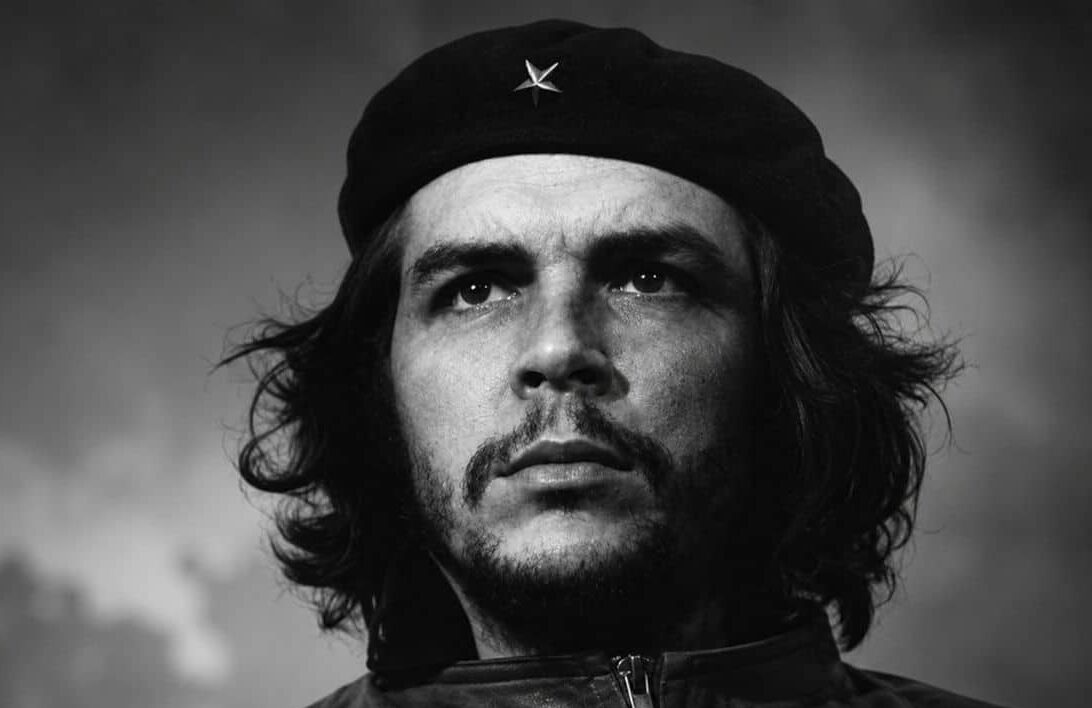
The most famous image of Che Guevara came from Cuban photographer Alberto Korda. The photograph, known as Guerrillero Heroico, was taken in Havana in 1960. Che looks past the camera with a fixed, severe expression. The angle gives him a larger-than-life presence. The beret, the hair, the stare, the emotional distance, everything works.
It is one of those rare images that seems to create its own mythology. The photo did not become globally powerful all at once. Its life grew over time, especially after Che’s death. Stylized versions, including the famous red-and-black graphic associated with artist Jim Fitzpatrick, helped turn the portrait into a political and cultural symbol that could be printed, copied, and shared almost anywhere.
That was the turning point. A real person became a visual language. Once that happened, biography became optional. People did not need to know about Rosario, Guatemala, the Sierra Maestra, Santa Clara, La Cabaña, Congo, or Bolivia. They only needed the face.
I think the image did what icons often do. It preserved Che and erased him at the same time. It kept his presence alive, but it made his life easier to misunderstand.
How an Anti-Capitalist Became a Global Product
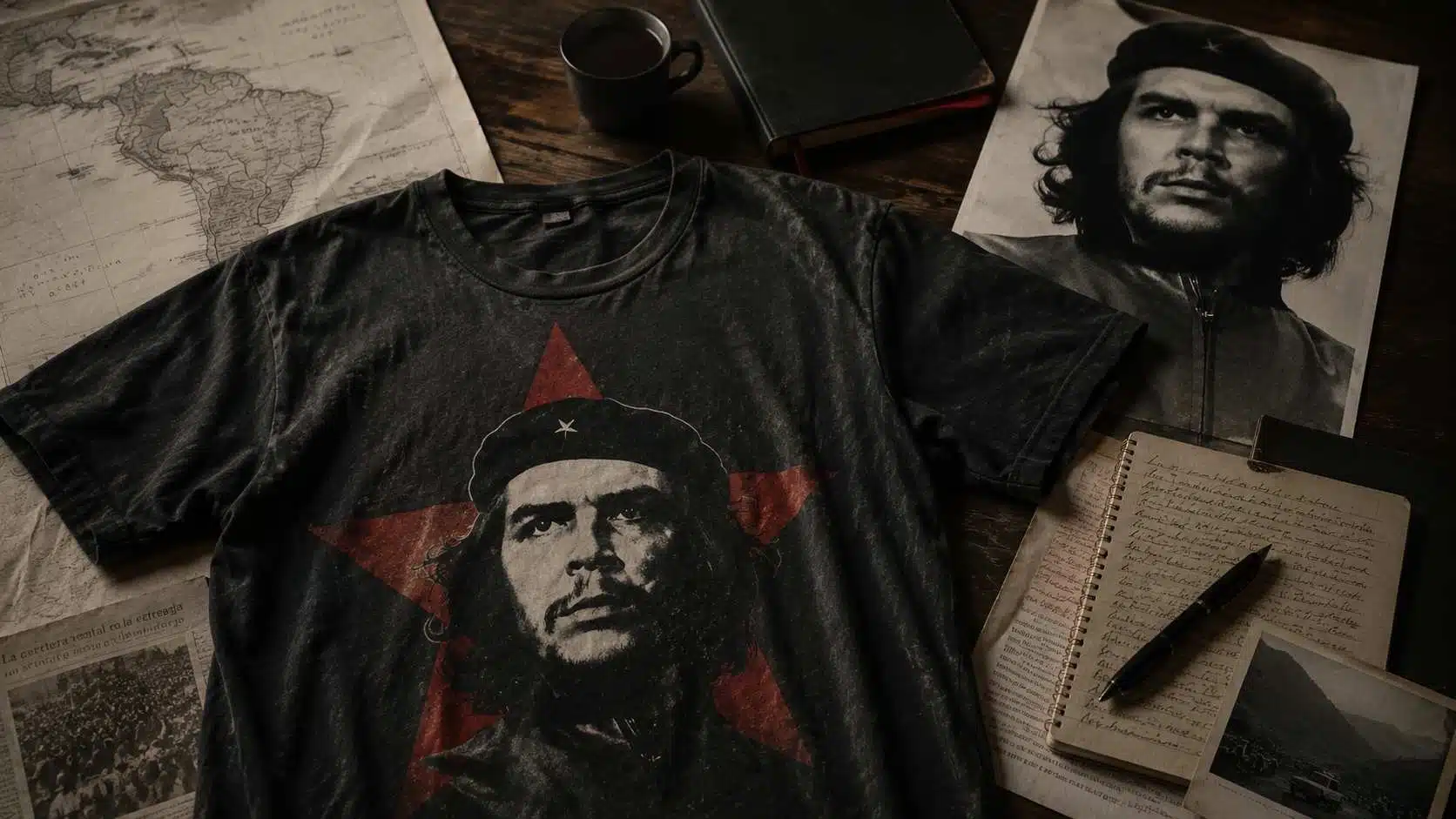
The irony is almost too perfect. Che Guevara, a committed critic of capitalism, became one of the most commercialized faces in modern culture.
His image appears on T-shirts, posters, bags, mugs, phone cases, caps, patches, and tourist souvenirs. It sells in markets that have no interest in Marxism. It decorates products bought by people who may never read a page of his writing. Capitalism did what capitalism often does. It absorbed its critic and sold him back as style.
I do not think every person who wears Che’s image is shallow. Some wear it because they connect with anti-imperial politics. Some see it as a symbol of Latin American pride. Some wear it as an expression of anger against inequality. Some know the history well.
But many do not. For many buyers, Che is not a political thinker or a revolutionary commander. He is a vibe. A symbol of edge. A way to look rebellious without having to explain the rebellion.
That is not only a Che problem. It is a modern cultural problem. We turn history into merchandise. We turn pain into design. We turn rebellion into branding. Then we wonder why memory feels thin.
Che’s face became famous because it carried meaning. It became marketable because that meaning could be simplified.
Hero, Villain, or Mirror?
Che Guevara is rarely discussed calmly.
To admirers, he is a hero of the oppressed. They remember the young doctor who saw poverty and refused to look away. They admire the internationalist who left comfort behind, fought dictatorship, and died trying to spread revolution. They see courage, sacrifice, and moral seriousness.
To critics, he is a dangerous revolutionary. They remember the executions, the authoritarian politics, the hard Marxist ideology, and the intolerance that followed revolutionary victory. They see not liberation, but a man who helped build a system where dissent had little room.
Then there is a third Che. This Che is a mirror.
I think people often look at him and find what they already brought with them. The angry see anger. The hopeful see purity. The oppressed see resistance. The anti-communist sees tyranny. The student sees rebellion. The fashion buyer sees attitude. The historian sees a contradiction.
That is why Che remains so hard to settle. He is not just a figure from the past. He is a place where people argue about justice, violence, power, memory, and the cost of political dreams.
Do We Really Understand Che Guevara?
I do not think most people understand Che Guevara before they understand the image. That is not surprising. Images move faster than history. A face can cross the world in seconds. A life takes work to understand.
Che’s life asks us to hold several truths at once.
- He was moved by poverty and injustice.
- He was brave.
- He was disciplined.
- He was intelligent.
- He gave up comfort for belief.
- He helped defeat a dictatorship.
- He also believed in armed struggle.
- He accepted executions as part of revolutionary justice.
- He helped build a political system that did not make much room for opposition.
- He failed in his later revolutionary campaigns outside Cuba.
- He became larger in death than he ever could have become in ordinary life.
None of these truths cancels the others. That is the difficult part. We prefer history with clean categories. Hero or villain. Saint or monster. Liberator or oppressor. Che resists that simplicity because his life contains too much contradiction.
The T-shirt gives us a face. History gives us the burden of context.
What Che’s Birthday Should Make Us Ask
I do not think Che Guevara’s birthday should be used only for slogans. It should make us ask better questions.
Why do people still need revolutionary icons? Why does Che’s face still speak to young people who were born long after the Cold War? Why do societies turn complicated lives into simple images? Can a flawed person still symbolize resistance? Can courage be admired without excusing cruelty? Can violence done in the name of justice still corrupt the justice it claims to serve?
And one more question matters. What happens when history becomes something we wear without understanding?
A real tribute does not flatten the dead. It does not polish away their failures. It does not turn them into a brand and call that memory. A real tribute looks closer.
It sees Ernesto before Che. The doctor before the commander. The reader before the icon. The idealist beside the hardliner. The revolutionary beside the state official. The man beside the myth.
That is a harder kind of remembrance. It is also the only kind worth having.
Che Guevara Legacy: Look Past the T-Shirt
Che Guevara’s face is easy to print. His life is harder to carry. That is why I still think the man behind the T-shirt matters. Not because he deserves blind worship. Not because he deserves lazy hatred. But his story forces us to confront a problem that has not gone away.
How far should people go in the name of justice?
Che believed the answer was revolution. He gave his life to that belief. He inspired millions and disturbed millions more. He fought oppression, but he also accepted violence as a political tool. He became a symbol of freedom to some and fear to others. That contradiction is not a side note. It is the story.
So, do we really understand Che Guevara? Maybe not fully. But I think we can begin in the right place. Not with the T-shirt. With the man.
Frequently Asked Questions About Che Guevara Legacy
1. Why is Che Guevara’s image so famous?
Che Guevara’s image became famous largely because of Alberto Korda’s 1960 photograph, Guerrillero Heroico. The image later spread through posters, protest art, T-shirts, murals, and political movements around the world.
2. What did Che Guevara do in the Cuban Revolution?
Che Guevara joined Fidel Castro’s 26th of July Movement and became one of its key guerrilla commanders. His role in the Cuban Revolution, especially around Santa Clara, helped make him one of the most recognized figures of the revolution.
3. Why is Che Guevara controversial?
Che Guevara is controversial because his legacy includes both anti-imperialist resistance and revolutionary violence. Admirers see him as a symbol of justice and sacrifice. Critics point to his role in executions, authoritarian politics, and armed revolutionary ideology.
4. Why do people wear Che Guevara T-shirts?
Some people wear Che Guevara T-shirts as a political statement against imperialism, capitalism, or inequality. Others wear the image as a general symbol of rebellion or style without knowing much about his life or beliefs.
5. Is Che Guevara seen as a hero or a villain?
It depends on who is answering. To supporters, he is a revolutionary hero who fought injustice. To critics, he is a violent ideologue tied to repression. A balanced view sees him as a complex historical figure whose legacy cannot be reduced to one label.
6. What is the main lesson from Che Guevara’s legacy?
The main lesson is that symbols can simplify history. Che Guevara’s face became a global icon, but the real man was far more complicated than the image printed on posters and T-shirts.