My four-year-old nephew could name things fine. Ball. Cup. Dog. But he could not string them into a sentence without help. So I stopped buying flashcards and started playing. Over four weeks I tried eight games to encourage language skills at home. Some were old ideas my mother used on me. One was an app.
I played each one for at least five sessions before I decided anything. My four-year-old nephew joined in most days, which was useful, because the same game landed very differently at four and at six.
This is what happened. Not what the research says should happen.
How I Tested Them
I kept it simple. Each game got five to seven short sessions. Ten to fifteen minutes each. No longer, because attention runs out fast at that age. I did not use a stopwatch or a scoring sheet. I just wrote a line in my phone notes after each session: Did he talk more than usual? Did he use a new word? Did he ask to play again?
That last one turned out to be the best signal. A game a child asks for is a game that keeps working next week.
My Quick Scorecard
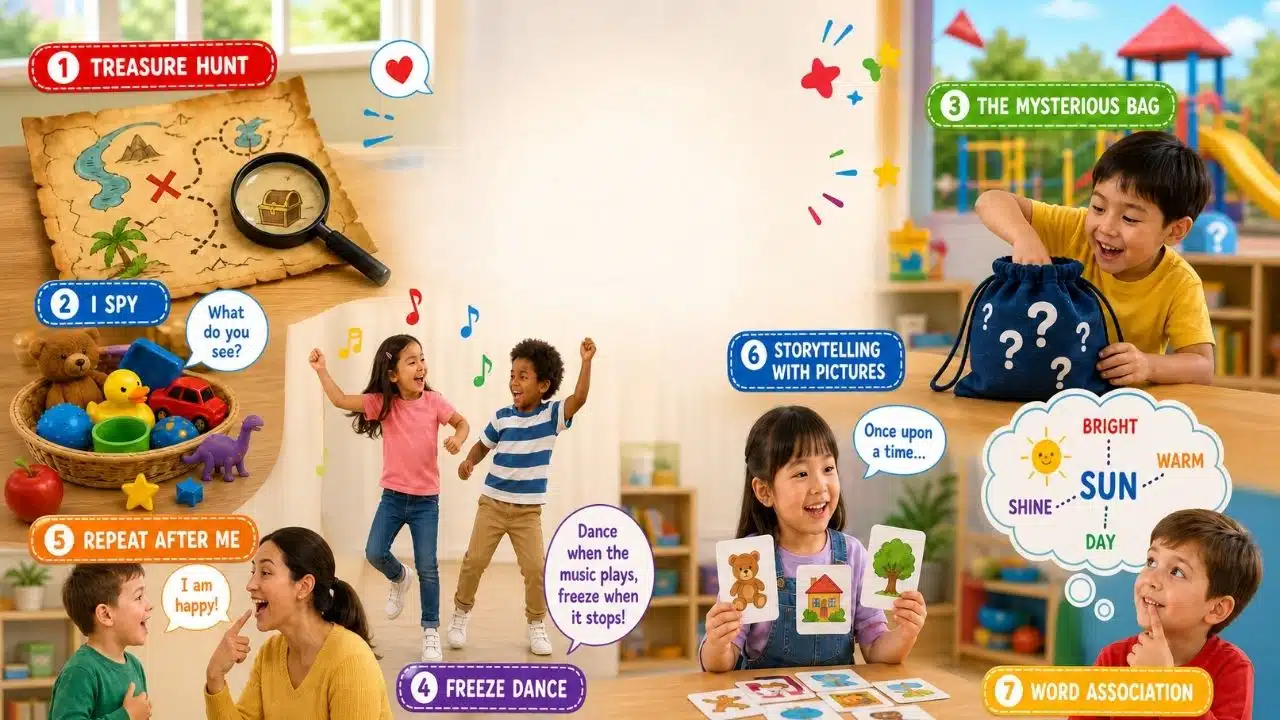
| Game | Best age | What it built | Did he ask to play again? |
|---|---|---|---|
| Treasure Hunt | 3 to 6 | Full sentences | Yes, every time |
| I Spy | 4 to 7 | Describing words | Yes |
| The Mysterious Bag | 3 to 5 | Touch words like “soft,” “bumpy” | Sometimes |
| Freeze Dance | 2 to 5 | Action words, listening | Yes, too much |
| 123 Magic Number Fun (App) | 2 to 8 | Number words, listening | Yes |
| Repeat After Me | 3 to 5 | Sentence shape | No |
| Storytelling with Pictures | 4 to 7 | Telling a story | Yes |
| Word Association | 5 and up | Linking ideas | Only with his cousin |
1. Treasure Hunt
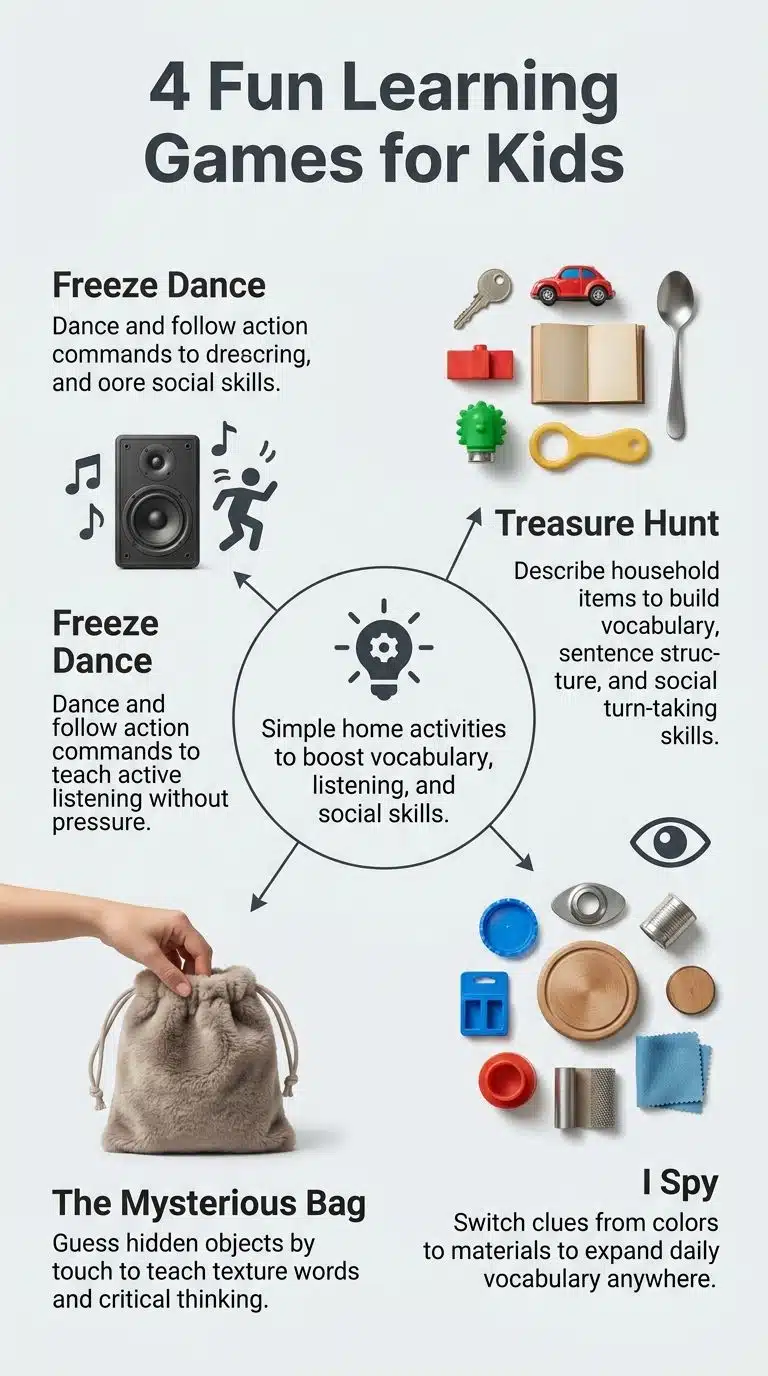
This was the winner, and it was not close. I put six things in a cloth bag. A spoon, a toy car, a hair clip, an apple, a sock, and a small torch. He pulled one out, named it, then said one thing about it.
The first two days he only named the item. “Car.” That is normal. I did not correct him. I just said my own sentence out loud after his turn. “I got a spoon. My spoon is cold.” By day three he copied the shape on his own. “I got a car. My car is fast.”
That copying is the whole point. Kids borrow your sentence and make it theirs.
For my nephew I raised the bar. He had to say what the object is used for, without naming it, and I had to guess. That turned it into a riddle game and she loved it. One small thing that mattered: use real household items, not toys only. Toys get named fast because he already knows them. A garlic press made him stop and think.
What it builds: new words, sentence structure, and turn-taking. The turn-taking part quietly helps social skills too.
2. I Spy
Everyone knows this one. It still works. I played it in the car, at the doctor’s waiting room, and once in a long queue at the bank. That is its real strength. It needs nothing.
But I had to change how I played it. Colors got boring by day two. So I switched the clue type. Shape one day. Sound the next one. Then material, which sounds hard but is not. “I spy something made of metal.” He learned the word “metal” in one afternoon because he needed it.
At four he could guess well but struggled to give clues. He would look straight at the thing and say the name by accident. That is fine. Let it happen. By week three he was hiding his eyes to stop himself.
Do not play it at bedtime. He got wound up and stayed awake.
3. The Mysterious Bag
Same bag as game one, different rule. No looking. Reach in, feel it, describe it, then guess. This one produced the words I was actually missing. Soft. Bumpy. Cold. Sharp at the edge. Sticky. Kids get object names easily from daily life. They rarely get texture words, because nobody says them out loud.
It faded faster than the others, though. After five rounds he knew every item in the bag by touch and the mystery was gone. I had to refill it each time, and some days I could not be bothered. That is an honest limit.
Best trick I found: put in one thing he has never touched. A pine cone did more for his vocabulary than the whole first week.
It also pushed him to guess and check his guess, which is early critical thinking.
4. Freeze Dance
Music on. Dance. Music off. Then I shout a command. I started with “Freeze.” Then I added “Jump,” “Clap,” “Turn around,” “Touch the floor,” and “Hands on head.” Every command is a verb he now understands without translation.
It works because he has to listen while excited. That is hard. Listening when calm is easy.
The problem is the comedown. Twenty minutes of this and he was too hot and too loud to do anything else. I moved it to late afternoon and it stopped being a problem.
If your child is shy about speaking, start here. There is no pressure to say anything at first. He was following commands for a week before he started shouting them at me.
5. 123 Magic Number Fun: Math Kid
This one is different from the rest, so read it differently. It is an app, not a game you play with your hands. I added it because we already had screen time in the house and I wanted that time to do something. 123 Magic Number Fun: Math Kid is built for ages two to eight and holds twelve small games inside one app, with a cartoon bunny guiding the child through them.
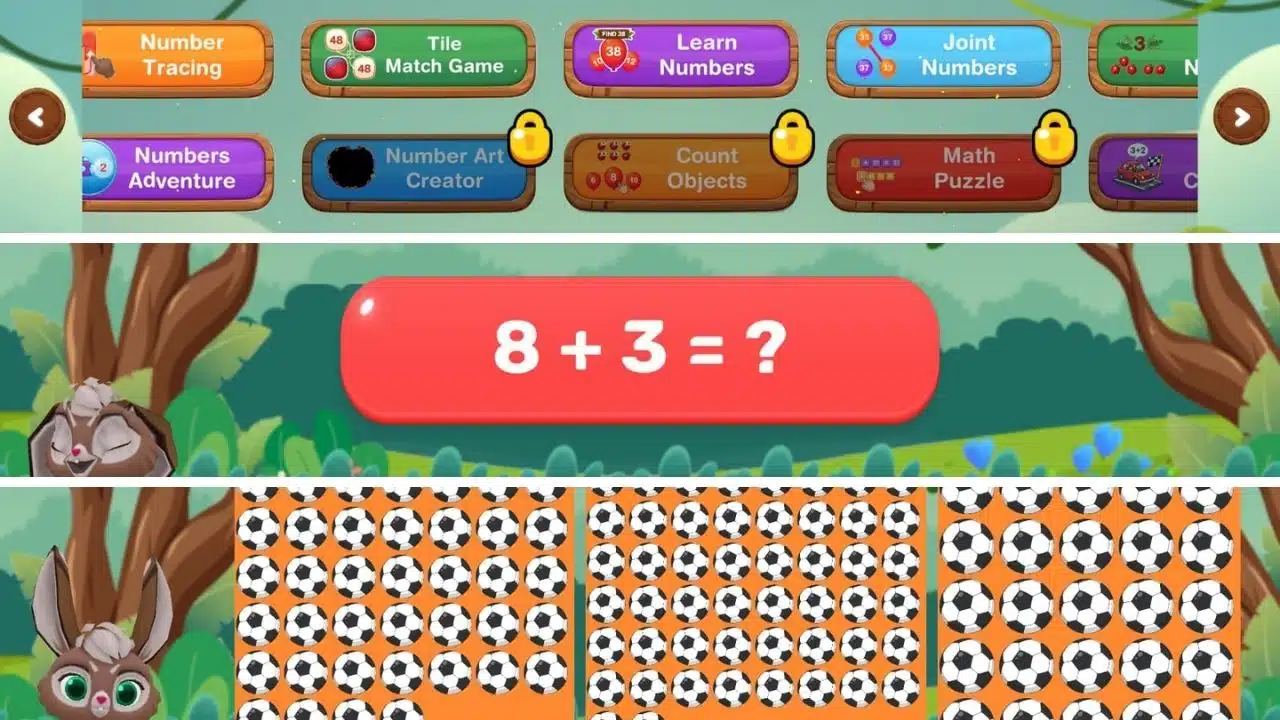
Be clear about what it teaches. It teaches numbers, counting, tracing, and simple sums. It is not a vocabulary app. So why is it on a language list?
Because of how he used it. Three of the games speak the number out loud and ask him to tap the right one. He repeated the word back every single time, without me asking. Number words are still words. One, seven, twelve, and thirty. He also had to hold a spoken instruction in his head long enough to act on it, which is the same listening muscle Freeze Dance builds.
The bigger gain came from me sitting next to him. I asked what he was doing. He explained. “The bunny wants six. I need six apples. “That is a full sentence about a task, and it is harder than naming an object.
What I liked: the tracing screens kept him quiet and focused for a long stretch, longer than anything else on this list. The voice is clear and slow. He could open it and use it alone.
What I would warn you about: it shows ads, so keep it on a device you control. And it is a solo activity by nature. If you leave the room, the talking stops and it becomes plain screen time. I set a rule that he plays it beside me, not in his room.
Best age: Three and up. My nephew at six went straight to the math puzzles and skipped the tracing.
6. Repeat After Me
I have to be honest. This one failed for us. The idea is sound. You say a sentence, the child repeats it, and you slowly make the sentences longer. “The dog is barking.” Then, “The big dog is barking loudly.”
He repeated the words back like a parrot and thought about none of them. By the third session he was rolling his eyes. It felt like a test, because it is a test.
I found one way to save it. I made the sentences silly. “The purple dog is eating my shoe.” Suddenly he was laughing and repeating and then changing the sentence himself, which is what I wanted all along.
So keep it, but only as a five-minute silly game. Do not run it as a drill.
7. Storytelling with Pictures
We did this at bedtime with picture books, but with the words covered. I would point at the page and ask what is happening. Then, “What happens next?” Then, “Why is she sad?” That last kind of question is where the real growth is. Naming what he sees is easy. Explaining why takes longer sentences and joining words like “because” and “so.”
Week one he gave me four words per page. Week four he gave me a story with a beginning and an ending, and he got annoyed when I interrupted.
My niece went further. She invented names for every character and kept them consistent across pages. At six they can hold a plot in their head. At four they cannot yet, so do not push for one.
If you want to stack this with reading, wordless picture books work best. Ordinary picture books also help build vocabulary, but the pictures do more work when the text is not there to lean on.
8. Word Association
Say a word. The child says a word that connects to it. Apple, fruit, and orange juice. At four this was too abstract. He said random words with no link and I could not explain the rule in a way that made sense to him. I stopped after three tries.
At six it clicked immediately. My niece turned it into a competition, added a rule that you lose if you pause too long, and played it for twenty minutes.
Age matters more here than with any other game on the list. If your child is under five, skip it and come back next year.
Why These Games Work Better Than Drilling
The first five years are when the brain grows fastest. It reaches roughly ninety percent of adult size by age five, and connections form at an enormous rate during this window. Talking to a child is one of the main things that builds those connections.
But that is not the interesting part. The interesting part is what I saw in my own notes.
Every session where he talked most had the same thing in common. He wanted something. He wanted to guess the object, win the round, get the bunny to the next level, or find out what happened next in the story. Language was the tool, not the task.
The sessions where he talked least were the ones where the goal was to talk. That is why Repeat After Me flopped and Treasure Hunt did not.
Mistakes I Made in Week One
- I corrected him too much. Every fixed word broke his flow. Now I say the correct version back in my own sentence and move on.
- I played too long. Twenty-five minutes was too much. Twelve is right.
- I asked yes or no questions. “Is it red?” gets you one word. “What color is it?” gets you three. “Why did you pick that one?” gets you a sentence.
- I filled the silence. He needed about five seconds to find a word. I was giving him two.
That last one changed more than any game did.
Final Thoughts
Do not try all eight of these games to encourage language skills at once. Pick two. Treasure Hunt and Storytelling with Pictures cover the most ground between them, and both fit into time you already spend with your child.
Add a third only when the first two feel automatic. If screen time is already part of your day, 123 Magic Number Fun is a reasonable place to put some of it, as long as you sit close enough to ask questions.
Give it three weeks before you judge anything. Nothing showed up in week one for us. The change was obvious by week three, and it did not come from the games being clever. It came from playing them often enough that talking stopped feeling like homework.