Most students default to highlighting text and rereading chapters because it feels productive. Running your eyes over the same page three times creates an illusion of competence. You recognize the words, so you assume you know the material. When the exam arrives, that recognition vanishes. To actually embed information into your long-term memory, you have to force your brain to retrieve it from scratch. Implementing proven active recall techniques shifts your study sessions from passive review to highly efficient cognitive labor.
The Science Behind Why Active Recall Techniques Work
The human brain does not store information simply because you look at it multiple times. Memory is strengthened through the act of retrieval. Every time you struggle to pull a fact from your mind, you are physically reinforcing the neural pathway to that information. Passive reading only requires recognition, which uses a completely different and shallower part of the brain. The discomfort you feel when you cannot immediately remember an answer is not a sign of failure; it is the exact mechanism required for long-term retention.
10 Active Recall Techniques That Force Your Brain to Remember
1. The Blank Page Brain Dump
Close the book, get a blank piece of paper, and write down everything you remember about the topic. It will be painful, and you will miss a lot of details. That is the point. The friction of struggling to remember is what signals your brain to keep the information. Once you finish, open your textbook and use a red pen to fill in the gaps you missed. This visual contrast shows you exactly what you do not know.
2. Flashcards with Spaced Repetition
Digital flashcard apps like Anki or Quizlet are highly effective, but only if you use them correctly. The mistake most people make is flipping the card too soon. You must force yourself to guess the answer out loud before checking. If you just look at the back and think, “I knew that,” you are falling back into passive recognition.
3. The Feynman Method
Explain the concept in plain English as if you were talking to a 12-year-old. If you have to rely on complex jargon or textbook definitions to make your point, you do not truly understand the material yet. Breaking a complex topic down into simple analogies highlights exactly where your knowledge is weak and forces you to simplify abstract ideas.
4. Closed-Book Concept Mapping
Visual learners often draw beautiful mind maps while looking directly at their notes. That is just transcription. Instead, map out the connections between concepts entirely from memory to force spatial and logical recall.
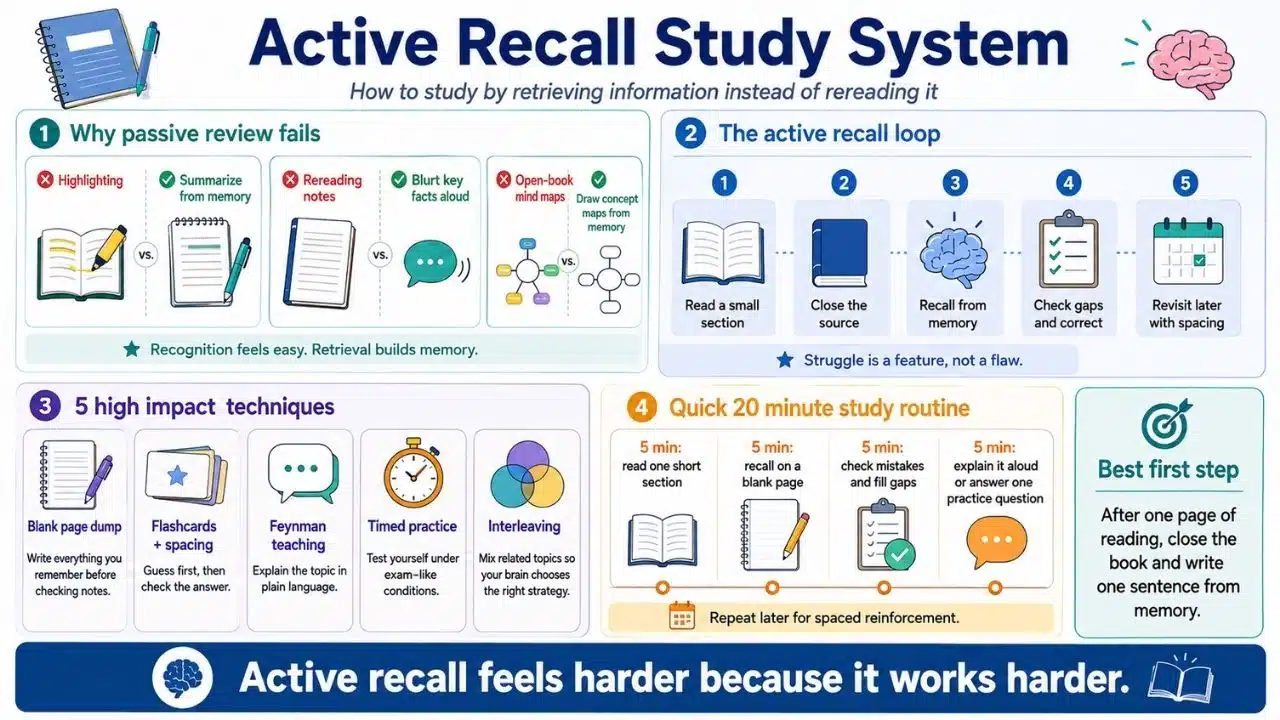
Review this breakdown of passive study habits and their highly efficient alternatives to see the difference in cognitive effort:
| Passive Habit | Why It Fails | Active Alternative |
| Highlighting text | Requires zero retrieval effort | Summarizing the page in one sentence |
| Rereading notes | Creates a false sense of fluency | Blurting facts verbally without notes |
| Open-book mapping | Transcribes instead of testing | Drawing mind maps from memory |
5. Practice Testing Under Realistic Conditions
Doing practice problems is standard, but doing them with your textbook open is useless. You have to recreate the pressure of the actual exam. Set a timer, clear your desk, and force yourself to answer the questions without any safety nets. Do not check the answer key until the entire test is finished.
6. The Blurting Method
Read a specific section of your material, close the source, and verbally blurt out the core concepts as fast as you can. This works exceptionally well for auditory learners who need to talk through a complex problem to fully grasp it. If you stumble on a sentence, it means that specific concept needs more review.
7. Writing Your Own Quiz Questions
Thinking like the professor forces you to identify the most important themes in the material. As you read a chapter, stop after every major heading and write down a potential exam question. Later that week, use those exact questions to test yourself. You are actively processing the hierarchy of information rather than just absorbing it.
8. Interleaving Different Subjects
Focusing on one specific type of math problem for three hours feels productive, but your brain goes on autopilot. Instead, mix different topics or problem types into a single study session. This forces your brain to actively recall not just the solution, but the specific strategy required to solve each unique problem.
9. Teaching an Invisible Audience
Stand up, pace around the room, and deliver a lecture on the material to an empty room. Speaking information aloud uses different neural pathways than reading it silently. Teaching requires you to organize the information logically, which prevents you from skipping over the difficult parts you normally gloss over while reading.
10. The Pre-Test Struggle
Take a quiz before you even start reading the chapter. You will likely fail miserably, but the effort primes your brain. When you finally read the text, the answers will jump out at you because your brain is actively looking for the solutions to the questions you just missed.
Combining Active Recall Techniques With Spaced Repetition
Active recall dictates how you study, but spaced repetition dictates when you study. If you test your memory on a topic today, you will likely forget a portion of it by next week. To stop the forgetting curve, you must space out your recall sessions. Test yourself one day after learning the material, then three days later, then a week later. Combining these two frameworks ensures that you are not just memorizing information for a single test, but retaining it for the long term.
The Quickest Way to Start Testing Your Memory
You cannot overhaul your entire study routine overnight. Start with the lowest friction change: close your book after reading a single page and try to summarize it in one sentence without looking. Once you experience how effectively active recall techniques lock information into your brain, you will never waste time passively rereading a textbook again.
Frequently Asked Questions (FAQs) About Active Recall Techniques
How often should I use active recall?
You should use it every time you sit down to study. Passive reading can be used once to introduce new material, but every subsequent review session must involve some form of forced retrieval to build long-term memory.
Are flashcards the only way to do this?
No, flashcards are just one tool. Writing summaries from memory, taking practice tests, and teaching the material to an audience are all equally valid and highly effective ways to test your retention without relying on an app.
Why does active recall feel so exhausting?
It feels exhausting because it requires heavy cognitive effort, unlike passive reading which is mentally relaxing. That mental strain is the exact mechanism that physically alters your brain pathways to store the information permanently.