

Game development budgets have risen significantly as players expect higher graphical fidelity, larger game worlds, and continuous post-launch content updates. For indie studios and established mid-tier developers alike, managing operational burn rates is essential for financial sustainability.
Reducing expenses does not require sacrificing game quality or overworking development teams. Instead, smart production management, modular architecture, and strategic asset allocation allow teams to maximize output while keeping overhead low. This guide examines 12 proven ways to reduce game development costs across pre-production, engine integration, asset creation, and quality assurance.
Pre-Production and Scope Optimization: Effective Ways to Reduce Game Development Costs
A game’s budget is largely defined during pre-production. Poor planning and uncontrolled feature expansion (scope creep) are leading causes of budget overruns in software development.
1. Enforcing Strict Scope Control and Feature Prioritization
Scope creep occurs when new mechanics, narrative branches, or graphical features are added mid-production without adjusting timelines or funding. Studios control scope by applying prioritization frameworks like MoSCoW (Must-have, Should-have, Could-have, Won’t-have) during early planning.
-
Implementation: Define a strict Game Design Document (GDD) and lock core mechanics before moving into full production.
-
Cost Impact: Prevents discarded engineering work and reduces unnecessary rework during late-stage development.
2. Utilizing Rapid Greybox Prototyping for Early Mechanic Validation
Developing high-detail art assets for unproven mechanics wastes time and capital. Greyboxing involves building grey-box environments using simple geometric shapes to test level design, player movement, and core combat loops before art teams begin asset creation.
-
Implementation: Validate level pacing and mechanics using basic primitives in the engine.
-
Cost Impact: Identifies flawed mechanics early, preventing artists from modeling assets for levels that get scrapped.
3. Adopting Modular Asset Architecture and Procedural Generation
Creating unique 3D meshes or environmental props for every area of a game world inflates production costs. Modular design relies on tileable wall segments, reusable architectural kitbashes, and procedural generation tools (like Unreal Engine PCG or Houdini) to build expansive levels.
-
Implementation: Design environment assets on standardized grid snaps so level designers can recombine props infinitely.
-
Cost Impact: Reduces environment art workloads by 30% to 50% while maintaining visual consistency.
Asset Pipelines and Software Choices to Lower Production Budgets
Software licensing fees and custom asset generation represent a major portion of game budgets. Leveraging existing tools and reusable assets frees up engineering hours for core gameplay.
4. Leveraging Commercial Asset Libraries for Core Content
Not every prop, background sound effect, or character animation needs to be custom-built from scratch. Marketplaces like the Unity Asset Store, Unreal Engine Marketplace, and TurboSquid offer high-quality 3D models, UI templates, and particle effects for a fraction of the cost of custom creation.
-
Implementation: Purchase secondary assets (like furniture, ambient audio, or basic particle effects) and customize textures to match the game’s art direction.
-
Cost Impact: Saves hundreds of art and audio production hours per project.
5. Integrating Open-Source Software Tools and Middleware
Subscription fees for proprietary software suites quickly add up across multi-person teams. Substituting paid digital content creation (DCC) software with mature open-source tools lowers recurring monthly overhead.
-
Implementation: Replace subscription-based modeling and editing tools with open-source alternatives like Blender for 3D modeling/animation, Audacity for audio processing, and VS Code for programming.
-
Cost Impact: Eliminates thousands of dollars in per-seat annual software licensing fees.
6. Deploying AI-Assisted Workflows for Production Boilerplate
Modern developers use artificial intelligence tools as production assistants to accelerate routine tasks. AI code assistants generate routine boilerplate scripts, while generative tools help artists iterate quickly on concept references and texture variations during pre-production.
-
Implementation: Use tools like GitHub Copilot for code auto-completion and AI image generators to create rapid concept mood boards.
-
Cost Impact: Shortens pre-production design cycles and reduces repetitive coding tasks.
Talent Allocation and Workflow Optimization Strategies
Labor salaries represent the single largest burn-rate expense for game studios. Structuring development teams efficiently keeps payroll manageable.
7. Strategic External Outsourcing for Asset Creation
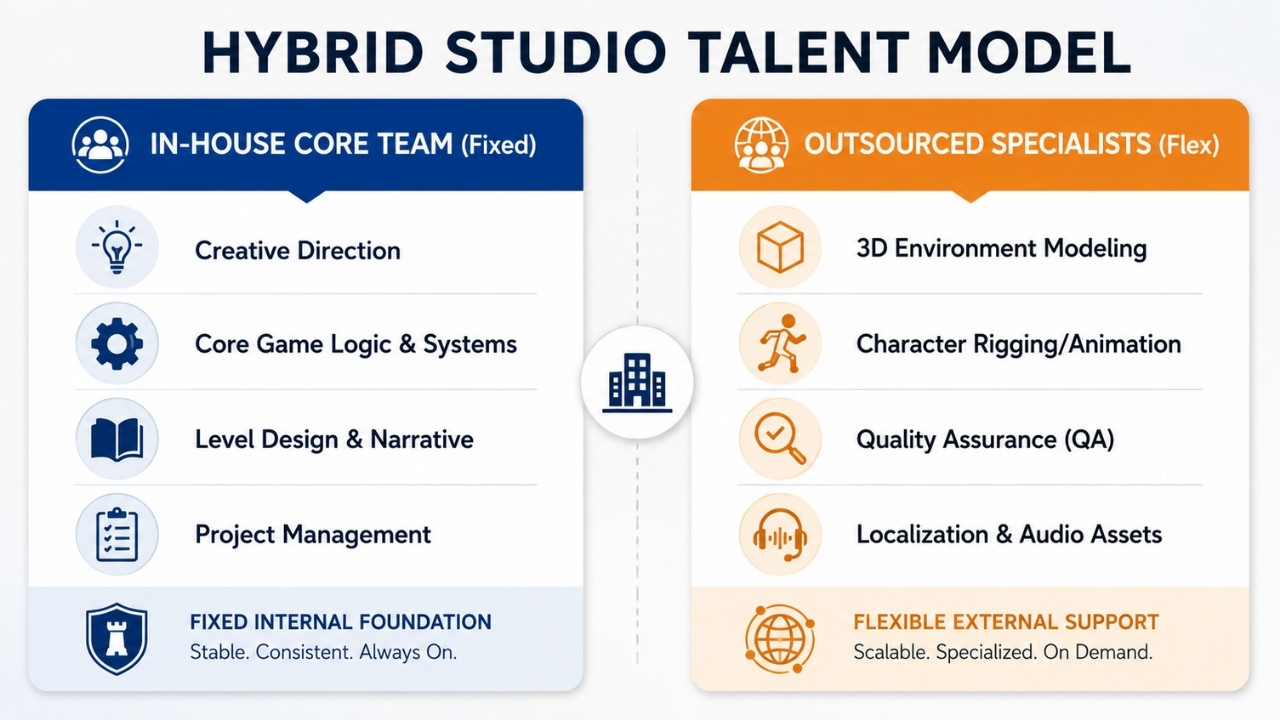
Maintaining a full-time, in-house team of specialized 3D animators, concept artists, and audio engineers throughout an entire project cycle creates high payroll overhead during periods of low activity. Outsourcing art production, 3D modeling, and QA testing to specialized external agencies allows studios to pay only for specific deliverables.
-
Implementation: Keep core game design and systems programming in-house while outsourcing asset-heavy production tasks to external studios.
-
Cost Impact: Reduces fixed payroll costs, employee benefits expenses, and office equipment overhead.
8. Utilizing Nearshore Rate Arbitrage and Distributed Teams
Hiring talent exclusively in high-cost tech hubs significantly increases development budgets. Remote-first workflows allow studios to hire experienced engineers and artists in regions with lower costs of living, balancing competitive pay with budget optimization.
-
Implementation: Establish distributed remote teams across regions like Eastern Europe, Latin America, or Southeast Asia.
-
Cost Impact: Reduces hourly labor rates by 30% to 60% compared to tier-one tech hubs without sacrificing work quality.
9. Implementing Automated QA Testing and CI/CD Build Pipelines
Manual quality assurance testing is slow, labor-intensive, and prone to human oversight. Setting up Continuous Integration/Continuous Deployment (CI/CD) pipelines with automated testing scripts catches code bugs instantly whenever new code is committed.
-
Implementation: Automate unit tests for physics collision, UI flow, and memory leaks, running overnight build verification scripts.
-
Cost Impact: Reduces reliance on large manual QA teams and prevents costly late-stage bug fixes.
Engine Selection and Phased Release Models
Technical choices made early in development directly influence long-term production expenses.
10. Standardizing on Multi-Platform Engine Infrastructure
Building a custom proprietary game engine requires dedicated low-level graphics engineers, continuous tool maintenance, and custom exporter development. Standardizing development on commercial engines like Unity, Unreal Engine, or Godot provides built-in multi-platform deployment capabilities out of the box.
-
Implementation: Use cross-platform engine deployment pipelines to publish simultaneously across PC, mobile, and console.
-
Cost Impact: Eliminates dedicated engine maintenance teams and drastically cuts console porting expenses.
11. Launching Minimum Viable Products with Phased Content LiveOps
Attempting to ship a massive, multi-hundred-hour game on day one increases financial risk. Building a Minimum Viable Product (MVP) focuses resources on a polished core experience, allowing studios to generate early revenue via Early Access or phased post-launch content updates.
-
Implementation: Release the polished core game loop first, gathering player feedback to prioritize post-launch DLC and expansions.
-
Cost Impact: Reduces initial production timelines and uses early player revenue to fund post-launch development.
12. Streamlining Localization Pipelines and Community-Led Marketing
Text-heavy games can incur high translation and voice-over expenses during international localization. Using structured string tables early in development simplifies localization workflows, while community-driven organic marketing lowers user acquisition costs.
-
Implementation: Externalize game text strings into JSON/CSV files from day one, and use social media, devlogs, and closed beta access to build an organic fan base.
-
Cost Impact: Minimizes localization engineering hours and lowers paid user acquisition spend.
Comparing Cost Reduction Strategies in Game Development
| Cost Reduction Strategy | Potential Savings | Implementation Complexity | Primary Operational Risk |
| Scope Control (MoSCoW) | High (20-30%) | Low | Creative constraint and internal team pushback |
| Modular Asset Design | High (25-40%) | Medium | Visual repetition if asset sets lack variance |
| External Asset Outsourcing | Very High (30-50%) | Medium | Quality control and communication friction |
| Open-Source Software | Low-Medium (10-15%) | Low | Feature limitations compared to paid suites |
| Automated QA & CI/CD | Medium (15-20%) | High | Upfront setup overhead and pipeline maintenance |
| Commercial Engine Choice | High (30-40%) | Low-Medium | Platform engine lock-in and royalty tiers |
Strategic Limitations and Trade-Offs of Cost Reduction
While optimizing production budgets is essential, aggressive cost-cutting without strategic planning can introduce operational risks.
Quality Management in Outsourced Pipelines
Outsourcing asset production or QA testing to third-party vendors reduces fixed overhead, but managing external teams requires clear documentation, art bibles, and active technical direction. Poor communication can result in mismatched asset styles, forcing internal teams to spend time fixing external deliverables.
The Risk of Over-Optimization
Relying too heavily on pre-built marketplace assets or stock templates can result in a generic visual identity. Studios must balance off-the-shelf components with unique hero assets to ensure their game stands out in competitive digital storefronts.
Optimizing Your Studio Production Pipeline
Implementing effective ways to reduce game development costs comes down to smart resource management rather than cutting corners on quality. By combining disciplined scope control during pre-production with modular asset design, commercial engine tools, and strategic outsourcing, studios can lower operational burn rates while maintaining creative excellence. Focus on building a streamlined, repeatable development pipeline that protects your budget and supports your game’s creative vision.
Frequently Asked Questions About Ways to Reduce Game Development Costs
What is the single most effective way to reduce game development costs?
Controlling project scope during pre-production is the most effective cost-reduction strategy. Preventing feature creep and locking game mechanics before full production stops teams from wasting time on content that gets cut later.
Can a game studio save money using free and open-source game development tools?
Yes. Studios can build commercial games using open-source platforms like Godot (engine), Blender (3D modeling and animation), Audacity (sound editing), and VS Code (programming), eliminating recurring software subscription costs entirely.
How does outsourcing help indie studios manage game development budgets?
Outsourcing converts fixed payroll expenses into variable, project-based costs. Instead of employing full-time specialists year-round, studios hire external artists, animators, or QA testers only when specific assets or testing cycles are needed.