


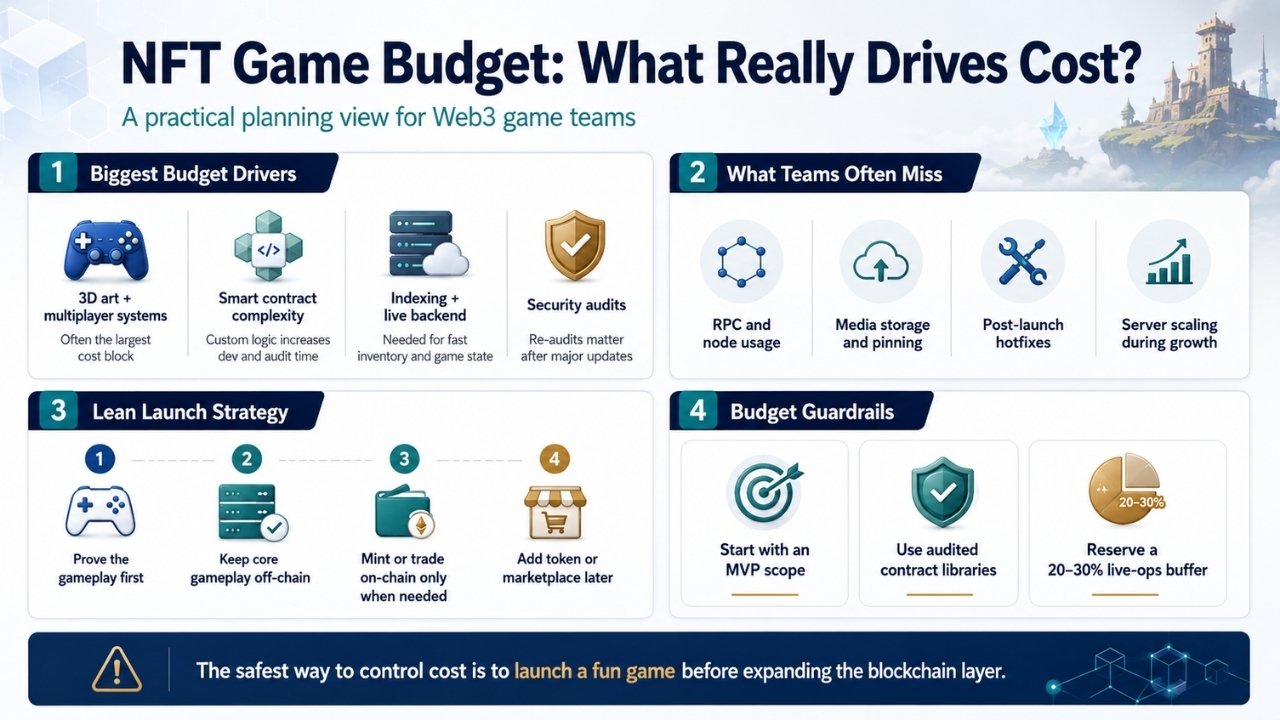
Most Web3 game studios do not run out of money because their 3D models were too expensive or their smart contracts took too long to write. They run out of money because their budget accounted for token minting and character art while completely ignoring the ongoing cost of indexers, multi-region game servers, RPC node quotas, and security re-audits after launch.
Estimating the NFT game development cost requires looking past basic contract deployment. A lean 2D prototype built on an established framework can cost as little as $25,000, while a feature-rich 3D multiplayer title often scales past $300,000. Understanding where these capital requirements actually go allows product teams to build sustainable budgets and avoid mid-production surprises.
Baseline Budgeting Assumptions
Software development estimates vary widely based on team structure, location, and technical scope. To evaluate the numbers in this guide accurately, consider the following baseline assumptions:
-
Labor Rates: Figures reflect mid-tier agency rates between $60 and $110 per hour, typical of development hubs in Eastern Europe or Latin America. Hiring an in-house team in North America or Western Europe ($150 to $250 per hour) will roughly double these estimates.
-
Asset Creation: Estimates assume original 2D or 3D visual assets created specifically for the game, rather than unmodified stock store packs.
-
Chain Infrastructure: Costs assume deployment on low-fee Layer-2 networks like Arbitrum, Polygon, or Immutable, or high-throughput Layer-1 chains like Solana. Deploying directly to Ethereum Layer-1 increases gas optimization testing costs.
-
Scope Exclusions: Financial ranges cover game design, smart contracts, backend state indexing, and quality assurance. They exclude legal opinion letters, exchange listing fees, token marketing, and market-making liquidity.
Development Cost Tiers
The complexity of your core game mechanics dictates your engineering budget far more than the blockchain layer itself.
Tier 1: Casual 2D MVP ($25,000 to $60,000)
This category covers turn-based card games, casual strategy titles, or simple browser-based games. Blockchain interactions are kept strictly minimal, focusing on wallet connectivity, character NFT minting, and basic inventory management.
A small team consisting of a game developer, a smart contract engineer, and a UI designer can typically deliver a polished prototype within three to five months.
Tier 2: Mid-Scale Multiplayer Titles ($60,000 to $180,000)
Built on engines like Unity or Unreal Engine, these projects feature real-time player interaction, 3D environments, and custom item economies.
Because multiplayer interactions require authoritative server logic to prevent cheating, backend engineering requirements increase sharply. Production usually spans six to twelve months and requires dedicated database engineers to sync on-chain state with live gameplay.
Tier 3: Enterprise 3D Environments ($180,000 to $450,000+)
High-fidelity open-world games or competitive titles require extensive production pipelines. Teams must build custom anti-cheat protection, complex crafting trees, and multi-asset economy systems.
Projects in this category take 12 to 24 months of full-time development across specialized game engineers, technical artists, smart contract specialists, and systems architects.
Estimated Budget Breakdown by Category
| Component Area | Simple MVP ($25k–$60k) | Mid-Scale ($60k–$180k) | Enterprise ($180k–$450k+) |
| Game Art & Gameplay Logic | $10,000 – $22,000 | $25,000 – $65,000 | $70,000 – $180,000 |
| Smart Contracts & Token Logic | $5,000 – $12,000 | $12,000 – $30,000 | $30,000 – $70,000 |
| Backend, Indexing & Database APIs | $4,000 – $10,000 | $10,000 – $28,000 | $28,000 – $65,000 |
| Interface & Wallet Integration | $3,000 – $8,000 | $8,000 – $20,000 | $20,000 – $45,000 |
| Security Audits & Quality Assurance | $3,000 – $8,000 | $8,000 – $22,000 | $22,000 – $55,000+ |
| Cloud Hosting & Node Setup | $2,000 – $5,000 | $5,000 – $15,000 | $15,000 – $35,000 |
Where the Money Goes: Primary Engineering Cost Drivers
Breaking down a Web3 game budget requires separating game client development from decentralized backend infrastructure.
Graphics, Game Engine Choice, and Netcode
Visual fidelity drives a major share of the gameplay budget. Choosing Unreal Engine often increases talent costs when specialized C++ engineers and custom shader artists are required, whereas Unity offers a broader talent pool for cross-platform 2D and 3D builds.
2D vs. 3D Asset Creation: Drawing 2D sprite sheets is vastly cheaper than rigging 3D character meshes with customizable armor, weapons, and animations.
Multiplayer Server Architecture: Running single-player or asynchronous turn-based loops keeps server hosting minimal. Real-time multiplayer games require authoritative cloud servers to process physics and hit detection, adding substantial monthly server expenses.
Smart Contract Complexity and On-Chain Logic
Contract development fees scale with the number of custom state changes your system requires. Basic ERC-721 or ERC-1155 token contracts built on open-source standards like OpenZeppelin are straightforward to implement and audit.
Expenses grow rapidly when adding custom game mechanics:
In-Game Item Upgrades: Logic that allows players to combine or burn multiple NFTs to create a rare item requires custom contract code and rigorous security checks.
Staking and Reward Distribution: Building contracts that calculate player rewards based on soft-staking or achievement milestones requires gas-optimized code to prevent transaction fees from eating into user rewards.
Marketplace Royalties: Enforcing secondary sale royalties via standard ERC-2981 requires careful integration, as zero-fee marketplaces can bypass contract-level royalties unless paired with custom operator filter registries.
State Indexing and Data Availability
A frequent mistake in Web3 game planning is assuming the game client can read player inventory directly from public blockchain nodes. Querying public RPC endpoints for every item lookup leads to rate-limiting and high latency during traffic spikes.
To deliver a responsive user experience, development teams must build or host an indexing layer:
Engineering Reality: Games use event indexers (such as custom GraphQL subgraphs or dedicated data pipelines) to listen for on-chain events and mirror player inventory into fast off-chain databases like PostgreSQL. This setup allows the game client to load inventory data instantly without making slow, direct calls to the blockchain.
Recurring Operational Expenses After Launch
Initial build costs cover getting to mainnet, but live operations bring ongoing commitments that must be factored into your runway.
Security Audits and Re-Audits
Independent auditing firms inspect smart contracts for vulnerabilities before deployment. Audit pricing ranges from $5,000 for simple token contracts to well over $30,000 for complex multi-contract ecosystems.
Crucially, any major contract update made post-launch to add game features requires a secondary audit pass, creating a recurring security cost.
RPC Nodes and Media Storage
-
RPC Service Quotas: Infrastructure providers like Alchemy or QuickNode charge based on request volume. As your active player base grows, monthly node infrastructure bills can scale from $500 to several thousand dollars.
-
Asset Storage Decisions: Hosting game media on IPFS requires paying a continuous pinning service like Pinata to ensure files remain accessible. Alternatively, permanent storage networks like Arweave require an upfront fee per megabyte.
-
Gas Relayers: If your game uses account abstraction to sponsor player gas fees and create a frictionless onboarding flow, your studio directly absorbs network transaction costs.
Practical Ways to Scope Down Your Web3 Game Budget
Early-stage projects can protect their runway by making smart architectural tradeoffs during initial design.
-
Limit On-Chain State to Essential Milestones: Keep core gameplay loops, movement, and combat logic entirely on traditional cloud servers. Settle transactions on-chain only when players explicitly mint, trade, or cash out items.
-
Pick the Right Network Architecture: Avoid deploying high-frequency game actions on congested networks. Utilizing low-cost Layer-2 networks (such as Arbitrum, Polygon, or Immutable) or high-throughput Layer-1s (such as Solana) keeps gas fees manageable for both players and relayers.
-
Avoid Feature Overload at Launch: Skip complex governance DAOs, multi-chain bridges, and custom decentralized exchanges for your initial release. Focus entirely on proving core gameplay engagement first.
Final Recommendations for Budget Planning
Managing your NFT game development cost effectively comes down to sequencing your engineering priorities.
Instead of building a complex token economy and custom marketplace on day one, focus your initial capital on proving your core gameplay loop off-chain. Use battle-tested smart contract templates for item minting, deploy on a low-cost network, and reserve a dedicated 25% contingency buffer for indexing pipelines, security audits, and post-launch infrastructure scaling. Deferring non-essential blockchain features until you have an active player base is the surest way to bring a Web3 game to market without exhausting your runway.
Frequently Asked Questions(FAQs) on NFT Game Development Cost
Can a Web3 game studio launch without its own token?
Yes, launching without a custom utility token is often the safest strategy for early-stage games. Studios can use established network currencies like ETH, SOL, or MATIC for item purchases, completely eliminating tokenomics design expenses and regulatory compliance hurdles at launch.
Does an NFT game need a custom built-in marketplace at launch?
No, building a proprietary marketplace adds $15,000 to $40,000 in frontend and contract engineering costs. Early-stage games can direct players to secondary marketplaces like OpenSea, Blur, or Magic Eden, or integrate white-label marketplace widgets at a fraction of custom build costs.
How much contingency budget should be reserved for post-launch live ops?
Studios should reserve 20% to 30% of their total initial budget specifically for post-launch operations. This contingency covers RPC usage spikes, server auto-scaling, contract re-audits for feature updates, and immediate hotfixes during the first three months.
Which features cause the worst scope creep in Web3 game development?
Multi-chain bridging, custom staking dashboards, and fully on-chain inventory systems generate the most scope creep. Each added chain doubles your indexing infrastructure work and requires independent contract security reviews.
How does outsourcing to an offshore agency compare to hiring an in-house team?
Outsourcing to a specialized Web3 agency typically saves 40% to 60% compared to full-time local hiring while providing immediate access to experienced smart contract developers. However, long-term live service games usually transition to an in-house core team after launching their initial product.





















