


Learning how to balance work and study comes down to managing two scarce resources: your available hours and your physical energy. When you stack 20 hours of shifts on top of a full course load, traditional advice like “just buy a planner” falls flat. Planners track time, but they don’t create extra hours in a day.
When you combine 15 to 20 hours of paid employment with a full academic load (typically 12 to 16 credit hours), you are taking on a 50-to-65-hour weekly commitment. Without clear boundaries and deliberate scheduling, your routine breaks down in a predictable sequence: sleep quality collapses first, academic comprehension drops second, job performance declines third, and chronic burnout settles in permanently.
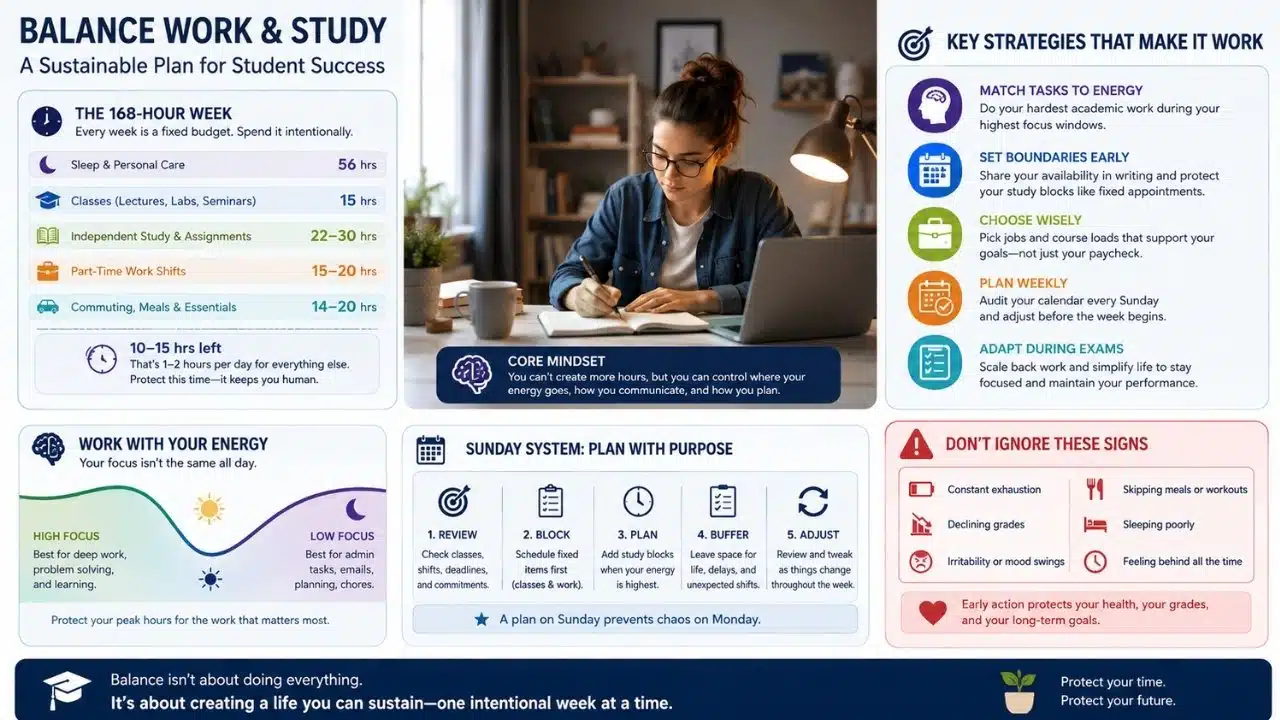
Managing both demands treating your weekly schedule like an unstretchable budget. You cannot manufacture extra hours out of thin air, but you can control where your peak energy goes, how you communicate with your manager, and how you structure your coursework.
Doing the Real Math on Your 168-Hour Week
Before registering for courses or agreeing to a work schedule, you need an honest count of your actual hours. Every week contains exactly 168 hours. When you stack job shifts on top of classes without counting your fixed living costs, you end up borrowing time from sleep or health to cover the deficit.
Here is what a standard working student’s weekly time budget looks like in practice:
-
Sleep and personal care: 56 hours (7 to 8 hours per night to keep your brain functioning).
-
Lectures, labs, and seminars: 15 hours (based on a typical 15-credit schedule).
-
Independent study and assignments: 22 to 30 hours (academic guidelines generally suggest 1.5 to 2 hours of self-study per credit hour).
-
Part-time work shifts: 15 to 20 hours.
-
Commuting, meals, and hygiene: 14 to 20 hours.
When you add those baseline numbers up, you are left with roughly 10 to 15 hours of unallocated time for the entire week—or about two hours per day for leisure, social connection, family, and unexpected delays.
If your weekly math shows total commitments exceeding 150 hours before factoring in downtime, you are mathematically set up for exhaustion. You need to adjust the numbers before the semester overwhelms you: scale back your work shifts, reduce your credit load for the term, or cut non-essential commitments.
Match Your Tasks to Your Brain Power
A calendar entry saying “Study organic chemistry from 8:00 PM to 10:00 PM” is worthless if you spent the preceding six hours running around a busy retail store or waiting tables. Time is elastic, but mental energy is finite. Figure out how to balance work and study by matching your hardest academic work to your peak focus windows.
Identify Your High-Focus Windows
Most people experience their highest level of analytical focus within the first four to six hours after waking up. If you schedule your most demanding work—writing research papers, analyzing complex data, or learning technical concepts—for late at night after a full shift, your retention rate drops drastically. What should take one hour ends up taking three hours because your brain is running on empty.
Group Your Work by Cognitive Load
Save your hardest academic work—like writing essays, solving problem sets, or prepping for major exams—for the hours when your brain is actually sharpest.
Don’t waste high-energy windows on mindless administrative tasks like formatting citations, downloading lecture slides, ordering textbooks, or checking emails. Save those low-drain administrative chores for when you’re already mentally tired between shifts or winding down for the night.
Setting Real Boundaries with Employers
An unpredictable work schedule is one of the fastest routes to student burnout. Managers fill empty shifts with whoever seems flexible, and if you don’t set clear schedule limits, you will eventually get scheduled for an opening shift the morning of a midterm.
Establish Availability in Writing Early
Submit your availability in writing at least two weeks before the academic term begins. Make it clear that your study blocks are fixed commitments rather than “free time.”
Avoid telling a manager, “I don’t have class on Thursday afternoons, so I might be able to pick up hours.” If you need Thursday afternoon for lab reports, state your limits clearly: “My fixed work availability for this semester is Monday, Wednesday, and Friday evenings, plus all day Saturday. I am unavailable on Tuesdays and Thursdays.”
How to Talk to Your Boss in Real Life
When asked to cover a last-minute shift during an exam week:
“I can’t cover that shift because I have an exam prep window I can’t move, but I’ll be there for my scheduled shifts on Thursday and Friday.”
When setting your semester availability:
“Here is my updated availability for the upcoming semester starting on [Date]. Due to my class schedule, these are the maximum hours and specific days I can work so I can stay reliable on shift and keep my grades up.”
Choosing the Right Job and Course Load
Not all part-time jobs impact your energy the same way, and not all academic terms carry the same workload. How you pair your employment with your course load determines your daily stress level.
Match Your Job to Your Academic Demands
Campus desk jobs (Ideal): Roles at the library, student center, or computer lab offer quiet downtime where you can get paid to complete assigned readings or draft outlines while monitoring a desk.
Retail or food service: These roles are physically and socially demanding. They can provide a nice mental break from sitting at a computer, but keep shifts away from late nights right before early morning lectures.
Flexible gig work: Tutoring, freelance work, or grading gives you control to pause work completely during midterms and scale up hours during lighter academic weeks.
Balance Heavy Classes Intentionally
Avoid registering for three writing-heavy courses or three lab-intensive science classes in the same semester while working 20 hours a week. Mix demanding analytical subjects with lighter electives to keep your weekly preparation hours manageable.
The Sunday Calendar Audit
Academic crises rarely happen because an assignment was inherently impossible; they happen because a deadline snuck up right behind an eight-hour work shift. Prevent this by spending 15 minutes every Sunday night running a quick calendar audit.
Cross-reference your syllabi due dates against your work roster for the next two weeks. If you spot a major 2,500-word paper due right after a string of evening shifts, break that paper down into 250-word daily chunks starting immediately.
Chunking Big Projects Into Small Units
Waiting until Wednesday night to start an assignment due Friday when you work eight-hour shifts on Wednesday and Thursday guarantees an all-nighter and a poor grade.
Spread the project across ten days in small, manageable pieces:
-
Days 1–2: Gather sources and write a rough 1-page outline (30–45 minutes a day).
-
Days 3–6: Write 500 to 600 words per day (45–60 minutes a day).
-
Day 7: Edit, format citations, and proofread (45 minutes).
By the time your heavy work shifts arrive, the assignment is already 90% complete.
Emergency Tactics for Midterms and Finals
During midterms and finals weeks, standard daily balance shifts out of alignment. You need an emergency protocol for these high-pressure periods.
Request Time Off 3 to 4 Weeks in Advance
Don’t wait until the week before finals to ask for time off. Look at your syllabus during the first week of classes, mark exam weeks on your calendar, and submit formal time-off or shift-swap requests a month ahead of time.
Bank Hours Early in the Semester
If you rely on a minimum monthly income, pick up extra shifts during the first four weeks of the term when coursework is light. Save that extra financial buffer so you can comfortably cut back your hours during midterms and finals.
Simplify Daily Living During Crunch Weeks
-
Cook in bulk: Prepare large batches of basic meals on Sunday so you aren’t spending time cooking or buying fast food between work and study.
-
Pause optional social plans: Say no to non-essential outings during exam weeks without feeling guilty.
-
Lower non-critical standards: Let minor household chores wait a few days while you focus on exams and shifts.
Spotting Burnout Before It Ruins Your Semester
There is a big difference between being busy for a week and crashing into chronic burnout. Pushing through severe burnout doesn’t make you disciplined—it causes you to fail classes, which costs far more in repeated tuition than you earned at your job.
Warning Signs You Need to Adjust
-
You experience persistent insomnia or wake up exhausted every morning regardless of sleep time.
-
You feel constant anxiety or brain fog during simple tasks.
-
Your grades are slipping across multiple subjects despite spending hours sitting in front of your textbooks.
-
You are making careless errors at work due to physical exhaustion.
How to Adjust Course Mid-Semester
If you hit a wall mid-semester, take structured steps before your grades or health collapse:
-
Talk to your academic advisor: Explore options like dropping one class before the withdrawal deadline, switching a grade to Pass/Fail, or requesting an incomplete for health reasons.
-
Check with financial aid: Before dropping below full-time student status (usually 12 credits), confirm how it affects your grants, scholarships, or campus housing.
-
Ask your manager for a shift reduction: Approach your supervisor with a direct request: “To keep my work quality consistent, I need to drop my schedule from 20 hours to 12 hours a week for the next month.”
Final Thoughts
Figure out how to balance work and study by being honest about your physical limits. Protect your calendar, set early expectations with your boss, and adjust your course load or work hours before exhaustion turns into a failed class. Treat your study time with the same professional discipline you bring to a paid shift, defend your sleep, and keep your workload sustainable.
Frequently Asked Questions(FAQs) on How to Balance Work and Study
How many hours can a full-time student work without their GPA dropping?
Working 10 to 15 hours per week is generally the safest range for full-time students. Working up to 15 hours can actually sharpen your time-management skills without harming your grades. However, passing the 20-hour-per-week mark shows a sharp statistical drop in GPA and a much higher course withdrawal rate.
Is it better to work on weekends or weekdays while studying?
Blocking shifts into weekend blocks (for example, eight hours on Saturday and eight hours on Sunday) is usually cleaner than scattering short shifts across every weekday. Weekend shift-blocking leaves your weekdays open for lectures, library study sessions, and academic focus. Just protect at least one half-day per week purely for rest.
What should I do if my work schedule conflicts with an exam?
Academic requirements take priority over part-time work shifts. Notify your manager in writing at least two to three weeks before the exam date. If your employer refuses to excuse you from the shift, talk to your professor immediately to explain the situation—many instructors offer alternative exam windows if notified well in advance.
How do I handle a manager who keeps pressuring me to take extra shifts?
Keep your response polite, short, and consistent. You don’t need elaborate excuses for why you can’t work outside your agreed availability. Simply say: “I can’t take on extra hours this week because of my class schedule, but I’ll be there for my regular shifts.” Repeating a simple refusal prevents supervisors from trying to negotiate around your study time.
Can online or asynchronous courses make balancing work easier?
Yes, if you have strong self-discipline. Asynchronous online classes eliminate commute times and let you study around irregular work shifts. However, because they lack fixed lecture times, falling behind is easy. Treat asynchronous classes as if they have mandatory live hours by blocking fixed study sessions in your calendar every week.





















