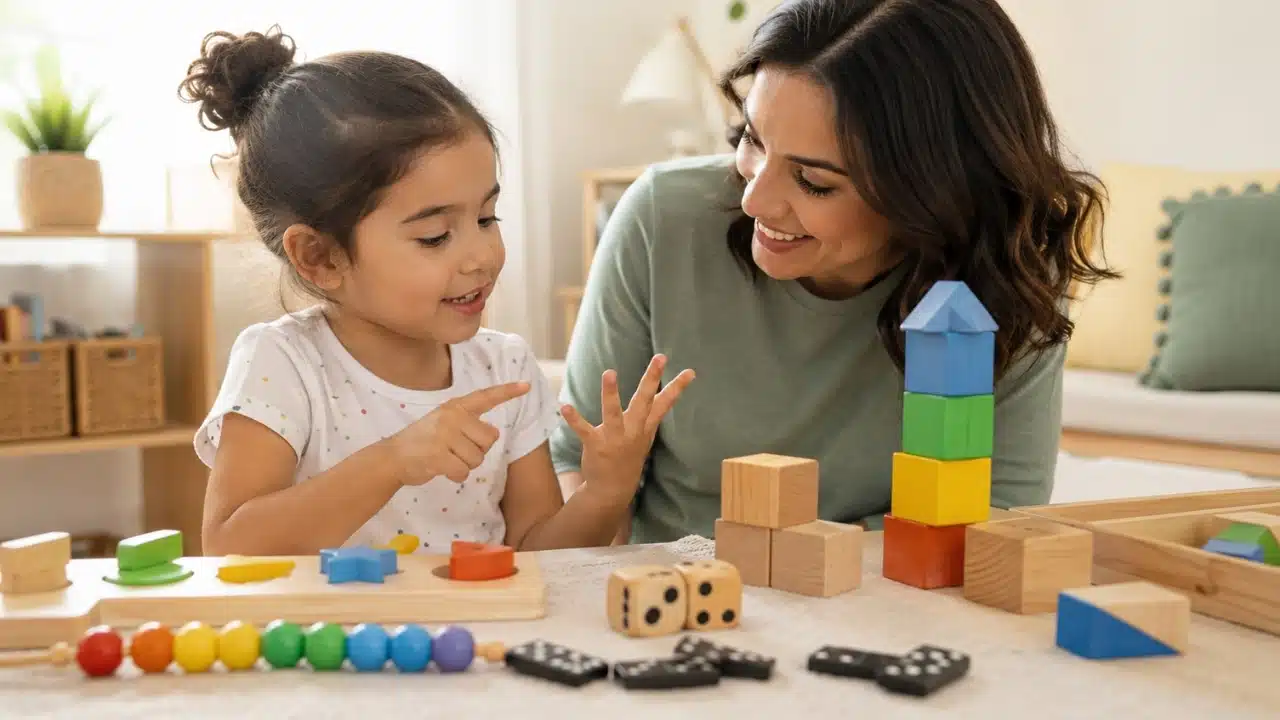
We tell parents to read to their children every night. We fill nurseries with board books and phonics toys. But when it comes to numbers, the advice often goes quiet or defaults to handing a toddler a stack of flashcards.
Early math education is heavily misunderstood today. Falling for common early math myths does not just slow down a child’s learning. It can trigger math anxiety that lasts well into adulthood. If you want to build a solid foundation for a child, it starts with unlearning the things that do not work.
Breaking Down the 8 Early Math Myths You Need to Ignore
Before diving into complex equations, parents and teachers need to rethink the basics. Here are the misconceptions that get in the way of real learning.
1. The belief that counting is the only math that matters
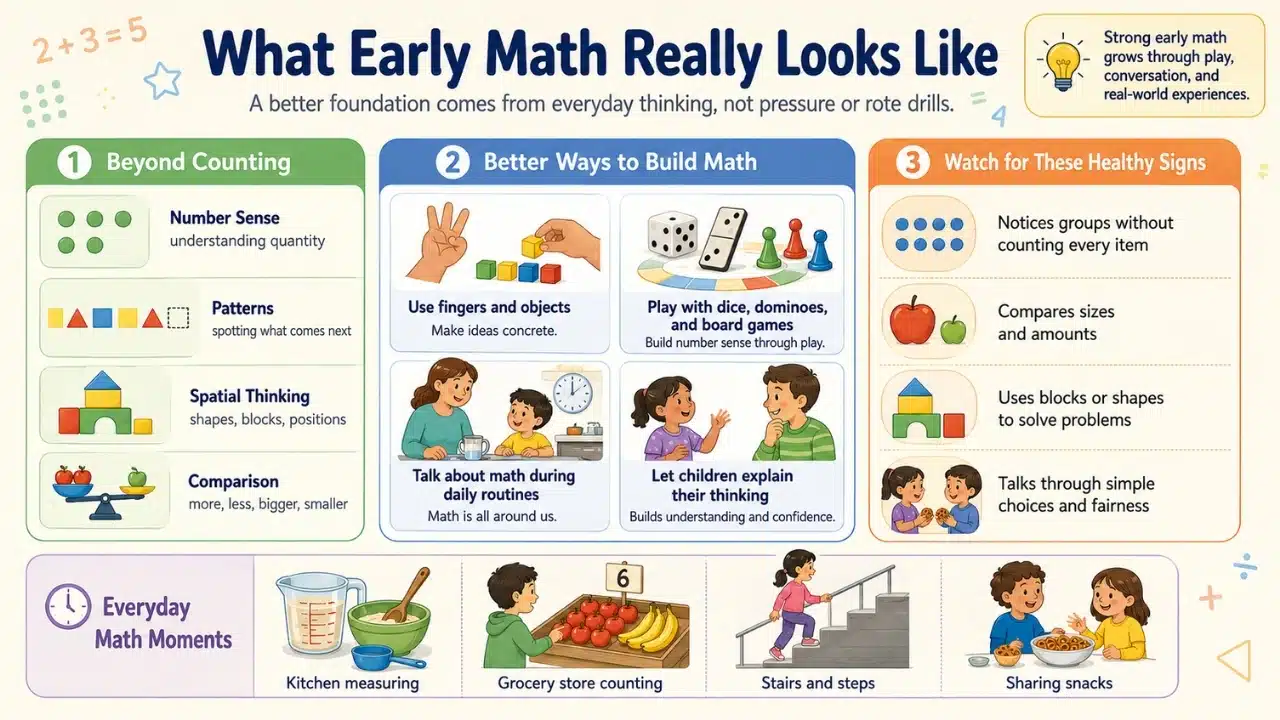
Many parents believe that if a three year old can recite numbers from one to twenty, they are excelling at math. But reciting numbers in order is just a memorization trick. It is the mathematical equivalent of singing the alphabet song. It does not mean the child actually knows how to read.
Real foundational math is about number sense, which is the understanding of what those numbers actually represent. It also involves concepts that have nothing to do with numbers at all. A child building a complex block tower and figuring out which shapes provide the most stability is doing math, even if they aren’t counting anything.
2. The idea of the “Math Brain” is one of the most damaging early math myths
You hear it in classrooms and at dinner tables everywhere. People love to say they are just not a math person.
This is a cultural excuse rather than a biological reality. While children have varying aptitudes for different subjects, the idea that you are either born with a special math brain or destined to struggle is entirely false. Cognitive science shows that mathematical ability is highly malleable. When adults reinforce the idea that math is an innate talent instead of a skill developed through effort, children shut down the moment a problem becomes difficult. They assume their struggle is proof they lack the gift.
3. Reading to kids is more important than doing math with them
Literacy gets all the attention in early childhood development. However, research paints a different picture regarding long term academic success.
Studies analyzing data from thousands of children have shown that early math skills are actually the strongest predictor of later academic success. In fact, a child’s early ability with numbers predicts their later reading skills better than their early reading ability does. This does not mean you should stop reading bedtime stories. It just means math deserves equal time on the rug.
4. Finger counting is a crutch that should be stopped
For generations, teachers have told students to put their hands under their desks and do the calculations in their heads.
Neuroscience proves this is a mistake. Brain imaging shows that the somatosensory finger area lights up when people solve complex math problems, even in adults who are not visibly moving their hands. Fingers are a child’s first visual aid for base ten mathematics. Forcing a child to stop using their fingers prematurely removes a critical physical bridge to abstract mental calculation. Let them use their hands until they naturally outgrow the need.
5. Flashcards are the best way to teach number sense
Flashcards demand rapid recall without context. When a child memorizes that three plus two equals five from a card, they are often retrieving a visual fact rather than understanding the physical quantity.
Instead of drilling equations, introduce games that require subitizing. Subitizing is the ability to instantly recognize the number of objects in a small group without having to count them one by one.
What to try instead of flashcards:
-
Play board games that use standard six sided dice.
-
Play dominoes.
-
Ask them to grab exactly three apples at the grocery store.
Real world physical quantities build a much stronger mathematical foundation than ink on cardboard.
6. Boys are naturally better at math than girls
This misconception refuses to die, despite decades of data debunking it. Comprehensive analyses of standardized testing across millions of students show no significant biological difference in mathematical ability between young boys and girls.
The gap that does occasionally appear in later years is driven by environmental factors. It comes from teachers calling on boys more often during lessons, parents buying building toys for sons and social toys for daughters, and the subtle societal expectation that engineering and coding are male domains.
7. Toddlers cannot understand abstract concepts
If you think a two year old cannot grasp fractions or division, try giving them half a cookie while giving their sibling a whole one. You will immediately get a loud and clear lecture on the concept of inequality.
Toddlers understand more, less, all gone, and fair share instinctively. The problem is not that the concepts are too abstract. The problem is that adults often try to teach them using written symbols too early. If you keep the lessons grounded in physical objects, toddlers can process remarkably complex logic.
8. Parents with math anxiety cannot help their children
Adults who struggle with math often pass that anxiety down like a genetic trait. If you audibly groan when splitting a restaurant bill, your child absorbs the message that numbers are something to be feared. Unpacking these early math myths means letting go of your own bad experiences in the classroom.
You do not need to understand calculus to build your child’s skills. You just need to talk out loud while doing everyday tasks.
A Practical Starting Path
Stop treating math like a formal subject that only happens at a desk. Point out the shapes of street signs on your drive to preschool. Count the stairs as you walk up to your apartment. Ask your child to help you measure one cup of flour for a recipe. When you ignore these early math myths, you realize that foundational skills are built in the kitchen, on the sidewalk, and at the grocery store. By simply pointing out the numbers and patterns that already exist in your day, you give your child the exact foundation they need.