Knowing your Customer Acquisition Cost (CAC) tells you what you spent to win a customer, but it reveals nothing about cash flow timing. I am a cash-flow-first realist when it comes to SaaS metrics, and if recovering that outlay takes three years, cheap acquisition numbers won’t prevent a liquidity crunch. Tracking CAC payback measures speed: how many months a customer needs to generate enough gross profit to cover their acquisition cost.
Tracking this time horizon gives a clearer, far more honest picture of financial health than looking at raw acquisition expense in isolation.
Why Payback Windows Matter More Than Acquisition Cost
I’ve seen a recurring pattern where a company’s acquisition dashboard looks almost too good to be true. CAC is falling, sign-ups are climbing, and the growth team wants to double ad spend immediately.
Then someone finally looks at how long it takes to recover the cash.
Consider a SaaS company acquiring users for around $80–$100 each. On the surface, that looks remarkably efficient. But if those customers come in on discounted monthly plans, onboarding requires hands-on support, and early churn is higher than headline numbers suggest, the reality changes fast. Suddenly, the business isn’t recovering acquisition spend in six or eight months—it’s taking 15 to 18 months.
That changes the entire conversation inside the business. Marketing says, “The campaigns are working.” Finance says, “Every new customer is tying up more cash.”
Both are right. You can have an attractive CAC and strong top-line growth while quietly creating a severe cash-flow problem underneath. Eventually, you have to slow acquisition, tighten discounting, improve onboarding, and refocus on customer segments that return capital faster.
How Is CAC Payback Calculated?
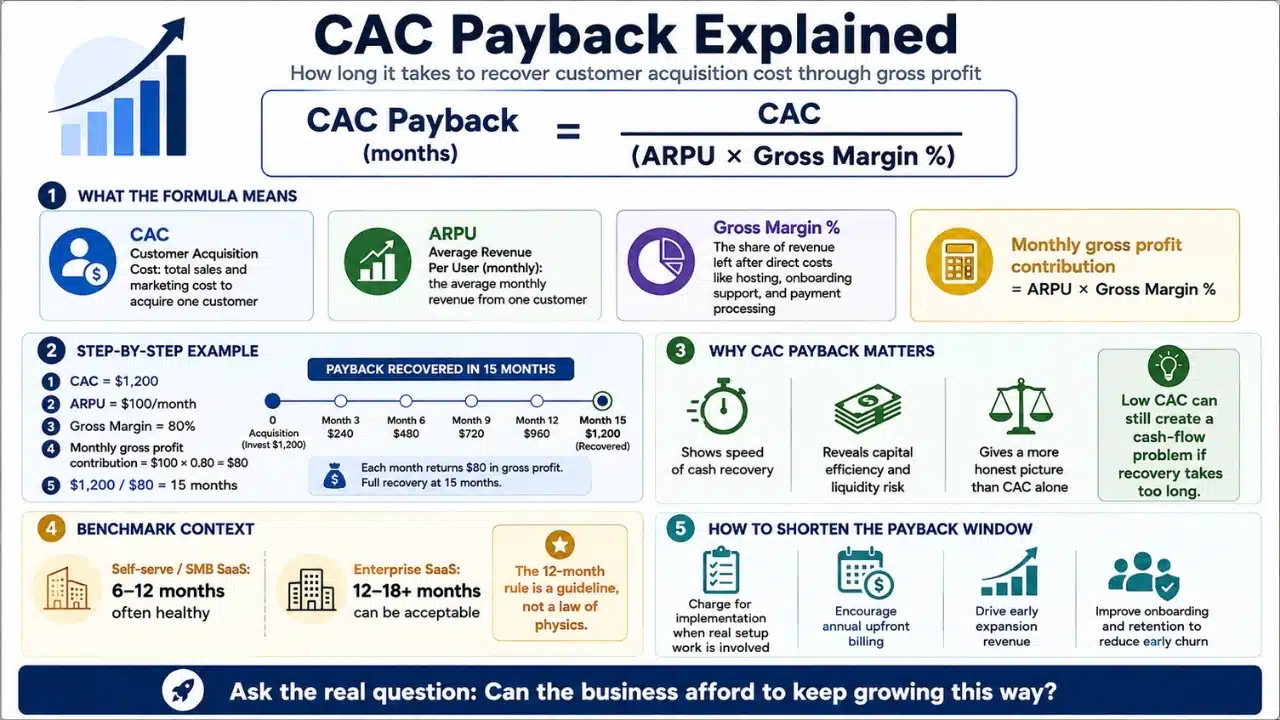
The formula for CAC payback measures time rather than dollars:
-
CAC is your total sales and marketing cost per acquired user.
-
ARPU is your Average Revenue Per User (monthly).
-
Gross Margin % is the percentage of revenue remaining after subtracting direct costs (server hosting, onboarding support, payment processing).
Take a $1,200 CAC on a customer paying $100 monthly at an 80% gross margin. Since their monthly profit contribution is $80 ($100 × 0.80), your payback timeline is exactly 15 months ($1,200 / $80).
Why the 12-Month CAC Payback Rule Isn’t a Law of Physics
One piece of standard SaaS advice I don’t like is treating a 12-month CAC payback period as some universal definition of healthy. It isn’t.
Twelve months might be completely reasonable for an enterprise software company with strong gross margins, predictable multi-year contracts, low churn, and plenty of capital in the bank. For a bootstrapped SaaS business selling month-to-month subscriptions, that exact same 12-month timeline can feel uncomfortable or downright dangerous.
The metric only makes sense in the context of your specific operating model. What I care about is straightforward: how much cash are we putting out, how reliably does it come back, and what happens if retention turns out worse than expected?
I would rather have a slightly higher CAC with a predictable eight-month recovery than brag about cheap acquisition that takes 18 months to pay for itself. Benchmarks are useful reference points, but treating them like laws of physics is where founders get into trouble.
Practical Ways to Shorten Your CAC Payback Window
If capital is locked up for too long, you need operational levers that pull real cash forward:
Charge properly for implementation: If a customer needs data migration, custom integrations, workflow configuration, or team training, do not absorb those costs and hope to recover them through subscriptions later. A reasonable implementation fee pulls cash forward immediately. Plus, customers with real money invested in setup have skin in the game, which drives activation and retention. Just ensure you deliver genuine value and keep services accounting separate from SaaS recurring revenue internally.
Shift to annual upfront billing: Offering a modest discount for annual billing completely eliminates the waiting period. Your acquisition spend is recovered on day one.
Drive expansion revenue early: Up-selling add-on features, higher tiers, or extra seats within the first 90 days accelerates monthly gross profit contribution, shrinking the break-even timeline without increasing initial marketing costs.
Final Thoughts
I view CAC payback as a flexible guardrail rather than a strict commandment. Stretching your recovery window can make complete sense when underlying retention is bulletproof, margins are healthy, and the company has enough capital to finance the wait.
However, aggressive acquisition becomes dangerous when the underlying argument is simply, “We’ll make the money back eventually.” Eventually isn’t a cash-flow strategy.
When evaluating your numbers, stop asking if your CAC payback matches a generic industry benchmark. Ask the question that actually matters: Can this business afford to keep growing this way?
Frequently Asked Questions (FAQs) About CAC Payback
What is a good CAC payback period for a SaaS company?
Answer: It depends entirely on your capital structure and customer segment. For self-serve or SMB products, 6 to 12 months is a healthy target, whereas enterprise models with low churn can comfortably stretch to 12–18+ months.
How does gross margin impact payback duration?
Answer: Gross margin determines how many actual profit dollars go toward paying down your acquisition spend each month. Lower margins leave less cash to cover that initial outlay, directly stretching out your timeline.
What is the difference between CAC payback and CAC ratio?
Answer: CAC measures the total dollar cost to acquire a single customer, while CAC payback measures how many months it takes to recover those dollars through gross profit.
Can annual upfront payments shorten the payback window?
Answer: Yes, collecting annual payments recovers acquisition costs on day one, completely eliminating capital lock-up.
Why do investors prioritize payback metrics over raw acquisition volume?
Answer: Payback metrics reveal capital efficiency and liquidity. Fast capital recycling means a company burns less cash and relies less on external funding to scale.