Most API businesses don’t die from bad technology. They die from bad math. I keep seeing it happen, and it’s almost always avoidable. The API management market is worth $16.29 billion and growing at a 34 percent CAGR, according to industry analyses. The average company now manages 354 APIs, up from 200 just two years ago, a 77 percent jump in complexity.
And yet 84 percent of enterprises say AI infrastructure costs are eroding their gross margins by more than 6 percent, according to the 2025 State of AI Cost Management research. Token prices have fallen 280x in two years, and enterprise AI spend has climbed 320 percent in the same window. The tool that can’t manage its cost curve doesn’t get to be the tool people remember. This guide breaks down exactly where API money leaks, why the leak decides survival, and how to build cost management into a product instead of bolting it on after the bill arrives.
The API business in 2026
APIs stopped being plumbing a long time ago. In 2026 they’re products, and the numbers prove it.
The API management market sits at $16.29 billion, a 2026 analysis from Orbilon puts it, and it’s growing at a 34 percent CAGR toward an expected $21.8 billion by 2027. Stripe processes more than $640 billion annually. Twilio passed $3.8 billion in revenue. Google Maps pulls in over $3 billion from API fees alone. These aren’t software companies that happen to have APIs. They’re API businesses that happen to make software.
The scale story is just as loud. Kong’s GenAI in Enterprise research found that 65 percent of organizations using APIs already generate revenue from them, and 83.2 percent have adopted some level of an API-first approach. Only 25 percent operate as fully API-first organizations, which is the gap where most of this article lives. The average company juggles 354 APIs, and every single one carries a cost, whether anyone is tracking it or not.
I’ve watched founders treat their API bill like weather, something that happens to them. That mindset is the first cost leak, and it’s the one that scales.
The invisible cost curve
Traditional infrastructure has a comforting shape: you buy servers, you pay roughly the same next month. APIs have a very different shape, and it’s the reason cost management went from an accounting chore to a survival skill.
Every API call is a metered event. Per-call pricing means revenue scales with usage, but it also means costs scale with usage, with no ceiling. LLM APIs took this further and priced per token, which makes the unit of cost invisible to the developer who writes the code. You don’t feel a token. You feel the bill.
The cost structure hides three landmines. Output tokens cost three to eight times more than input tokens, with a median ratio near four, as SiliconData’s pricing work shows, so verbose responses quietly dominate invoices. Per-token pricing varies by more than 600x across models, according to CloudZero, which means model selection alone can swing a monthly bill by 10x. And context isn’t free: a single request with a full 1 million-token context can cost dollars before the model generates a single word.
A small change in prompt design, model choice, or context length can swing a monthly bill by 10x. CloudZero’s State of AI Costs report says so. Ten times, on a single decision most teams never revisit.
The paradox that kills tools
This is the number that should stop every API founder cold: per-token AI costs have fallen roughly 280x in two years, from $30 per million tokens in 2023 to about $0.10 today, Epoch AI’s tracking shows. And in that same window, average enterprise AI spend climbed from $1.2 million to $7 million a year, a 320 percent increase, in AnalyticsWeek’s 2026 numbers.
Prices collapse. Bills explode. How?
The answer is the agentic multiplier. A simple chatbot query triggers one inference call. An agentic workflow reasons, calls tools, verifies output, and self-corrects, which Gartner’s March 2026 analysis puts at 5 to 30 times more tokens per task than a standard chatbot. Always-on agents never sleep. Usage grew faster than prices fell, and the total spiraled.
Two LangChain agents locked in a recursive loop for 11 days burned $47,000 while everyone thought they were working, according to a developer post that did the rounds. A stolen API key generated 14,200 failed requests in 48 hours and cost $82,314. These used to be edge cases. Now they’re just Tuesday.
Where the waste hides
Audits of production AI applications routinely find that 40 to 60 percent of token spend is waste, capability paid for but never used, Maxim AI’s analysis of enterprise LLM spend put the damage at 40 to 60 percent, on an estimated $8.4 billion of API spend in 2025.
The waste has a shape. Repeated queries pay full price every time when no cache exists. Tool-definition bloat resends large catalogs in every request of agentic workflows. Retries and failover gaps consume tokens and produce no usable output. Context balloons: a task that starts with a 500-token prompt can reach 50,000 tokens by the final step, and by turn ten of a conversation the cost per call is roughly seven times the cost of turn one, in Iternal AI’s usage guide.
Visibility is the deepest hole. IDC research, cited by DataRobot, found that 71 percent of IT leaders admit to little or no control over where AI costs originate. CloudZero found that only 22 percent of organizations track AI spend by transaction, and only 51 percent strongly agree they can accurately track AI ROI, even though 91 percent feel confident they can. That gap between confidence and capability is where budgets quietly disappear.
The scariest single data point I found in all this research: an AI-native search company discovered that OpenAI spend consumed 25 percent of its entire cloud bill with zero visibility, in CloudZero’s writeup. A quarter of the bill, invisible. I still think about that one.
Why cost decides survival
One sentence says it all: a tool survives when its unit economics hold, and API unit economics are decided by cost per call or cost per token, whether you measure it or not.
Eighty-four percent of enterprises report AI infrastructure costs eroding gross margins by more than 6 percent, and 80 percent miss their AI forecasts by more than 25 percent, per the 2025 State of AI Cost Management research. A tool that hides its own cost curve passes that volatility to customers, and customers notice. When LLM APIs reset the price floor, a $0.10-per-call transactional API suddenly feels expensive even when the underlying value is high, Moesif’s 2026 pricing analysis makes this point well. The reference price your buyers compare against is now a fraction of a cent.
AI agents make it worse. A single human session can trigger dozens of downstream API calls through tool-using agents, and pricing built for one user, one call, one bill leaks revenue when an agent does the calling. Per-call pricing extracts more revenue from agent traffic, but it also raises perceived cost, because buyers compare it directly against their LLM bill.
The tools that survive are the ones that can answer one question in a boardroom: what does one unit of value cost us, and what does it cost our customer?
If you can’t answer it, your margin will answer it for you.
Pricing models that survive
Cost management isn’t just about spending less. It’s about pricing in a way that survives the agentic era.
The hybrid model is the industry’s consensus answer. A subscription base covers a quota of usage, and metered overage charges per unit above it. Moesif calls it the model most public API companies converge on by the time they pass $10 million ARR, because it gives customers predictability and gives you upside on growth.
The pricing unit matters more than the price. Charging per transaction when nobody on the customer’s side can predict their own transaction count is how you create surprise bills. Pick a unit the buyer can forecast, and for AI workloads, meter on the unit the customer values, not the unit you serve. An agent might consume your API a hundred times to satisfy one human intent; if you bill per call but the value lives at the intent level, you’re setting up a renegotiation.
Cache-hit discounts stopped being a differentiator a while ago. They’re expected now. OpenAI and Anthropic both discount cached input tokens by up to 90 percent, and batch processing takes another 50 percent off; combined, effective per-call cost drops to roughly 25 percent of on-demand rates, CloudZero’s data shows. If your API benefits from caching, exposing that discount is table stakes in 2026.
Chargeback is back. Finance teams want engineering to attribute API and AI costs back to the business unit that drove them. If your bill isn’t exportable and attributable to a cost center, the renewal conversation gets harder than it needs to be.
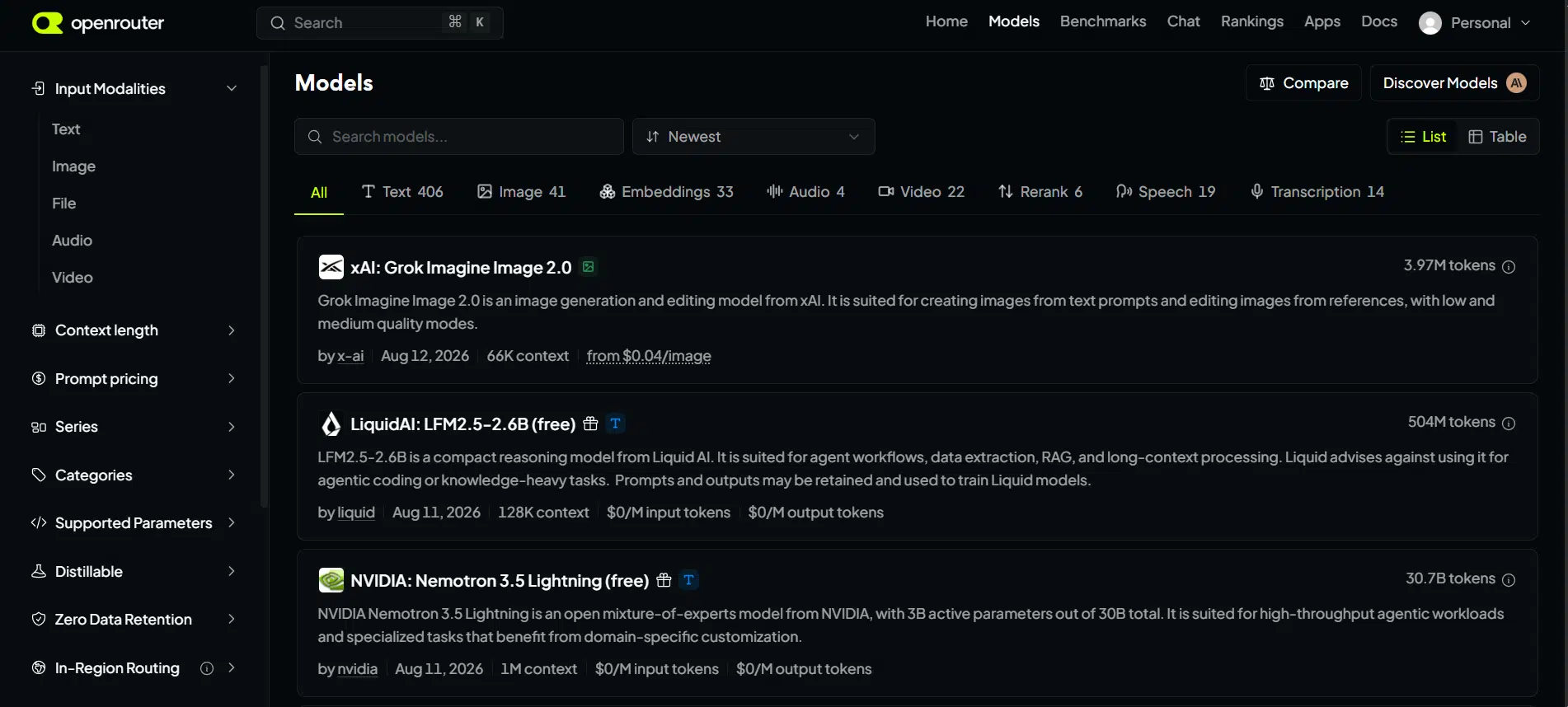
OpenRouter’s model catalog puts per-token pricing for hundreds of models in one filterable table, which is exactly the visibility a cost-managed team needs before choosing a model. Screenshot: openrouter.ai, captured August 2026.
A cost management playbook
This is the sequence I push teams through, and it works for APIs and LLM APIs alike.
First, get visibility. You cannot manage a cost you cannot see. Instrument every call with per-feature, per-team, and per-customer attribution. CloudZero’s example is the benchmark: know that document processing costs $0.12 per document for customer A and $0.31 for customer B, and why. Anomaly detection that alerts the owning team within the hour beats a quarterly review where everyone pretends they saw it coming.
Second, route to the right model. Model selection is the single largest lever on LLM API costs. Frontier models cost more than 100x per token than budget models for the same request. Route high-volume, low-complexity work to inexpensive models and reserve frontier models for tasks that genuinely need them.
Third, cache aggressively. Semantic caching can reduce LLM API costs by 73 to 86 percent, lifting cache hit rates from 18 to 67 percent and cutting latency by 65 to 88 percent, Trussed’s analysis found. Prompt caching and batch processing stack on top of it.
Fourth, enforce budgets. Set per-team and per-customer budgets with enforcement, not just dashboards. Half of companies with AI-core products don’t track LLM API costs at all, by industry research. That’s not a strategy; that’s a coin flip.
Fifth, budget per outcome, not per token. Track cost per customer interaction, per transaction, or per inference call. The teams that answer was it worth it with data survive budget season. Everyone else gets cut.
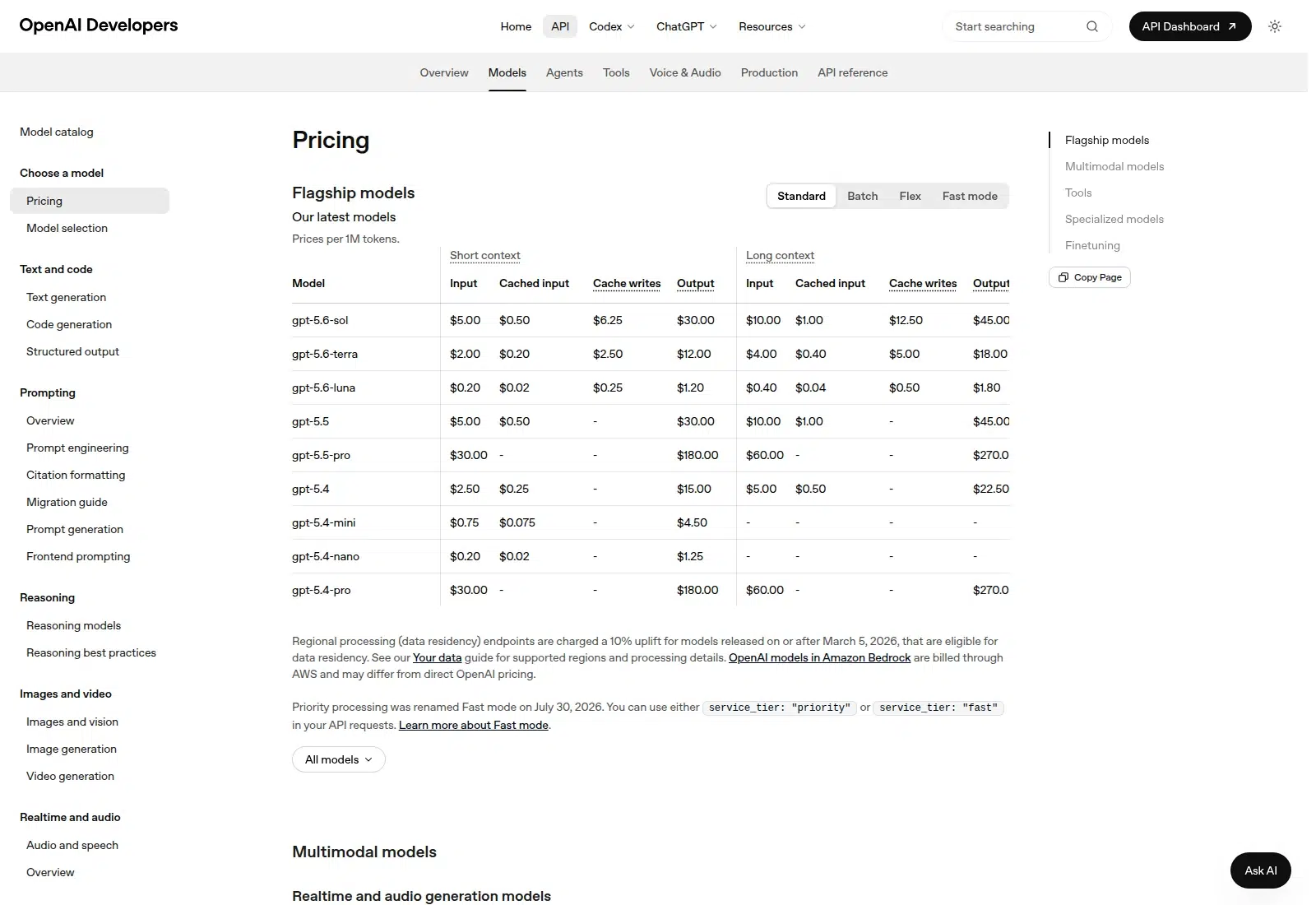
OpenAI’s pricing page makes the input versus output token split visible, the exact asymmetry that decides most AI API invoices. Screenshot: platform.openai.com, captured August 2026.
The survival test
Before you ship your next API feature, run it through five questions. I’ve watched teams fail all five in a single budget meeting, so take them seriously. None of them are hard to answer. All of them are hard to avoid.
- Can you name the cost of one unit of value, to the rupee or the cent?
- Can your customer forecast their own bill within 20 percent?
- Do you know which team or feature generated last month’s biggest cost spike?
- Would a 10x usage jump still leave you profitable?
- Can you reprice in a week if the market moves?
If you can’t answer the first one, nothing else matters. The rest is survival hygiene. Tools that pass all five can absorb price wars, agentic traffic, and surprise margin pressure. Tools that fail the first question are a budget cycle away from a shutdown memo.
Common API cost mistakes
- Pricing on a unit nobody owns. If your buyer can’t forecast their own usage, you’ve built surprise bills.
- Treating the API bill like weather. Costs are decisions, and someone should own every line.
- Ignoring output tokens. They cost three to eight times input, and verbose completions dominate invoices.
- No caching. Semantic caching alone can cut 73 to 86 percent of LLM costs.
- No enforcement. Dashboards that nobody acts on are decoration.
- Repricing never. The fastest-growing API businesses reprice every six to twelve months.
- Building for humans only. Agents consume APIs at machine speed, and your pricing needs to survive them.
The cautionary tale: Jasper
Every cost conversation needs a ghost story, and Jasper is the best one in the industry.
Jasper rode OpenAI’s GPT-3 to $42.5 million ARR with just nine employees. In October 2022 it raised a $125 million Series A at a $1.5 billion valuation with 70,000 paying customers. Forty-three days later, ChatGPT shipped. For free. On the same model family Jasper was wrapping.
The pricing anchor moved overnight. Jasper’s lowest tier started at $29 a month. ChatGPT was free, then $20. Jasper’s whole price ladder suddenly felt expensive, even to customers who preferred its marketing-focused UX. The viral demo lost its punch when the same YouTube creators who built Jasper’s affiliate engine pivoted to ChatGPT tutorials within weeks. By summer 2023 Jasper had cut its 2023 forecast by at least 30 percent, per The Information. Revenue collapsed from around $120 million toward $55 million by 2024, and the company spent the next two years manufacturing a moat after the substrate commoditized.
Here’s the brutal part: Jasper had great gross margins. What it didn’t have was a cost structure that could survive its input being repriced to zero. The tool that lives on someone else’s API lives on someone else’s terms. That’s the survival lesson, and it’s why cost management was never an operations topic. It is the business model, full stop. For the record, Jasper didn’t die. It acquired Clipdrop from Stability AI in 2024, rebranded around its AI content platform, and it’s still shipping updates in 2026, per its own product blog. But the company that raised at $1.5 billion no longer exists in the form anyone invested in.
The math that matters
Let’s stop talking abstractly and do the arithmetic that decides survival.
Say you’re an AI wrapper with 100,000 monthly active users. Each user makes 50 API calls a month, averaging 2,000 tokens per call, half input and half output. At a mid-tier model priced at $2.50 per million input tokens and $15 per million output tokens, per CloudZero’s 2026 pricing data, here’s the monthly picture:
| Item | Value |
| Monthly calls | 5,000,000 |
| Input tokens per call | 1,000 |
| Output tokens per call | 1,000 |
| Input cost per month | $12,500 |
| Output cost per month | $75,000 |
| Total API cost per month | $87,500 |
| Per user per month | $0.88 |
| Revenue at $10/user/month | $1,000,000 |
| API cost as share of revenue | 8.75% |
Now imagine your agentic feature ships and triples tokens per call, per Gartner’s 5 to 30x warning. Output cost triples to $225,000, input stays at $12,500, and the combined bill of $237,500 hits 23.75 percent of revenue. Your gross margin just took a quarter-sized bite because of one feature toggle.
That’s why the teams who win measure cost per outcome, not cost per token. A feature that costs $2 per completed task is fine if the customer pays $10 for the outcome. A feature that costs $0.02 per token but burns 10,000 tokens per task is a quiet funeral.
Five red flags your API cost is killing you
When did you last open your API bill and actually understand every line? If the answer is a long pause, read on. These are the five signs I look for first.
- The bill spiked and nobody can explain why. If your finance team knows before your engineering team does, you’re flying blind.
- No one owns the number. If “how much do we spend on APIs” gets answered with a shrug, the cost is already out of control.
- Per-feature costs are invisible. If you can’t say what document processing costs per document, per customer, you’re pricing on hope.
- Agent traffic is unmonitored. If a single user session can trigger dozens of calls and nobody watches, you’re one runaway loop from a $47,000 Tuesday.
- Margin erosion is treated as seasonal. If gross margin dips and the response is a shrug about “AI costs,” the math is telling you something you don’t want to hear.
Where this goes: the 2027 outlook
Picture the budget meeting in January 2027. The finance lead has a spreadsheet, the engineer has a usage chart, and the two don’t agree on a single number. That meeting is already scheduled; the only question is which side of the table you’re on.
The trajectory is already set. The API management market heads toward $21.8 billion by 2027, per Orbilon’s projection, and every percentage point of that growth is agent-inflected.
Three forces collide next year. First, agentic traffic keeps multiplying calls per human intent, so per-call pricing models keep leaking. Second, the model price war continues, with budget models like DeepSeek and Mistral forcing frontier pricing down, which compresses margins for pure wrappers while rewarding teams with routing and caching discipline. Third, finance gets serious: chargeback, attribution, and cost-per-outcome reporting become standard in procurement conversations, not differentiators.
The tools that survive 2027 won’t be the smartest ones. They’ll be the ones whose unit economics survive machine-speed consumption. The API economy is about to be measured in agent interactions, and the companies that priced for humans are going to have a very uncomfortable budgeting season.
Final thoughts
The API economy is a $16 billion market growing at 34 percent, and the tools that own it will be the ones that treat cost as product design, not finance noise. Prices fell 280x and spend rose 320 percent because the unit of value changed: an agent now burns a dozen calls to do what a human did with one. That’s not a bug. That’s the new normal.
The winners in 2026 will have visibility into every dollar, pricing that survives machine-speed consumption, and the ability to reprice faster than the market moves. In my experience, the teams that win are the ones who ask the boardroom question early: what does one unit of value cost us, and what does it cost our customer? Answer that, and survival takes care of itself. Ignore it, and the margin will answer it for you.
Frequently asked questions about API cost management
1. Why are API costs exploding when token prices keep falling?
Token prices fell roughly 280x in two years, but usage grew faster. Agentic workflows use 5 to 30 times more tokens per task than standard chatbots, per Gartner’s 2026 analysis, so total enterprise AI spend rose 320 percent in the same window.
2. What is the biggest cost lever for LLM APIs?
Model selection. Per-token pricing varies by more than 100x across models, so routing each request to the cheapest model that can handle it swings monthly costs by 10x or more. Output tokens also cost three to eight times input tokens.
3. How much API cost is waste?
Audits of production AI applications routinely find 40 to 60 percent of token spend is waste, per Maxim AI. Common causes: repeated uncached queries, tool-definition bloat in agentic workflows, retries, and context that balloons from hundreds to tens of thousands of tokens.
4. What’s the best API pricing model in 2026?
Hybrid: a subscription base covering a baseline quota plus metered overage. Most public API companies converge on it by the time they pass $10 million ARR, per Moesif. For AI workloads, add per-agent attribution and cache-hit discounts.
5. How do I start managing API costs?
Get visibility first. Instrument every call with per-feature, per-team, and per-customer attribution. Only 22 percent of organizations track AI spend by transaction, CloudZero’s research shows, and you can’t manage what you can’t see.
6. Are AI agents really a cost threat?
Yes. A single human session can trigger dozens of downstream API calls through tool-using agents. One documented incident involved two agents locked in a recursive loop for 11 days that burned $47,000. Pricing built for one user, one call, one bill leaks revenue when an agent does the calling.