Ernesto “Che” Guevara remains one of the most polarizing figures of the 20th century — adored by some as a selfless revolutionary and dismissed by others as a misguided idealist. Nearly six decades after his death, his story still captures imaginations and divides historians.
The final 100 days of Che Guevara’s life in Bolivia offer a window into the man behind the myth — his endurance, miscalculations, and unwavering belief in armed revolution. From July to October 1967, Che led a dwindling group of guerrillas through the jungles and ravines of southeastern Bolivia, hoping to ignite a continental uprising. Instead, he found isolation, betrayal, and the limits of ideology against geography and modern warfare.
This is a chronological and analytical look at those last 100 days — how they unfolded, why they failed, and how they transformed Che from a mortal commander into a global symbol.
Background: How Che Guevara Reached Bolivia
After the success of the Cuban Revolution in 1959, Che became one of the new government’s most visible leaders. He served as Minister of Industry, head of the National Bank, and an international ambassador for socialist solidarity. Yet bureaucratic duties frustrated him. He grew disillusioned with the Soviet model and Cuba’s growing dependence on Moscow.
By 1965, Che vanished from public life. His farewell letter to Fidel Castro spoke of new battlefields abroad. He first tried to spark revolution in the Congo, but the mission collapsed amid chaos and lack of discipline. His next destination was Bolivia — a mountainous, landlocked nation he believed could serve as the “heart of the revolution” in South America.
Che’s plan was to build a rural guerrilla base, train local peasants, and eventually expand across borders into Peru, Argentina, and Chile. The theory was bold but flawed: he overestimated peasant support, underestimated Bolivia’s isolation, and ignored warnings from local communists that conditions were unfavorable.
By late 1966, he entered Bolivia under a false name — “Ramón.” In the early months, the group trained quietly. But by mid-1967, their secrecy unraveled, and the stage was set for his final campaign.
Setting the Scene: The Guerrilla Front in 1967
Che’s small band of about 50 men included Cubans, Bolivians, and a few international volunteers. Their base was deep in the Ñancahuazú region — thick jungle, steep ridges, and treacherous rivers. Supplies were scarce. Communication with Cuba and urban allies was unreliable.
The Bolivian Communist Party, led by Mario Monje, withdrew support early on after internal disputes. Peasants in nearby villages, instead of joining, often informed the authorities out of fear or distrust.
By July 1967, the guerrillas were already on the defensive. Bolivian forces, advised and trained by the U.S. Army’s Green Berets, began methodical search operations. The stage was set for an unequal confrontation — a disciplined state army backed by intelligence networks versus a starving, isolated insurgent group.
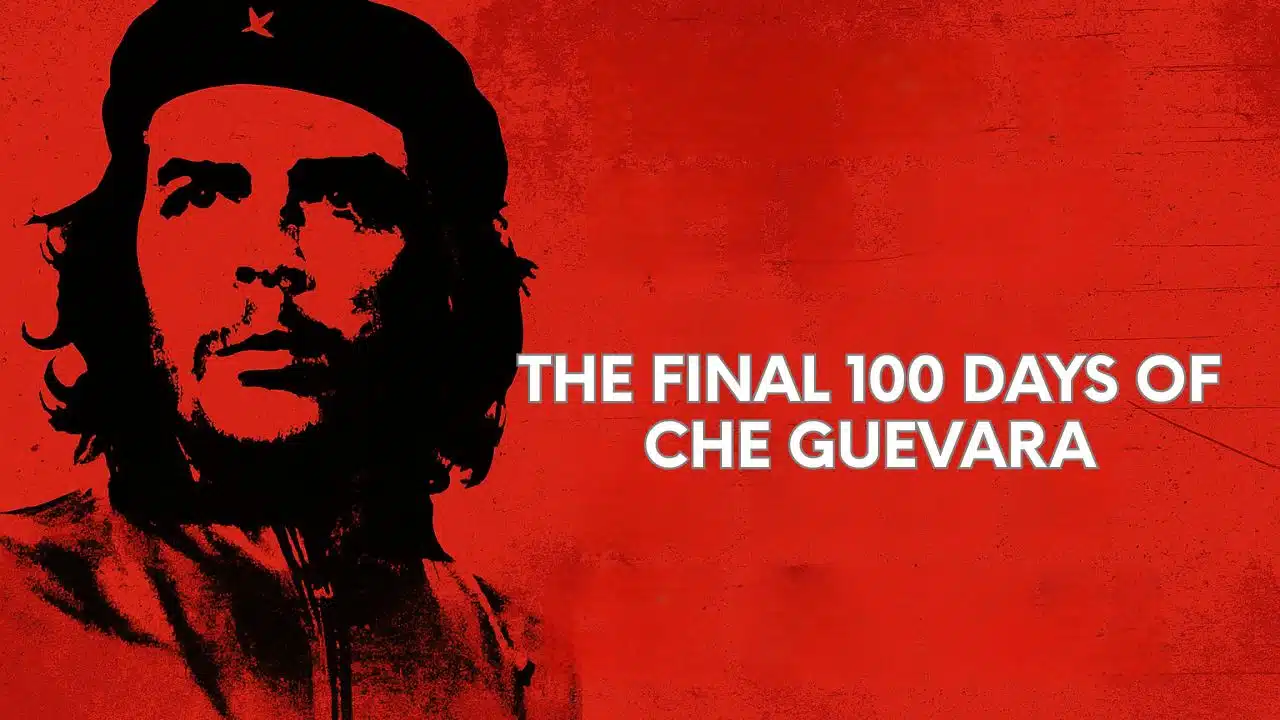
The Final 100 Days of Che Guevara
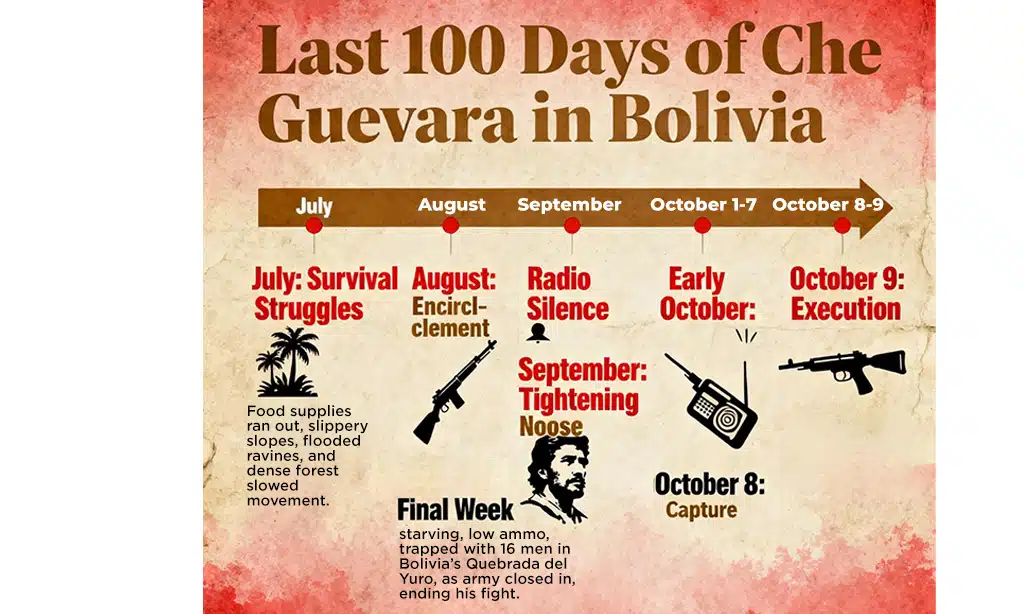
The final 100 days of Che Guevara’s life in Bolivia were marked by isolation, hunger, and unyielding determination. Cut off from allies and surrounded by enemy forces, Che led a dwindling group of guerrillas through the unforgiving jungles of Ñancahuazú. Each day brought new hardships—disease, loss, and encirclement—but also glimpses of extraordinary resolve. What began as a revolutionary campaign ended as a testament to endurance, transforming Che’s defeat into one of the most enduring legends of the 20th century.
July 1967 — Survival Becomes the Mission
In early July, Che’s group faced mounting hardships. Food supplies ran out faster than expected. The terrain proved more punishing than anticipated — slippery slopes, flooded ravines, and dense forest slowed movement. Many guerrillas were sick with malaria or dysentery.
Skirmishes with government troops increased. Though the rebels often escaped with tactical agility, their losses of weapons and rations were devastating. By mid-July, Che realized that the dream of building a permanent base was fading. His writings from this period reflected a tone of pragmatism mixed with frustration.
As the Bolivian army tightened its control over nearby villages, Che’s men began rationing food and medicine. Every march was a gamble — stay too long in one place and risk encirclement; move too fast and risk exhaustion. Survival, not revolution, became the day-to-day goal.
August 1967 — Encirclement and Isolation
August marked the turning point. The Bolivian army, now trained by U.S. advisors, had begun coordinated sweeps through the jungle. Local farmers, frightened by both sides, reported guerrilla sightings.
“In the jungles of Bolivia, hunger and conviction marched side by side.”
On August 5, a patrol spotted tracks near the Rio Grande river, leading to a minor clash. The guerrillas narrowly escaped but lost vital supplies. On August 31, at Vado del Yeso, they suffered a devastating ambush — eight of Che’s best fighters were killed. It was one of the heaviest blows of the campaign.
| Date | Event | Outcome | Impact |
|---|---|---|---|
| Aug 5 | Encounter near Rio Grande | Rebels escape | Loss of food and ammo |
| Aug 31 | Ambush at Vado del Yeso | 8 killed | Major morale drop |
| Aug 25–30 | Radio malfunctions | No communication | Total isolation |
With each loss, morale plummeted. By late August, only about 25 guerrillas remained. Che’s asthma grew worse, forcing slower marches. Yet he refused to abandon the mission, still believing a wider uprising could be sparked.
September 1967 — The Noose Tightens
By September, Che’s unit was trapped in a shrinking operational zone. The Bolivian Rangers — now aided by CIA intelligence — launched precise operations to corner the remaining rebels.
Che split his forces into smaller groups to avoid total annihilation. But fragmentation only deepened their vulnerability. Lack of food and contact with external networks meant no reinforcements or resupply.
His diaries from this period convey a mixture of discipline and despair. He still encouraged his fighters to maintain morale, even as he admitted their prospects were grim. The revolutionary idealism that had fueled him for years was now tested by the harsh reality of jungle warfare.
Bolivian villagers, once neutral, began avoiding contact altogether. Fear of army reprisals made collaboration impossible. What had started as a movement to inspire liberation now looked like a ghost column wandering through the wilderness.
October 1–7, 1967 — The Final Week
The last week of Che’s life began with exhaustion and hunger. On October 1, the remaining guerrillas moved toward the Quebrada del Yuro valley — an isolated ravine surrounded by mountains. They were unaware that the Bolivian Rangers had intercepted messages revealing their approximate location.
By October 5, Che recorded his final full entry. He acknowledged that conditions were desperate: his men were starving, their boots worn out, and their ammunition nearly depleted.
Between October 6 and 7, army patrols closed in. Scouts reported footprints, smoke from campfires, and discarded gear. Che’s group of 16 men was now surrounded. He ordered them to move higher into the ravine, hoping to break through, but the terrain trapped them instead.
The revolutionary, who had survived Cuba’s mountains and Africa’s jungles, now faced the end in a narrow Bolivian valley.
October 8, 1967 — The Capture
At dawn on October 8, a patrol of Bolivian Rangers made contact with the guerrillas near Quebrada del Yuro. A fierce exchange of gunfire followed. Several rebels were killed early in the fighting.
Che, wounded in the leg and his rifle damaged, tried to rally his men but was soon overpowered. He surrendered to a Bolivian soldier, identifying himself calmly: “I am Che Guevara.”
He was taken to the small village of La Higuera and locked in a one-room schoolhouse. Over the next 24 hours, he was interrogated by Bolivian officers and two CIA operatives. Witnesses described him as composed, even defiant. Despite his physical pain, he reportedly refused to plead for his life.
That evening, Bolivian President René Barrientos authorized his execution to prevent future rescue attempts and avoid an international trial. Che’s fate was sealed.
October 9, 1967 — Execution and Aftermath
The next morning, October 9, 1967, Sergeant Mario Terán was chosen to carry out the execution. Around 1:10 PM, Che Guevara was shot multiple times in the schoolhouse.
His body was transported to Vallegrande, 50 kilometers away, where it was displayed publicly to confirm his death. Journalists and photographers were invited — the goal was to prove to the world that the legendary guerrilla was no longer a threat.
“What began as revolution ended as endurance—and the birth of a legend.”
Images of his body, eyes half-open, beard unkempt, quickly spread worldwide. To many, he appeared Christ-like — a martyr’s posture that paradoxically strengthened his symbolic power.
Che’s body was buried secretly in an unmarked grave near the Vallegrande airstrip. For decades, the location remained unknown. In 1997, a Cuban-Argentine forensic team recovered his remains and returned them to Cuba. Today, they rest in the Che Guevara Mausoleum in Santa Clara, the city he had liberated during the Cuban Revolution.
Aftermath: Myth, Memory, and Meaning
Che’s death shocked Latin America. In Cuba, Fidel Castro declared three days of mourning and delivered a passionate eulogy. Across the region, his image became a rallying cry for leftist youth and insurgent movements.
In the West, reactions were divided. Governments saw his death as a victory against communism. Intellectuals and students, however, saw it as proof of how power silences dissent. Within months, Che’s name and face appeared in protests from Paris to Mexico City, symbolizing defiance against authority.
The Making of a Global Icon
Ironically, the Bolivian army’s decision to display Che’s corpse turned him into an immortal icon. Photographer Alberto Korda’s earlier image of Che, “Guerrillero Heroico,” became one of the most reproduced images in history.
In the decades that followed, his face appeared on murals, banners, T-shirts, and magazine covers. Yet the commercialization of his image sparked debate: was it honoring his ideals or hollowing them out?
To his followers, Che remained the ultimate revolutionary — a man who lived and died for his beliefs. To critics, he was a flawed idealist whose rigid ideology brought suffering and economic failure.
Either way, his death turned him from a regional fighter into a global symbol — one that transcended politics and entered mythology.
Analysis: Why the Bolivian Campaign Failed
The failure of Che’s Bolivian campaign stemmed from multiple factors:
-
Lack of Local Support: Che expected Bolivian peasants to rise up, but they were poor, apolitical, and fearful of army retaliation. His Marxist rhetoric didn’t resonate with their daily struggles.
-
Weak Political Alliances: The Bolivian Communist Party withdrew support early, leaving the guerrillas without an urban network or logistical supply chain.
-
Geographical Misjudgment: The Ñancahuazú region’s terrain was hostile and isolated — good for hiding, terrible for sustaining movement or building a mass base.
-
Health and Logistics: Che’s chronic asthma and limited medical supplies slowed operations.
-
Intelligence Superiority: The Bolivian army, supported by the CIA, intercepted messages and adapted to guerrilla tactics with specialized Ranger units.
Despite these failures, Che’s discipline and personal courage remained remarkable. Even in defeat, he never abandoned his sense of duty or moral conviction. That steadfastness, rather than his military success, cemented his legend.
Key Lessons from the Final 100 Days of Che Guevara
Che’s last campaign teaches timeless lessons about leadership, conviction, and the limits of ideology:
-
Vision Alone Is Not Enough: His belief in continental revolution underestimated local complexities.
-
Morale Must Meet Material: Idealism cannot substitute for food, medicine, and local trust.
-
Adaptability Defines Survival: Che’s strategic rigidity prevented him from adjusting to new realities.
-
Courage and Consequence Coexist: His bravery inspired millions, but it also led his men into a doomed mission.
In many ways, Che’s final days encapsulate the paradox of revolutionary leadership — the tension between moral purity and practical success.
Legacy: From Man to Myth
Che Guevara’s execution in Bolivia ended one chapter but began another — the transformation of a man into an idea. His story continues to be taught, debated, and romanticized worldwide.
In Latin America, he remains a symbol of anti-imperialism and social justice. In academic circles, his writings on guerrilla warfare and socialist ethics are still studied. And in pop culture, his face endures as shorthand for rebellion — sometimes stripped of context, yet always evocative.
His final 100 days in Bolivia were not a triumph of revolution, but a testament to conviction. Surrounded, ill, and outnumbered, Che persisted — convinced that sacrifice could inspire future generations. In that sense, he succeeded more through his death than through his war.
Takeaways
On October 9, 1967, Ernesto “Che” Guevara died not as a victorious general but as a hunted man. Yet history would transform his defeat into immortality.
The final 100 days in Bolivia reveal both his humanity and his legend — the doctor who became a fighter, the thinker who became a martyr, and the rebel who refused to surrender his ideals even when surrounded by enemies.
For the world, the final 100 days of Che Guevara became more than a timeline; they became a parable about conviction, sacrifice, and the eternal struggle between dream and reality.