SaaS analytics tools track recurring revenue, customer churn, and user behavior to help subscription businesses scale predictably. While subscription analytics platforms like ChartMogul monitor MRR shifts, expansion, and lifetime value, product analytics platforms like Mixpanel reveal the feature adoption, activation bottlenecks, and cohort behaviors driving those financial changes.
Understanding this distinction is critical: finance teams require billing precision, whereas growth and product teams need behavioral context. Because no single tool solves both challenges equally, selecting the right analytics stack depends on your company stage, billing complexity, and go-to-market motion. This guide categorizes the top subscription and product analytics platforms to help you measure, optimize, and grow your recurring revenue.
Before Choosing: Decide Which Number You Do Not Trust
Before comparing dashboards, identify the unanswered question. If people argue over MRR, ARR, expansion, contraction, churn, or retention, start with a subscription analytics tool.
Those metrics are trusted but nobody can explain why new users fail to activate, which features correlate with retention, or where customers abandon onboarding, product analytics should come first. Installing two products that calculate the same metric differently usually creates another problem rather than solving the original one.
1. ChartMogul
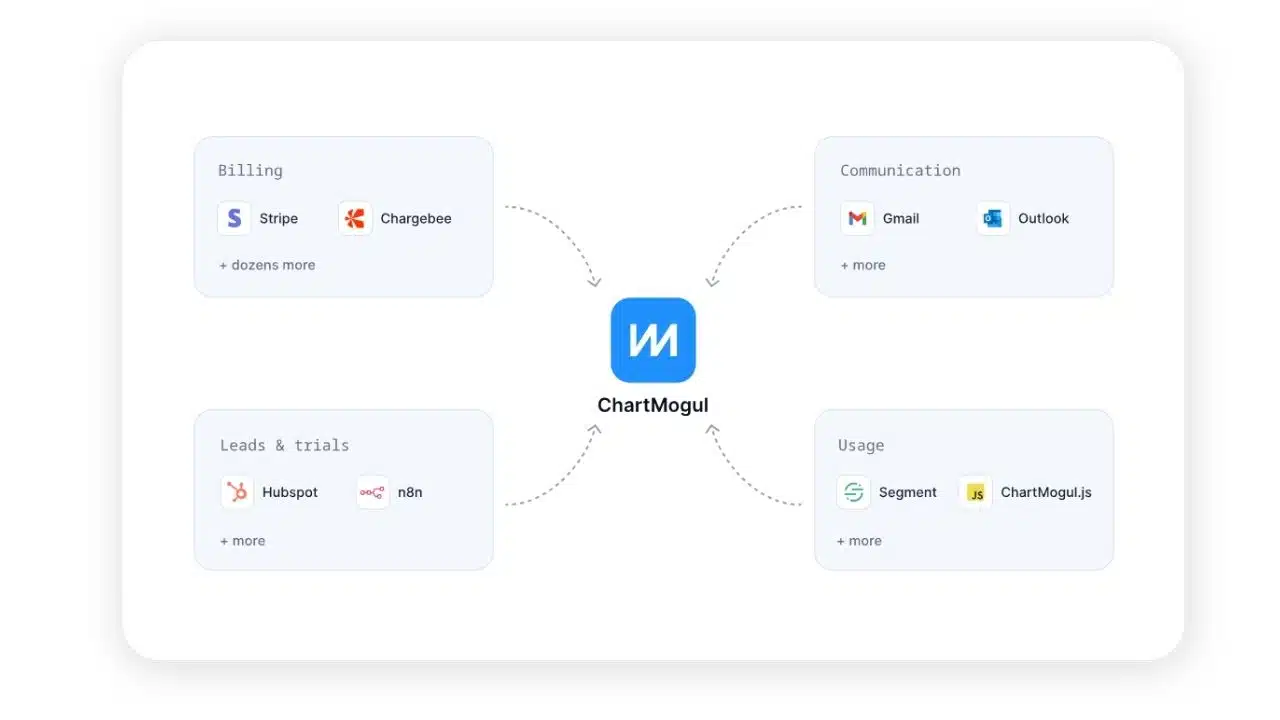
ChartMogul is one of the most sensible starting points for a subscription SaaS company that needs reliable recurring-revenue reporting without building its own data model.
It covers subscription metrics, segmentation, customer information, and increasingly CRM and product-led growth workflows. That broader scope matters because SaaS teams rarely want MRR in complete isolation. They want to see which customers expanded, which plans are losing momentum, and how accounts move through the commercial lifecycle.
Its current free tier covers companies up to $10,000 MRR, or $120,000 ARR, which gives early-stage teams meaningful room before paid pricing begins.
ChartMogul deserves its position near the top because it solves a common first analytics problem cleanly. It would not be the first choice for detailed questions about clicks, funnels, or feature-level behavior. That is a different job.
2. Baremetrics
Baremetrics is easier to read than many analytics platforms, and that is more valuable than it sounds. The core product tracks more than two dozen subscription metrics, with trial analysis, segmentation, automated reporting, and customer enrichment. Higher tiers add features such as benchmarks, custom dashboards, advanced exports, goals, and deeper segmentation.
At the time of writing, the Launch plan starts at $75 per month for companies in the lowest ARR band, while Growth starts at $255 per month. Pricing rises with company revenue.
That is the part worth thinking about before signing up. Baremetrics can be a comfortable fit when founders or operators want subscription performance without building elaborate reports. A growing SaaS company should still calculate what the product costs at its likely ARR a year or two from now, not just today’s entry price.
3. ProfitWell Metrics by Paddle
ProfitWell Metrics remains difficult to ignore for one reason: its core subscription analytics is free. It covers familiar recurring-revenue questions around MRR, churn, retention, cohorts, customer segmentation, and plans. For a young subscription business that wants a clearer view of its revenue without immediately creating another software bill, that is a strong proposition.
ProfitWell Metrics is useful for subscription reporting. It is not a substitute for a full finance operations platform, complex billing system, or behavioral analytics stack.
For a straightforward SaaS business that mainly needs to stop calculating basic recurring metrics in spreadsheets, it can be enough for quite a while.
4. Maxio
Maxio is a different class of product. It combines SaaS metrics with subscription management, invoicing, collections, usage-based billing, revenue recognition, and broader finance operations. Its reporting can separate MRR and ARR movement into new business, expansion, contraction, and churn.
That makes it far more relevant to an established B2B SaaS company managing contracts and complex billing than to a founder selling one simple monthly plan.
The difference is reflected in the price. Maxio’s Grow plan currently starts at $599 per month for businesses with up to $100,000 in monthly billings, while larger customers move to quoted pricing.
For the right finance team, that can be justified. For someone who only wants a clean churn dashboard, it is unnecessary machinery.
5. Chargebee RevenueStory
RevenueStory should usually enter the conversation after another decision has already been made: the company uses Chargebee. It analyzes subscriptions, revenue, payments, activations, churn, and related KPIs, with more than 150 prepared reports and a set of default dashboards.
The benefit is not that RevenueStory is universally better than every standalone analytics product. It is that the reporting sits close to the billing system producing the data.
Chargebee currently offers Standard RevenueStory with paid Chargebee plans, while Premium is available separately. If the company already runs billing through Chargebee, evaluate what RevenueStory can answer before paying another vendor to ingest the same subscription records. If Chargebee is not part of the stack, there is little reason to start here.
6. Recurly Analytics
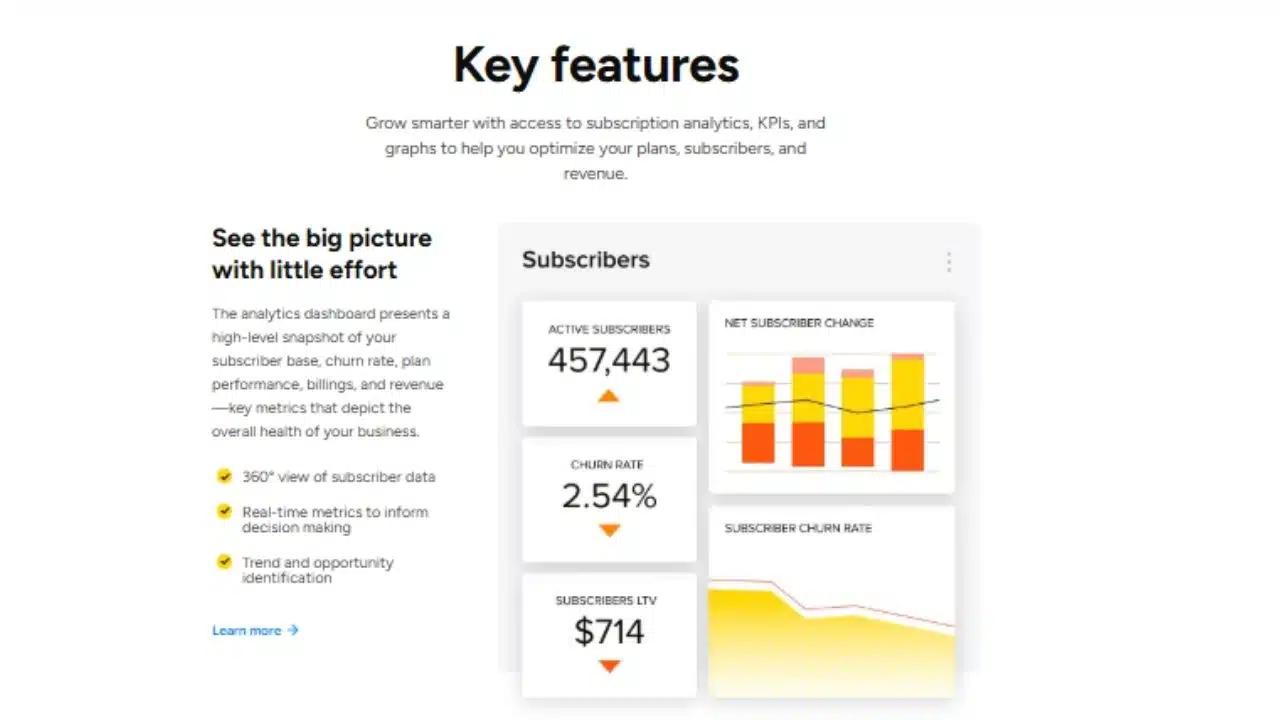
Recurly Analytics follows much the same logic. It covers recurring-revenue measures including MRR, churn, retention, financial performance, dunning, custom reporting, and benchmarks. Analytics is available across Recurly plans.
The broader platform is a subscription billing system rather than a lightweight analytics add-on. Recurly’s current Starter pricing begins at $249 per month plus volume-based charges after the included billing allowance.
That makes Recurly Analytics valuable mainly to companies already choosing Recurly for subscription management. Switching billing platforms because one analytics dashboard looks attractive would be difficult to justify.
7. Stripe Billing and Stripe Sigma
Stripe users should exhaust the reporting already inside Stripe before automatically buying another subscription analytics product. Stripe Billing provides subscription analytics, while Sigma opens up much more detailed analysis using SQL inside the Stripe environment. Teams can query customers, subscriptions, invoices, payments, refunds, and other Stripe data and create recurring reports. Sigma also supports AI-assisted query generation.
Current Sigma pricing starts at $15 per month on its monthly option, with additional pricing linked to charge volume. Its strength appears when the built-in Stripe dashboard almost answers a question but not quite.
For example, an operations team might want a custom view of subscription behavior by product and geography, or finance may want a recurring reconciliation report involving several Stripe objects.
The boundary is equally clear: Sigma understands Stripe data. It does not automatically explain what users did inside the product before they upgraded or cancelled.
8. Mixpanel

Mixpanel is where the problem changes. Instead of asking what happened to revenue, it helps answer what users did. The current free plan includes up to 1 million events per month and 10,000 monthly session replays, alongside core funnel and retention analysis.
For a product-led SaaS team, the questions quickly become more useful than pageview counts:
- Where do trial users abandon onboarding?
- Do customers who invite teammates retain longer?
- Which behavior tends to happen before an upgrade?
Mixpanel is a strong first product analytics choice because it can answer those questions without requiring the company to adopt a much broader suite. It should not become the place where finance invents a second definition of MRR simply because the team likes its interface.
9. Amplitude
Amplitude overlaps heavily with Mixpanel, but it is increasingly positioned as a broader product growth platform. Its free plan currently includes 2 million monthly events and 10,000 session replays, with access to analytics plus limited versions of experimentation, guides, surveys, and related capabilities.
Amplitude becomes more compelling as the product organization becomes more mature. Company with several product managers investigating activation, journeys, cohorts, retention, and experiments every week can make good use of the breadth.
A founder checking churn once a month cannot. This is one of the tools on the list where sophistication can either be useful or become expensive analytical theatre. The value depends on whether the team has enough product questions to justify the platform.
10. PostHog
PostHog is particularly attractive to engineering-led SaaS companies. Product analytics sits alongside session replay, feature flags, experiments, surveys, data tooling, error tracking, and other developer-oriented capabilities. That can reduce the number of separate tools a technical team has to integrate.
Its current pricing also makes experimentation easy. The first 1 million product analytics events each month are free, after which usage-based pricing begins.
Autocapture and generous usage limits make it easy to collect huge amounts of behavioral data before anyone decides which events actually matter.
PostHog is most useful when engineering wants control over instrumentation and likes the idea of keeping analytics, experiments, and feature management close together. Teams looking for a polished plug-and-play executive subscription dashboard should look elsewhere.
11. Heap
Heap earns its place because it handles a common analytics regret: realizing months later that the team should have tracked something.
Its autocapture records many user interactions from the start, allowing teams to define some events retrospectively rather than planning every tracking question beforehand.
The Free plan currently supports up to 10,000 monthly sessions. That flexibility can save engineering time, particularly for teams still learning what behavior matters.
Autocapture is sometimes oversold, though. It does not remove the need to deliberately track backend events, account-level attributes, subscription states, or other business-specific information that does not exist as an obvious browser interaction. Heap reduces the cost of missed frontend instrumentation. It does not eliminate analytics design.
12. Pendo
Pendo belongs on this list because its job is not simply to measure product behavior. Alongside analytics, Pendo includes in-app guides, onboarding tools, feedback and NPS capabilities, roadmaps, and other product-experience features. Session replay is available within higher offerings.
Its Free tier currently supports up to 500 monthly active users. Once a free account moves beyond that level, some analytics may be sampled and certain creation features become restricted unless usage drops or the company upgrades.
That makes Pendo more attractive to product and customer-success teams working on adoption than to analysts who only want raw behavioral exploration.
If the company’s main need is funnels and event analysis, Mixpanel, Amplitude, or PostHog may be easier to justify. If the team wants to act on what it discovers using in-product guidance, Pendo becomes more interesting.
Before You Choose
The best SaaS analytics tools are not the ones with the longest feature lists. They are the ones that close a specific information gap without creating competing definitions elsewhere.
A practical starting path looks like this:
For basic subscription reporting, compare ChartMogul, Baremetrics, and ProfitWell Metrics. For heavier B2B billing and finance operations, look at Maxio or the analytics already available inside Chargebee or Recurly.
If Stripe is the financial center of the business, check Billing and Sigma before exporting the same data into another paid dashboard. For product behavior, compare Mixpanel, Amplitude, PostHog, Heap, and Pendo based on how much instrumentation, experimentation, replay, and in-app engagement the team actually needs.
Finance or billing should own recurring-revenue definitions. Product analytics should own behavioral definitions. Connect the two when there is a real question worth answering, such as whether adoption of a feature predicts expansion or whether failed onboarding precedes churn. Do not start by collecting dashboards. Start by deciding what you need to know.
Final Thoughts
Choosing SaaS analytics tools becomes much easier once the company stops asking for a single platform that “does analytics” and starts defining the decisions it needs data to support.
If revenue metrics are unreliable, fix that first. If the numbers are trusted but nobody understands the behavior behind them, add product analytics. If the existing billing platform already provides the reporting you need, do not buy another tool merely because its dashboard is more attractive.
The strongest analytics stack is rarely the largest one. It is the smallest set of systems that gives finance, product, and growth teams numbers they trust—and makes it clear which system owns each number.
FAQs
Can one SaaS analytics tool handle both revenue and product analytics?
Some platforms are expanding into both areas, but most still have a clear strength. A subscription platform usually understands billing and revenue better, while a product analytics platform provides much deeper behavioral analysis. A growing SaaS company may eventually use both, but it should avoid creating two competing sources for the same metric.
Which SaaS analytics tool is easiest for an early-stage startup?
ChartMogul and ProfitWell Metrics are strong places to compare first because both lower the cost of establishing basic subscription reporting. The better choice depends on the billing stack and how much CRM or account-level functionality the company wants.
Do I need Mixpanel or Amplitude if I already use ChartMogul?
Only if the questions have moved beyond subscription outcomes. ChartMogul can tell you how recurring revenue and accounts are changing. Mixpanel or Amplitude becomes useful when the team needs to understand detailed product behavior behind those changes.
Should SaaS companies track every possible product event?
Usually not. More events do not automatically produce better analysis. Tracking should begin with meaningful actions tied to activation, adoption, conversion, retention, or other real product questions. Collecting thousands of poorly defined events often makes analysis harder.
When should a SaaS company replace spreadsheets with analytics software?
Once recurring reporting takes meaningful manual work, different teams calculate the same metric differently, or important decisions rely on data that is difficult to reproduce, dedicated analytics software starts becoming easier to justify. Very early companies with simple billing may still get by with basic reports and spreadsheets.