Most idea lists have the same problem. They hand you something that needs a team of five, eight months of work, and money you do not have. Or they say “build a CRM for dentists” and stop there. No word on who pays for it. No word on what it costs to run every month. No word on why nobody has already done it.
I spent a large part of the last year checking SaaS and micro SaaS products for ImagineLab.art. Features, pricing pages, and what people complained about in reviews. After a few hundred of them, a pattern showed up that changed how I think about this. The tools that survive as one-person businesses are almost never clever. They are small and boring, and they answer one question fast.
So this list of micro SaaS ideas for solopreneurs is built around that. Each idea is something one person can ship. Each one solves a problem people already search for. And I have flagged the ones that look easy but are not.
What Counts as Micro SaaS Here
I am using a narrow definition because the word gets stretched a lot. A micro SaaS does one job. One person can build it, run it, and support it without hiring. It works while you sleep, which means no manual delivery for each customer. And it makes real money at a small scale, usually somewhere between a few hundred and a few thousand dollars a month.
That last part matters. A micro SaaS is not a small startup waiting to grow up. It is a finished thing at a small size. If your idea only makes sense at 50,000 users, it is not this.
The three questions I ask before building anything
At ImagineLab we kept running into ideas that sounded good in a meeting and died on a whiteboard. So the filter got simple.
Can I explain it in one line without using the word “platform”? If the explanation needs three sentences and a diagram, the product is too broad. Cut it down.
Does the user get an answer in under 30 seconds? Not a dashboard. An answer. A date, a number, a yes or no.
Would someone actually search for this problem? This is the one that kills most ideas. If you have to explain why the problem exists before you can sell the fix, your marketing cost just tripled.
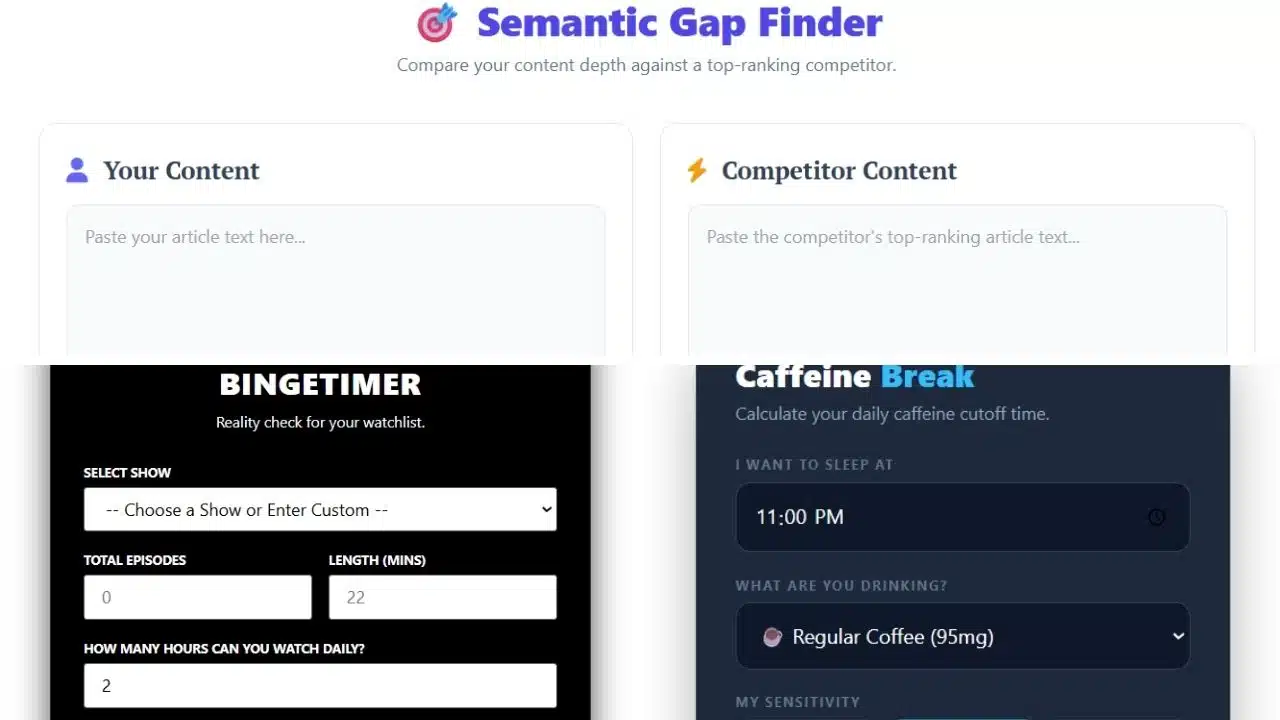
The three tools we shipped on Editorialge came out of that filter. The Caffeine Break Calculator does one thing: it tells you the last time you can drink coffee and still sleep. It uses caffeine half-life and a 50mg sleep threshold, and it gives you a single clock time. No account, no dashboard.
BingeTimer answers, “How long will this show take?” The part people actually react to is not the finish date. It is the “Full 8hr Days” number, which turns 73 hours of The Office into a stack of workdays. That one line changes how people feel about their watchlist.
Semantic Gap Finder is the SEO one. You paste your draft and a competitor’s page, and it shows you the concepts they cover that you missed, with a coverage score. Nobody needed a tutorial for it.
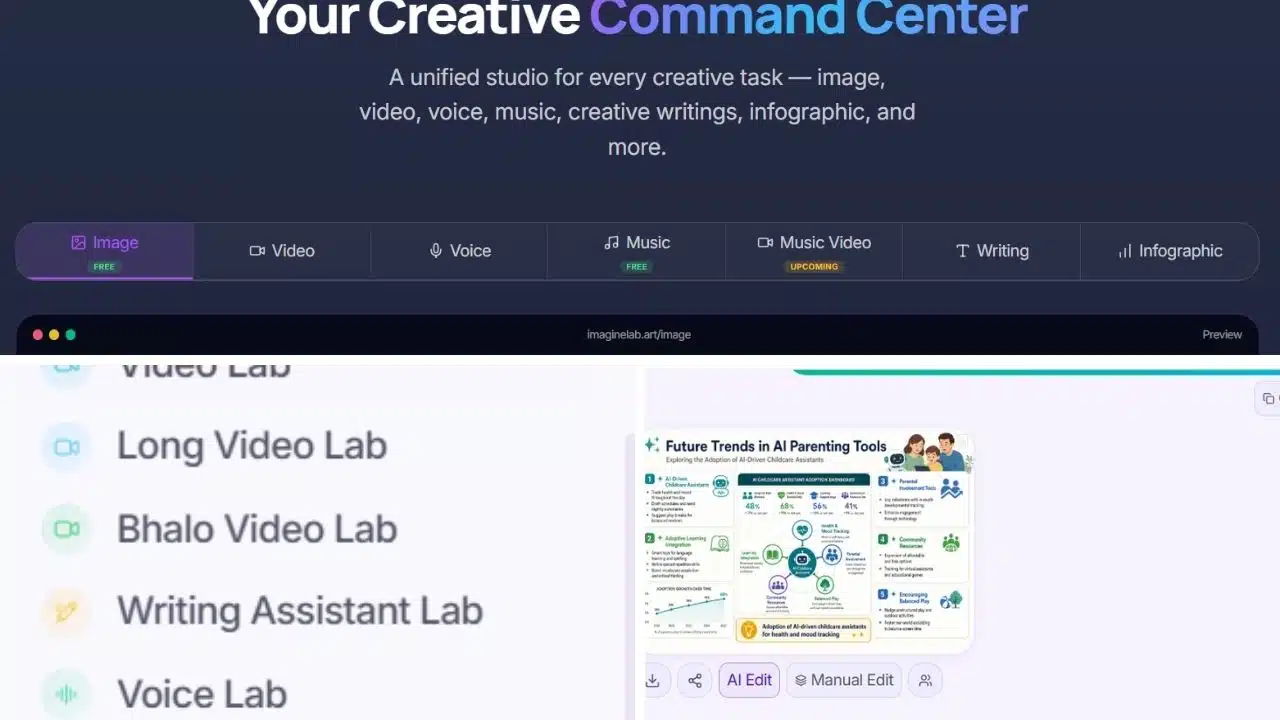
The same thinking scaled up into ImagineLab.art, which runs on a token system we call EDT. Users spend tokens across images, infographics, video, music, voice, ad copy, and blog content in one place instead of paying five separate subscriptions. We are building a second platform, RankPilot.ai, for writers and bloggers. Different sizes, same rule: remove one specific annoyance completely.
The boring problem that paid a million a year
Before the list, one story is worth sitting with. Jon Yongfook was Head of Product at Aviva in Singapore, earning around $20,000 a month. He quit to build his own products and then failed seven times in a row over about a year. Seven startups, no real revenue.
The thing that finally worked was the least exciting idea he had. He was tired of making the same social images and open graph banners over and over. So he built a tool that generates them from templates through an API. It became Bannerbear.
Two details from that story matter more than the revenue number.
First, he raised his entry price instead of lowering it. Cheap plans brought in customers who filed the most support tickets, which is a real problem when you are one person. Second, he split his time evenly between building and marketing, one week coding and one week writing. Most technical founders skip the second week.
Bannerbear crossed $1 million in annual revenue in September 2025. Solo. No funding. For a job most people would call dull.
Small tools that answer one question
These are weekend or two-week builds. They will not make you rich on their own, but they are the right place to start if you have never shipped anything, and they work well as free tools that feed a bigger paid product later.
1. Free Trial Radar. People sign up for trials and forget them. A simple tool where you paste the service name and trial end date, and it emails you two days before the charge hits. Add a monthly total so users see what they are actually spending. This is easy to build and easy to search for.
2. Study Pacer. Same math as BingeTimer, pointed at exams. The student enters the syllabus chapter count, the exam date, and how many hours a day they can study. The tool gives back a daily target and an honest warning if the plan does not fit. Parents share tools like this, which is free distribution.
3. Landed Cost Estimator. Small importers guess badly. They see a $4 unit price and forget shipping, duty, VAT, and payment fees. A calculator that turns unit price plus freight plus duty rate into a true per-unit cost is genuinely useful. Keep it to two or three countries at first. Duty rates change, so build in a “last updated” date and check it.
4. Menu Margin Calculator. For cafés and small kitchens. Enter ingredient costs per dish and portion sizes to get the true food cost and the margin at your current menu price. Owners know this matters. Very few of them have a spreadsheet for it.
Ideas for writers, bloggers, and SEO teams
This is the group I know best, and it is where the money gets more serious. Content people already pay for tools, which removes the hardest part of the sale.
5. Internal Link Gap Checker. Upload a sitemap or connect a site, and the tool finds pages with no incoming internal links, then suggests which existing posts should link to them and with what anchor. Big SEO suites do this as a buried feature inside a $99 plan. A focused tool at $19 that does only this and does it clearly has room. The build is real work, mostly crawling and storage, so budget a month.
6. Content Decay Alert. Connect Google Search Console, and get one email a week listing posts that lost clicks compared to the previous 28 days, sorted by how much traffic is at risk. That is it. No dashboard to log into.
I would rank this the strongest idea on the list. Every publisher has this problem; almost nobody watches for it on purpose, and the fix is one API and a cron job. The hard part is not the code. It is convincing people to connect their Search Console account, so your privacy page needs to be better than everyone else’s.
7. AI Answer Citation Tracker. Brands now want to know if they get mentioned inside AI-generated answers, not just in blue links. A tool that runs a set of your target questions across the major AI search products weekly and reports where you appear and which competitor gets named instead is something people are actively asking for.
Be careful here. Results change constantly and are hard to reproduce, so never promise accuracy you cannot deliver. Sell it as a trend signal, not a scoreboard.
8. Author and E-E-A-T Auditor. Crawls a site and flags pages with no author byline, no author schema, no visible published or updated date, and no link to an author page. Then it exports a fix list. Small teams keep failing these basics. The tool takes a few days to build.
9. Redirect Map Builder. For site migrations. Feed it the old URL list and the new one, and it matches them by slug similarity, flags the ones it is unsure about, and exports a clean redirect file. This is a painful, expensive task that people currently do by hand in spreadsheets, badly. Charge per project instead of monthly. Nobody migrates every month.
What the PDF.ai story teaches about this group
Damon Chen did not build his best-known product. He bought it. It was a weekend project called looseleaf.ai with no revenue, and he paid around $20,000 for the code, then roughly $10,000 more for the domain pdf.ai.
That domain was the whole strategy. When people search for a PDF AI tool, the site name is the search term. A very large share of his traffic came in through search, for free, forever. He grew it past $50,000 in monthly recurring revenue, and by 2025, his products together were making somewhere near $1.3 million a year.
He has also been open about the other side. The AI tool space filled up with copies, and monthly revenue came down. He stopped publishing his exact numbers years earlier for the same reason.
The lesson for a content tool is not “buy an expensive domain.” It is that distribution should be part of the product decision, not something you figure out after launch. Pick a problem people type into a search box using words they can own.
Ideas for freelancers and one-person agencies
10. Scope Creep Tracker. A freelancer logs the tasks a retainer client asks for, and the tool compares them against what the contract actually covers. At the end of the month it produces a short summary: here is what was in scope, here is what was extra, and here is what it would have cost.
The point is not the tracking. It is having a document that makes the awkward conversation less awkward. That emotional job is what people pay for, and it is why this can charge more than it looks like it should.
11. Cross-Border Payout Calculator. Freelancers outside the US and EU lose real money to payment routing and never see exactly where. A tool that compares what actually lands in your account across the common payout methods, after conversion spread and fixed fees, for a given invoice amount and country pair. Fees change often, so this needs monthly maintenance and a visible update date. That maintenance work is also your moat, since it is the reason competitors give up.
12. Proposal Follow-Up Nudger. You send a proposal and paste the link into the tool. It reminds you on day three, day seven, and day fourteen, with a suggested message for each. Small idea, but the reason freelancers lose deals is silence, not price.
Ideas for small local businesses
Harder to sell, because these customers are not sitting on the internet waiting for tools. But churn is low once you are in.
13. Shift Swap Board. Restaurants and salons run shift swaps through group chat, and it goes wrong constantly. A simple board where staff post a shift, a colleague claims it, and the manager approves with one tap. Charge per location, not per user.
14. Warranty Vault. For appliance and electronics retailers. The shop logs the sale, the customer gets a link holding their receipt and warranty end date, and the shop gets a reminder to contact them before it expires. Sell it on the second part, since that is the part that brings customers back.
15. Review Reply Assistant. Pulls new Google reviews for a business, drafts a reply in the owner’s tone, and waits for approval before posting. Keep the approval step. Owners will not trust anything that posts on its own, and they are right not to.
The dependency trap that kills good tools
One story before you start building. Tony Dinh built a Twitter analytics tool called Black Magic. It worked. It reached around $14,000 in monthly revenue as a solo product. Then Twitter changed its API pricing and his monthly cost to run the tool jumped to roughly $42,000. Three times his revenue, overnight, through no fault of his own.
He had turned down a $500,000 acquisition offer earlier. He had about two weeks to sell before the business became worthless, and he got $128,000.
He recovered. When the ChatGPT API launched, he built TypingMind in a weekend, priced it at $9, raised it to $39 within days, and by mid-2023, it was doing around $30,000 a month.
So the point is not that he lost. The point is that his best-executed product was destroyed by a pricing decision made in a room he was not in.
Before you build, write down every outside service your tool needs to work. For each one, answer this honestly: if they raise the price ten times tomorrow or shut off access, does my product still exist? If the answer is no for anything critical, either price with that risk built in or build a second product early. Do not let one API be your whole business.
What to check before you write any code
Skip the market research reports. Do these four things in an afternoon. Search your problem the way a customer would phrase it. If the results are all forum threads and nobody is selling a fix, that is a good sign. If the results are ten polished tools with funding, pick something else.
Find where people complain about it. Reddit, review sites, YouTube comments under tutorials for the manual method. Copy the exact words they use. Those words go on your landing page.
Build the landing page before the product. One clear line, one screenshot or mockup, one email field. Send it to twenty people who have the problem. If none of them give you an email address, none of them will give you a card.
Then price it higher than feels comfortable. Every solo founder I have looked at closely says the same thing about their early days, and Bannerbear’s price increase is the clearest example. Cheap customers cost you the most time, and time is the only thing you cannot buy back.
Frequently Asked Questions (FAQs)
1. How much should I charge for something this small?
Higher than instinct says. A tool that saves a business two hours a month is worth far more than $5, and $5 customers write the most support emails. Somewhere between $19 and $49 a month works for most of these. For project-based tools like the redirect builder, a one-time fee per project fits better than a subscription nobody uses in month two.
2. Do I need to be a developer?
For the calculators in the first group, no. Those are front-end tools with no accounts and no database, and current AI coding tools handle them well. For anything that connects to Search Console, stores customer data, or runs scheduled jobs, you need real development skill or a partner who has it. Be honest with yourself about which group your idea is in before you promise a launch date.
3. How long before it makes money?
Longer than the success stories suggest. Yongfook failed seven times before Bannerbear, and it took about four years to reach a million a year. Chen has said publicly that hitting a million a year took him four years and did not feel fast. Plan for twelve to eighteen months of unglamorous work, and treat anything earlier as a bonus.
Final Thoughts
The best micro SaaS ideas for solopreneurs are not clever. They are specific. Somebody is doing a small annoying task by hand every week and quietly hating it. Your job is to find that task and remove it completely, not partly.
If you are starting today, take one idea from the first group and ship it in two weeks, even badly. You will learn more from twenty real users than from twenty more hours of planning. Then take what you learned and build something from the SEO or freelancer group, where people are already used to paying.
You can see the full set of tools we have shipped on our micro SaaS products page and the larger creative platform this thinking grew into at ImagineLab.art. None of them started as a big idea. They started as one small problem that would not go away.