
Entrepreneurs, financial analysts, and operators reference the LTV to CAC ratio constantly because it gets treated like a core diagnostic test for whether a business model is actually working or just leaking cash on a slow trajectory toward failure.
Yet, for all the times people quote the benchmark, the metric is frequently misunderstood, miscalculated, or distorted by overly optimistic assumptions. Understanding what the LTV to CAC ratio actually measures, and more importantly, what it tells you about your business growth, it is essential for any entrepreneur or digital publisher scaling a venture.
What is LTV and Why Does It Matter?
To understand how these numbers interact, we first have to look at customer lifetime value on its own terms.
LTV stands for Customer Lifetime Value, which is simply the total revenue a business can expect from a single customer account across their entire relationship.
If you run a digital membership site where a user pays $50 a month and sticks around for 20 months, your LTV is $1,000.
A high LTV means strong retention and good pricing power, but that metric alone doesn’t mean much if it costs an absolute fortune to acquire those users in the first place.
Breaking Down CAC (Customer Acquisition Cost)
CAC stands for Customer Acquisition Cost, representing the total sales and marketing spend required to win a single new customer over a specific timeframe.
Calculating CAC sounds easy, but founders miss hidden expenses. To get an accurate number, you need to add up:
-
Total marketing spend (ads, content creation, campaigns)
-
Sales salaries, commissions, and bonuses
-
Software tools used by growth teams
-
Agency fees tied to acquisition
Divide that total sum by the number of new customers acquired. Spend $10,000 last month and land 100 new customers? Your CAC is $100.
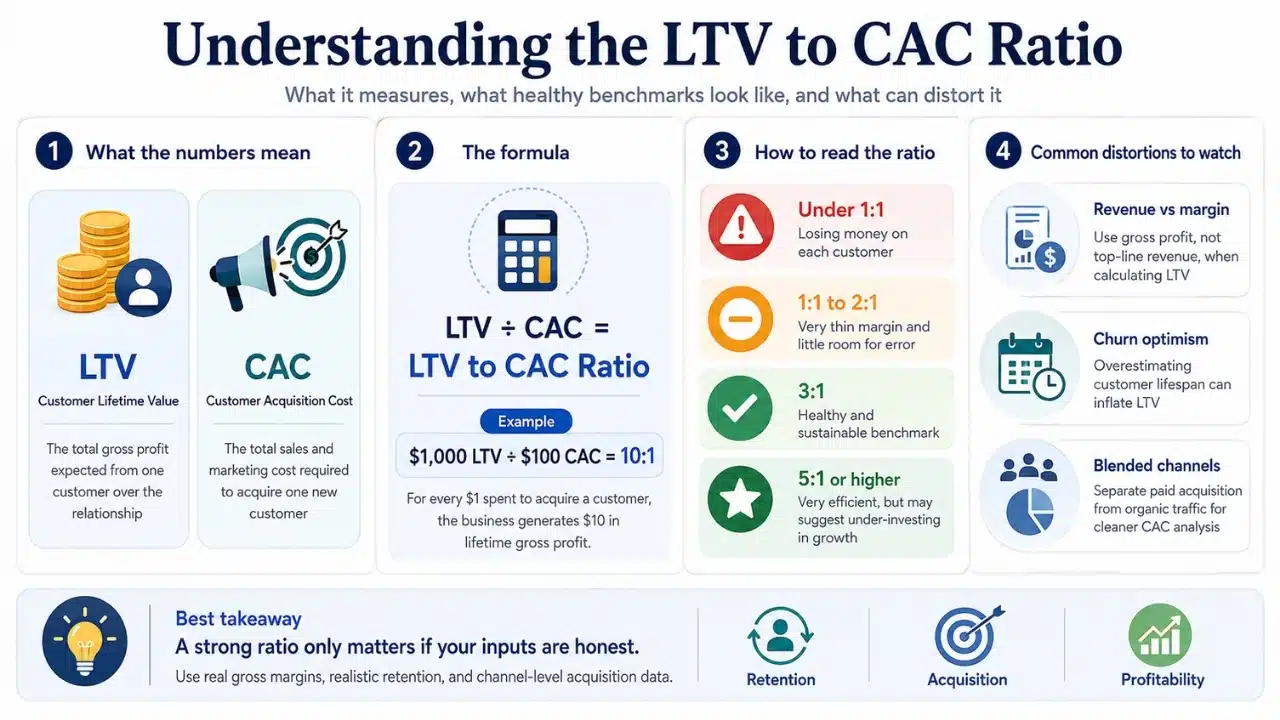
Putting Them Together: The Magic Formula
Once you have both numbers, evaluating the LTV to CAC ratio is basic math. Divide your Customer Lifetime Value by your Customer Acquisition Cost.
Using our previous examples: a $1,000 LTV and a $100 CAC, your ratio sits at 10:1.
For every single dollar you spend pulling a customer through your doors, you generate ten dollars back in gross profit over their lifespan. On paper, that looks incredible, but standard benchmarks paint a more nuanced picture.
The Golden Benchmark: What Ratio Should You Aim For?
Consensus usually settles around a few specific tiers:
-
Under 1:1: You are losing money on every customer and need to fix your unit economics immediately.
-
1:1 to 2:1: Barely breaking even. This leaves zero room for error when factoring in operational overhead.
-
3:1: The traditional benchmark accepted by strategists, indicating a healthy, sustainable model.
-
5:1 or Higher: Outstanding efficiency, though a ratio this high sometimes indicates under-investing in growth and leaving market share on the table.
Common Traps That Distort Your Metrics
It is remarkably easy to make your LTV to CAC ratio look brilliant by tweaking assumptions. Watch out for these three pitfalls:
1. Using Gross Revenue Instead of Gross Margin
LTV should be calculated using gross profit, not top-line revenue. If it costs money to service each customer (like cloud hosting or support), those expenses must be stripped out first.
2. Ignoring Churn Volatility
Calculating LTV requires predicting retention. If your business is young and you only have three months of data, projecting a 3-year customer lifespan is pure fiction. High early churn will destroy a projected LTV.
3. Blending Paid and Organic Channels
If organic search traffic brings in customers for free, blending those numbers with expensive ad campaigns muddies your performance data. Segment your channels.
Final Thoughts
The LTV to CAC ratio is a vital diagnostic tool. Keep your calculations grounded in real gross margins and honest retention data so you can accurately evaluate your growth trajectory.
Frequently Asked Questions (FAQs) About the LTV to CAC Ratio
How do you calculate the LTV to CAC ratio?
Answer: Divide your Customer Lifetime Value by your Customer Acquisition Cost. If LTV is $3,000 and CAC is $1,000, your ratio is 3:1.
What is considered a good LTV to CAC ratio?
Answer: A 3:1 ratio is widely considered the gold standard benchmark for sustainable growth. Lower risks unprofitability, while extremely high ratios may mean under-investing.
Why is my LTV to CAC ratio looking artificially high?
Answer: It is often distorted if you use top-line revenue instead of gross margin, or base lifespan on optimistic retention projections.
Can a startup have too high of a ratio?
Answer: Yes. A ratio above 5:1 or 10:1 often suggests you are too conservative with marketing budgets.
How often should I recalculate this metric?
Answer: Review your metrics monthly or quarterly as acquisition costs and churn rates fluctuate.