


SaaS growth marketing sounds exciting until the signups arrive, and revenue still does not grow. That is the part many founders learn the hard way. Traffic is not growth. Free users are not growing. A launch spike is not growth. A nice landing page is not growth. Real SaaS growth happens when the right users find your product, understand its value, activate quickly, pay with confidence, keep using it, and eventually expand or refer others.
That is why SaaS marketing is different from ordinary lead generation. You are not selling a one-time product. You are earning continued trust every month or every year. If the product does not retain users, more marketing only fills a leaky bucket faster. If onboarding is confusing, trials do not convert. If customer success is weak, churn quietly eats your growth.
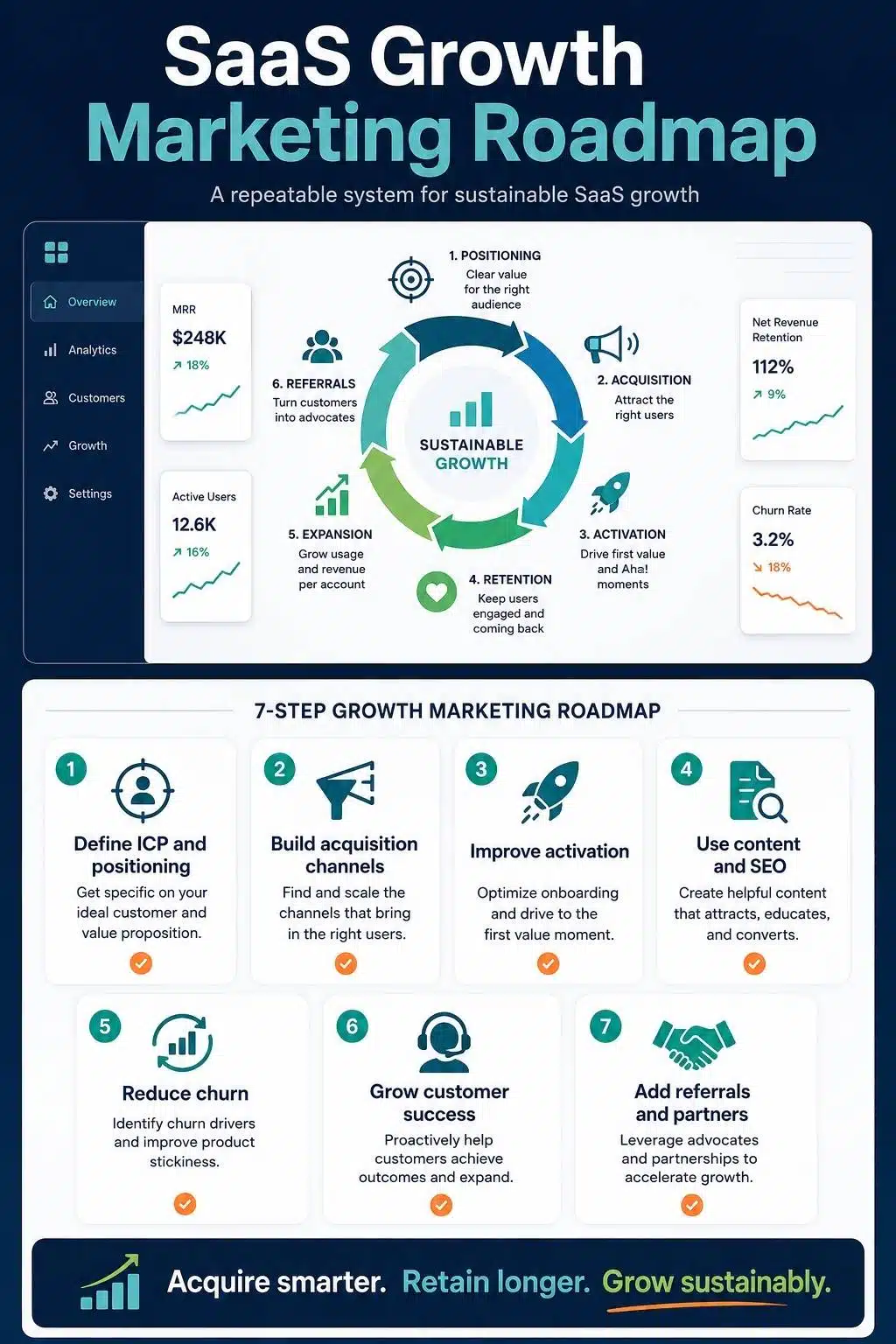
This guide explains SaaS growth marketing as a complete system. It covers positioning, acquisition, product-led growth, content, SEO, launches, email, churn reduction, customer success, referrals, partner marketing, and funding paths. Use it as a practical roadmap for building a SaaS business that can grow without depending on random tactics.
What Is SaaS Growth Marketing?
SaaS growth marketing is the process of growing recurring revenue by connecting marketing, product, data, sales, and customer success.
It covers the full customer journey:
- Awareness
- Acquisition
- Activation
- Conversion
- Retention
- Expansion
- Referral
A traditional marketing team may focus on traffic, leads, and campaigns. A SaaS growth team has to care about what happens after the signup.
- Do users complete the setup?
- Do they reach the first value moment?
- Do they invite teammates?
- Do they convert to paid plans?
- Do they renew?
- Do they upgrade?
- Do they recommend the product?
This is why a strong SaaS marketing strategy cannot sit separately from the product. The best growth work happens when the product experience and the marketing promise support each other.
Why SaaS Growth Is Different From Traditional Marketing
SaaS companies grow through recurring value. That changes the whole marketing model. A customer does not simply buy once and disappear. They continue through onboarding, usage, support, renewals, upgrades, and sometimes team expansion.
That means SaaS growth depends on three connected forces.
| Growth Force | What It Means | Why It Matters |
| Acquisition | Bringing the right users or accounts into the funnel | Without demand, the business cannot grow |
| Activation | Helping new users reach value quickly | Without activation, signups rarely become customers |
| Retention | Keeping customers long enough to compound revenue | Without retention, growth becomes expensive |
Many SaaS teams get stuck because they focus only on acquisition. They ask, “How do we get more users?” when the better question may be, “Why are the users we already have not staying?”
A growing SaaS business is usually not about one magic channel. It is about improving the whole system.
Start With the Growth Model Before the Tactics
Before choosing channels, define your growth model. A SaaS growth model explains how people discover, try, buy, use, and expand with your product.
Common SaaS growth models include:
- Product-led growth
- Sales-led growth
- Marketing-led growth
- Community-led growth
- Partner-led growth
- Founder-led growth
- Hybrid growth
A lightweight productivity tool may grow through self-serve trials, templates, team invites, and free usage. A complex enterprise security platform may need demos, implementation support, sales calls, procurement help, and customer success.
The wrong model creates waste. For example, a simple freemium plan may work well for a product that users can understand quickly. But it may fail for a technical product that needs setup, data migration, compliance approval, or team training.
Choose the model that fits your product complexity, price point, buyer, market maturity, and sales cycle.
The SaaS Growth Foundation
Many SaaS teams chase tactics too early. They want SEO, ads, LinkedIn content, affiliates, referrals, and partnerships before the basics are clear.
1. Define a Clear Ideal Customer Profile
Your ideal customer profile, or ICP, defines who gets the most value from your product.
A strong ICP includes:
- Company type
- Team size
- Industry
- Pain points
- Budget range
- Decision-maker
- End user
- Current alternatives
- Urgency level
- Success outcome
Do not define your ICP as “small businesses” or “marketers.” That is too broad.
A sharper ICP might be:
“B2B content teams with 5 to 20 writers that need workflow approvals, SEO briefs, and publishing calendars in one tool.”
That level of clarity improves messaging, onboarding, content, pricing, and sales conversations.
2. Make Positioning Easy to Understand
Positioning answers one simple question: Why should this customer choose your SaaS instead of doing nothing, using a spreadsheet, hiring someone, or buying another tool?
Good positioning is not a slogan. It helps the buyer understand where your product fits.
Strong positioning includes:
- Who the product is for
- What painful problem does it solve
- What bad alternative does it replace
- What outcome does it help create
- Why the product is different
- Why the buyer should believe you
Weak positioning makes every channel harder. Paid ads become vague. SEO pages become generic. Sales calls become repetitive. Onboarding becomes confusing.
3. Identify the Activation Moment
The activation moment is when a new user first experiences real value.
- For an email tool, it may be sending the first campaign.
- For an analytics tool, it may be connecting data and seeing the first dashboard.
- For a project management tool, it may be inviting teammates and completing the first task.
This is one of the most important SaaS growth tactics because activation affects trial conversion, retention, support volume, and referrals. Your goal is to reduce the time between signup and value.
4. Fix Retention Before Scaling
Retention is the part of SaaS growth that many teams underestimate. If customers stay, upgrade, and expand, new acquisitions compound. If they leave quickly, every month starts with a gap you must refill.
Before increasing acquisition spend, ask:
- Are users reaching value fast?
- Are paying customers active?
- Are renewals healthy?
- Which segment churns most?
- Which features predict retention?
- Which users expand?
- Which customers need too much support?
If retention is weak, more marketing can make the business look busy while the economics get worse.
Product-Led Growth Fundamentals
Product-led growth means the product itself helps drive acquisition, activation, conversion, retention, and expansion. PLG works best when users can try the product easily and reach value without a long sales process.
It usually fits products where:
- Signup is simple
- Setup is guided
- The value appears quickly
- Users can invite teammates
- Usage creates expansion opportunities
- The product has clear upgrade triggers
Slack is a good example of a product-led motion because teams can start with a free workspace, communicate in channels, and experience collaboration value before upgrading. Notion is another example where individuals and teams can begin with a free plan and grow into paid plans as usage and collaboration needs expand.
But product-led growth is not just “offer a free plan.” A free plan without activation creates support costs, not growth. A free trial without a clear first value moment creates drop-offs.
A strong PLG system needs:
- Simple signup
- Useful templates
- Clear onboarding
- Fast first value
- In-product education
- Team invitations
- Usage-based upgrade prompts
- Self-serve billing
- Lifecycle emails
- Product analytics
For many SaaS companies, the best model is hybrid. Small teams can self-serve, while larger accounts can talk to sales when security, procurement, or implementation becomes more complex.
SaaS Content Marketing Strategy
SaaS content works best when it helps buyers make progress. Many SaaS companies publish blog posts for traffic but forget to connect that traffic to product value. That creates a large content library with weak business impact.
A better SaaS content marketing strategy covers the full journey.
| Stage | Search Intent | Content Type |
| Problem aware | “Why is our onboarding bad?” | Educational guides |
| Solution aware | “Best onboarding tools” | Comparison and category pages |
| Product aware | “Tool A vs Tool B” | Alternative pages |
| Decision stage | “Pricing, reviews, case studies” | Product proof pages |
| Retention stage | “How to improve usage” | Customer education |
HubSpot is a useful example here. Its inbound marketing approach has long focused on attracting and educating buyers through useful content before pushing a sale. That lesson still matters for SaaS brands: good content should earn trust before asking for conversion.
Strong SaaS content includes:
- How-to guides
- Use-case pages
- Template pages
- Comparison pages
- Alternative pages
- Integration pages
- Glossary pages
- Customer stories
- Benchmark reports
- Product tutorials
The goal is not to publish more. The goal is to build authority around the problems your product is built to solve.
SaaS SEO Specific Tactics
SaaS SEO should connect search intent with product value. Do not chase only broad, high-volume keywords. Those terms may bring students, casual readers, or people with no buying intent.
Better SaaS SEO often comes from:
- Pain-point keywords
- Use-case keywords
- Comparison keywords
- Alternative keywords
- Integration keywords
- Template keywords
- Industry-specific pages
- Feature-led pages
- Bottom-funnel product pages
For example, “project management” is broad. A more useful SaaS keyword might be “project management software for remote marketing teams” or “Asana alternative for client approval workflows.”
A strong SaaS SEO page should answer the searcher’s question and give them a natural next step. It could be a template, calculator, checklist, free trial, demo, product tour, use-case page, or a comparison page Traffic without a product connection is just publishing activity.
SaaS Launch Day Checklist
A SaaS launch is not just one announcement. It is a coordinated learning event.
Before launch, prepare:
- A clear landing page
- A working signup flow
- Analytics tracking
- Email capture
- Onboarding emails
- Help docs
- Pricing or waitlist logic
- Bug reporting flow
- Product demo assets
- Support coverage
- Founder announcement post
- Social launch posts
- Beta user testimonials
- Community outreach
- Post-launch feedback process
A launch should create attention, but more importantly, it should create learning. The best launch teams use launch day to improve the next 90 days.
Beta Testing Programs for SaaS
A beta program helps you test the product before a wider release. But beta users are not free QA workers. They need a clear reason to participate and a simple feedback process.
A good beta program includes:
- A specific user profile
- Clear expectations
- A feedback channel
- Weekly check-ins
- Bug reporting
- Usage tracking
- Onboarding support
- Exit interviews
- A success metric
Avoid inviting everyone. The wrong beta users create noisy feedback. The best beta users have the problem now, feel the pain clearly, and are willing to give honest feedback.
Use beta testing to validate:
- Problem urgency
- Feature clarity
- Onboarding friction
- Activation moment
- Pricing sensitivity
- Support needs
- Positioning language
A beta program should reduce uncertainty before you scale marketing.
Freemium vs Free Trial
Freemium and free trials solve different problems. Freemium gives users ongoing access to a limited version of the product. A free trial gives users temporary access, often to the full product.
| Model | Best For | Main Risk |
| Freemium | Broad products with viral or collaborative usage | Too many free users who never convert |
| Free Trial | Products with clear paid value and fast evaluation | Users may leave before reaching the value |
| Reverse Trial | Products where users need to feel premium features first | Confusion if the downgrade is unclear |
| Demo First | Complex or high-value products | Longer sales cycle |
Freemium works when free usage creates habit, sharing, or long-term expansion. Free trials work when users can evaluate value quickly. Demo-first works when the product needs setup, security review, or a custom workflow.
Do not copy another SaaS company’s pricing model without understanding why it works for their product.
SaaS Email Marketing Best Practices
Email is one of the most practical SaaS growth channels because it supports activation, retention, and expansion. SaaS email should be behavior-based, not just calendar-based.
Useful email flows include:
- Welcome sequence
- Activation nudges
- Feature education
- Trial reminders
- Usage milestone emails
- Inactive user recovery
- Upgrade prompts
- Customer success tips
- Renewal reminders
- Referral invitations
The best SaaS emails are short and tied to user behavior.
For example:
- If a user signs up but does not complete setup, send a setup help email.
- If a user invites teammates, send collaboration tips.
- If a trial user tries a premium feature, explain the paid value.
- If a customer becomes inactive, offer help before they churn.
Generic newsletters can support brand awareness, but lifecycle emails usually drive more direct product outcomes.
Reducing SaaS Churn
Churn is not only a customer success problem. It is often a product, marketing, sales, onboarding, and pricing problem.
Customers churn when:
- They never reach value
- They bought the wrong product
- The product is too hard to use
- The price feels too high
- The team does not adopt it
- Support is weak
- A competitor solves the problem better
- The original problem disappears
- The product never becomes a habit
Start with segmentation.
Ask:
- Which segment churns most?
- Which acquisition channel creates weak customers?
- Which plan has poor retention?
- Which onboarding step predicts success?
- Which features correlate with renewal?
- Which customers expand?
Practical churn reduction tactics include:
- Better onboarding
- Usage alerts
- Customer health scores
- In-app guidance
- Proactive support
- Clearer pricing
- Annual plan incentives
- Cancellation surveys
- Win-back campaigns
- Product improvements based on churn reasons
A SaaS company with strong retention can grow with less pressure on acquisition.

SaaS Customer Success Programs
Customer success is not the same as support. Support reacts to problems. Customer success helps customers reach outcomes before problems become churn.
A SaaS customer success program should define:
- What does success mean for each customer segment
- Which onboarding steps matter
- Which usage signals predict retention
- When to intervene
- How to identify expansion opportunities
- How to collect feedback
- How to manage renewals
For low-ACV SaaS, customer success may be mostly automated through onboarding flows, help docs, lifecycle emails, webinars, and in-app guides.
For high-ACV SaaS, it may include success managers, onboarding plans, quarterly business reviews, health scoring, and executive relationships.
Match customer success efforts to revenue size and product complexity. Do not over-serve tiny accounts manually if the economics do not support it. Do not under-serve enterprise accounts that need guidance to renew.
SaaS Referral Program Design
Referral programs work when customers already trust the product. Do not add a referral program to fix weak retention. If users are unhappy, they will not refer.
A good SaaS referral program needs:
- A clear reward
- Simple sharing
- Relevant audience fit
- Low-friction signup
- Tracking and attribution
- Fraud prevention
- In-product prompts at the right moment
The best time to ask for a referral is after a success moment.
Examples include:
- A user completes setup.
- A customer reaches a usage milestone.
- A team invites members.
- A customer gives positive feedback.
- A user renews or upgrades.
Referral rewards can include account credits, free months, upgraded features, partner rewards, or charitable donations. The reward should fit the customer. A solo creator may like free months. A business customer may care more about team credits or premium support.
Partner Marketing for SaaS Companies
Partner marketing helps SaaS companies grow through trusted relationships.
Common SaaS partner types include:
- Agencies
- Consultants
- Integration partners
- Technology marketplaces
- Resellers
- Affiliate partners
- Communities
- Industry associations
- Training providers
- Implementation partners
Shopify is a strong example of ecosystem-driven growth. Its partner program includes agencies, developers, theme creators, app builders, and referral partners that help merchants build and improve stores. That kind of ecosystem can create distribution, product value, and customer support beyond the company’s own team.
Partner marketing works when the partner has a real reason to recommend your product. For example, an SEO agency may recommend a reporting SaaS if it improves client delivery. A CRM consultant may recommend an automation tool if it fits their implementation work. Partners need enablement.
Give them:
- Clear positioning
- Demo assets
- Use-case pages
- Partner training
- Co-branded content
- Referral tracking
- Sales support
- Revenue share or incentives
- Implementation documentation
A strong partner channel takes time, but it can become a durable growth path.
Bootstrap vs Funded SaaS Growth Paths
Bootstrapped and funded SaaS companies can both win, but they play different games. A bootstrapped company must protect cash early. It usually focuses on profitable acquisition, strong retention, founder-led sales, SEO, referrals, and careful hiring.
A funded company can move faster, hire earlier, invest in product and sales, and expand into bigger markets. But it also faces pressure to grow quickly and justify investor expectations.
| Path | Strength | Risk |
| Bootstrapped | More control and discipline | Slower hiring and slower market capture |
| Funded | Faster scale and bigger bets | Burn pressure and growth expectations |
| Hybrid | Optionality and balance | Requires careful timing |
There is no universal best path. Choose based on market size, competition speed, founder goals, product complexity, and capital needs. If the market is huge and moving fast, funding may help. If the market is niche and profitable, bootstrapping may create a stronger long-term business.
Angel Investors Explained for SaaS Founders
Angel investors are individuals who invest their own money into early-stage companies.
For SaaS founders, angels can help with:
- Early capital
- Customer introductions
- Product feedback
- Hiring advice
- Credibility
- Fundraising preparation
- Go-to-market guidance
But angel money is not free. It usually means giving up equity or using an instrument such as a SAFE or convertible note.
Before raising from angels, founders should be clear on:
- How much capital is needed
- What milestone will the money unlock
- What terms make sense
- Which investors add strategic value
- How much dilution is acceptable
- Whether the business truly needs outside capital
Do not raise just because other startups are raising. Raising capital increases your odds of building a stronger company.
The SaaS Metrics That Matter
SaaS growth marketing needs measurement, but tracking too many numbers can confuse the team.
Start with the essentials.
| Metric | What It Tells You |
| MRR or ARR | Recurring revenue-based |
| New MRR | Revenue from new customers |
| Expansion MRR | Revenue growth from existing customers |
| Churned MRR | Lost recurring revenue |
| Net Revenue Retention | Whether existing revenue expands or shrinks |
| Gross Revenue Retention | How much revenue stays before expansion |
| CAC Payback | How long does it take to recover the acquisition cost |
| Activation Rate | How many users reach the first value |
| Trial-to-Paid Conversion | How well does evaluation convert to revenue |
| Logo Churn | How many customers leave |
| LTV/CAC | Long-term value compared with acquisition cost |
Do not look at metrics alone. A low CAC looks good until those customers churn quickly. A high CAC may be acceptable if retention and expansion are strong. A fast-growing free user base may look exciting until support costs rise and conversion stays low.
The best SaaS teams read metrics as a system.
Real-World SaaS Growth Examples
These examples are not templates to copy blindly. They show how different SaaS growth motions work.
| Company | Growth Lesson | What SaaS Founders Can Learn |
| Slack | Free team usage can drive product-led adoption | Let teams experience value before forcing a sale |
| Notion | Flexible free usage can build a habit before upgrading | Make the product useful before asking users to pay |
| HubSpot | Educational content can create long-term inbound demand | Teach the market, then connect education to product value |
| Shopify | Partner ecosystems can extend growth beyond direct marketing | Build channels where others win by helping your users succeed |
The lesson is not “copy Slack” or “copy HubSpot.” The lesson is to match the growth motion to the product.
A collaboration product may grow through teams and invites. A CRM platform may grow through content and education. A commerce platform may grow through partners and developers.
A Practical SaaS Growth Roadmap
Use this roadmap to decide what matters at each stage.
Stage 01: Validate the Problem
Focus on customer interviews, beta users, founder-led sales, early pricing tests, usage feedback, and problem clarity.
Goal: prove people care enough to use or pay.
Stage 02: Improve Activation
Focus on onboarding, templates, setup flow, lifecycle emails, help docs, in-app prompts, and product analytics.
Goal: help users reach value faster.
Stage 03: Build Repeatable Acquisition
Focus on SEO, content marketing, partnerships, paid tests, email capture, comparison pages, referrals, and community presence.
Goal: find channels that bring customers who retain.
Stage 04: Reduce Churn and Expand Accounts
Focus on customer success, usage alerts, expansion prompts, plan packaging, annual renewals, win-back campaigns, and customer education.
Goal: improve retention and expansion revenue.
Stage 05: Scale What Works
Focus on hiring, channel expansion, sales process, partner programs, international growth, new product lines, advanced analytics, and brand building.
Goal: grow without breaking retention or efficiency.
Common SaaS Growth Mistakes
Mistake 01: Scaling Acquisition Before Retention
More traffic cannot fix a product that people do not keep using.
If churn is high, scaling acquisition only increases waste.
Mistake 02: Copying Another SaaS Company’s Playbook
A freemium model, PLG motion, or outbound strategy may work for another company because their product, market, pricing, and audience are different.
Copy principles, not tactics.
Mistake 03: Targeting Too Broad an Audience
Broad messaging feels safe, but it often converts poorly.
A narrow ICP usually creates stronger positioning, better content, and faster learning.
Mistake 04: Treating Content as Only Blog Traffic
SaaS content should support acquisition, education, conversion, retention, and expansion.
Traffic is useful only when it connects to business goals.
Mistake 05: Ignoring Onboarding
Many SaaS companies lose users before the product has a fair chance.
Better onboarding can improve activation, conversion, retention, and support efficiency.
Mistake 06: Measuring Vanity Metrics
Signups, impressions, and followers can look good while revenue stays flat.
Track the metrics that explain recurring revenue.
Mistake 07: Underinvesting in Customer Success
Customers do not renew because they once signed up. They renew because the product keeps solving a meaningful problem.
Customer success protects growth.
Final Thoughts
SaaS growth marketing is not a bag of tactics. It is a system for turning the right audience into activated users, paying customers, loyal accounts, and advocates.
That system starts with the basics: clear positioning, a sharp ICP, a product that reaches value quickly, and a growth model that fits the market. After that, channels like SEO, content, email, referrals, paid acquisition, launches, and partnerships become more effective.
The biggest lesson is simple. SaaS growth compounds when acquisition and retention work together.
If you only chase new users, growth becomes expensive. If you only serve current users, growth may be too slow. The best SaaS companies do both. They attract the right people, help them succeed, keep them engaged, and create reasons for them to expand or refer others. That is the practical foundation of sustainable SaaS growth marketing.
Frequently Asked Questions About SaaS Growth Marketing
1. What Is SaaS Growth Marketing?
SaaS growth marketing is the process of growing recurring revenue by improving the full customer journey, from acquisition and activation to retention, expansion, and referrals. It combines marketing, product, data, sales, and customer success.
2. What Is the Best SaaS Marketing Strategy?
The best SaaS marketing strategy depends on the product, price, buyer, and sales cycle. Many SaaS companies use a mix of SEO, content marketing, product-led growth, email marketing, customer success, referrals, and partnerships.
3. How Do You Grow a SaaS Business?
You grow a SaaS business by solving a clear problem, attracting the right users, improving activation, converting users into customers, reducing churn, increasing expansion revenue, and building repeatable acquisition channels.
4. Is Product-Led Growth Right for Every SaaS Company?
No. Product-led growth works best when users can try the product easily and reach value quickly. Complex enterprise products may need a sales-led or hybrid model with demos, onboarding, and implementation support.
5. What Are the Most Important SaaS Growth Metrics?
The most important SaaS growth metrics include MRR, ARR, activation rate, trial-to-paid conversion, CAC payback, churn, gross revenue retention, net revenue retention, expansion revenue, and LTV/CAC.
6. How Can SaaS Companies Reduce Churn?
SaaS companies can reduce churn by improving onboarding, tracking product usage, identifying weak customer segments, offering proactive support, improving customer success, fixing product friction, and helping users reach value faster.























