While venture-backed teams burn millions chasing horizontal AI platforms, solo founders and small teams are crossing $10K MRR by solving one painful, specific problem for one well-defined audience.
The niches below share four traits: a narrow buyer, a workflow that repeats weekly, an existing software budget the buyer already spends, and an AI layer that does 80% of the heavy lifting. If you’re hunting for niches AI SaaS founders making $10K MRR are actually building in right now, this list is your starting point.
Some Key Points Before Starting
- Solo founders routinely reach $5K–$50K+ MRR by targeting niche workflow pain rather than broad markets.
- The strongest AI SaaS niches share five traits: narrow ICP, recurring pain, existing budget line, AI compression, and no-code-friendly distribution.
- Hyper-specialized tools win on retention because switching costs are high once the tool is embedded in a daily workflow.
- Sub-$50/month pricing with high-volume seats often outperforms enterprise deals for solo builders.
- The 15 niches below are underserved, defensible, and actively producing $10K+ MRR for early-stage founders in 2026.
- Platforms like RankPilot.ai (AI-driven SEO) and ImagineLab.art (AI creative generation) demonstrate that focused, verticalized AI tools can build real recurring revenue without a large team.
- Distribution is often easier than building — pick a niche where the buyers already congregate in a Facebook group, Slack community, or industry forum.
- Avoid building a Swiss Army knife. Build a scalpel.
Why These Niches Work: The 5-Point Framework
The pattern behind every niche on this list is the same. Understanding it helps you evaluate your own idea before you write a single line of code.

1. Narrow ICP (Ideal Customer Profile)
The buyer is specific enough that you can find 500 of them in one LinkedIn search or one industry Facebook group. “Small business owners” is too broad. Independent orthodontists with two or fewer locations” is a real ICP.
2. Recurring workflow pain
The problem happens every week, not once a year. Tax filing is annual. Writing patient follow-up emails is done weekly. Weekly pain = monthly subscription.
3. Existing budget line
The buyer already pays for something adjacent. A real estate agent who pays $300/month for a CRM will pay $29/month for an AI tool that writes their listing descriptions. You’re not creating a new budget category—you’re slotting into an existing one.
4. AI compresses 80% of the work
The best AI SaaS tools don’t replace a human entirely. They eliminate the repetitive 80% so the human can focus on the 20% that requires judgment. That’s the value proposition buyers actually pay for.
5. No-code-friendly distribution
The founder can reach buyers through content, communities, or direct outreach without a sales team. Product-led growth or community-led growth is the default.
At Editorialge, we’ve built two AI SaaS platforms that follow this exact framework. RankPilot.ai is a focused AI SEO platform built for content teams and agencies who need ranking intelligence without the bloat of enterprise tools. ImagineLab.art is a specialized AI image generation platform for creative professionals who need consistent, brand-safe visual output at scale. Both are narrow, both solve recurring pain, and both sit inside existing budget lines their users already maintain. That experience informs every niche on this list.
The 15 Niches AI SaaS Founders Are Making $10K+ MRR
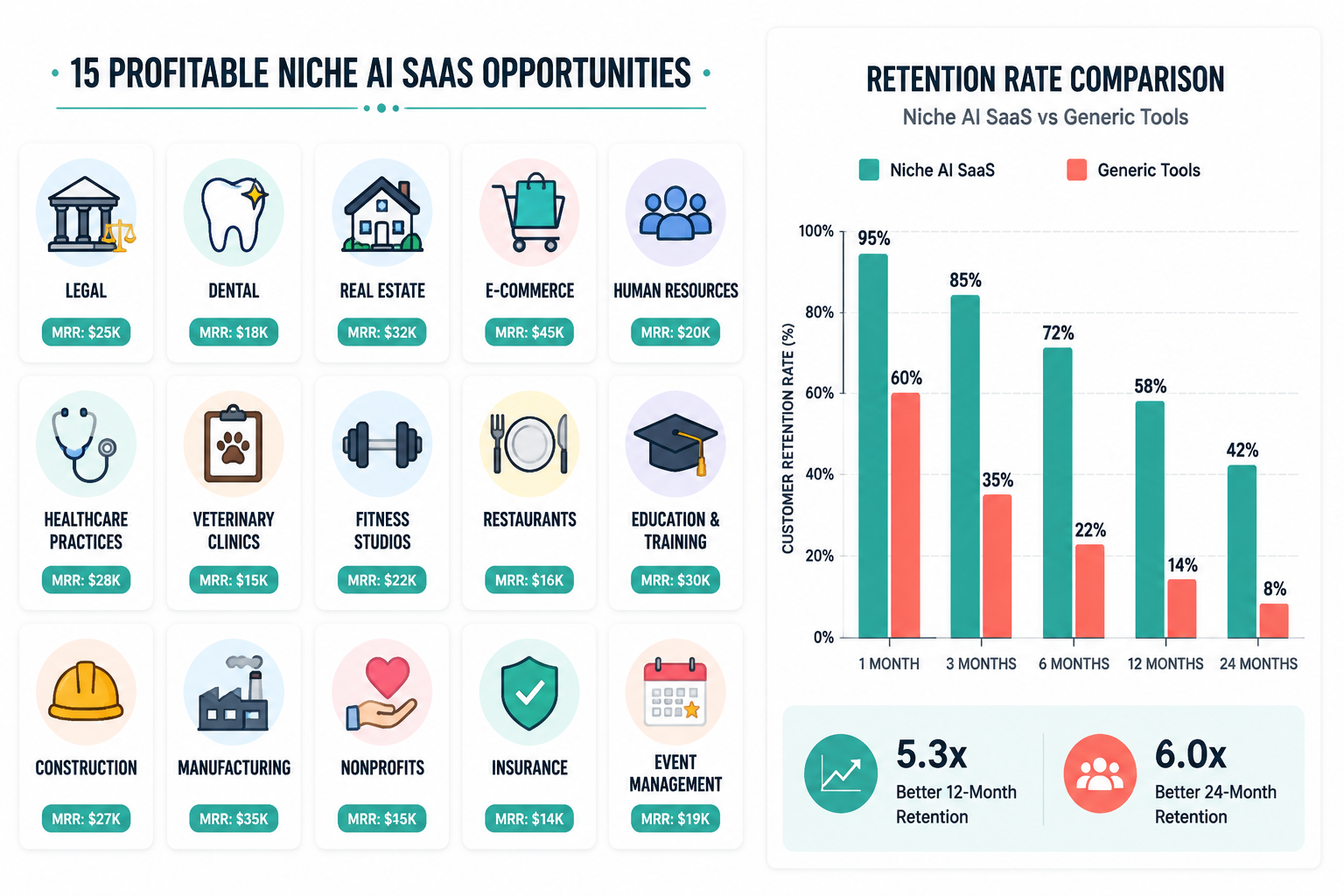
Below are 15 specific, underserved niches where the five-point framework applies cleanly. Each entry includes the core pain, the AI angle, and a rough pricing signal.
1. Dental Practice Patient Reactivation
The pain: Dental offices lose revenue every month from patients who haven’t booked in 12+ months. Front desk staff don’t have time to run reactivation campaigns manually.
The AI angle: An AI tool that pulls lapsed patient data from practice management software (like Dentrix or Eaglesoft), writes personalized reactivation SMS/email sequences, and schedules sends automatically.
Pricing signal: $99–$299/month per practice. With 50 practices, that’s $5K–$15K MRR.
Why it works: Dental offices have a clear ROI story. One reactivated patient = $200–$800 in revenue. The tool pays for itself in one booking.
2. Solo Attorney Document Drafting
The pain: Solo and small-firm attorneys spend hours drafting routine documents—demand letters, NDAs, and client intake forms—that follow predictable templates.
The AI angle: A jurisdiction-aware AI drafting tool that generates first drafts based on matter type, client inputs, and state-specific requirements. Not a replacement for legal judgment — a first-draft accelerator.
Pricing signal: $49–$149/month. Attorneys already pay for Clio, Westlaw, and other tools. This slots in cleanly.
Why it works: Narrow audience, high trust requirement (which creates a moat), and the pain repeats daily.
3. Real Estate Listing Copy
The pain: Agents write dozens of property listings per month. The copy is often generic and written under time pressure.
The AI angle: An AI tool that takes property specs, neighborhood data, and agent tone preferences and outputs MLS-ready listing copy in under 60 seconds. Integrations with Zillow or MLS feeds make it stickier.
Pricing signal: $29–$79/month. High-volume agents will pay without blinking.
Why it works: This is one of the clearest niches. AI SaaS founders making $10K MRR are already operating in. The buyer pool is large, the pain is obvious, and distribution through real estate Facebook groups is straightforward.
4. Amazon Seller Review Response Automation
The pain: Amazon sellers are required (by best practice, not policy) to respond to negative reviews quickly. Most don’t, and it hurts their conversion rates.
The AI angle: An AI tool that monitors new reviews, classifies sentiment, and drafts brand-appropriate responses for seller approval with one click.
Pricing signal: $39–$99/month. Sellers already pay for Helium 10, Jungle Scout, and similar tools.
Why it works: The buyer has a direct revenue connection to the problem. Negative reviews cost money. This tool saves money.
5. Fitness Coach Program Builder
The pain: Online fitness coaches spend hours building individualized training programs for each client. It’s the biggest time sink in their business.
The AI angle: An AI program builder that takes client intake data (goals, equipment, injury history, schedule) and generates a fully structured 4–12 week training plan in minutes. Coaches review and adjust.
Pricing signal: $49–$129/month. Coaches already pay for Trainerize or TrueCoach. This is an add-on or replacement.
Why it works: The fitness coaching market is large, the buyers are tech-comfortable, and the pain is real.
6. SaaS Churn Prediction for Micro-ISVs
The pain: Small SaaS companies (under $1M ARR) have no data science team to build churn models. They find out a customer is leaving when they cancel.
The AI angle: A plug-and-play churn prediction tool that connects to Stripe and product analytics (Mixpanel, Amplitude, or PostHog), scores accounts by churn risk weekly, and suggests intervention actions.
Pricing signal: $99–$299/month. The buyer is a SaaS founder who understands MRR and churn math intimately. Easy sell.
Why it works: The ROI story is immediate. Saving one $200/month customer pays for the tool.
7. Bookkeeper Client Report Automation
The pain: Freelance bookkeepers and small accounting firms spend 2–4 hours per client per month generating financial summary reports in plain English for non-financial clients.
The AI angle: An AI tool that pulls QuickBooks or Xero data and auto-generates a plain-English monthly summary report with key insights, flagged anomalies, and cash flow commentary. The bookkeeper reviews and sends.
Pricing signal: $49–$149/month. Bookkeepers have 10–50 clients. The time savings are immediate.
Why it works: This is a pure time-for-money swap. Bookkeepers understand the value instantly.
8. Course Creator Script Generator
The pain: Online course creators spend more time scripting video lessons than recording them. The blank page problem is real and recurring.
The AI angle: An AI script generator that takes a course outline, target audience, and teaching style preferences and produces lesson scripts, talking points, and on-screen text suggestions.
Pricing signal: $29–$79/month. Course creators already pay for Kajabi, Teachable, and Loom.
Why it works: The buyer pool is enormous and growing. Distribution through creator communities (Skool, Circle, YouTube) is organic.
9. Construction Bid Proposal Writer
The pain: Small general contractors and subcontractors spend hours writing bid proposals for every job. The writing is often weak, which costs them contracts.
The AI angle: An AI proposal writer that takes job specs, labor estimates, and material costs and generates a professional, formatted bid document in 10 minutes.
Pricing signal: $99–$249/month. Contractors win one extra bid per month and the tool pays for itself many times over.
Why it works: Contractors are underserved by SaaS. Low competition, high willingness to pay for tools with obvious ROI.
10. E-Commerce Product Description Bulk Generator
The pain: Shopify store owners with large catalogs (500+ SKUs) have incomplete or duplicate product descriptions that hurt SEO and conversion.
The AI angle: A bulk AI description generator that takes product attributes, category, and brand voice and outputs SEO-optimized descriptions at scale. Integrates directly with Shopify via API.
Pricing signal: $49–$149/month based on SKU volume. High retention because the catalog keeps growing.
Why it works: This is one of the niches AI SaaS founders making $10K MRR have validated most publicly. The Shopify app store is a built-in distribution channel.
11. Medical Spa Consent Form & Aftercare Generator
The pain: Med spas and aesthetic clinics need customized consent forms and aftercare instruction sheets for every treatment they add. Creating these from scratch is slow and legally risky.
The AI angle: An AI tool that generates treatment-specific consent forms and aftercare documents based on procedure type, state regulations, and clinic branding. Not legal advice — a starting draft that clinicians review.
Pricing signal: $79–$199/month per location.
Why it works: Narrow audience, high compliance anxiety (which drives urgency to buy), and recurring need as new treatments are added.
12. Social Media Content for Local Service Businesses
The pain: Plumbers, HVAC companies, landscapers, and other local service businesses know they need social media content but have no time or budget for a marketing agency.
The AI angle: An AI content tool that generates a month of platform-specific social posts (Facebook, Instagram, Google Business Profile) based on the business type, seasonal promotions, and local area. Scheduled automatically.
Pricing signal: $29–$79/month. Extremely price-sensitive buyers, but volume makes up for it.
Why it works: The buyer pool is in the millions. Distribution through local business Facebook groups and Google Ads is cost-effective.
13. HR Policy Document Generator for SMBs
The pain: Small businesses (10–100 employees) need employee handbooks, PTO policies, and HR policy documents but can’t afford an HR consultant to write them.
The AI angle: An AI HR document generator that produces state-compliant policy documents based on company size, industry, and state. Updated automatically when employment law changes.
Pricing signal: $49–$149/month. HR managers and business owners are the buyers.
Why it works: Compliance anxiety is a powerful purchase driver. The “set it and forget it” update feature creates strong retention.
14. Paid Ad Copy Tester for DTC Brands
The pain: Direct-to-consumer brands run Meta and Google ads constantly but struggle to produce enough creative variations to test properly. Copywriters are expensive and slow.
The AI angle: An AI ad copy generator that produces 10–20 headline and body copy variations per product, organized by angle (pain, aspiration, social proof, urgency). Integrates with Meta Ads Manager for direct upload.
Pricing signal: $79–$199/month. DTC brands already spend thousands on ad spend. This is a rounding error.
Why it works: The buyer has a direct performance feedback loop. If the copy improves ROAS, they renew without thinking.
15. Local SEO Audit & Report Automation for Agencies
The pain: Small digital marketing agencies run local SEO audits for every new client prospect. Each audit takes 2–4 hours to compile manually.
The AI angle: An AI local SEO audit tool that pulls Google Business Profile data, citation consistency, review sentiment, and competitor gap analysis into a branded PDF report in minutes.
Pricing signal: $99–$299/month per agency seat. Agencies have 10–50 active clients.
Why it works: This is a direct time-to-money conversion. An agency that closes one extra client per month using a polished audit report earns back the tool cost many times over. It’s also one of the clearest niches. AI SaaS founders making $10K MRR are actively building in because the distribution path (agency Slack groups, SEO communities) is well-defined.
Comparison: Niche AI SaaS vs. Generalist AI Tools
| Factor | Niche AI SaaS | Generalist AI Tool |
|---|---|---|
| Churn rate | Low (embedded in workflow) | High (easy to replace) |
| Sales cycle | Short (obvious ROI) | Long (needs education) |
| Competition | Low to moderate | Extremely high |
| Pricing power | Moderate to high | Race to the bottom |
| Distribution | Community-led, targeted | Requires broad marketing |
| Founder advantage | Deep niche knowledge | None |
Frequently Asked Questions (FAQs)
Do I need to be a developer to build one of these AI SaaS tools?
No. Many founders in these niches use no-code platforms (Bubble, Glide, and Softr) combined with OpenAI or Anthropic APIs. Technical co-founders help, but they’re not required to validate the idea.
What’s a realistic timeline to reach $10K MRR in a niche AI SaaS?
Based on patterns from indie hacker communities, founders with a focused niche and active distribution typically reach $10K MRR in 6–18 months. Faster if the niche has a tight community and clear ROI.
Should I charge monthly or annually?
Start monthly to reduce friction. Offer an annual discount (15–20%) once you have retention data. Annual plans improve cash flow and reduce churn.
How do I validate a niche before building?
Post in the niche’s community (Facebook group, Slack, or Reddit) with a problem statement and a Typeform. If 20+ people fill it out and 5+ say they’d pay, build a landing page before writing code.
What’s the biggest mistake founders make in these niches?
Building too broadly. The instinct is to add features for adjacent buyers. Resist it. The niche that made you $10K MRR will take you to $50K MRR if you go deeper, not wider.
Can I compete with large AI platforms in these niches?
Yes. Large platforms optimize for the broadest possible audience. A dental reactivation tool built specifically for Dentrix users will always beat a generic AI tool for that use case. Specificity is your moat.
How important is the existing budget line?
Very important. If your buyer has never paid for software in this category, you’ll spend most of your energy educating instead of selling. Find buyers who already have a software budget in the adjacent category.
What pricing model works best for sub-$50/month tools?
Flat monthly fee with usage tiers. Keep the entry price low enough to remove friction, then upsell on volume (more clients, more SKUs, more seats). Stripe Billing handles this cleanly.
Final Words: Pick One, Go Deep
The 15 niches above aren’t exhaustive. They’re representative of a pattern that’s producing real revenue for real founders in 2026 without venture capital, without large teams, and without chasing trends.
The framework is simple:
- Pick one niche where you have some context or access to the buyer community.
- Validate the pain with 20 conversations before building anything.
- Build the 80% AI layer that eliminates the repetitive work.
- A price for obvious ROI so the buyer doesn’t need a spreadsheet to justify it.
- Distribute where the buyers already are — one community, one channel, one message.
The founders crossing $10K MRR in these niches aren’t smarter than everyone else. They just stopped trying to build something for everyone and started building something indispensable for someone specific.
That’s the whole playbook.