

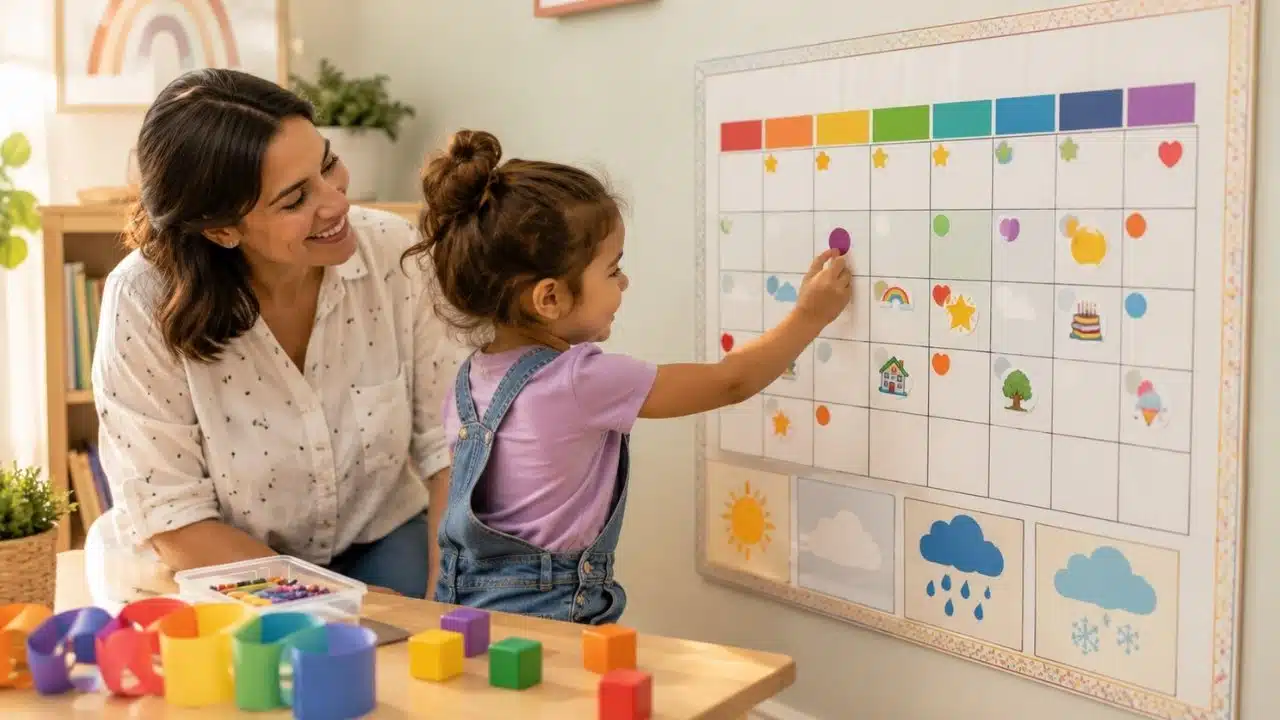
Time is an abstract concept for young children. Words like “yesterday,” “next week,” or “in three months” often feel meaningless to kids who live entirely in the present moment. Incorporating structured calendar activities for early learners transforms abstract units of duration into tangible, visual benchmarks.
Grounded in foundational principles of early childhood education, daily engagement with grid layouts, color patterns, and counting sequences helps young children connect numerical dates with the actual flow of real-world experiences.
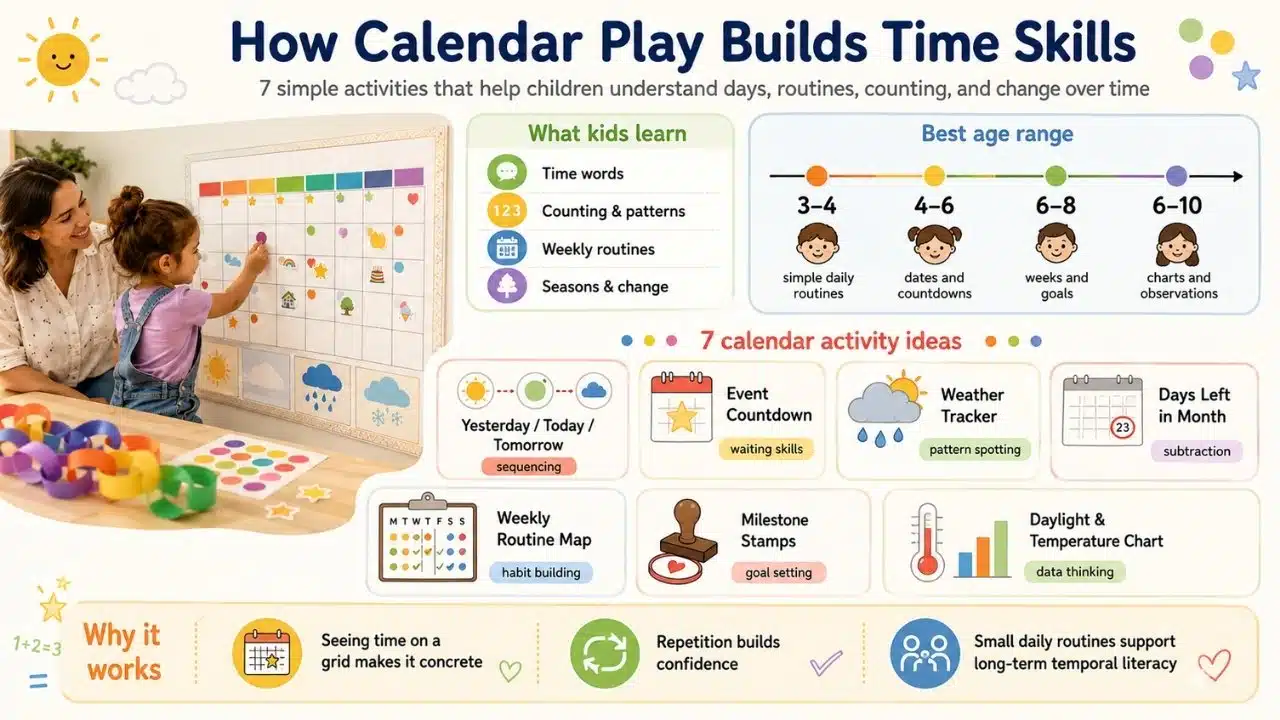
| Activity | Target Skill | Primary Benefit | Recommended Age Group |
| Yesterday-Today-Tomorrow Shift | Sequential Memory | Anchors past, present, and future timelines | Ages 3–6 |
| Color-Coded Event Countdown | Duration & Elapse | Visualizes time remaining before key events | Ages 4–7 |
| Weather & Season Pattern Tracking | Cyclic Reasoning | Connects monthly calendars to environmental cycles | Ages 4–8 |
| “Days Left” Backward Counter | Subtraction & Ordinals | Strengthens mental math and reverse counting | Ages 5–8 |
| Visual Weekly Routine Mapping | Categorization | Links days of the week to recurring family activities | Ages 3–7 |
| Monthly Milestone Stamping | Medium-Term Planning | Teaches month-level duration and goal setting | Ages 6–9 |
| Daylight & Temperature Charting | Data Analysis | Integrates numerical time with scientific observation | Ages 6–10 |
7 Calendar Activities for Early Learners
1. The Daily Yesterday-Today-Tomorrow Shift
Set up three moveable tags labeled Yesterday, Today, and Tomorrow alongside your wall calendar. Every morning, have your child physically move each indicator to the appropriate date square while reciting the day of the week. This physical movement grounds temporal vocabulary in spatial positioning, helping young minds differentiate between immediate past, present, and immediate future.
2. Color-Coded Event Countdown Strips
When a child continually asks “How many days until my birthday?”, build a paper chain or use colored stickers on the calendar grid leading up to the target date. Each evening, cross off or remove one link. Physically removing a link provides a concrete representation of elapsed time, teaching children that days pass in a steady, unhurried sequence.
3. Weather & Season Pattern Tracking
Use small weather icons (sun, rain, clouds, snow) on each daily calendar square. At the end of every month, count how many sunny or rainy days occurred. Combining weather tracking with monthly calendars helps children notice seasonal patterns and understand how larger blocks of time correlate with environmental changes.
4. The “Days Left in the Month” Backward Counter
Rather than simply counting forward from the 1st of the month, introduce a secondary daily number: the count of days remaining. If the month has 30 days and today is the 10th, point out that 20 days remain. This activity builds subtraction fluency while expanding a child’s understanding of how individual days deplete a fixed monthly allowance of time.
5. Visual Weekly Routine Mapping
Assign distinct colors or icons to specific days of the week based on regular events, blue for swim practice on Tuesdays, green for library visits on Thursdays, yellow for weekends. Mapping weekly routines onto a physical grid helps children develop practical time management skills by establishing recognizable weekly rhythms and expectations.
6. Monthly Milestone & Goal Stamping
At the beginning of each month, place a distinct stamp on key checkpoints, such as the 1st, 15th, and last day of the month. Use these markers to set short-term reading or habit goals. Reviewing these checkpoints weekly teaches children how long a month actually lasts, bridging the gap between daily routines and long-term project planning.
7. Daylight & Temperature Charting
For older children, pair a monthly calendar grid with daily sunset times or peak temperatures. Plotting these figures at the end of each week turns a simple calendar into an interactive data graph. Children observe how daylight hours gradually shrink or expand, connecting mathematical units of hours and minutes to seasonal shifts.
Building Long-Term Temporal Literacy
Mastering the calendar is a foundational milestone in early cognitive development. By incorporating these seven hands-on routines into your family’s morning or evening habits, you transform abstract numbers into meaningful life patterns. Consistency is the secret to success: spending just two minutes every day engaging with a physical calendar builds lasting temporal literacy, spatial awareness, and mathematical confidence.
Frequently Asked Questions(FAQs) on Calendar Activities for Early Learners
At what age should I start using calendar activities with my child?
Basic calendar concepts can be introduced around age 3 or 4 using visual picture calendars. Structured daily calendar math activities generally yield the best learning results between ages 5 and 8 when children understand basic number representations.
Why do children struggle to understand how calendars measure time?
Calendars represent time as a two-dimensional grid of rows and columns, which requires abstract spatial reasoning. Children naturally view time linearly or experientially, so converting real-world days into grid squares takes consistent practice.
Are digital calendars as effective as physical wall calendars for teaching time?
Physical wall calendars are significantly more effective for young children. Tangible calendars allow kids to touch dates, place physical markers, and visually observe the entire month at once without screen distractions or hidden navigation menus.





















