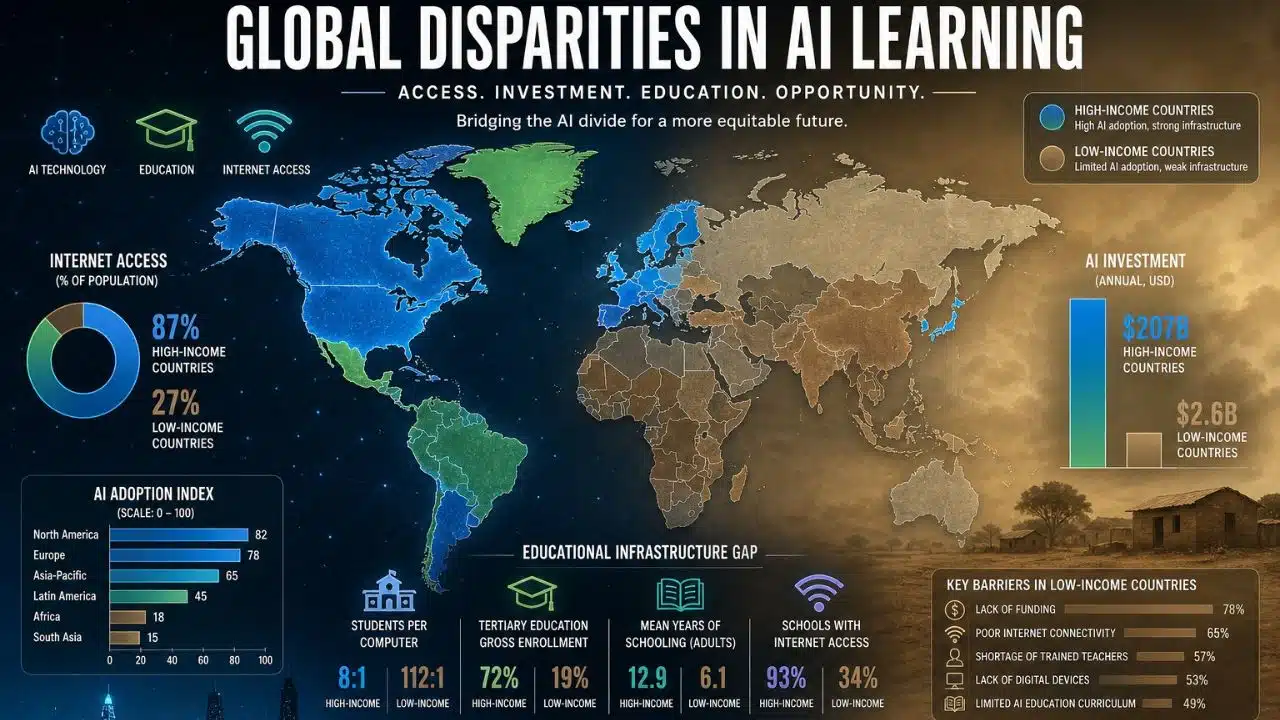
In 2023, the International Telecommunication Union estimated that 27 percent of people in low-income countries used the internet. Three years on, after the fastest technology adoption curve in modern history, the figure the ITU publishes is 23 percent. Some of that is revised methodology and population growth rather than people losing connections. But the comparison that matters is not year against year. It is country against country: 94 percent of people in high-income economies are online, against roughly a quarter in the poorest ones.
Generative AI, meanwhile, reached 53 percent of the world’s population within three years of ChatGPT’s release, outpacing both the personal computer and the internet itself. Stanford’s AI Index found that adoption tracks closely with GDP per capita.
That pairing is the whole argument. The technology spread faster than anything before it, and it spread along the contours of existing wealth. I no longer think of this as a gap that will close on its own. I think of it as a gap that is being actively widened by the speed of the thing crossing it.
What are the Current Global Trends in AI Education?
The headline capability race has narrowed. By March 2026, the best American model led the best Chinese one by under three percentage points on head-to-head arena rankings, and the two have traded the top position repeatedly since early 2025. What has not narrowed is the money. American firms attracted $285.9 billion in private AI investment in 2025 against China’s $12.4 billion, with global private investment reaching $344.7 billion; more than double the previous year.
Set that against what UNESCO reports about the schools those students actually sit in. One in four primary schools worldwide still has no electricity. Sixty per cent are not connected to the internet at all.
I find it hard to read those two paragraphs together without concluding that we are running two entirely separate conversations and calling them one. The first is about frontier capability and education growth in places that already had it. The second is about whether the lights come on.
Curriculum policy has moved fast in the countries that could afford to move. Beijing became the first provincial-level region in China to make AI education compulsory, with more than 1,400 schools delivering a minimum of eight class hours a year from September 2025, starting at age six. The UAE launched a national K–12 AI curriculum for 2025–26. Saudi Arabia set out to reach six million learners. The United States issued an executive order in April 2025 creating a task force and a national student challenge, but appropriated no new money for it.
Elsewhere, the picture is thinner. UNESCO’s mapping found only eleven countries with government-endorsed K–12 AI curricula and four more in development. The African Union adopted its Continental AI Strategy in July 2024, with the first implementation phase running through 2026, but as of April 2026, most African member states still had no national AI strategy at all.
Economic Factors Affecting AI Education Access
I want to be careful here, because “the poor lack money” is a tautology, not an analysis. The specific mechanism matters.
How does income inequality affect AI learning worldwide?
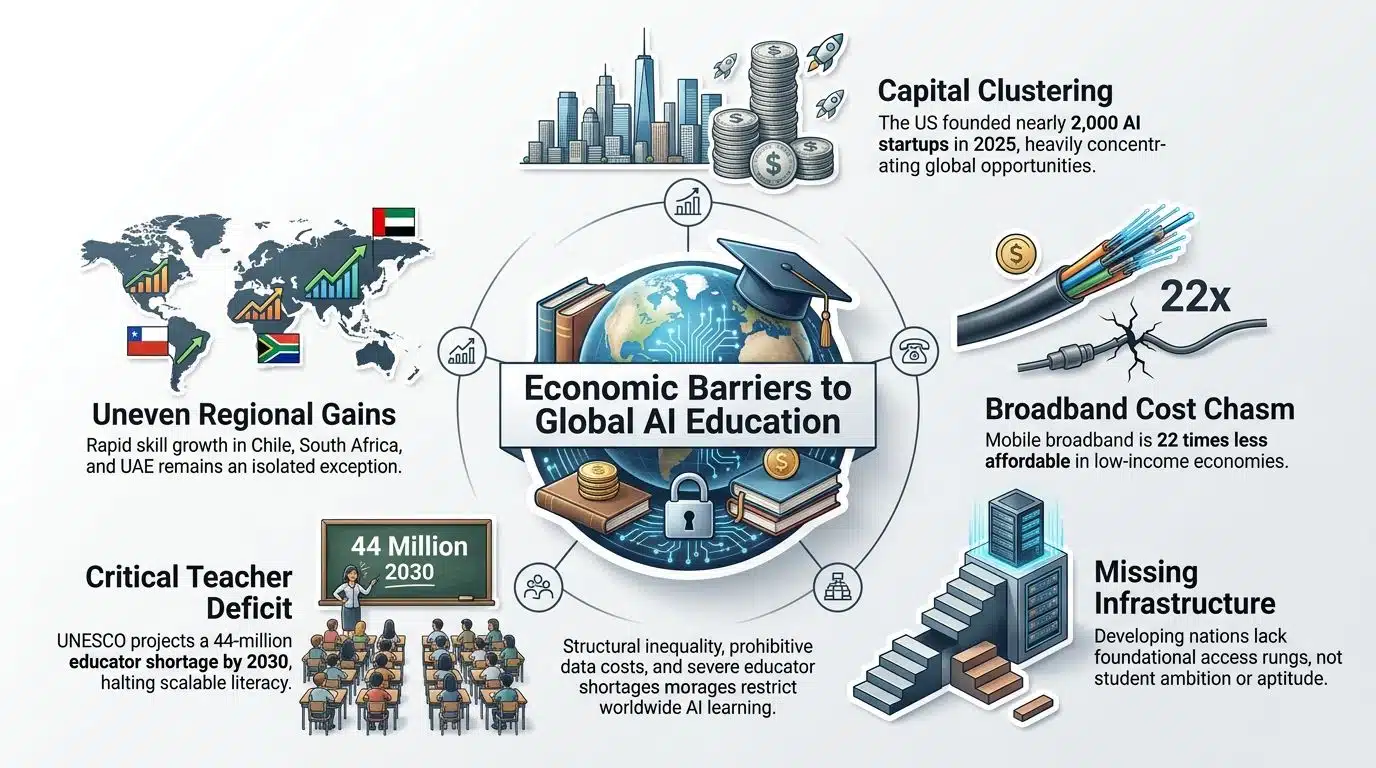
The investment asymmetry compounds into a talent asymmetry, and the talent asymmetry compounds back into investment. Nearly 2,000 newly funded AI companies formed in the United States in 2025, more than ten times the next closest country. Where those companies cluster, the graduate programs, the internships, and the informal apprenticeship of simply being near the work cluster too.
For a student in Dhaka or Dar es Salaam, the ladder’s bottom rung is missing. Not the ambition, not the aptitude — the rung. And I’d argue the framing of “catching up on modern AI learning” quietly misleads, because it implies a single track where some runners started earlier. What is actually happening is that one group is building the track.
There is a counter-signal worth holding onto. The AI Index found AI engineering skills accelerating fastest in the UAE, Chile, and South Africa. Rapid capability growth outside the traditional centers is real. It is just nowhere near evenly distributed across the Global South, and three bright spots do not make a trend.
What funding gaps impact AI educational resources?
Affordability has improved and remains punishing. The global median price of a fixed broadband basket sits at 2.5 percent of monthly income per capita. In a low-income country, where the service exists at all, it costs more than a quarter of the average monthly income. Mobile broadband runs about 22 times less affordable in low-income economies than in high-income ones, and in nine out of ten low-income countries, a 5GB monthly mobile basket exceeds 10 percent of average monthly income.
A household choosing between connectivity and food is not going to enroll a child in a cloud-based machine learning course. That is not a curriculum problem. No amount of pedagogical innovation solves it.
The teacher numbers make it worse. UNESCO projects the world needs 44 million additional primary and secondary teachers by 2030, with sub-Saharan Africa alone requiring 15 million, at a cost of roughly $120 billion a year in salaries. AI literacy has to be taught by somebody. We are short of somebody.
Availability of AI Educational Tools Worldwide
Scarcity is the wrong word, and I think it does real damage. The tools are not scarce. A frontier chatbot is free at the point of use in most of the world. What is scarce is everything underneath it.
The clearest illustration is 5G. It now covers 55 per cent of the global population and accounts for roughly a third of all mobile broadband subscriptions. Coverage reaches 84 per cent of people in high-income countries and 4 per cent in low-income ones. A typical user in a wealthy country generates nearly eight times more mobile data than one in a poor country — a usable proxy for how much of the internet a person can actually touch.
Fixed broadband in the least developed countries sits at around two subscriptions per hundred people. Effectively absent, exactly where bandwidth-hungry applications live. So rural schools cannot reach online learning platforms in any sustained way, and the free tool at the far end of the connection may as well not exist.
How do high costs of AI tools limit education?
The visible cost is subscriptions. The real costs are electricity, devices, data, and a teacher who has been trained.
India’s experience is instructive, and it is the case I would most like to see reported accurately, because it usually is not. BharatNet has laid over 719,000 route kilometers of fiber and made roughly 221,000 gram panchayats—village councils, not villages—service-ready as of mid-2026. That is a genuine achievement. But operational points of presence existed at only about 80,000 gram panchayats, and in February 2026 a parliamentary standing committee flagged the shortfall and called for a state-wise audit and a time-bound completion plan. Phase III launched in May 2026 with a ₹1.5 lakh crore budget, targeting the remaining councils and some 625,000 villages by 2028.
Fiber in the ground is not connectivity. It is potential connectivity. The distance between those two things is where most rural artificial intelligence learning programs quietly die.
How Does Language Diversity Impact AI Learning?
This is the disparity I think gets least attention relative to how much it determines.
All 2,123 native African languages are classified as low-resource, including the 31 with more than ten million speakers. On IrokoBench, a human-translated benchmark spanning 17 African languages, the best models trailed their English performance by up to 28 points. AfroBench, covering 64 languages across 15 tasks, found the same pattern, with knowledge-intensive and reasoning tasks showing the widest gaps — precisely the tasks a student needs.
A student who asks a question in Amharic or Bambara and gets a confidently wrong answer does not experience a language limitation. They experience a machine that seems to think they are stupid. That is a learning experience with a negative value, and we ship it at scale.
Efforts like Masakhane have built genuine infrastructure for African-language NLP, and benchmark work has at least made the gap measurable. “Measurable” is not solved.
How do non-English speakers struggle with AI education?
Beyond raw accuracy, there is the question of what the model knows about. Curriculum examples, historical framing, worked problems in local units and local contexts—a system trained overwhelmingly on English web text carries assumptions about whose classroom it is in.
Layer the gender divide on top: 77 per cent of men are online against 71 per cent of women globally, and in low-income countries the split is 29 per cent of men against 18 per cent of women. The global gender parity score has not moved since 2019. A girl in a low-income, low-resource-language household sits at the intersection of three separate exclusions, and we tend to count only one of them.
How Does Digital Infrastructure Influence AI Literacy?
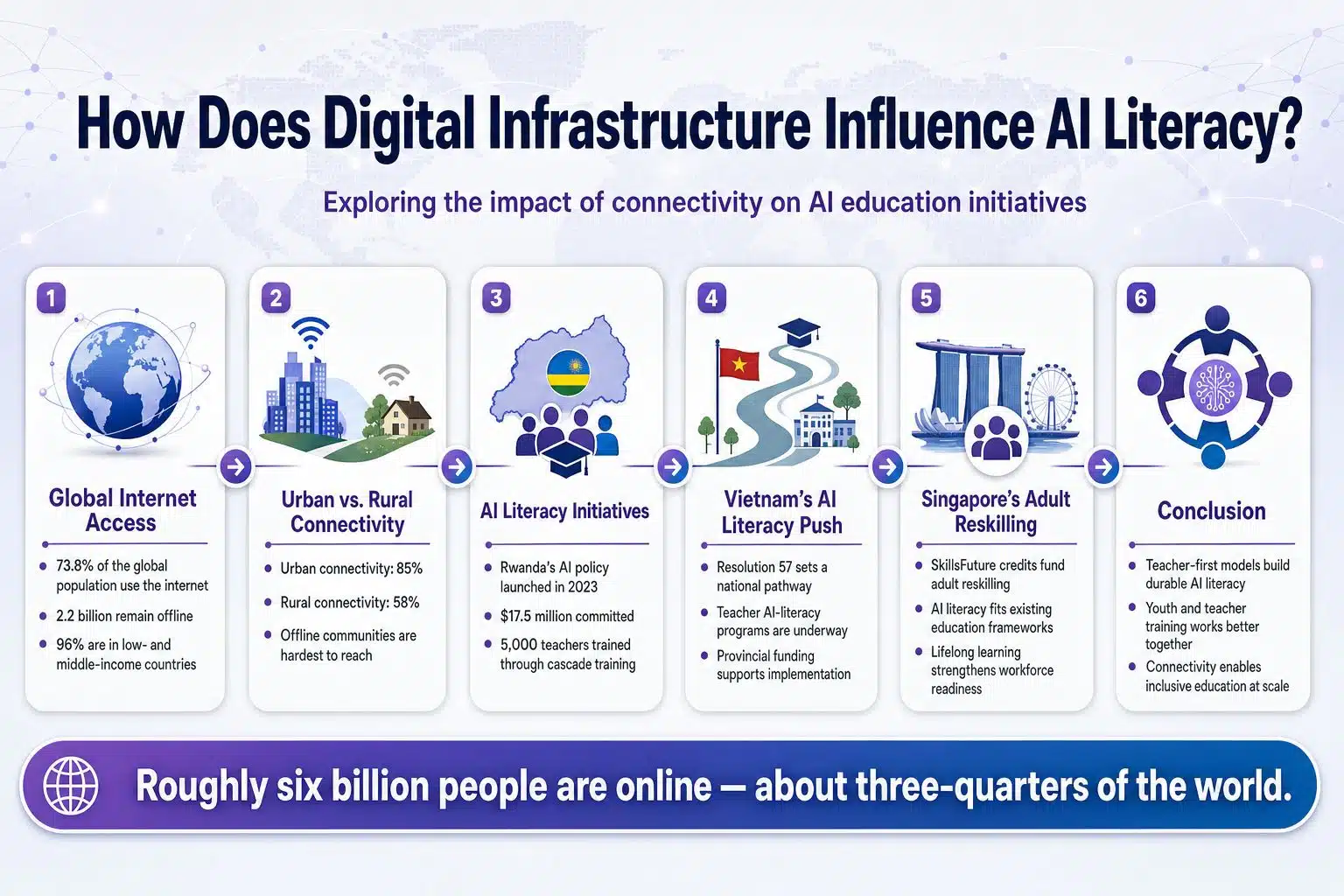
Roughly six billion people are online, about three-quarters of the world. The remaining 2.2 billion are not evenly scattered—96 percent of them live in low- and middle-income countries. Urban connectivity sits at 85 percent against 58 percent rural.
I’d flag that progress is now slowing, which matters more than it sounds. The people still offline are the hardest and most expensive to reach, which means the final stretch will cost more per person than everything before it, at exactly the moment attention and capital have moved on to compute.
What initiatives promote AI literacy in underprivileged areas?
Some of the most interesting work is small and specific rather than national and announced.
Rwanda adopted a national AI policy in 2023 and secured a Gates Foundation commitment that grew from $7.5 million to $17.5 million to anchor Africa’s first AI Scaling Hub, launched at the Global AI Summit on Africa in Kigali. More usefully for classrooms, Rwanda’s education ministry ran a cascade teacher-training model with MIT’s Day of AI, starting with about 150 master teachers in July 2025 and reaching over 5,000 teachers in the first phase, with AI literacy folded into the primary and secondary ICT curriculum.
Vietnam’s push runs through Resolution 57 and a digital competency framework for learners, with provincially funded teacher AI-literacy programs working toward a national pathway by 2027. Singapore continues to fund adult reskilling through SkillsFuture credits.
What links the ones I take seriously is that they train youth and teachers together, rather than shipping tools and hoping. Teacher-first is slower, less announcable, and the only version I have seen produce anything durable.
AI Inclusion Challenges for Vulnerable Groups
Exclusion is rarely a locked door. It is a series of small frictions that each look reasonable.
Age verification that assumes documentation. Phone-number signup that assumes a phone in your own name. Interfaces that assume literacy in a second language. UNESCO’s guidance suggests a minimum age of 13 for independent use of generative AI platforms, which is sensible policy and also, in practice, another gate in a system already full of them.
For students with disabilities, the same technology cuts both ways: speech-to-text and text-to-speech tools are among the genuinely transformative applications, and they are concentrated in exactly the well-resourced systems that needed them least.
In what ways does AI reinforce educational inequalities?
Here is where I want to correct a claim that circulates widely, including in the earlier version of this article.
The figure often quoted—that automation will eliminate 60 percent of Bangladesh’s garment jobs by 2030—misstates the underlying study. The A2i and ILO research put that scenario at 2041, not 2030. More recent work published in 2026 estimates AI and automation could displace around 1.22 million apparel jobs by 2041, with up to 60 per cent of existing female employment at risk, and separately suggests AI and automation could disrupt roughly 40 per cent of Bangladeshi jobs overall. The garment labor force has already contracted sharply.
The corrected numbers are not comforting. They are more useful, because a 2041 horizon is a policy window and a 2030 horizon is a panic. Bangladesh has roughly fifteen years to move a workforce, most of it women, into work that automation does not erase. Doing that requires vocational systems and data science pathways that connect to actual employers, which the 2026 assessment found the country’s TVET system is not currently delivering.
That is what AI-driven inequality looks like in a garment economy. Not robots in the classroom. A shrinking floor beneath the families whose children are in the classroom.
Why is Cultural Relevance Important in AI Education?
Cultural alignment gets treated as a nice-to-have, added after the real work. I think that is backwards, and the language benchmarks are the evidence: models perform worst on exactly the knowledge and reasoning tasks where local context carries the most weight.
The practical version is unglamorous. Train models on agricultural patterns that match the local crop calendar. Build speech datasets in the languages people actually teach in. Write worked examples using local currency, local distances, and local names. Rwanda’s initiative explicitly includes developing localized African language models rather than only deploying imported ones, which strikes me as the correct order of operations.
A genuinely decolonial digital education policy is not about rejecting imported tools. It is about who holds the data and who decides what a good answer looks like.
Global Policymaking Roles in AI Education
The multilateral architecture has actually been built, which surprised me.
The Global Digital Compact was adopted in September 2024 as part of the Pact for the Future. In August 2025, the UN General Assembly established the Independent International Scientific Panel on AI by consensus. Its 40 members were appointed in February 2026, electing Yoshua Bengio and Maria Ressa as co-chairs. The first Global Dialogue on AI Governance was held in Geneva in July 2026, informed by the panel’s preliminary report, with a high-level review scheduled for 2027.
What has not been built is the money. The Compact commits members to “consider options” for a global fund on AI. Consider options. Meanwhile, private investment cleared $344 billion in a single year. I don’t think the governance architecture is worthless—an evidence body with genuine independence is worth having. But a panel that can describe a divide is not a mechanism that can fund closing one.
How is fair distribution of AI educational resources ensured?
Honestly, at present, it isn’t. The proposals worth pursuing are familiar and politically difficult: treat connectivity as public infrastructure rather than a consumer product; tax the tech giants whose models are trained partly on the world’s collective output; and ring-fence education budgets so that AI spending is additive rather than cannibalizing teacher salaries. UNESCO has been unusually direct about that last point, and it is the one I would defend hardest. A ministry that buys licenses by cutting teacher pay has made the divide worse while announcing that it fixed it.
Energy belongs in this conversation too. Kenya’s geothermal capacity supplies close to 40 percent of its electricity generation, which is a real and underdiscussed advantage for hosting data infrastructure on the continent—and a reminder that “digital” policy is downstream of power policy.
How Can AI Help Overcome Educational Challenges?
I don’t want to end up arguing that AI has nothing to offer the students it is currently failing. It plainly does.
Adaptive tutoring genuinely works when the infrastructure holds. Tools like Khanmigo can generate practice at a student’s level indefinitely, which is meaningful in a classroom of sixty. Speech-to-text and text-to-speech open material that was previously closed to students with dyslexia or visual impairment. Offline-capable mobile apps sidestep the connectivity problem rather than pretending it away, and I’d rate offline-first design as the single most underrated feature in educational AI for low-resource settings.
The catch is the evidence base. The AI Index found that over 80 percent of American high school and college students now use AI for schoolwork, while only half of middle and high schools have AI policies at all and just 6 percent of teachers describe those policies as clear. Adoption has comprehensively outrun guidance in the best-resourced system on earth. I would not assume it goes better elsewhere.
How can AI address teacher shortages?
Cautiously, and only as a supplement. Automated grading returns hours to teachers, and in systems missing 15 million of them, hours are the scarce resource. Cloud-based education services can connect rural students to subject specialists who do not exist locally. Generative tutors running in web apps can hold a struggling student’s hand at 11pm.
But I want to be blunt about the risk in the framing. “AI addresses teacher shortages” is one short step from “AI replaces teachers we decided not to hire,” and finance ministries under pressure will take that step. Rwanda’s education minister put the boundary well: AI should enhance classroom learning and support teachers, not replace them. UNESCO makes the same argument in budget terms — AI money must be additional to education money, never a substitute for it.
Where digital classrooms online have worked, a trained human was always in the room.
Final Thoughts
I started with the 23 per cent figure. Let me end with the one that sits underneath it: 60 percent of the world’s primary schools have no internet connection, and one in four has no electricity.
Every conversation about AI in education that skips past those two facts is a conversation about a minority of the world’s children. Not a small minority — but not the students this article is nominally about.
What I’d want from the next three years is unfashionable. Power and connectivity to schools before licenses. Teachers trained before tools deployed. Local-language data built before imported models rolled out. Budgets where AI spending is genuinely additional and can be shown to be. And enough honesty in the reporting that when a country lays fiber past 221,000 village councils, we say clearly that only 80,000 of them have a working connection.
The gap will not close because the technology gets cheaper. It got cheaper. It will close if someone decides to pay for the boring infrastructure underneath it, and that is a political choice, made annually, in budget documents. It is being made right now, and mostly it is being made the other way.