
Investing in mobile software represents a massive commitment of capital, engineering time, and operational focus. Many companies build or purchase software simply because competitors have done so, only to end up with low user retention and inflated maintenance costs.
Before committing resources, leadership teams must rigorously evaluate strategic fit, technical feasibility, and long-term financial impact. Thoroughly vetting your goals before deciding on a mobile app for your business prevents costly missteps and aligns technology with core revenue drivers.
10 Questions to Ask Before Deciding on a Mobile App for Your Business
1. Does a Mobile App Solve a Real Problem That Your Website Cannot?
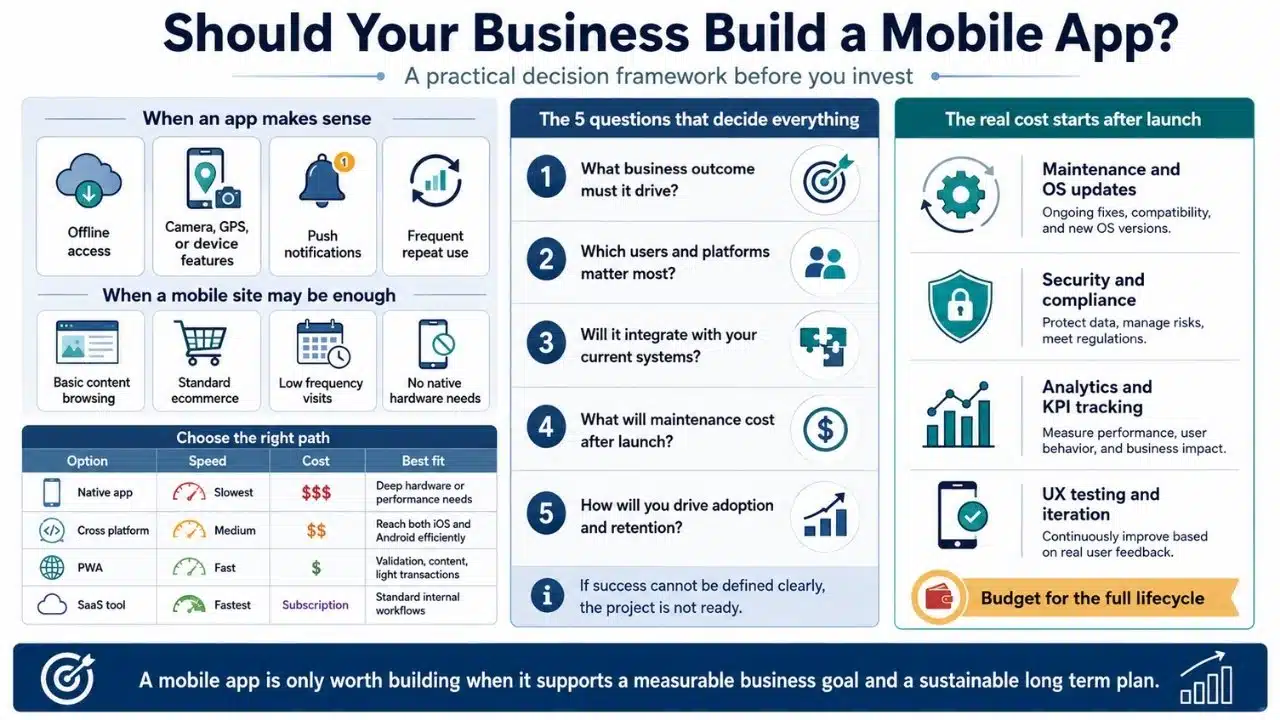
A mobile presence is not a vanity metric. If your target audience can accomplish their goals just as easily on a responsive mobile website, building a dedicated application creates unnecessary friction. Mobile applications excel when they leverage hardware-specific features like camera access, offline data caching, Bluetooth connectivity, or real-time push notifications. If your core user experience does not require native device capabilities, a progressive web application or mobile site is often the smarter financial choice.
2. What Core Business Problem Are You Solving by Deciding on a Mobile App for Your Business?
Every software project must tie directly to a measurable business outcome. Are you trying to reduce customer support volume, increase repeat purchase frequency, streamline field worker operations, or open a brand-new revenue channel? Clearly defining the primary objective before deciding on a mobile app for your business ensures that feature scoping remains disciplined throughout development. If leadership cannot define success in a single sentence, the project is not ready to launch.
3. Should You Target iOS, Android, or a Cross-Platform Framework First?
Launching simultaneously on iOS and Android doubles your maintenance footprint and quality assurance testing. Analyze your existing customer analytics to determine where your primary audience lives. High-income consumer markets in North America and Western Europe often favor iOS, whereas global markets and broader demographics lean heavily toward Android. Cross-platform frameworks like Flutter or React Native can significantly reduce initial build time, but they introduce trade-offs if your software relies heavily on deep, native operating system integrations.
4. What Is the True Total Cost of Ownership Beyond Initial Launch?
The initial development quote is only a fraction of your long-term expenditure. Industry benchmarks show that annual post-launch maintenance, server infrastructure, security patches, and third-party API licensing typically cost 15% to 20% of the original build price every year. Failing to budget for mandatory annual operating system updates will cause your product to break or be removed from digital stores.
5. How Will the Product Integrate With Your Existing IT Infrastructure?
An application does not exist in isolation. It must sync data cleanly with your existing customer relationship management systems, enterprise resource planning platforms, and payment gateways. Assess whether your current backend infrastructure features secure, well-documented REST or GraphQL APIs ready to support mobile traffic. If your backend architecture requires a complete overhaul to feed data to the front end, your timeline and budget will scale rapidly.
Compare how key deployment paths differ across initial capital requirements, speed, and long-term operational maintenance before locking in your technical roadmap:
| Strategy Option | Initial Capital Required | Time to Market | Annual Maintenance Effort | Primary Use Case |
| Custom Native Build | High ($100,000+) | 6–12 Months | High | Deep hardware integration & maximum speed |
| Cross-Platform Framework | Moderate ($50,000–$100,000) | 4–6 Months | Moderate | Dual-OS deployment on a balanced budget |
| Progressive Web App | Low ($15,000–$40,000) | 1–3 Months | Low | Content platforms & rapid market validation |
| Off-the-Shelf SaaS | Subscription-Based | Immediate | Vendor-Managed | Standardized internal workflow automation |
6. What Is Your Protocol for UX Design and Usability Testing?
A beautiful user interface means nothing if customers struggle to complete basic tasks. Skipping early usability testing is one of the most common causes of post-launch product failure. Your team should validate interactive prototypes with real end-users long before engineers write production code. Running moderated testing sessions with target users identifies confusing navigation flows and reduces expensive mid-project code revisions.
7. Who Retains Intellectual Property and Code Ownership?
If you choose to partner with an external agency or third-party development firm, contract terms regarding intellectual property must be clear from day one. Ensure your agreement explicitly states that your organization owns all source code, design assets, database schemas, and developer account credentials upon payment. Avoid contract structures that trap your business in proprietary frameworks, leaving you unable to transfer code to an in-house team later.
8. What Security, Privacy, and Compliance Regulations Apply?
Handling user data introduces substantial legal liability. Depending on your industry and target market, your platform may need to comply with strict regulatory frameworks such as GDPR, CCPA, HIPAA, or PCI-DSS for payment handling. You must define data retention policies, end-to-end encryption standards, and user consent mechanisms during the initial architecture phase rather than attempting to retrofit compliance late in the project.
9. How Will You Drive Initial Adoption and User Retention?
Publishing an application to the App Store or Google Play Store does not guarantee downloads. Without a dedicated user acquisition and onboarding strategy, your product will quickly be forgotten. Define how you intend to drive initial awareness through direct customer communications, physical point-of-sale marketing, or targeted paid channels. More importantly, design early re-engagement triggers to ensure users return after their first session.
10. How Will You Track Post-Launch KPIs and Performance Metrics?
You cannot improve what you do not measure. Before pushing code to production, establish baseline key performance indicators aligned with your business model. Track critical operational metrics such as daily active users, feature adoption rates, crash frequencies, average screen load times, and customer acquisition costs. Continuous data monitoring allows product managers to make evidence-based decisions regarding future feature iterations.
Build vs. Buy: Evaluating Custom Development Against Off-the-Shelf SaaS
A major strategic junction for enterprise leaders is deciding whether to build a custom solution or license an existing platform. Custom software gives your company total control over user experience, proprietary features, and data ownership, creating a distinct competitive moat. However, it carries significant capital risk and extended timelines. Off-the-shelf software offers immediate deployment and vendor-managed security updates, but limits your ability to customize workflows. If a software feature does not represent your core competitive advantage, licensing an existing tool is almost always more cost-effective.
Managing Technical Debt and Post-Launch Product Lifecycles
Software is never truly finished. The day your product launches is simply the start of its operational lifecycle. Technical debt accumulates when early development teams take shortcuts to meet tight deadlines, resulting in fragile code that slows down future feature releases. Establishing a dedicated maintenance budget and establishing a disciplined update schedule ensures your digital assets remain fast, secure, and fully compatible with modern hardware releases.
Strategic Next Steps When Deciding on a Mobile App for Your Business
Bringing clarity to your software roadmap requires balancing ambitious business goals with practical technical constraints. Before signing development contracts or allocating internal engineering resources, systematically work through these ten evaluation points with key stakeholders. Forcing your team to define scope, verify compliance, and establish realistic operational budgets early protects your capital. Taking a structured, analytical approach when deciding on a mobile app for your business guarantees that your technology investment generates long-term commercial value.
Frequently Asked Questions (FAQs) About Deciding on a Mobile App for Your Business
How much does it realistically cost to build a custom business application?
Basic applications with standard database connections typically range from $30,000 to $70,000. Complex enterprise platforms involving custom backend infrastructure, real-time data sync, and specialized security integrations frequently exceed $150,000 to $300,000 in initial development costs.
How long does the development process usually take from concept to launch?
A streamlined cross-platform product or MVP generally takes 3 to 5 months to design, build, and test. Full-scale custom enterprise builds with extensive third-party integrations typically require 6 to 12 months before reaching commercial release.
Is a mobile application necessary if our website is already mobile-responsive?
Not always. A mobile-responsive website is sufficient for basic content consumption and standard e-commerce. You only need a dedicated mobile application if your users require offline access, hardware integration like camera or GPS tracking, or high-frequency push notifications.
What percentage of my budget should be allocated to post-launch marketing?
Industry experts recommend allocating at least 20% to 30% of your total project budget toward post-launch user acquisition, onboarding optimization, and ongoing product marketing to ensure target adoption rates are met.